Everything at full
Every zone at its maximum. It is bright, and it is flat: the pool, the wall and the planting compete, and nothing leads. This is how most systems without dimming run all night.
Specialty
Zones are how a lit property is edited. With them, the path can stay on while the garden dims, the pool can turn blue while the palms stay warm, and the whole place can be quiet at midnight without anyone touching a switch.
Tell us about the property
If everything is on one switch
If every light on your property goes on and off together at one brightness, you cannot set the evening the way you live it. Zoning splits the lights into groups. Dimming sets each group to any level. Color, on fixtures that support it, changes what one group gives off while the rest stays warm white.
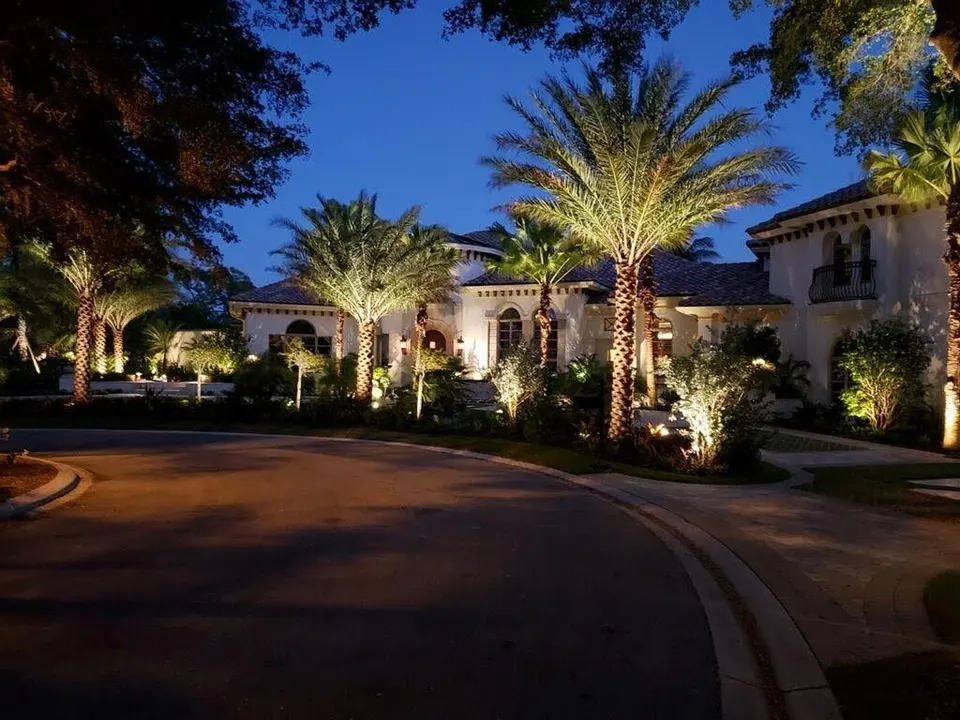
A system on one switch has one setting, and it is wrong most of the time. Bright enough for a party is too bright at midnight. Low enough for a quiet evening is too dark for the walk to the car. The pool light cannot go off without the garden going with it.
FX Luminaire, whose controllers and fixtures we use, puts the three ideas simply. Zoning "allows lights to be programmed into preset groups." Dimming "allows lights to emit any desired illumination percentage." And on fixtures built for it, color can change to one of what FX describes as "30,000 color options per zone."
The technology is the easy part. The design work is deciding where the lines between zones go and what level each one runs at, which is what this page is about.
Landscape lighting zones
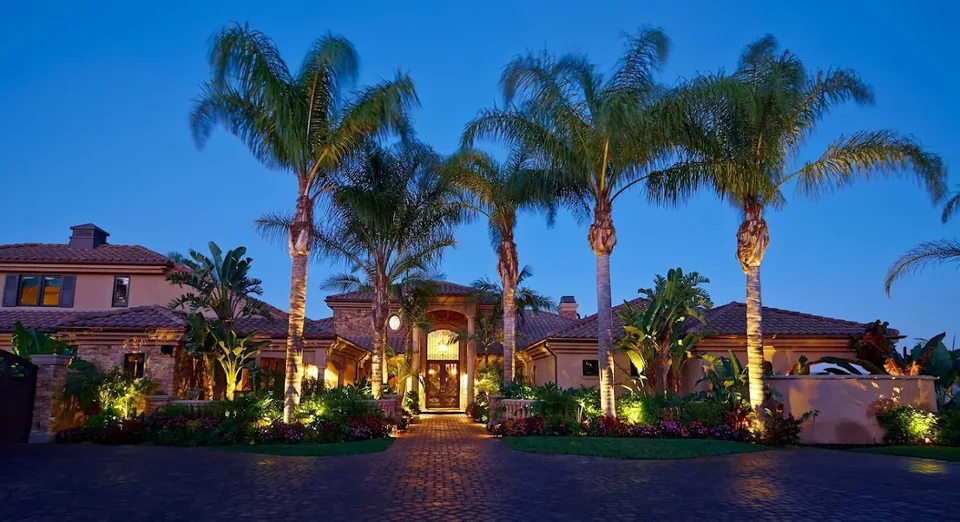
Zones follow how a property is used, not how it was wired. The entry gets its own, the water gets its own, the walls pair left with right, the palms are one group and the drive and paths stay separate from anything decorative. Each knob below sits on its zone: drag one up or down and only that group moves.
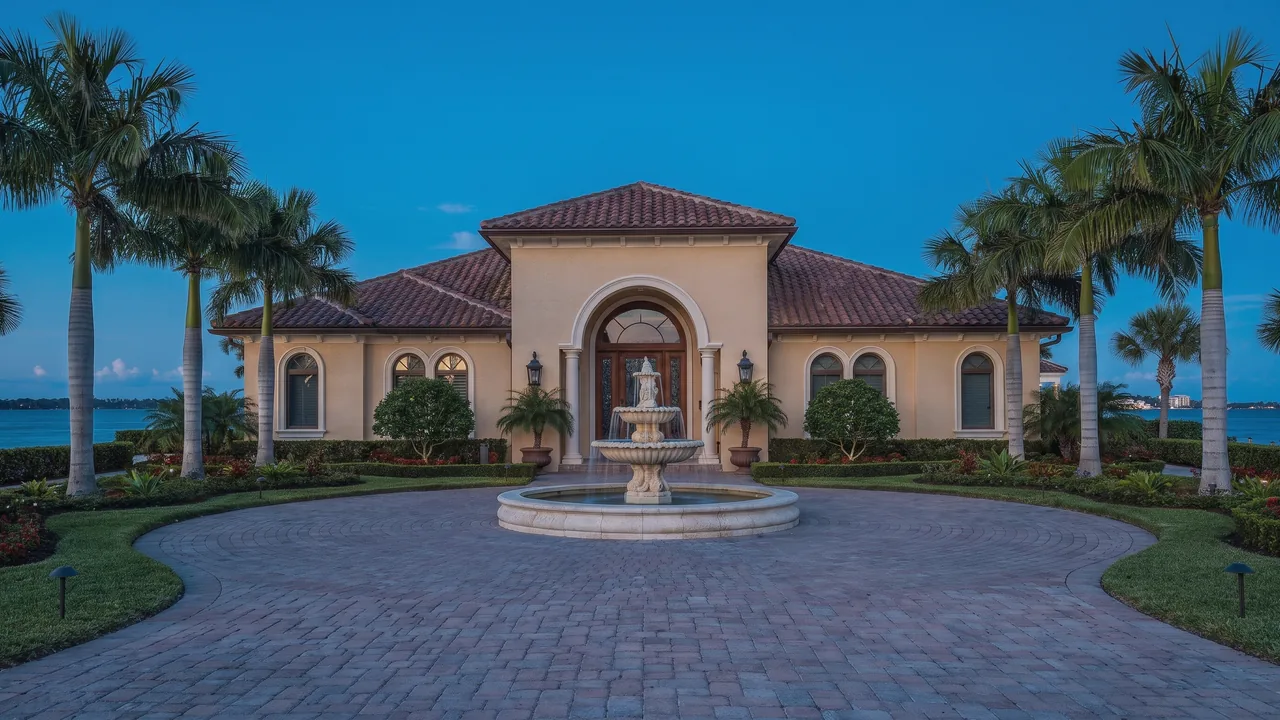
The front door and its arch: the brightest thing on the elevation and the zone most often adjusted, up for guests, down late at night. It is on its own because nothing else should move when it does.
A fountain is often the centerpiece in the evening and switched off later, when its movement and sound are not wanted. It is the zone most likely to take color for an occasion, so it stands alone.
The wings of the house are washed together, at a level a step below the entry. Left and right are usually one zone, because a facade lit unevenly from side to side looks like a fault.
The tallest things on the property, lit from their bases. They set the height of the picture and are the first zone to dim late in the evening, so the house stays the subject.
The paving, the path lights and the planting at the front edge. It is the zone that stays on longest, because it is the one people need to arrive and leave by.
Landscape lighting dimming
A well-lit property is rarely bright. What makes it look designed is the difference between levels: the pool leading, the planting a step below, the wall lower again. FX Luminaire's Luxor dims each zone from 0 to 100 percent in 1 percent steps, and most of the useful settings sit in the bottom half. Drag to see why.
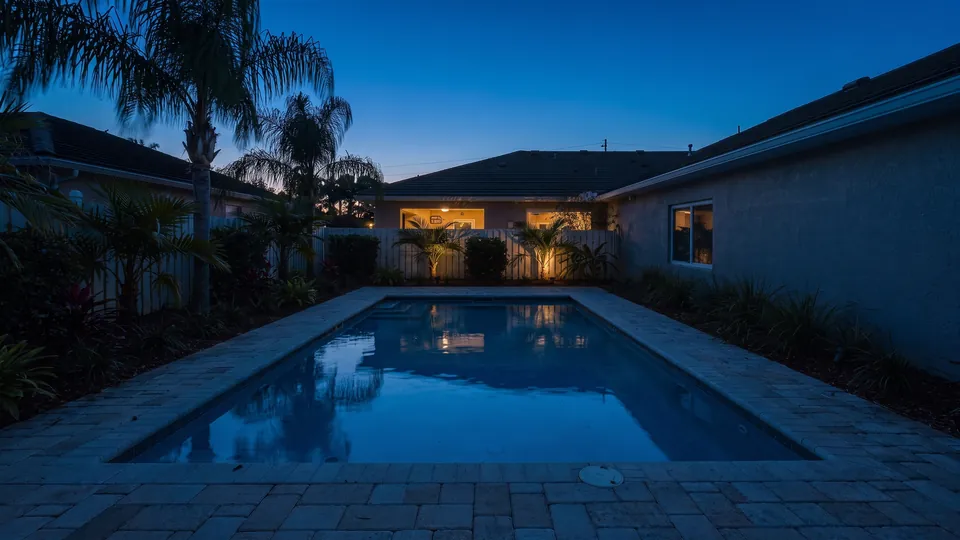
Every zone at its maximum. It is bright, and it is flat: the pool, the wall and the planting compete, and nothing leads. This is how most systems without dimming run all night.
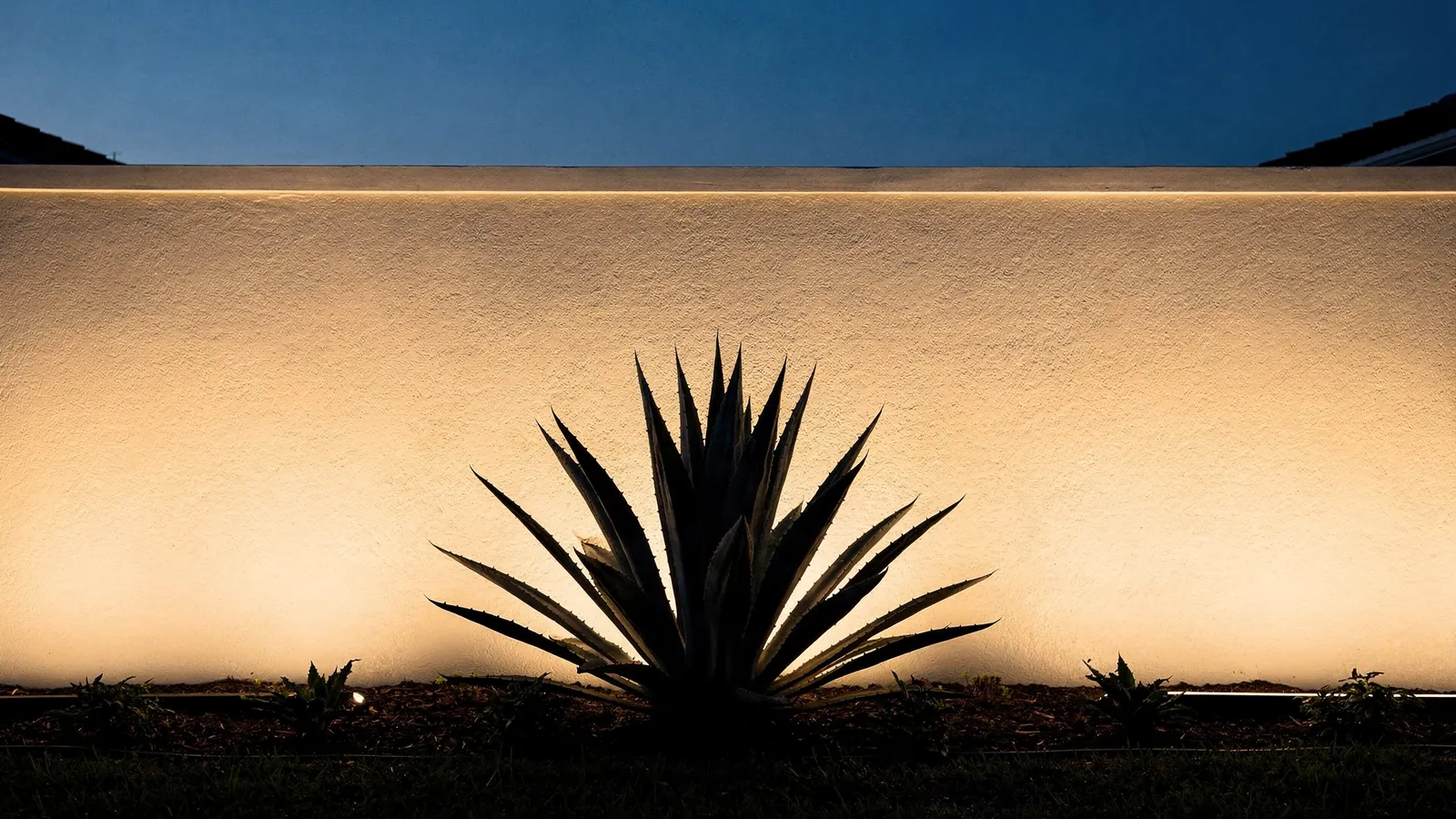
The pool leads, the planting sits a little below it, the house wall lower again. None of these levels is high; the scene works because they differ. Most of a good design is decided down here.
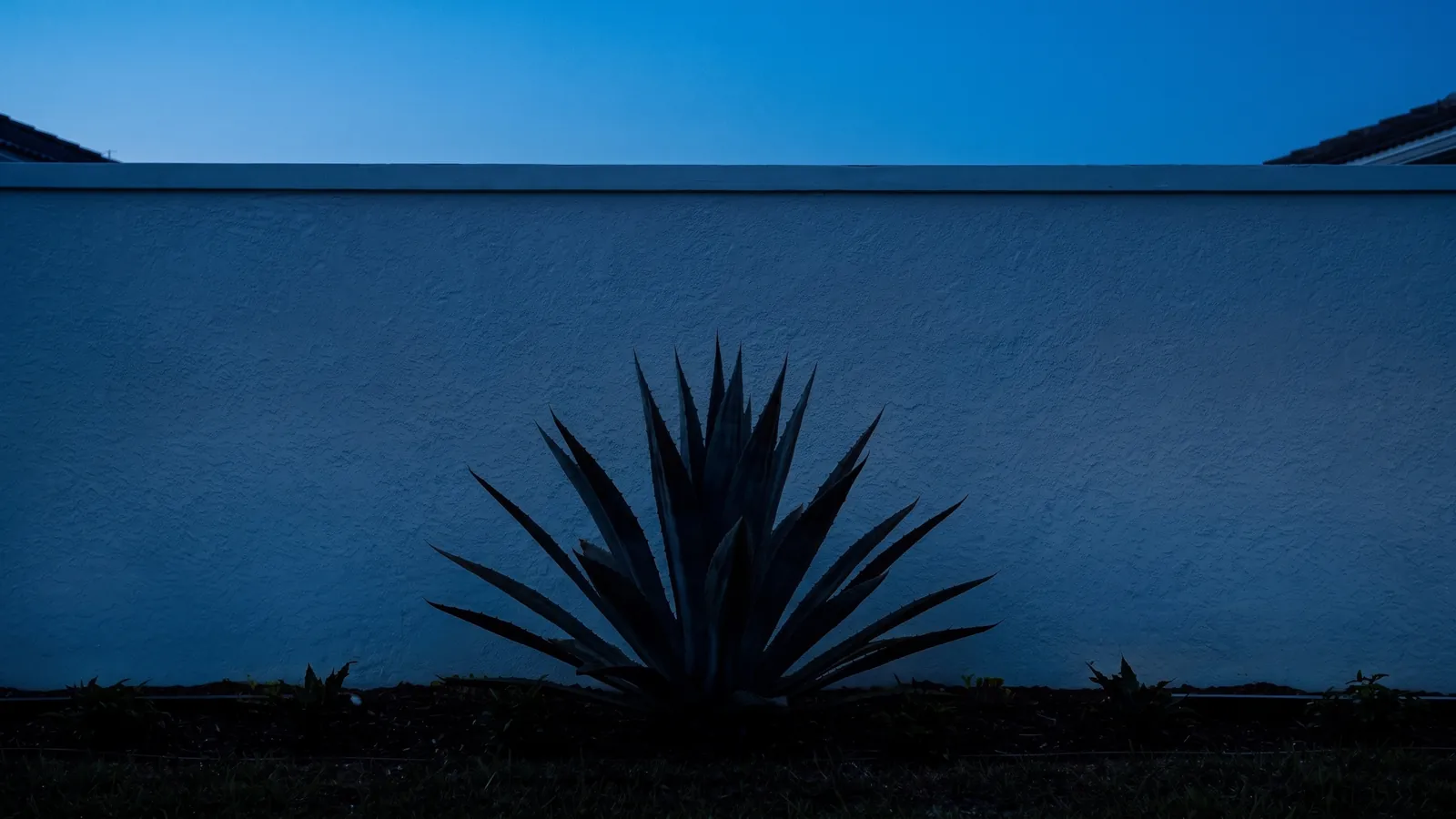
Decorative zones almost out, the planting a glow, one low light on the wall by the door. Enough to see the courtyard from the bedroom window, and quiet enough to sleep beside.
Illustration of one courtyard with four zones: pool, house wall, planting and the back wall.
Zone planning
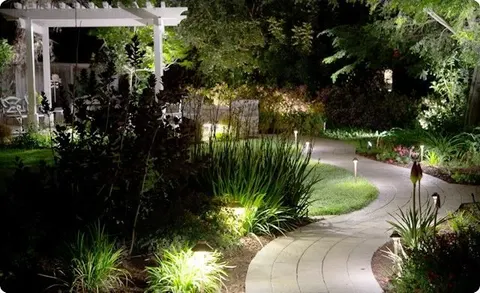
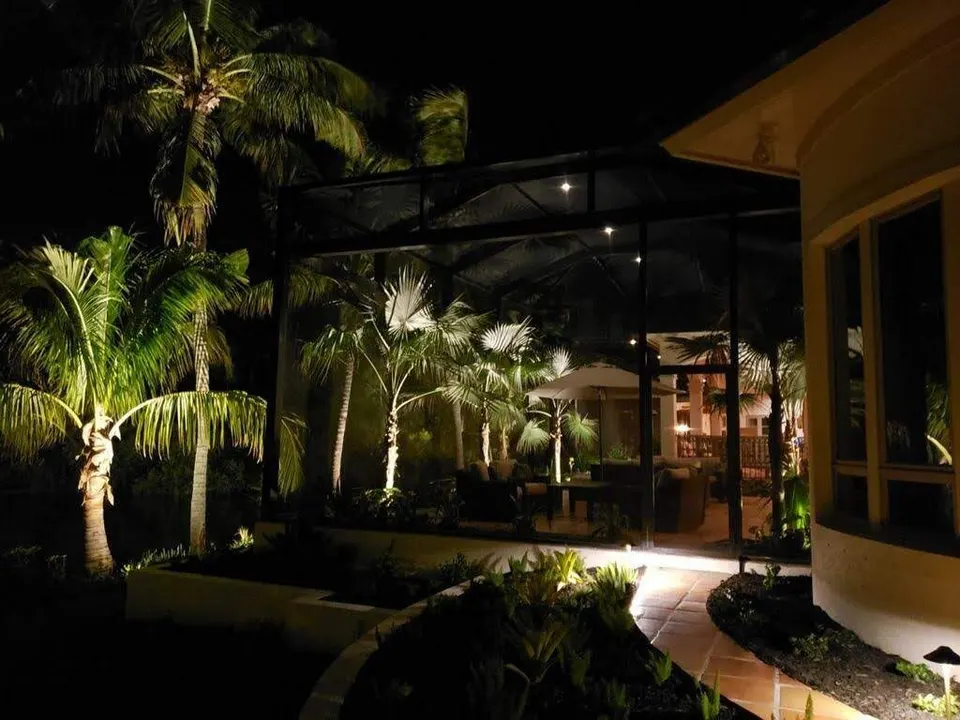
Some lights must never be on the same zone, because they need different levels or hours. Walkways and decoration, the front and the back of the house, and water and land are the three pairs we always keep apart. Sharing a zone is how a quiet evening ends up dimming the way to the car. Point at each.
Boundaries
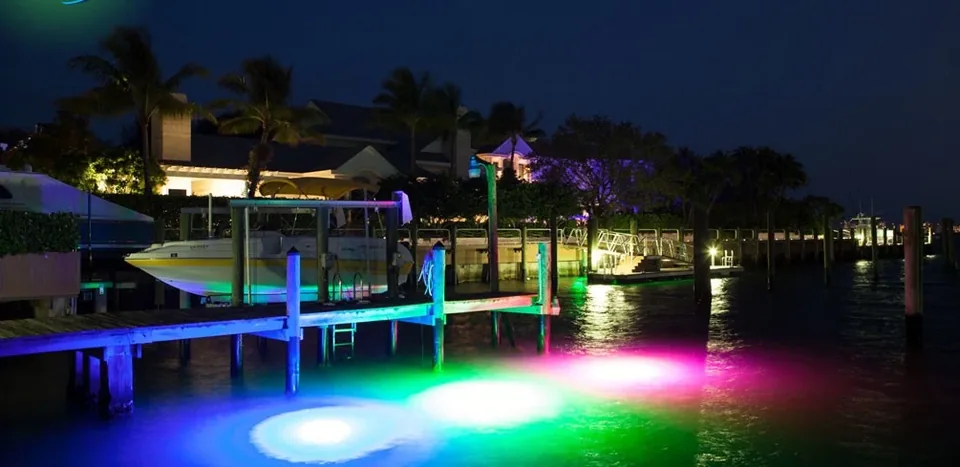
Some zones exist because of who is on the other side. A seaward zone lets beach-facing fixtures follow sea turtle rules for the season while the street side is unchanged. A water zone keeps dock and pool color apart from the garden. A boundary zone lets lights near a neighbor run lower or end earlier.
On a Gulf-front lot the fixtures visible from the sand go on their own zone, because sea turtle rules may require them off or changed for the season. Color has no place on that zone: FWC’s certification criteria rule out color-change options. The details are on what changes on the beach side during nesting season.
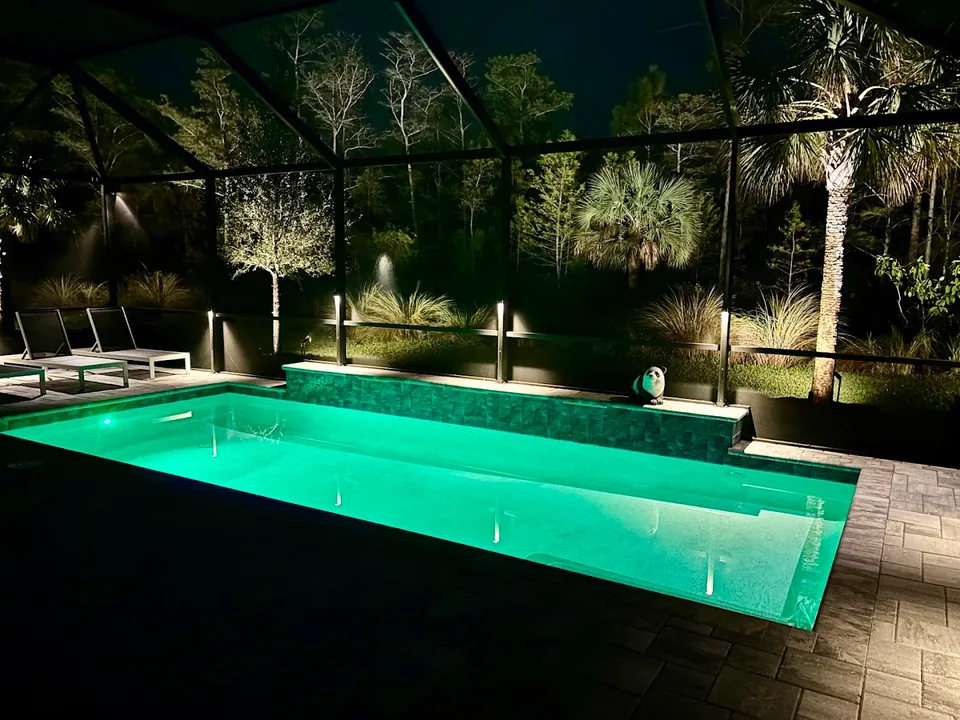
Pool, fountain and dock lights are switched by the evening and are the most likely to take color. On their own zones, they can be blue for a party and off for a quiet night without touching the garden. See pool deck and screen enclosure lighting and color below the waterline at the dock.
Fixtures near a property line, or facing a neighbor’s windows, can sit on a zone that runs a little lower and ends a little earlier than the rest. It takes nothing from the look of the property and it is the easiest way to keep the peace on a close lot.
Color-changing landscape lighting
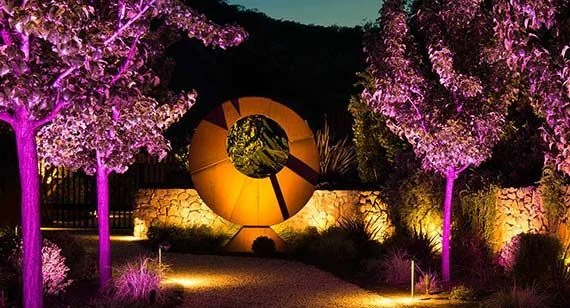
Color belongs on a specimen tree, a canopy, a fountain or the pool, on its own zone, for an evening or an occasion. Warm white stays on the house, the walks and anything people need to see by. A color fixture should look right in warm white first. Point at a color to put it on the tree alone.
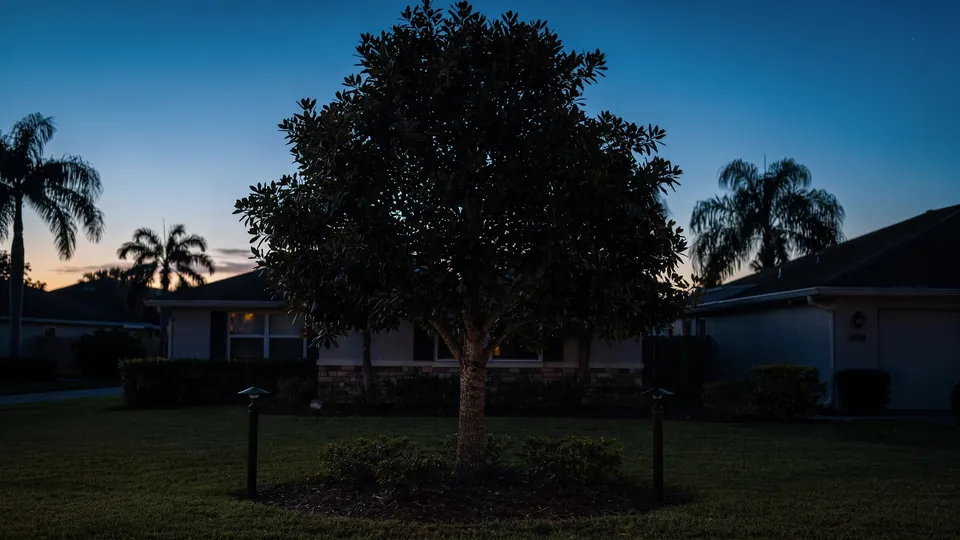
The tree in the same warm white as everything else. This is how a color-capable fixture spends most of its life. If it does not look right in warm white, color will not save it.
Blue on a canopy reads as moonlight in a way warm white cannot, and it is the color most often chosen for a quiet evening. It works because the path lights below it stay warm.
A saturated green on foliage makes a tree look lush rather than lit. It is the subtlest color on planting, and the one most likely to be left on for a whole evening.
Strong colors are for events: a party, a holiday, a team. They are stored as a scene, used for the night, and the tree goes back to warm white in the morning on its own.
Illustration: one tree on a color zone, two path lights on a warm white zone.
Mixed systems
A system does not have to be all color or none. Only fixtures with Luxor technology work with the Luxor controller, at one of three levels: zoning only, zoning and dimming, or zoning, dimming and color. Most properties use color fixtures in a few places and zoning-and-dimming fixtures everywhere else.
FX Luminaire states that "only fixtures or devices with Luxor Technology are compatible with the Luxor Controller," and that devices have "varying levels of control, including: 1) zoning, or 2) zoning/ dimming, or 3) zoning/dimming/color." It calls the second ZD and the third ZDC. The controller carries all three "using a simple two-wire path installation," so color and standard fixtures sit on the same cable.
A color board makes white by mixing; FX’s guide describes ZDC boards using red, green, blue and white LEDs. A dedicated warm white fixture is the better choice wherever the light will be white all year, which is most places. Color fixtures go where color will actually be used.
FX’s design guide says Luxor can "generate and save up to 250 colors" and "design up to 40 distinctive themes ranging from every-night living to holidays, parties, and special events." In practice a household uses a few: everyday, late night, away, and one or two for occasions. How those run on a schedule is covered under schedules, scenes and the app.
Sources, read 2026-10-13: FX Luminaire, Luxor controller; FX Luminaire, NP up light (ZD and ZDC options); FX Luminaire, Landscape lighting design guide (2021).
Retrofit
An existing system can usually be zoned. First every run is traced back to the transformer to see what it feeds. Fixtures with MR-16 sockets can often take zoning and dimming lamps; FX says its ZD MR-16 lamps work in any brand of low-voltage fixture. Where one cable feeds two zones, the run is split.
When a system needs more than that, see reworking an older system into zones.
Ask about zonesExisting systemNightScapes Landscape Lighting
Traced first, zoned second, then set.
Who does the work
NightScapes Landscape Lighting has designed outdoor lighting in Naples since 2006 (Todd since 1998). Todd and Sherry own and run it, outdoor lighting is the only work it does, it is a Hunter Preferred Contractor, and its Google Business Profile shows 63 reviews at 4.9. Zones are drawn from how you use the property, then set.
Before any zone is drawn we ask how the property is used: where you sit in the evening, which way guests arrive, which windows face the garden, whether the house is empty part of the year. The zones follow from the answers.
We work across Naples, Marco Island and Bonita Springs, and through Lee and Collier counties.
Ask about zones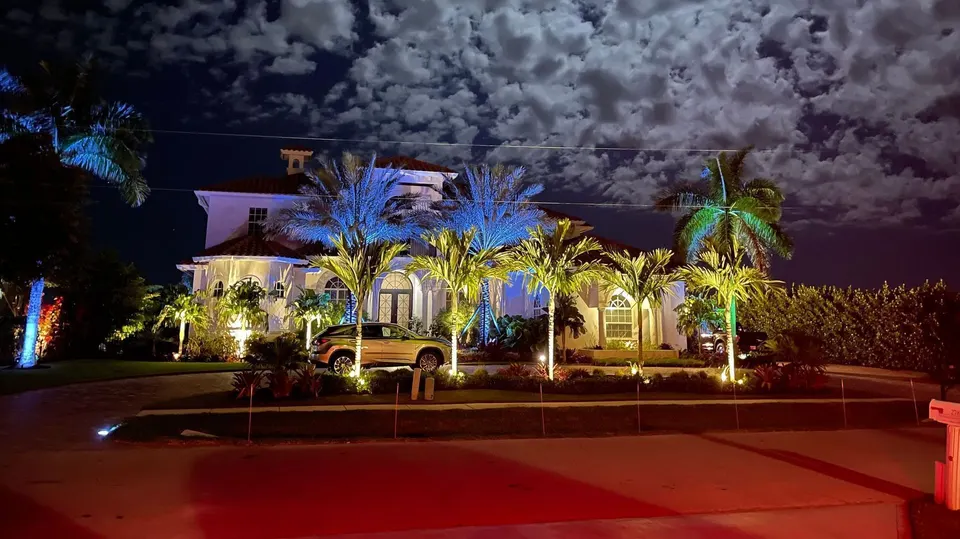
Questions we hear
The difference between zoning, dimming and color, how many zones a system can have, whether color and warm white can mix, whether existing lights can be zoned, where the control box goes and whether the pool can join a color scene. Product facts in the answers are FX Luminaire's, quoted.
 NightScapes Landscape Lighting Outdoor lighting only, Naples since 2006
Choose a question
Ask us about zones, dimming or color. Choose a question, or call and we will answer it on the phone.
Zoning divides the lights into groups that can be switched separately. Dimming sets each group to any level, not just on or off. Color changes what color a group of fixtures gives. FX Luminaire defines zoning as letting "lights to be programmed into preset groups" and dimming as letting lights "emit any desired illumination percentage."
FX Luminaire states that its Luxor controller supports "up to 250 independently adjustable lighting zones." No house needs that many. Most need somewhere between a handful and a dozen, divided by what is used differently: paths, decoration, front, back and water.
Yes, and that is how color is best used. Only fixtures with color boards can change color; FX describes its ZDC fixtures as using red, green, blue and white LEDs. Those go where color is wanted, on their own zone, and every other fixture stays warm white.
Often, in part. FX Luminaire notes that its ZD MR-16 lamps can "add zoning and dimming capabilities to any brand of low-voltage lighting fixture," which covers many existing systems with MR-16 sockets. Where the wiring feeds two zones from one run, it may need splitting. We trace it before suggesting anything.
The controller usually sits outside beside the house, near the transformer it replaces or works with. FX describes the Luxor enclosure as 304 stainless steel and powder-coated galvanized steel, made to live outdoors. Where it goes also depends on reaching power and, for app control, the home network.
Yes. The pool or a fountain is often the best place for color, because water carries it and the planting around can stay warm. The water goes on its own zone so it can change color, or switch off for a quiet evening, without touching anything else.
Free Consultations and Estimates
Tell us how the property is used: where you sit, how guests arrive, whether there is water, and whether you want color anywhere. We draw the zones with you and set each level.
Tell us about the property