Vanderbilt Beach Park
The public county access at the end of Vanderbilt Beach Road, open 8 a.m. to sunset, on a beach the county tracks for nests.
Vanderbilt Beach guide
Vanderbilt Beach is a public Collier County beach with its own nest count, a state park next door that keeps its sand dark on purpose, and canals running back from the Gulf. Lighting here answers to the county's sea turtle code, not the City of Naples code. This guide sets out what that means for a Gulf-front condo, a canal home and the lots between.
Tell us about the property
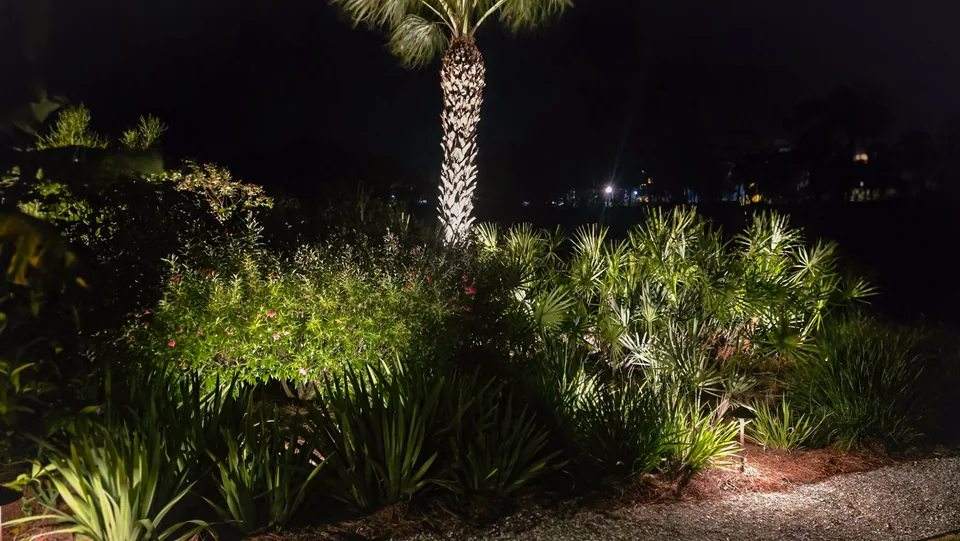
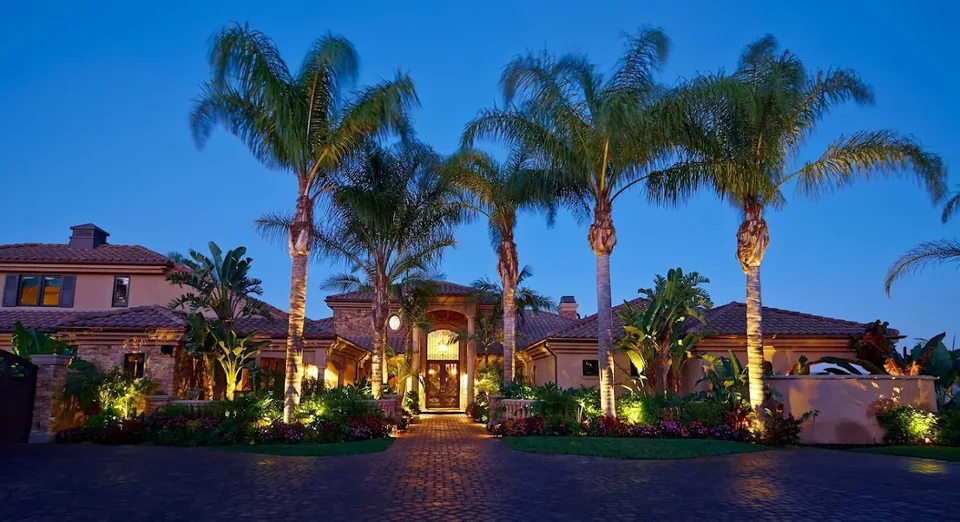
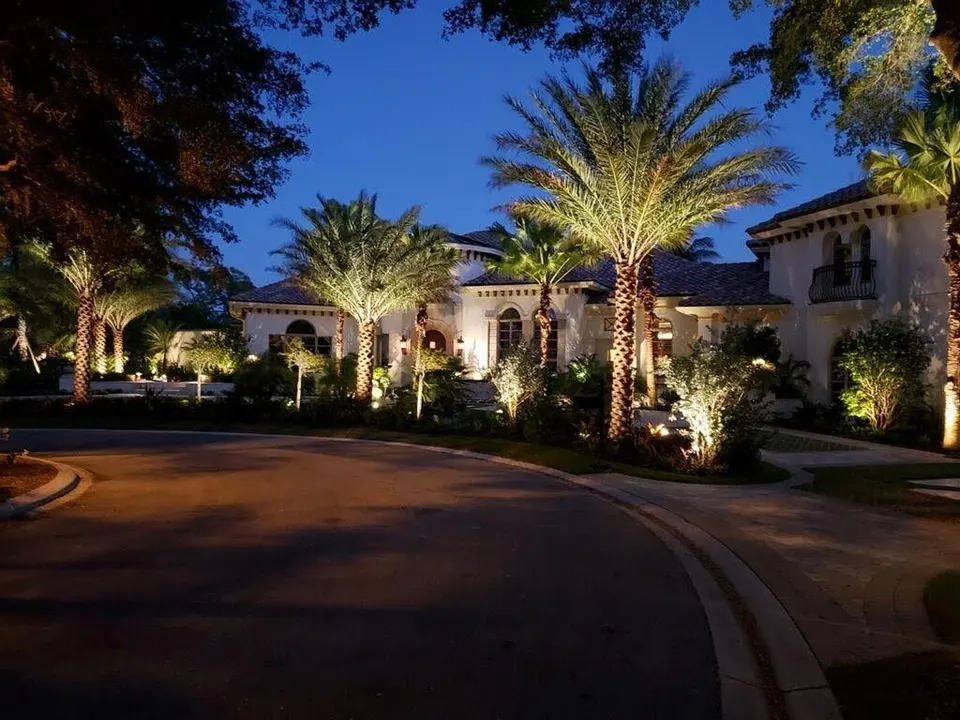
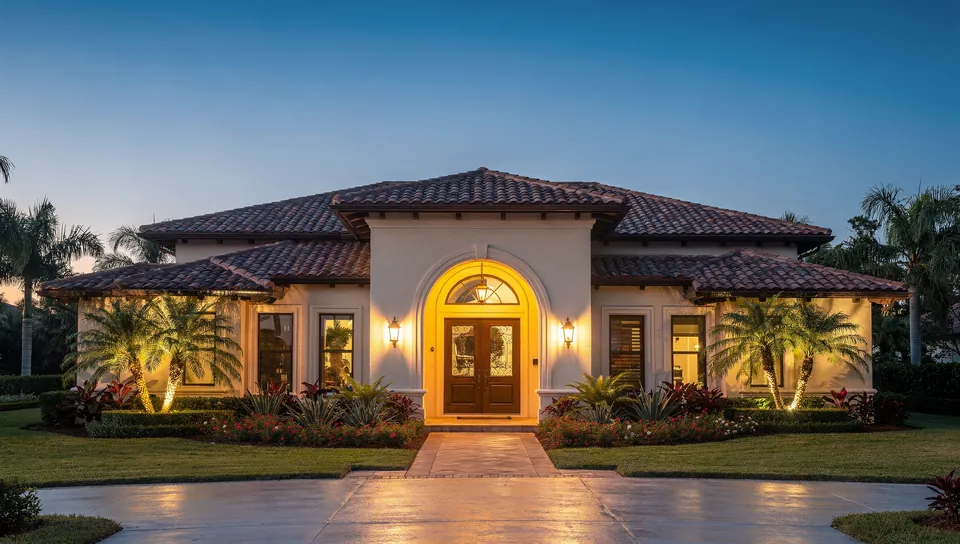
Photograph: palms and a home at blue hour, shown for the lighting, not the place.
The first question
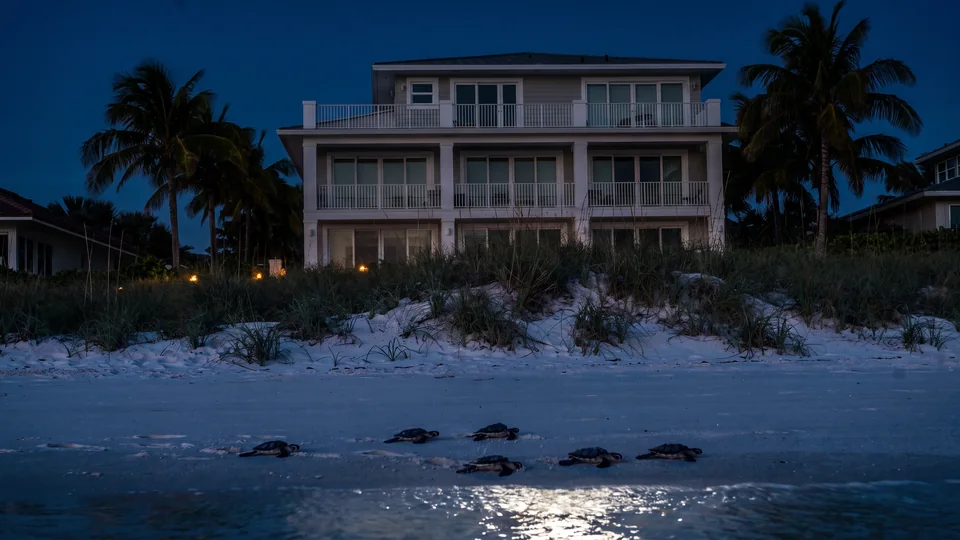
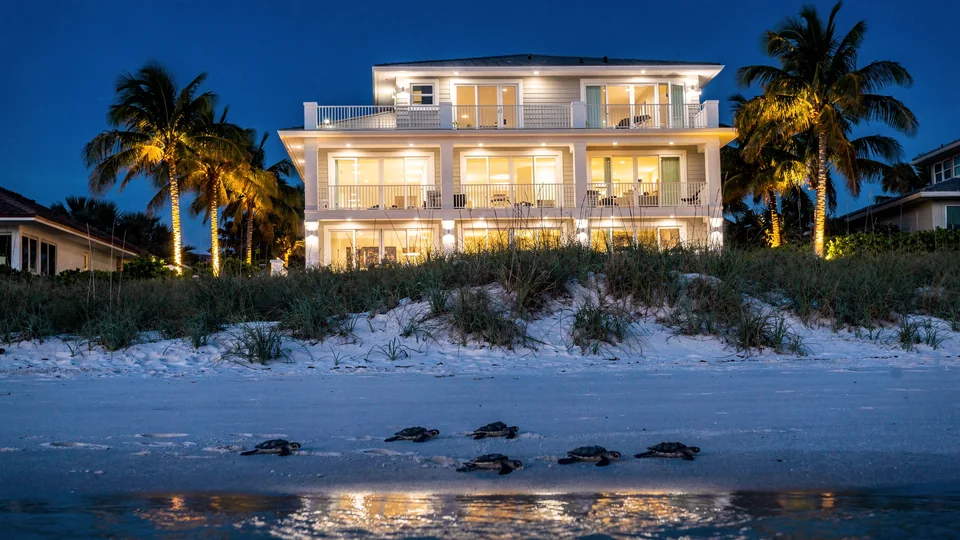
Vanderbilt is one of the nesting beaches Collier County Parks tracks by name, and county staff inspect beach lighting twice a month during nesting season. The county treats a light that throws a visible shadow on the sand as a violation. So the first design question for a Gulf-front home or condo here is simple: can anyone standing on the beach see the light or its glow?
Collier County Parks and Recreation says its “inspections are conducted by Parks & Recreation staff semimonthly throughout sea turtle nesting and hatching season.” The same page sets the standard in one line: “Light sources that create a visible shadow on the beach are considered a violation.” That is a test anyone can run. Stand on the sand at night, look back at the building, then look down at your feet.
Vanderbilt Beach is a public beach. Collier County’s December 2025 renourishment update says so in its own words, “Since Vanderbilt Beach is open to the public per County Ordinance 2018-31,” which is why tourist tax money paid to rebuild it. The Pelican Bay beach to the south is funded by the Pelican Bay Services Division instead, “since it is not a public beach.” Collier Parks calls Vanderbilt Beach Park “one of the most popular beach accesses,” a 5 acre park at 100 Vanderbilt Beach Road near upscale hotels, open from 8 a.m. to sunset. When the park closes, the beach is still a nesting beach.
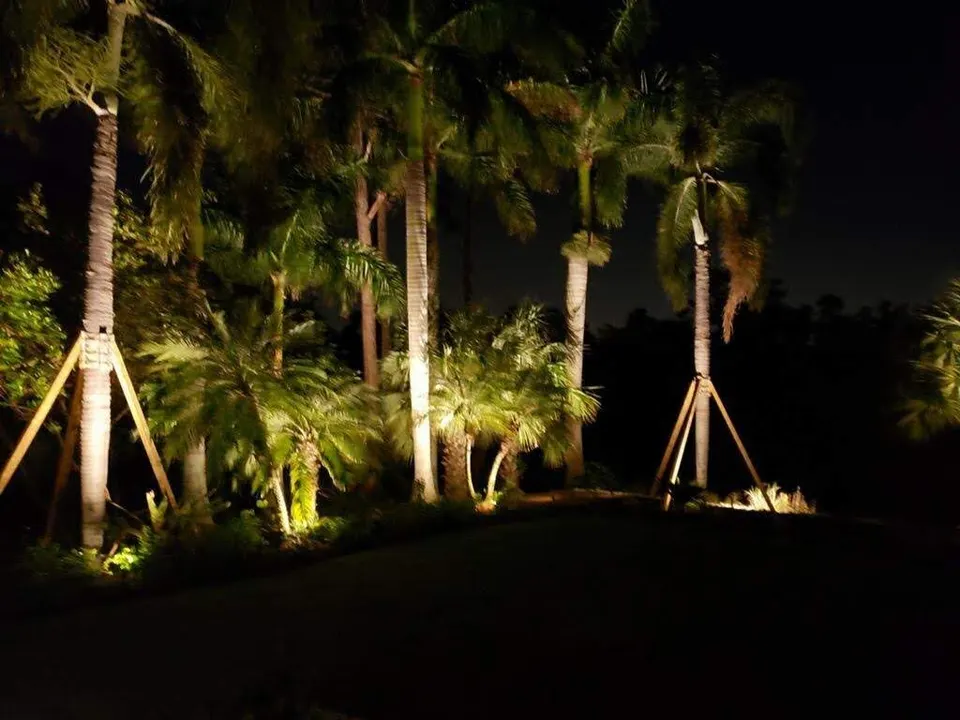
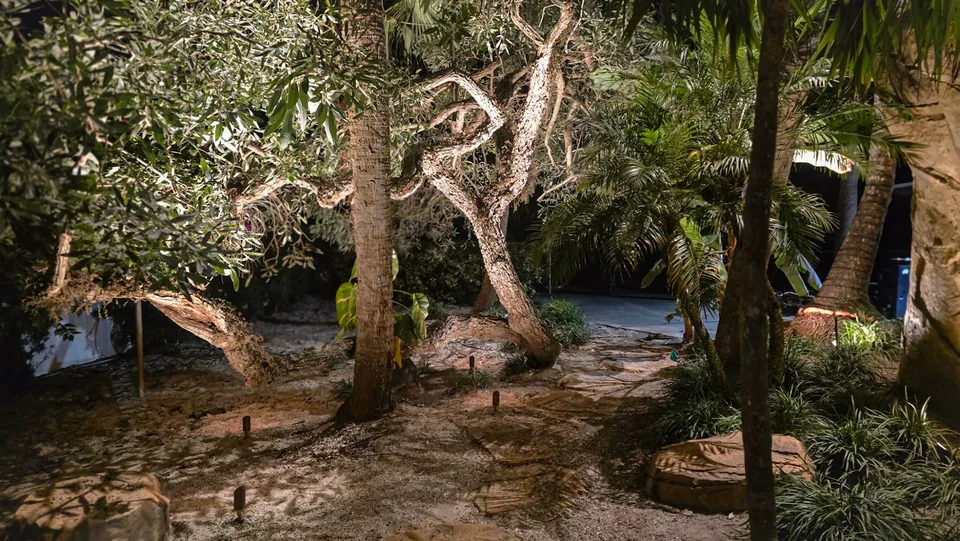
A sharp shadow means light is reaching the beach directly: a balcony floodlight, an uplit palm on the dune side, an open fixture on a walkover. Glow over the dune is subtler, which is why the county’s rule speaks of the light source and of “any reflective surfaces illuminated by such sources.” The fix is rarely a new fixture first. FWC’s own lighting page puts turning off unneeded lights ahead of everything else, saying there is no substitute for naturally dark habitats.
Sources: Collier County Parks Sea Turtle Protection (ledger F-46), read 2026-10-13 and 2026-10-14; Collier County renourishment update and Collier Parks Vanderbilt Beach Park, read 2026-10-14; Collier LDC 3.04.02 (F-42) and FWC (F-15), read 2026-10-13.
The county code
Vanderbilt Beach is governed by Collier County's Land Development Code, not the City of Naples code. Where the county's sea turtle section applies, including lighting within 300 feet of mean high water, floodlights and landscape or accent lighting are prohibited, and fixtures must be low intensity and hooded so the source cannot be seen from the beach. Whether it reaches your lot depends on distance and visibility.
Beach, pass and canals
Vanderbilt Beach packs three kinds of waterfront into a short stretch: the Gulf beach, Wiggins Pass with the Cocohatchee estuary behind it, and the canals off the Vanderbilt Channel. A light that is fine on one can be wrong on another. Each bulb marks a place where the lighting question changes, from the public beach park to the state park and the boat launch.
The public county access at the end of Vanderbilt Beach Road, open 8 a.m. to sunset, on a beach the county tracks for nests.
The sand that seaward lighting must not reach or be seen from. A visible shadow here is a violation.
A nesting beach kept dark on purpose, whose draft plan reports disorientations from artificial light and sky-glow nearby.
The natural inlet where the Cocohatchee estuary meets the Gulf. Salt and wind come through here; a maintenance dredge began in 2026.
Part of the Cocohatchee estuary, an Outstanding Florida Water since 1996. The edge for dock and seawall lighting.
County beach parking on 111th Avenue North with a butterfly garden, open dawn to dusk, about a quarter mile from the Bluebill Avenue access.
A 7 acre county boat park on Vanderbilt Drive with Gulf access through Wiggins Pass: the river and dock side of the area.
Points placed from nominatim.openstreetmap.org. Map data from Google.
Next door to the north
The state park just north of Vanderbilt Beach keeps its beach dark on purpose. Its 2026 draft management plan says rebuilt restrooms should have no structural lighting because the park closes at night, and that disorientations caused by artificial light and sky-glow near the park are reported to FWC and Collier County. Homes nearby add to that glow, or help reduce it.
The park sits immediately north of the Vanderbilt strip at 11135 Gulfshore Drive and is open from 8 a.m. to sunset. It covers 199.78 acres, about 80 percent of it submerged land and mangrove swamp, on about a mile of undeveloped barrier island. Its June 2026 draft management plan says plans for rebuilt restrooms “should not include structural lighting since the park is closed to the public at night.”
The same plan records what happens when light reaches the sand anyway: “Disorientation events attributed to artificial light sources and area sky-glow near the park are reported to FWC and Collier County.” Sky-glow is not one fixture. It is the light of the whole shoreline added together, and a Gulf-front building a short walk south is part of that total.
The plan also notes that least terns nested on the park’s north end until 1987 and were seen foraging and resting on its beach as recently as 2024, and that the park joins FWC’s winter shorebird survey for piping plover and red knot. Florida State Parks lists eagles, ospreys, owls, shorebirds, dolphins and manatees at the park, and state-threatened gopher tortoises live on its dune. No source we read ties home lighting to any of those animals, and we do not suggest one. The lighting reason here is the turtles.
Sources, read 2026-10-14: Florida State Parks, Delnor-Wiggins Pass State Park and experiences; Florida DEP, draft management plan, June 2026.
The numbers
Collier County’s sea turtle activity table lists Vanderbilt with 274 nests in its latest season column and 36 entries under “Disoriented.” The state park next door recorded 65 loggerhead nests in 2025, its highest year, and its first green sea turtle nest in 2021. Those numbers come from the county and the state, and they are why seaward lighting here deserves real planning.
Collier Parks keeps Vanderbilt as its own row, separate from Park Shore and the City of Naples. Two cautions in reading it. The table prints no year: the file was created in November 2025, and its Delnor-Wiggins row of 65 nests matches the state’s figure for 2025, which points to that season. And it does not define “Disoriented,” so we do not say whether 36 counts nests or events. It is still the county’s own record for this beach.
FWC’s guidelines explain why the number of fixtures matters as much as their type. Even when a fixture and lamp are low, shielded and long wavelength, “too many fixtures may still result in sea turtles becoming disoriented.” On a shoreline of towers and hotels, the count adds up quickly.
Sources: Collier County Parks, sea turtle activity table, read 2026-10-14; Florida DEP, Delnor-Wiggins draft plan, read 2026-10-14; FWC lighting guidelines (ledger F-21), read 2026-10-13.
Ask about a Vanderbilt Beach planWhat the county and state countedNightScapes Landscape Lighting
Counts from Collier Parks and Florida DEP.
Behind the beach
The Vanderbilt Channel was dredged between 1950 and 1952 to reach the Gulf, and the Cocohatchee estuary beyond it, including Water Turkey Bay, is an Outstanding Florida Water. For docks and seawalls on these waterways, the practical aim is light on the deck and the steps, shielded and aimed down, rather than light pouring across the water at night.
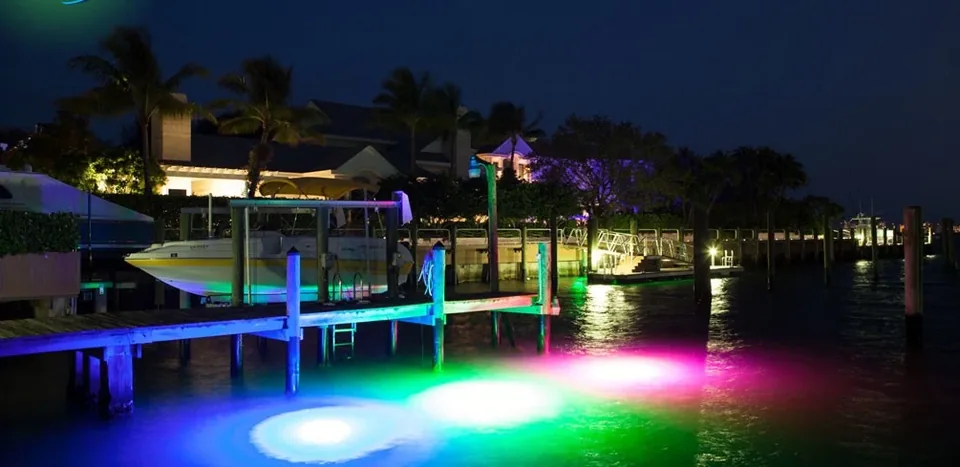
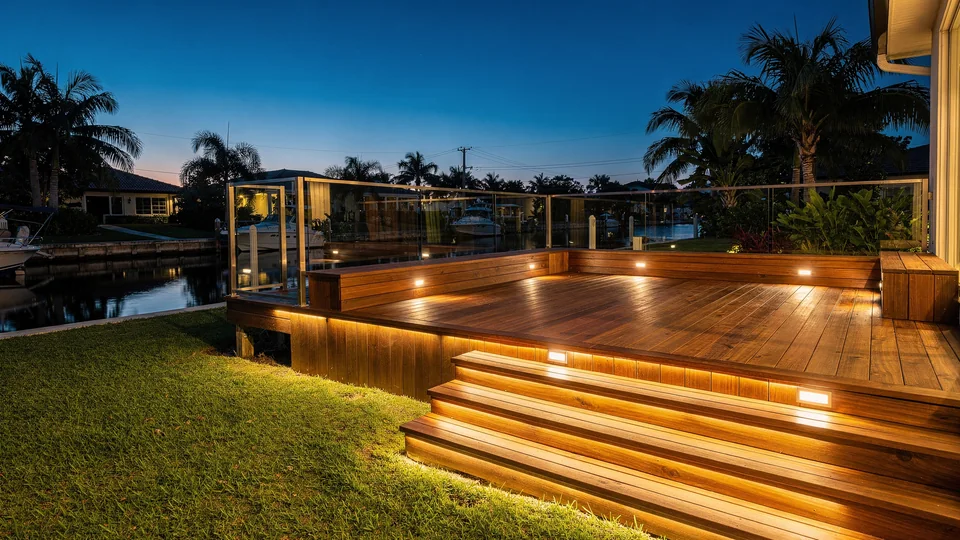
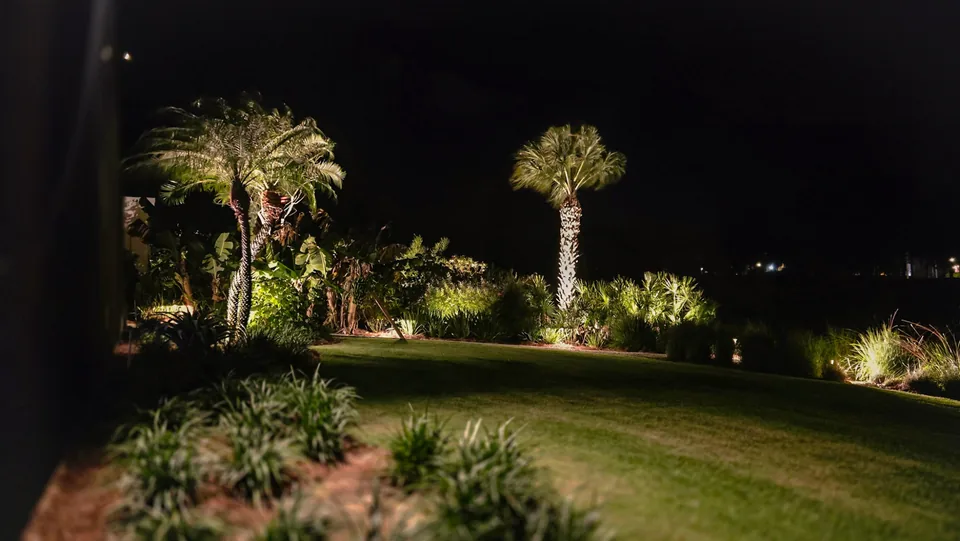
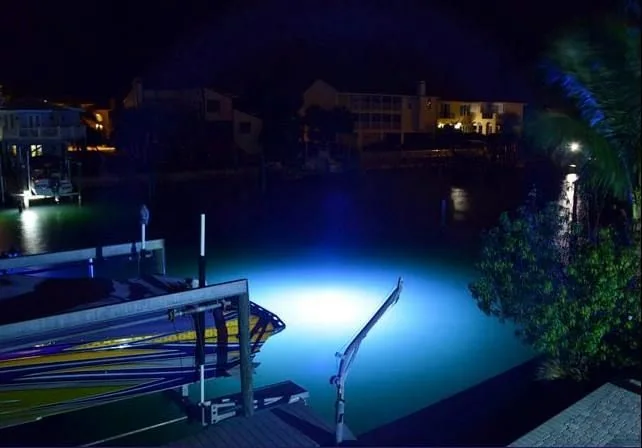
Florida State Parks records that “The Vanderbilt Channel was dredged between 1950 and 1952 to provide access to the Gulf of America,” through what had been mangrove and lagoon. The finger streets off Vanderbilt Drive back onto that water, so many homes here are canal-front rather than beachfront. Whether Collier’s sea turtle section reaches a canal lot depends on its 300-foot and visibility tests, checked one property at a time.
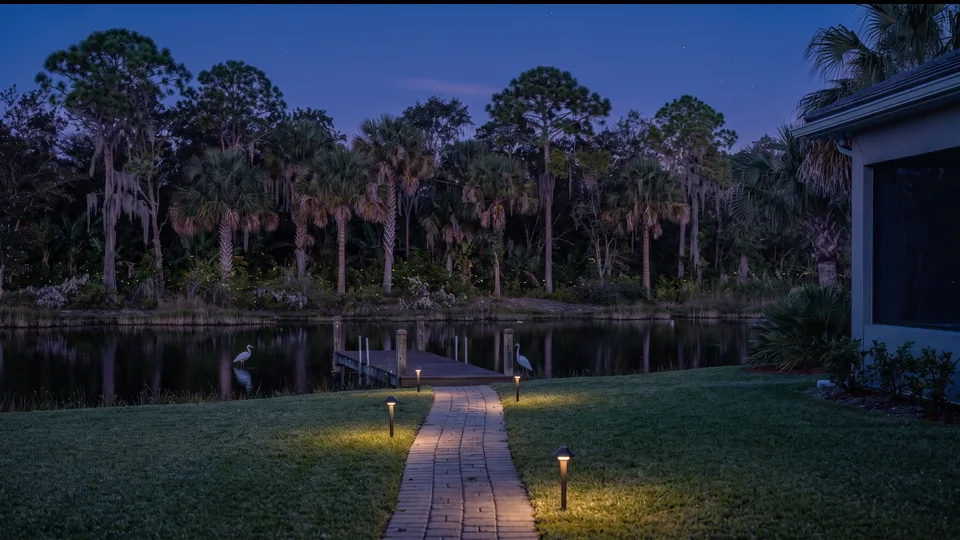
On a dock or seawall, the light that earns its place is on the walking surface, the steps and the edge: low, shielded and aimed down. That keeps footing clear at night and keeps glare out of the windows across the channel. Light poured across open water does neither job. Our deck and dock lighting page covers fixtures for treads, rails and seawalls.
The Cocohatchee River is part of a brackish, tidal estuary that flows to the Gulf through Wiggins Pass. In 1996 that estuary, Water Turkey Bay included, was declared an Outstanding Florida Water “due to its exceptional recreational and ecological significance.” We found no lighting rule tied to the designation and do not suggest one. It is a reason for restraint, not a regulation.
One study is worth knowing about. In an Australian field experiment, LED spotlights under a wharf made fish predatory behavior far higher than on unlit nights. That is a general finding about light under structures, not a Vanderbilt result. No agency guidance we found links dock lights to manatees, in either direction, so we make no claim either way. If you want underwater lights, put them on a timer; see underwater and dock lighting.
Salt
Gulf-front and pass-side lots here sit where FEMA says airborne salt is heaviest, close to breaking waves, falling off over the first few hundred to few thousand feet inland. Salt builds up on metal and speeds corrosion, and surfaces that stay damp corrode faster. Fixture materials, sealed connections and regular cleaning matter more here than they do a mile inland.
FEMA’s technical bulletin on coastal corrosion is written about building connectors and fasteners, not light fixtures, but it describes the mechanism clearly. “Salt spray from breaking waves and onshore winds significantly accelerates the rate of corrosion of metal connectors and fasteners.” Ocean salts “accumulate on metal surfaces and accelerate the electrochemical reactions that cause rusting and other forms of corrosion.” The amount in the air “is greatest near breaking waves and declines rapidly in the first 300 to 3,000 feet landward of the shoreline.” And “The longer a surface remains damp during the normal daily fluctuations in humidity, the higher the corrosion rate.”
Gulf-front towers and homes take the beach’s salt. Lots near the north end take the pass as well. Wiggins Pass, Florida State Parks says, “is a natural inlet named after Joe Wiggins, who settled into the area in the late 1860s,” and the Cocohatchee River estuary flows out to the Gulf through it. A lot near the inlet takes the exposure of both the beach and the pass.
We do not call any fixture salt rated. What helps is plain: sealed connections, fixtures and fasteners chosen with the exposure in mind, and cleaning off the salt that builds up on lenses and housings. Where a fixture sits under dense, damp planting, it is worth checking more often. An older system near the water is a candidate for a halogen to LED retrofit or a regular look under one of our maintenance plans.
Sources: FEMA Technical Bulletin 8 (ledger F-156 to F-160), read 2026-10-13; Florida State Parks, waterways and wetlands at Delnor-Wiggins, read 2026-10-14.
Towers and hotels
Collier Parks describes Vanderbilt Beach as sitting near upscale hotels, and much of the shoreline is condominium towers. FWC notes that many fixtures can still disorient turtles even when each one is low, shielded and long wavelength. For a tower, that means planning balconies, garages, stairwells and grounds together, and asking the association about its own rules first. Try it on the tower below.
A Gulf-front tower is not one light. It is balconies, a garage, stairwells, a pool deck, a dune walkover and the grounds, each looked after by someone different. Collier County’s section names parking lots, dune walkovers and other outdoor lighting visible from the beach in its scope, and where it applies it holds outdoor lighting to “the minimum necessary for security and safety.” Because many fixtures together can disorient turtles even when each is low, shielded and long wavelength, replacing fixtures one at a time can leave the total glow unchanged.
Start with the association’s own rules. We could not read them for this guide; they are not public, so ask the board or the manager. Then walk the beach side at night with the people who control each part: maintenance for the garage and stairwells, whoever looks after the pool deck, the board for the grounds. One plan for the whole seaward side is easier to keep right than a dozen separate fixes. Our commercial and HOA lighting page covers how community lighting is planned and recorded.
FWC’s guidelines list private balcony lights, pond lights, dune walkover lights and fountain lights on the seaward or shore-perpendicular side among the lighting it does not recommend, since they are not needed for safety. A lit pool deck the beach can see belongs in the same conversation; see pool and lanai lighting.
Sources: Collier LDC 3.04.02, Municode (ledger F-40, F-41), and FWC guidelines (F-19, F-21), read 2026-10-13; Collier Parks Vanderbilt Beach Park, read 2026-10-14.
New sand
Collier County renourished Vanderbilt Beach from late 2025 into January 2026, from the state park south past Vanderbilt Beach Road, and Wiggins Pass is being dredged this fall. When the sand changes height and width, what can be seen from the beach can change too. A lighting plan that passed last season is worth re-aiming and checking again from the sand.
0 of 6
Repeat it before each season starts on May 1. That is judgment, not a rule.
The shadow at your feet and the lamps you can see are the two the county inspects for.
After a renourishment or a dredge, nobody can tell from a drawing what the beach now sees.
The county’s December 24, 2025 update reported that work on “Vanderbilt Beach from Delnor-Wiggins Pass State Park to Vanderbilt Beach Road is complete,” with work continuing to the south. Florida State Parks posted that from September 25, 2026, “Wiggins Pass at the north end of Delnor-Wiggins Pass State Park is undergoing a maintenance dredge project,” with equipment on and near the beach. A timer or smart control that turns beach-visible zones off by 9:00 p.m. from May 1 to October 31 is one of the two options the county gives existing buildings. Sources: Collier County renourishment update and Florida State Parks Delnor-Wiggins page, read 2026-10-14; Collier LDC 3.04.02 (ledger F-42, F-43) and Collier Parks sea turtle lighting sheet (F-47), read 2026-10-13.
A mile inland
Naples Park sits east of Vanderbilt Drive, roughly a mile from the beach. Collier County's beach rules are tied to distance from the water and visibility from the beach, so most Naples Park homes face a different lighting question than a Gulf-front condo does. This guide covers the beach, the pass and the canals; the streets inland need their own plan.
The distances are measured, not guessed: the Naples Park map point sits about 0.72 miles east of the Vanderbilt Beach neighborhood point and about 1.09 miles from the beach point, computed from the two OpenStreetMap coordinates. Collier’s sea turtle section applies within 300 feet of coastal mean high water, among its other triggers, so the beach rules that run through this guide are not the starting point for most homes there.
We have not researched Naples Park to the standard of this guide, so we will not describe its streets, its rules or its conditions here. If you live there, start with our general landscape lighting page, and we will look at your property on its own terms.
Questions we hear
These are the questions the county's pages and the state park's plan answer most directly: lights-off hours, palm uplighting on the Gulf side, whose code applies, why Delnor-Wiggins is so dark, dock lighting on the channel, salt near the pass and where a condo association should start. Every answer is drawn from those sources.
 NightScapes Landscape Lighting Outdoor lighting only, Naples since 1998
Choose a question
Ask us about lighting at Vanderbilt Beach. Choose a question, or call and we will answer it on the phone.
For existing homes and buildings with lights visible from the beach, Collier County’s code gives two options from May 1 to October 31: turn those lights off after 9:00 p.m., or hood or position them so neither the source nor what it lights can be seen from the beach. The code sets a start time but no end time, so check your own lot’s visibility from the sand.
Where Collier County’s sea turtle section applies, landscape and accent lighting are prohibited, and FWC advises against uplighting vegetation where it is visible from the beach. Palms on the land side of the building, fully hidden from the sand, are a different question, but they still must not show from the beach. Ask for a plan that starts from what the beach can see.
No. Vanderbilt Beach is managed by Collier County: the county runs Vanderbilt Beach Park, paid to renourish the beach because it is public under County Ordinance 2018-31, and tracks its sea turtle nests separately from the City of Naples beach. Collier County’s Land Development Code sea turtle section is the one to read, not the city’s code.
The park closes at sunset, and Florida’s draft management plan for it says rebuilt restrooms should not include structural lighting because the park is closed to the public at night. The same plan records sea turtle disorientations linked to artificial light and sky-glow near the park, which are reported to FWC and Collier County.
Light the dock surface, steps and edges with low fixtures aimed down and shielded, and keep beams off the open water. The channel connects to the Cocohatchee estuary and Water Turkey Bay, an Outstanding Florida Water. Research elsewhere shows light under a structure can change fish behavior, so there is no reason to flood the water just for looks.
FEMA says salt from breaking waves and onshore wind builds up on metal and speeds corrosion, that it is heaviest near the water and falls off over the first few hundred to few thousand feet inland, and that damp surfaces corrode faster. Pass-side and Gulf-front lots here are in that zone, so materials, connections and cleaning all deserve attention.
Start with the association’s own rules, which were not public for this guide, then with Collier County’s sea turtle section, which covers parking lots, dune walkovers and other outdoor lighting visible from the beach. FWC also warns that many fixtures can still disorient turtles together, so a tower needs one plan for every level, not fixture-by-fixture swaps.
Who does the work
NightScapes Landscape Lighting is family owned, run by Todd and Sherry, and has done outdoor lighting in Naples and Southwest Florida since 1998. It does outdoor lighting and nothing else, and its Google Business Profile shows 63 reviews at 5.0. This guide was built from Collier County's code, Collier Parks, the state park's draft plan and FEMA, each linked where it is used.
The photographs on this page show lighting, not particular Vanderbilt Beach homes or condominiums, and drawings are labeled as illustrations. Where a figure comes from the county, the state or FEMA, the page says which. Where a source leaves a gap, such as the year on the county’s nest table, we say so rather than fill it.
Ask about a Vanderbilt Beach plan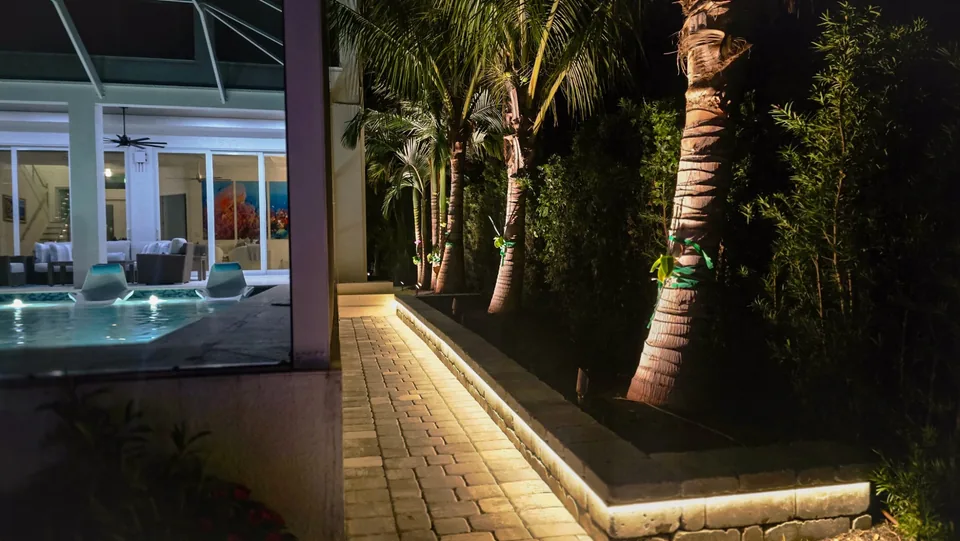
Free Consultations and Estimates
Tell us whether the property faces the Gulf, the pass or a canal, what is lit now and what you would like to see at night. On the beach side we start from what the sand can see. On the canal side we start from the deck and the steps.
Tell us about the property