Half a run goes dark and the assumption is that the lights have burned out.
Usually they have not. We find where the circuit stops before anything is replaced.
A landscape lighting system is one line. Power leaves the house, passes
through a transformer and a timer, and travels along a buried cable to each
fixture in turn. A fault at any point takes out everything after it, so the
place where the lights stop is rarely the place that is broken.
Scroll to follow the fault down the line
Point 1 of 6
The outlet
The transformer plugs into an outdoor outlet, and that outlet is protected by a ground-fault device that shuts off when it detects current leaking to ground. Outdoors, moisture is the usual reason. A whole system that goes dark at once, with no warning, often starts here and not in the yard.
On the stairFrom the yard this looks exactly like a failed transformer or a timer that never switched on: every light is out, on every run.
What we checkWhether the outlet has power, and what made it trip.
Point 2 of 6
The transformer
It steps house current down to low voltage for the yard. Every fixture adds to its load, so a transformer sized for the original system can be past its limit after years of additions. Many protect themselves by shutting off when they overheat and coming back when they cool, which looks like lights that quit some nights and not others.
On the stairEverything it feeds goes out together, which is the same picture a tripped outlet makes.
What we checkIts output, and the total load against what it is rated to carry.
Point 3 of 6
The timer or photocell
This decides when the lights run. A mechanical timer loses its place every time the power blinks, so the schedule drifts a little after each outage. A photocell stops seeing dusk when a plant grows over it or its lens clouds.
On the stairThe system is healthy and simply has not been told to come on.
What we checkThe settings, where the sensor sits, and what it actually does after dark.
Point 4 of 6
The buried run
The cable is only a few inches down, which is shallow enough for an edger, an aerator or a new planting hole to find it. Voltage also falls the farther it travels, so the last fixtures on a long run are fed less than the first ones.
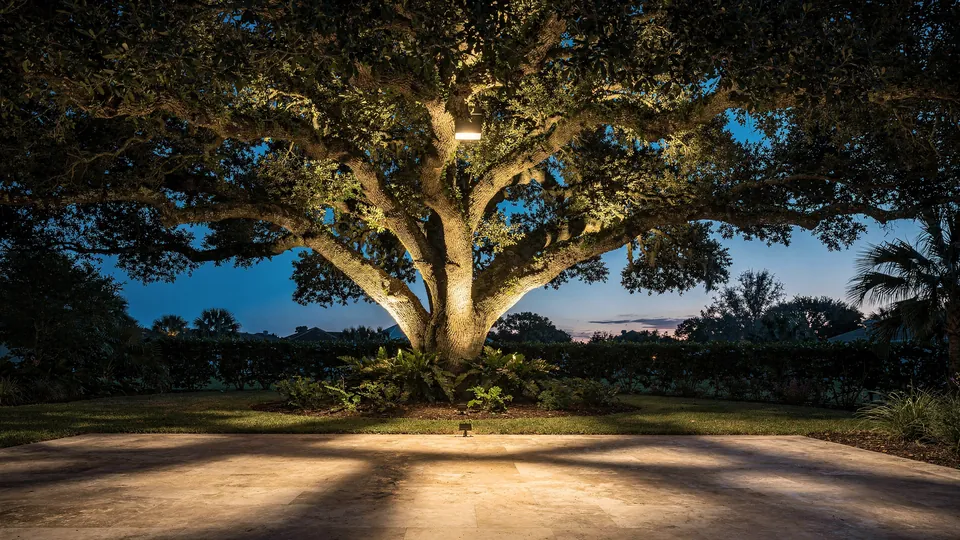
On the stairThe wall light is fed before the cut, so it stays on. The three steps after it go dark as a group.
What we checkVoltage at the far end of the run, not just at the transformer.
Point 5 of 6
The connections
Each fixture joins the run at a splice. In ground that stays wet, a twist-on connector corrodes until it stops carrying current, and everything past that point goes dark together. It is the most common reason a section of a system fails in Southwest Florida.
On the stairThe top step is before the failed splice and still lit. The two below it are not.
What we checkEvery splice along the affected run, opened and remade where it has failed.
Point 6 of 6
The fixture
The part everyone suspects first. Lamps do fail, and thin aluminum housings pit from the inside in salt air, sometimes while the lamp inside still works. But a fixture is only the cause when it is the only thing that is out.
On the stairOnly the bottom step is out, and everything else is lit. This is the one pattern where the fixture is the likely cause.
What we checkThe housing, the socket and the seal, for corrosion and water.
Found and fixed
Back on
Whichever point it was, the repair is the same idea. Find where the circuit
stops, put that right, and every light after it comes back on its own.
Seven things a lighting system does when something is wrong, each marked on
the photograph, with the causes behind it, most likely first. It is a guide to
what is probable. It is not a diagnosis, and it does not replace someone
tracing the run.
Point at a numberTap a number
One section is dark
Part of the yard is out and the rest still works.
Most likelyA failed connection just before the first dark fixture. Everything past it loses power together, which is why a group goes out at once.
NextA cut cable. Edging, aeration and new planting all happen at the depth the wire is buried.
Also possibleOne output on the transformer has shut off, if that section runs on its own circuit.
Where we startWe work back from the first dark fixture to the last lit one. The fault is almost always between the two.
Most likelyThe outdoor outlet has tripped. Moisture is the usual cause, and it normally resets with a button on the outlet itself or on another outlet on the same circuit.
NextThe timer or photocell is no longer switching the system on.
Also possibleThe transformer has shut down on its own protection, or has failed.
Where we startPower at the outlet first, then at the transformer, then what the timer is telling it to do.
Salt airGround that stays wetEveryone who works in the yardLightning and power blinksHow fast everything grows
Southwest Florida
Why systems here fail differently
Salt air, sand and standing water are what the hardware is up against. None
of it is a fault in the lighting. It is the reason a repair that only replaces
what is visibly broken tends to be followed by another one.
Salt air
It reaches well inland on an onshore breeze. Thin aluminum pits from the inside, brass and copper last, and a socket that looks clean can be green underneath.
Ground that stays wet
Summer rain arrives most afternoons, the water table is close to the surface, and irrigation runs year round. A splice that would last for years in dry soil sits in damp sand here.
Everyone who works in the yard
Edgers, aerators, trimmers and new planting all happen at cable depth. Cut wires tend to turn up close to a bed edge.
Lightning and power blinks
Florida is one of the most lightning-prone states in the country. Surges are hard on transformers and controls, and every brief outage resets a mechanical timer.
How fast everything grows
A palm can outgrow the beam that was set for it in a few seasons. Nothing has failed, but the light is no longer where it was aimed.
Repair, convert or redesign
Not every tired system needs the same answer
A repair returns a system to how it was built. Sometimes that is exactly right,
and sometimes the fault is a sign that the system has been outgrown. These are
the three directions a visit usually points in.
01
Repair what is there
Point here to see when it fits
It fits when
The layout still suits the property, and the trouble is confined to a run, a connection, the transformer or a handful of fixtures.
What changes
The failed parts, and the connections around them.
The first thing we do is find where the circuit actually stops. That means
working back along the run to the connections, the transformer and the wire
itself before anything gets replaced.
It is slower than swapping the fixtures that are dark, and it is the only way a
repair lasts. The point of the visit is to find the cause, not the symptom.
Ask us what your lights are doing. Choose a question, or call and we will
answer it on the phone.
Why did half my landscape lights go out at the same time?
Because they share a wire. The fixtures on a run are fed one after another, so when a connection fails or the cable is cut, everything past that point loses power together. It is rarely several fixtures failing at once. It is one fault, upstream of the first dark light.
Can I just replace the fixture that is not working?
If it is a single fixture with lit neighbors on both sides, the lamp or the fixture is a reasonable place to start. If a group is out, a new fixture at the end of a dead run will not light either, because the power is not reaching it.
Why are the lights at the end of the run dimmer than the ones near the house?
Voltage falls as it travels along the cable. A long run, a thin wire or too many fixtures on one circuit all make the drop larger, and the last fixtures show it first. It often appears after fixtures were added to a system that was sized for fewer.
Is an old halogen system worth repairing?
Often, yes, when the wiring and the layout are sound. The question is usually whether to keep feeding it halogen lamps or to convert it to LED while the work is being done, since LED draws far less power and takes the strain off the same wire and transformer.
My lights come on in the afternoon. Is something broken?
Usually it is the control and not the lights. A mechanical timer stops whenever the power does and restarts from where it stopped, so after a few outages it can be hours out. A photocell that is shaded by new growth will also switch on early.
What should I check after a storm?
Whether the outlet the transformer plugs into has tripped, whether any fixtures have been knocked over or buried, and whether sections that worked before are dark now. Standing water and fallen limbs both find the weak points in a system.
Which lights are out, when it started, and anything that changed in the yard
around then. We walk the property and find the cause before anything
is replaced.