Underwater dock lighting for Naples canals and bays
Below the waterline the rules change. Color behaves differently, the tide moves the surface, and salt water goes to work on everything. What you see under your dock is decided by the water as much as by the light.
If you are trying to choose between green, white and blue for your dock, start with your water. In a clear bay, white shows the bottom and blue looks rich. In a tannin-stained canal, green is the usual choice because it carries. After heavy rain everything is shorter. Depth is set so the fixture stays under at low tide. Answer four questions about yours.
Question 1 of 4
On a calm day, what is the water like under your dock?
Question 2 of 4
What is the light mostly for?
Question 3 of 4
What is across the water from you?
Question 4 of 4
What else is lit on the property?
Where each answer leads
Our answer
Green, the usual choice in a stained canal
Makers say green carries furthest in the greenish, slightly cloudy water of a canal, and it is the color most associated with drawing bait. From the dock it reads as a wide, even glow. From the house it is the strongest color on the property and will lead whatever else is lit.
White shows the water as it is: the bottom, the pilings, the fish in their own colors. In clear water over sand it is beautiful. In stained or silty water much of it scatters close to the lens, so the pool is smaller and hazier. From the house it sits with warm landscape lighting more easily than green.
Blue gives deep, saturated water and suits a modern property. It tends to light less of the water than green for the same fixture, and in tannin-stained canal water it can look dim, so it is at its best where the water is clear.
Not everyone agrees that green is best for fishing; at least one published snook guide prefers amber or white at a dock. Amber is also the easiest on the eyes and the least likely to bother anyone across the water. It does not travel far, which on some canals is the point.
Most of the advice about dock lights comes from people selling them. The same fixture gives three different results in three different canals, and the water changes after a summer storm. So we look at your water first and talk through the colors with you before anything is fixed.
Water does not treat colors alike. Makers of dock lights say green travels furthest through the greenish, particle-filled water of a canal, while white scatters close to the lens and blue falls away in stained water. Anglers do not all agree, and at least one published guide prefers amber. Point at a color to see it on this dock.
Point at a colorTap a color
Green
The color most often sold for docks. Makers say it carries furthest in the greenish, slightly cloudy water of a canal, and it is the color most associated with drawing bait. From the dock it reads as a wide, even glow. From the lanai it is unmistakable.
From the dock
A broad pool of light with soft edges, visible well out from the pilings.
From the house
The strongest color on the property. It will lead whatever else is lit.
White
White shows the water as it is: the bottom, the pilings, the fish in their own colors. In clear water over sand it is beautiful. In stained or silty water much of it scatters close to the lens, so the pool is smaller and hazier than the same fixture gives in green.
From the dock
True color, a tighter pool, and more haze when the water is cloudy.
From the house
Quieter than green. It sits with warm landscape lighting more easily.
Blue
Blue is chosen for how it looks from the house. It gives deep, saturated water and it suits a modern property. It tends to light less of the water than green for the same fixture, and in tannin-stained canal water it can look dim.
From the dock
Rich color close in, falling away quickly in stained water.
From the house
The most dramatic. Best where the water is clear.
Amber, and the anglers who prefer it
Not everyone agrees that green is best for fishing. At least one published snook guide prefers amber or white light at a dock. Amber is also the easiest on the eyes and the least likely to bother anyone across the water. It is a choice with reasons on both sides.
From the dock
A warm, modest pool. It does not travel far.
From the house
Barely there, which on some canals is the point.
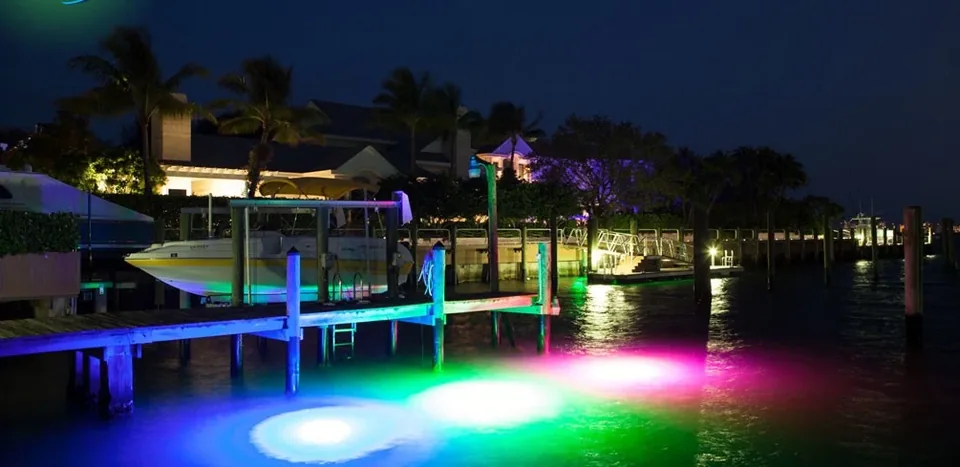
A NightScapes dock on a canal. The color shown is laid over the photograph to illustrate each choice; the real water was lit in several colors when this was taken.
Placement
Depth, tide and where the fixture sits
An underwater fixture has to stay submerged at the lowest tide and still show at the highest. It sits off the dock far enough to light open water and clear of the bottom so silt does not bury it. Pilings, the seawall and the boat lift decide where it can be fixed. Move the tide and the fixture below to see why.
Drawing: a dock in section, not to scale. No depth is given because the right one is found on site, with a fixture on a line.
At low tideUnder water
At high tideStill shows
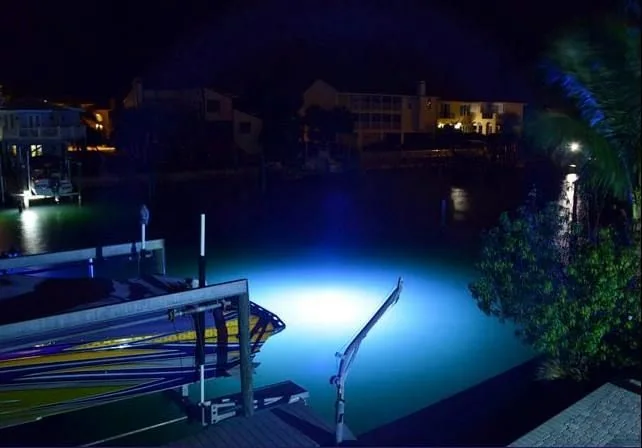
Under at low tide, clear of the bottom. The pool spreads and softens, it lights open water off the end of the dock, and it stays clear of the lift.
Low water decides the depth
The tide in a Naples canal is modest, but it is enough to matter. A fixture placed at a comfortable depth on a high tide can be at the surface, or out of it, on a low one. Out of the water it overheats and lights the underside of the dock. So the position is found at low water, and the question is how the same fixture will look when there is more water over it.
Too shallow, too deep
Near the surface the light is bright and the pool is small, and the fixture is where barnacles grow fastest. Deeper, the pool spreads and softens, and less of the light reaches your eye. Close to the bottom, it lights the sand and stirs up nothing, until silt settles on the lens. There is no single right depth to quote; sources that give one disagree with each other, and the right answer for your dock is found with a fixture on a line.
What it can be fixed to
Pilings, the seawall and the dock frame are the mounting points, and the boat lift is the thing to stay clear of. A fixture has to be held against current and against a hull or a line that brushes it, and it has to come up again for cleaning. Where the boat lives matters as much as where the light looks best.
The water itself
Water varies from dock to dock. Open bay water can sit over clear water and pale sand. A dock at the head of a long canal sits over darker, stiller water with more in it. Both change after a summer storm, when runoff clouds everything for days. The same fixture gives three different results in three different canals, which is why it is tried in yours.
Makers of underwater lights describe a chain: light draws tiny organisms, those draw baitfish, and baitfish draw larger fish such as snook. Many dock owners see exactly that. Nobody can promise it, because it depends on the canal, the season, the tide and how long the light has been running.
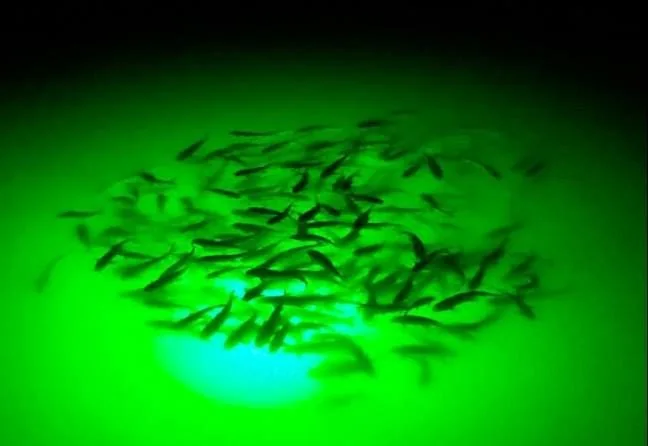
Baitfish gathered in green light under a NightScapes dock.
What owners report
The usual account is that it takes a few nights. The light runs, small life collects in
it, and then the schools arrive. After that it becomes a thing people walk down to the
dock to watch after dinner. The photograph beside this paragraph was taken under a dock
we lit.
What nobody can promise
Some canals are busy with fish and some are not, and a light does not change that. Water
temperature, salinity after rain, the time of year and the state of the tide all move
fish around. We will light the water properly. What comes to look at it is up to the
canal.
Color and fish
Sellers generally say green draws the most life. A published snook guide has said he
prefers amber or white on a dock. Both can be right in different water. If fishing is
the reason you want the light, say so, and we will set it up so the color can be
changed: see choosing color and level zone by
zone.
Materials
Salt water, electrolysis and what the fixture is made of
The waterline is the harshest place on a property. Below it, salt water attacks coated metals, wicks along copper through a poor connection, and eats one of any two different metals left touching. So the fixture, its bracket and its fasteners are matched, connections are made above the water and sealed, and cable is secured.
Everything under this dock lives in salt water: fixture, bracket, fasteners and cable.
The housing and the lens
Salt water attacks any metal that relies on a coating, from the first scratch. An
underwater fixture for a tidal canal has a body in a metal chosen for immersion, and a
lens sealed against pressure as well as splash. The thing to watch for is a fixture made
for a pond: fresh water and a tidal canal are different jobs.
Cable and connections
Water wicks along copper, and one poor connection lets salt into the whole cable. So
connections are made above the water, sealed, and kept where they can be reached. Cable
is secured along the pilings, not left loose under a dock, where current, debris and a
boat can find it.
Below the waterline, two different metals touching is a slow fire.
Electrolysis and mixed metals
Two different metals touching in salt water form a cell, and one of them is eaten. The
fixture, its bracket and its fasteners are matched, and kept clear of the lift and the
boat. The classic mistake is a stainless screw in a bronze bracket. It looks fine for a
season.
Upkeep
Marine growth and keeping the light bright
Anything left still in salt water grows a coat. Barnacles and algae settle on a lens and the light dims month by month, fastest in the warm season. Suppliers note that cool-running LED fixtures foul sooner than older hot lamps did, so cleaning is part of owning one. It is quick when the fixture can be reached.
BarnaclesThey settle on anything still. A lens left alone through a summer is crusted by fall.
Algae and slimeGrows fastest on a lit lens in warm water. It wipes off if it is caught early.
A routineLenses wiped on a schedule, more often in the warm months.
ReachFixtures placed so they can be brought up or reached from the dock at low tide.
Summer awayA plan for the months the house is empty: left running, or switched off and cleaned on return.
After a stormBrackets, cable and aim checked before the lights are run again.
A clean lens is most of the brightness.
Cleaned
On the water
Glare, neighbors and boats on the water
Water carries light a long way, so an underwater fixture is aimed to keep its glow in the water beside your own dock. Light that breaks the surface crosses the canal as glare, and a bright pool in the channel takes away a boater's night vision. Beachfront lots are a separate subject with their own rules.
Across open water every light on the far side is seen. A dock glow should stop well short of it.Seen from the water: color in front of the property, darkness in the channel.Illustration. A Gulf-front lot follows separate rules about light seen from the sand.
Light the water, not the far bank
An underwater fixture is aimed down or outward along the dock, so its light stays in the water column. Aimed up and out, it breaks the surface and travels across the canal as glare. The glow should stop well short of the opposite seawall.
Keep it out of the channel
Someone running a boat down the canal at night needs their night vision. A bright pool of light across the channel takes it away. The lit water belongs under and beside your own dock, and the middle of the canal stays dark.
Beachfront is a different subject
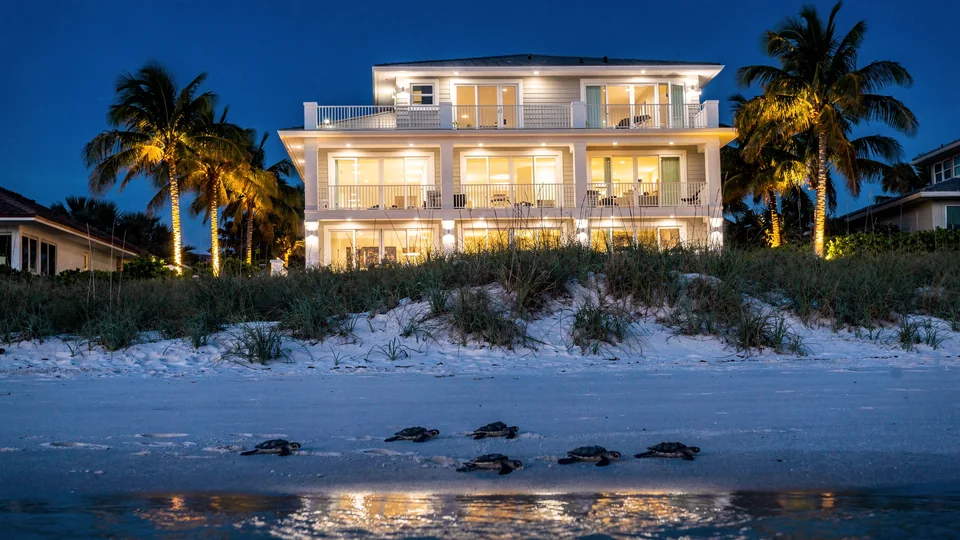
On a Gulf-front lot the rules about light near the beach apply, and they are strict about color, shielding and what may be seen from the sand. That is not a dock question and it has its own page: shielded, long-wavelength light for beachfront lots.
Who does the work
Who lights the water: NightScapes Landscape Lighting, Naples
NightScapes Landscape Lighting has lit docks and waterfront properties in Naples since 1998. Todd and Sherry own and run it, outdoor lighting is the only work it does, and its Google Business Profile shows 63 reviews at 5.0. Underwater lights are set at low tide with a fixture on a line, and judged from the lanai.
The docks and the baitfish on this page are NightScapes jobs. We light docks and
waterfront across Naples, Marco Island and Bonita Springs, and through Lee and Collier
counties.
The same people who set the lights come back to clean them, which on salt water is most
of what keeps a dock light worth having.
They were especially impressed with the dock lights and underwater lights that Todd put in. You could see all of the fish!!!
Lighting properties in Naples and Southwest Florida.
Todd and Sherry
Family and locally owned. The owners are the people you deal with.
63 Google reviews
Rated 5.0 on the NightScapes Google Business Profile.
Lee and Collier counties
Naples, Marco Island, Bonita Springs, Fort Myers, Sanibel and Captiva.
Questions we hear
Questions about underwater dock lights
Which color, why green, whether fishing lights work, how many are needed, whether a permit is required, whether they have to be cleaned, how long they last near the coast and whether you can swim with them on. These are the questions dock owners ask, answered without the promises the catalogs make.
NightScapes Landscape LightingOutdoor lighting only, Naples since 1998
Ask us about your dock. Choose a question, or call and we will answer it on the phone.
What is the best color for underwater dock lights?
It depends on the water and on what you want. Green is the most common and makers say it carries furthest in canal water. White shows true color and suits clear water. Blue looks dramatic from the house. Amber is quiet and is preferred by some anglers. We would rather show you two colors in your own water than tell you which is best.
Why are underwater lights green?
Largely because green has become the standard for docks. Makers say green light travels further than other colors through the greenish, particle-filled water of a canal, and that it draws the small organisms baitfish feed on. That explanation comes from the people who sell the lights; we have not found an independent source that settles it, and some anglers prefer amber or white.
Do underwater fishing lights work?
Many owners find that bait gathers in the light and larger fish follow it, and one of our own customers wrote that guests could see all of the fish under his dock. It is not something anyone can promise. It depends on the canal, the season, the tide and how long the light has been running.
How many underwater lights do I need?
Often one or two. A single fixture lights a surprising amount of water, and a second is added where the dock is long or where there is a lift or a corner worth lighting separately. More than that usually means more glare across the canal, not a better result.
Do I need a permit, and are underwater lights allowed on my canal?
That is a question for your city or county and, in some communities, the association. Rules for docks and waterways vary and we do not publish them. Ask before you install, and tell us what you are told. Gulf-front and beach-adjacent property has its own lighting rules, covered on our coastal lighting page.
Will I need to clean the lights?
Yes. Barnacles and algae settle on a lens in salt water, and a light that is not cleaned gets dimmer every month. How often depends on the season and the canal. It is quick if the fixture can be reached, which is why reach is decided at install.
How long do underwater dock lights last near the coast?
We do not quote a life, because it depends far more on the water, the materials and the cleaning than on a figure in a catalog. A fixture built for salt water, with sealed connections and a clean lens, lasts. One that is not is the first thing on a waterfront property to fail.
Can you swim with the lights on?
That is a question for the maker of the specific fixture, and you should follow their instructions for it. We install low-voltage systems as their makers direct. If swimming off the dock is part of how you use it, tell us at the start, because it affects what we recommend and where it goes.
Tell us where the dock is, how deep the water is at low tide if you know, and whether there is a lift. We look at your dock and water with you and talk through the colors before anything is fixed.