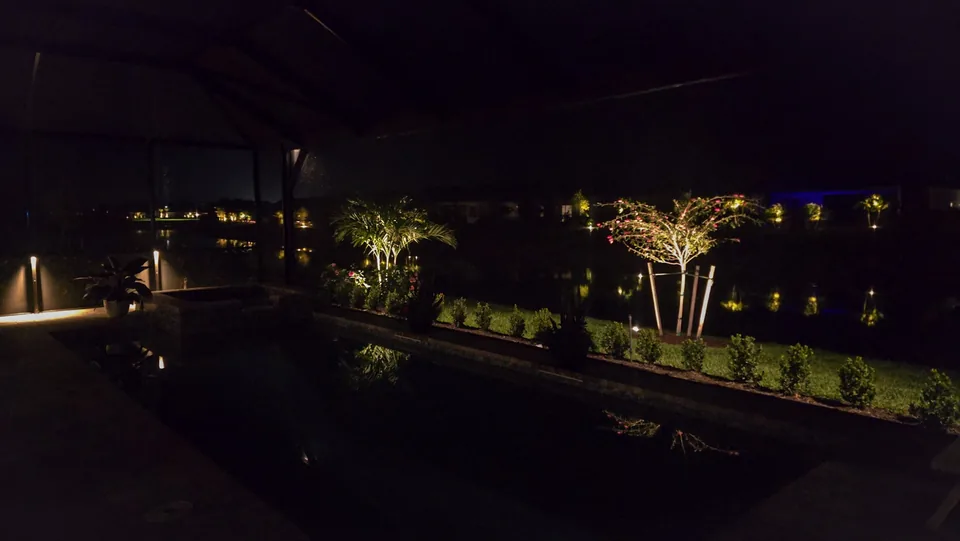
Pool deck and lanai lighting for Naples screen enclosures
At night a screen cage is a mirror. Light the inside and all you see is your own fixtures in the mesh. Light what is beyond it, keep the deck low, and the screen disappears.
Why you see your own lights in the lanai screen at night
If you sit on the lanai after dark and all you can see in the screen is your own lights, the inside is brighter than the outside. Lit mesh glows and glass reflects, and both hide whatever is darker behind them. Turn the deck down, light the planting beyond the cage a little brighter, and you see through it again.
As taken
See throughMirror
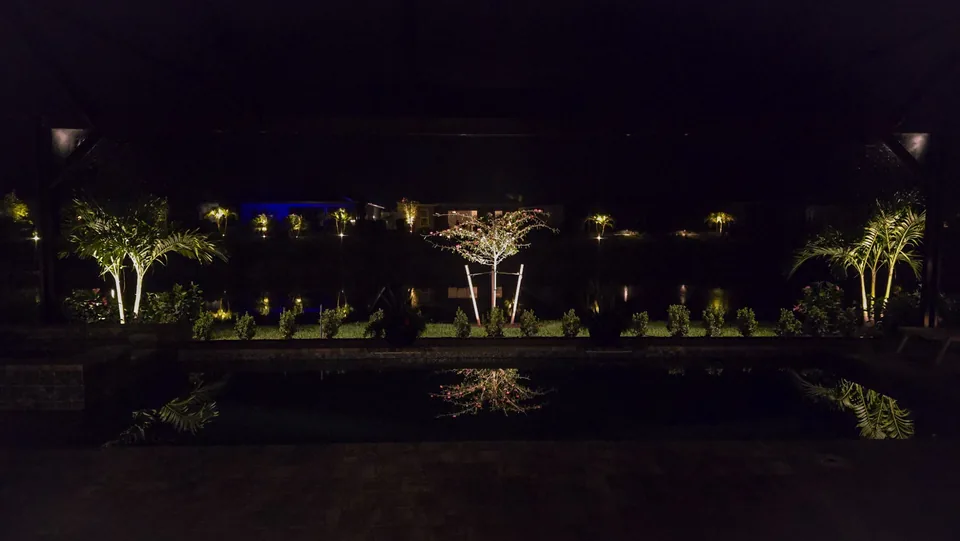
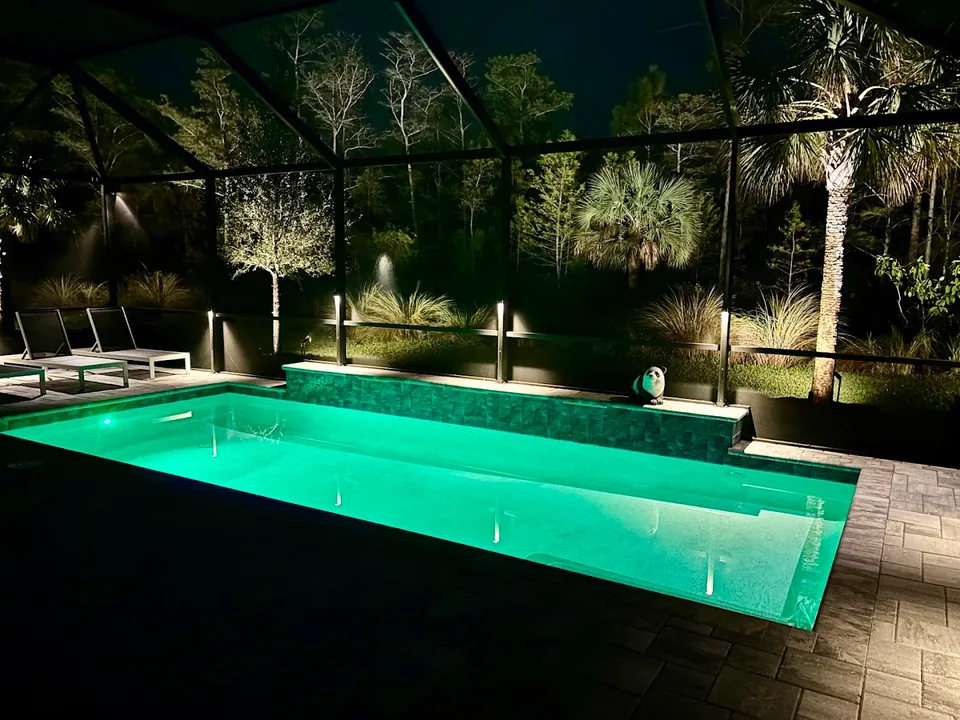
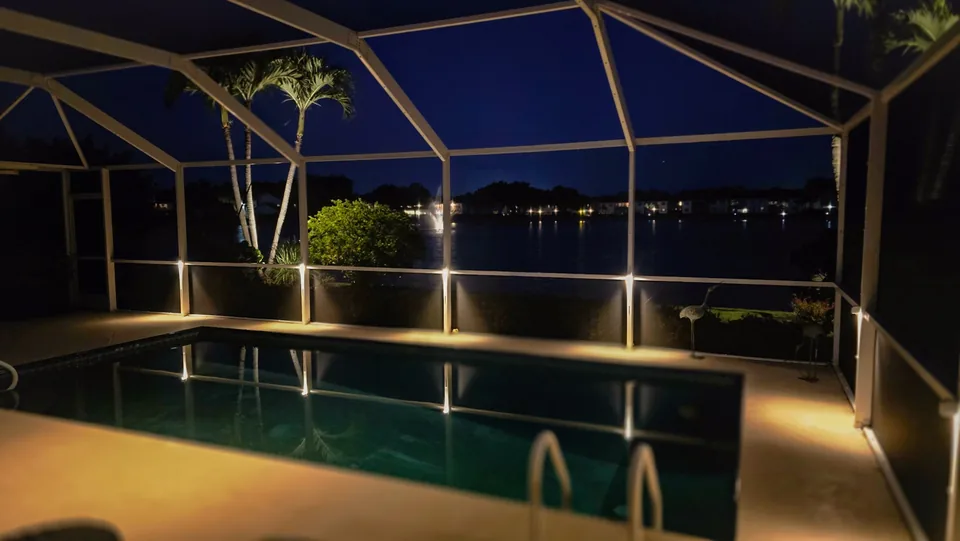
You see through the screen. The planting beyond the cage is the brightest thing in view, so the eye goes straight through the mesh to it. The few lights inside are low and shielded, and none of them shows in the screen.
A NightScapes lanai, photographed from inside the cage. The haze and reflections are a simulation drawn over the photo to show the effect; the photo itself is as taken.
A pool cage is fine mesh, and fine mesh behaves like a sheer curtain. In daylight you look straight through it, because the garden outside is far brighter than the lanai. At night the balance flips. The lanai is lit, the yard is black, and the lit mesh throws the room back at you. The sliders do the same from inside the house.
It is why adding light to a lanai so often makes it worse. More fixtures inside the cage mean more reflections and a darker-looking yard. The fix runs the other way: fewer, lower, shielded sources inside, and the real lighting outside, on the palms and planting that the screen is there to let you look at.
Nearly every pool home in Naples has this problem and most have never had it named. Once it is, the rest of the design follows from it. Ask about your lanai.
The cause
A lit interior and a dark exterior. Lit mesh and glass hide the darker side.
The fix
Low, shielded light inside the cage. Brighter light on what is beyond it.
The test
From a lounger, after dark, with the house lights on behind you.
Lanai lighting layout
Inside the cage or outside it: where each fixture belongs
Light outside the screen puts planting and shadow on the far side and keeps every source out of the room. Light inside controls the deck and the seating, but each fixture is now in view and in the mesh. Most enclosures use both, on separate zones, with more of it outside. Point at a number on this lanai.
Point at a numberTap a number
Planting lit outside the cage
This is the light that fixes the mirror. Trees and planting lit beyond the screen give the eye something brighter to look at on the far side, so the mesh goes transparent again. The sources are outside the room altogether, so none of them can glare.
Belongs
Outside. Uplights on palms and trees, a soft wash on the hedge or fence.
Level
A little brighter than the deck inside, which is what lets you see through.
The tall things at the edge
A palm or two lit beyond the corner of the cage sets the height of the view and stops the enclosure feeling like a box. Lit from outside, the trunk is seen through the screen and the crown above it.
Belongs
Outside, at the base of the palm, shielded from the lanai.
Level
The brightest thing in the view, so the eye goes out and up.
Low lights at the edge of the deck
Inside the cage, light is kept low and at the perimeter. Short shaded fixtures in the planter at the back of the deck light the surface and the planting at their feet, and at this height they sit below the sight line of someone in a chair.
Belongs
Inside, in the planters and beds at the edge, never in the middle.
Level
Low. Every source in here is in view, so each one is shielded.
The pool is its own light
A lit pool is the largest light source on the lanai, and its color sets the mood for everything around it. The deck lighting is balanced against it. With the pool on, most decks need less light than people expect.
Belongs
In the water, on its own switch or zone.
Level
Decides how bright the deck can be before the water goes dull.
The deck you walk on, barefoot and wet
The pavers need enough light to see the edge of the pool and any step, and no more. It comes from the low fixtures at the perimeter and from the glow of the water, not from anything overhead aimed down at a wet, reflective floor.
Belongs
Inside, borrowed from the edge lights and the pool.
Level
The lowest on the lanai. A wet deck doubles whatever lands on it.
Where you actually sit
Everything is judged from here. A fixture that looks perfect from the lawn can be a bare lamp from a lounger, and a reflection that is invisible standing up can sit right in the screen at seated height.
Belongs
Nothing aimed at it. Light reaches the seating by reflection.
Level
Enough to see a face and a glass, on a dimmer.
Pool light color
The pool surface is a second mirror
Still water doubles any fixture aimed near it, so deck levels are kept low enough that the pool stays dark and reflective between its own lights. The color the pool is showing changes what the deck needs: white water lights the deck by itself, blue gives it very little. Point at a color to see the difference.
Point at a colorTap a color
A white pool light
White water is the brightest setting and reads as clean and cool. It throws a lot of light up onto the deck and the cage, so the deck fixtures can be turned well down. Warm planting light beside white water looks its warmest.
The deck
Needs the least help. Edge lights at their lowest.
The planting
Warm white beyond the screen, as the contrast.
A blue pool light
Blue is the classic and the darkest of the common colors. The water glows but gives little usable light to the deck, so the perimeter fixtures do more of the work. Against blue, warm white on the planting separates cleanly.
The deck
Needs a little more from the edge lights.
The planting
Warm white. Blue on the plants as well turns the whole lanai cold.
A green or aqua pool light
Green and aqua are bright and tropical and reflect strongly off a pale deck and the underside of the cage. They are the colors most likely to show in the screen as a reflection, so the planting outside is lifted to compensate.
The deck
Turned down. Green water lights a pale deck by itself.
The planting
Lifted beyond the screen, so you still see out.
With the pool light off
Dark, still water is a perfect mirror. It reflects the lit palms and the sky, and the lanai feels larger. This is the setting for a quiet evening, and it only works if the deck lights are low enough not to show in the water.
The deck
At its very lowest, or the fixtures appear upside down in the pool.
The planting
Doing all the work, and seen twice.
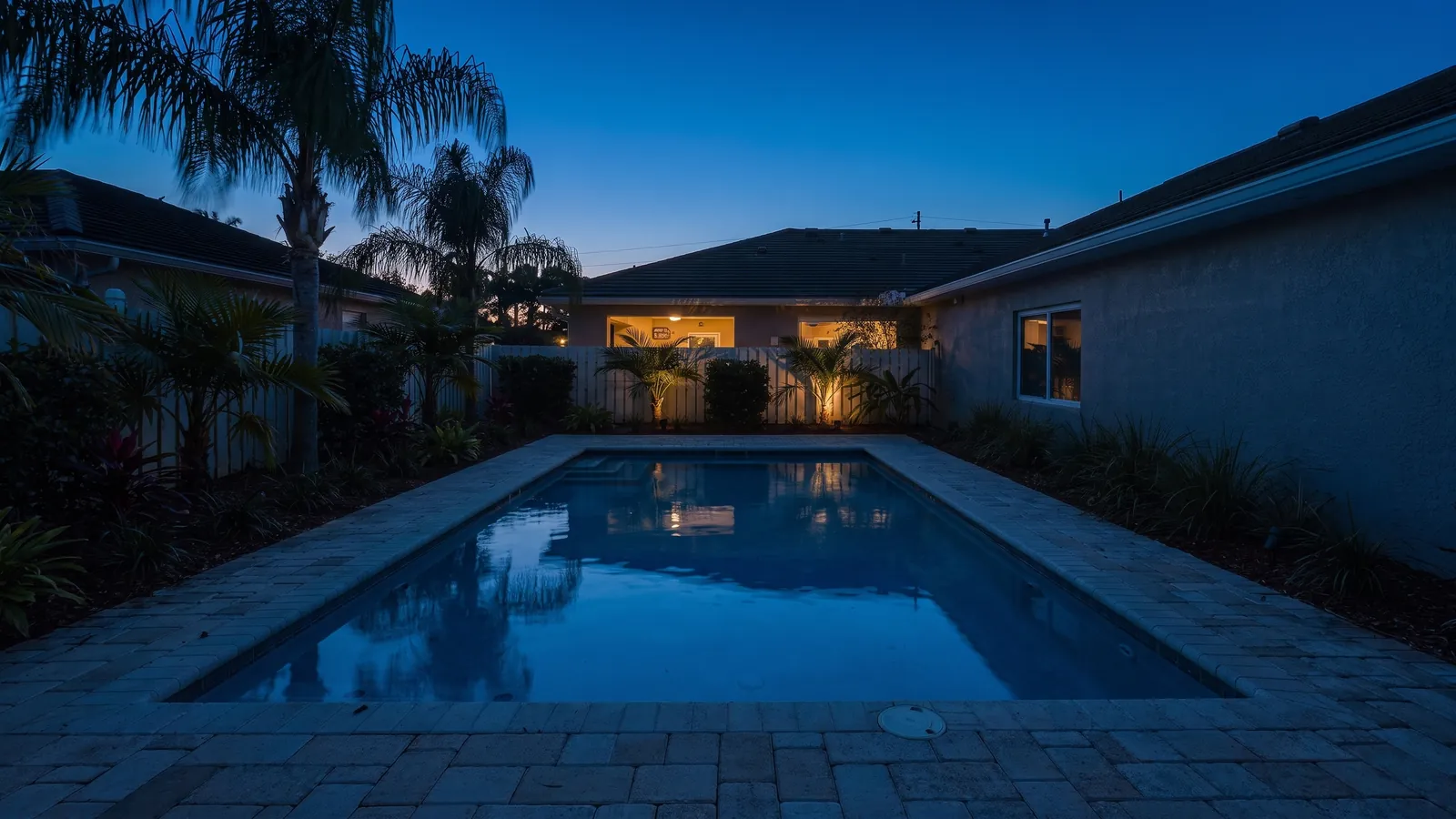
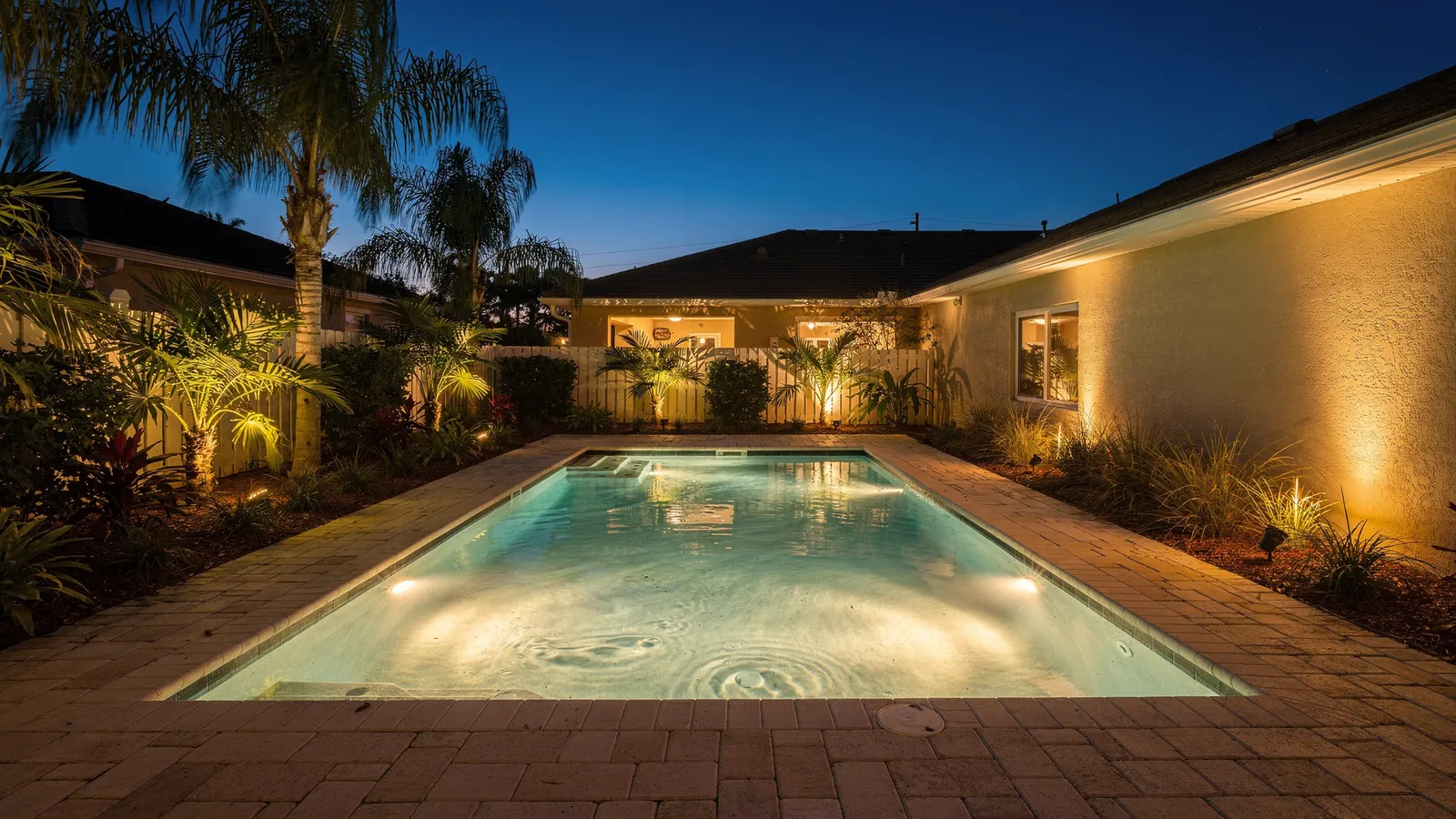
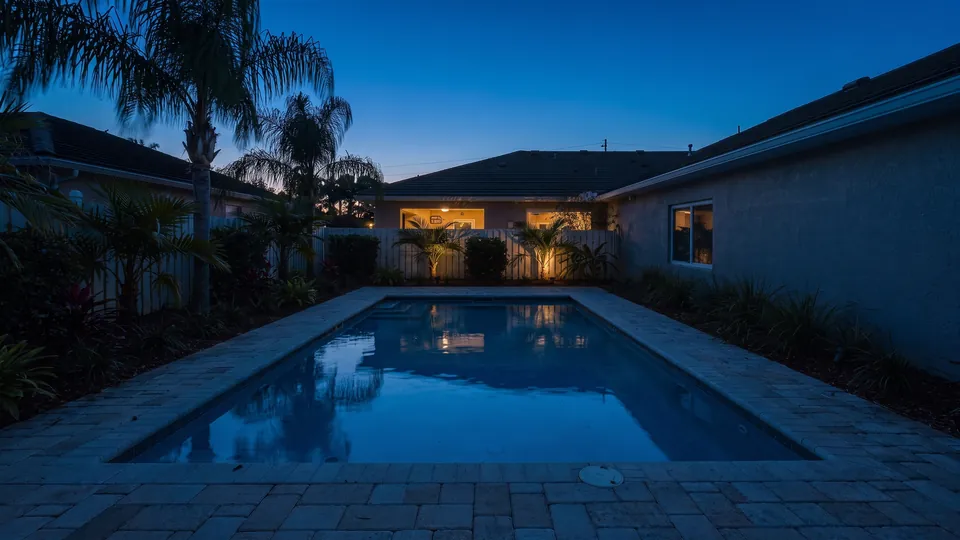
Illustration of a pool in a courtyard. The color shown is the pool's own light; the deck, wall and planting levels are what we set around it.
Sight lines
Checked from the chair, not from the lawn
A lanai is lived in sitting down, so that is where it is checked from: the loungers, the dining chairs, the sliders and the kitchen window. Shielding, mounting height and aim are settled from each seat. A light that looks right from the lawn can be the one in your eyes all evening. Try it on yours tonight.
0 of 7
It passes from the chair
Low inside, lit beyond, and nothing in your eye. Lanais that pass this usually just need a look at the fixtures themselves: what salt air and pool water have done to them.
Close: a few sources to move or shield
Most of it works. The lines you left unticked point at the fixtures to lower, shield or move outside the cage, or at a zone that wants its own control.
The screen is probably a mirror
The inside is out-lighting the yard. The usual fix is fewer, lower fixtures inside and the planting beyond the screen lit, set from your own chairs. Ask about your lanai.
This is how we design a lanai: seated, with every source looked for in your eye, in the screen and in the water.
Footing
Steps, edges and the wet deck
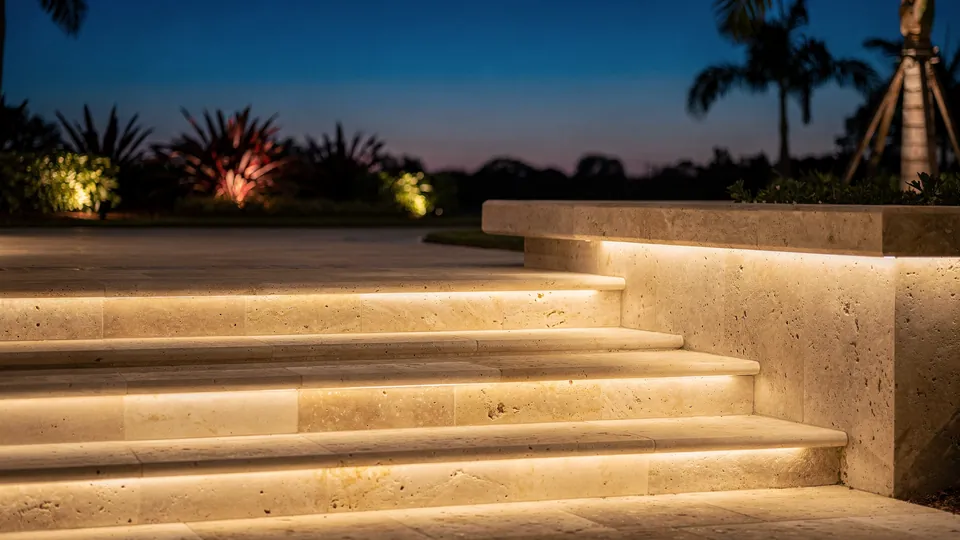
A pool deck is walked barefoot and wet, so footing comes before effect. The places that need to be read are the pool edge and sun shelf, the steps of a raised spa, and the threshold at the sliders. Each is lit on the surface, from low down, and never by a light in the eye. Point at each.
The pool edge and the sun shelf
Point here to see how it is lit
The risk
The coping, and the shallow shelf just inside it, which is hard to see at night.
Lit from
The glow of the water itself, with the deck kept dim enough that the edge reads against it.
Watch for
A bright deck beside dark water. Then the edge is the one thing you cannot see.
A raised spa and its steps
Point here to see how it is lit
The risk
Two or three wet steps, climbed barefoot, often with a drink in one hand.
Lit from
Under each tread or from the wall beside it, so every edge is a line.
Watch for
Light aimed across the spa at eye level for the people sitting in it.
The threshold and the wet deck
Point here to see how it is lit
The risk
The step down from the sliders, and a deck that is glossy when wet.
Lit from
A low wash at the door and shielded lights at the perimeter.
Watch for
Any downlight over a wet surface. It reflects straight back up.
Beside the pool
Salt air, pool chemistry and what survives beside a pool
A fixture on a Naples lanai sits in salt air and within reach of pool water, splash and the chemistry used to clean the deck. Thin, coated housings pit and flake. Solid brass and copper darken and carry on. Connections matter as much as the fixture, because that is where moisture gets in first.
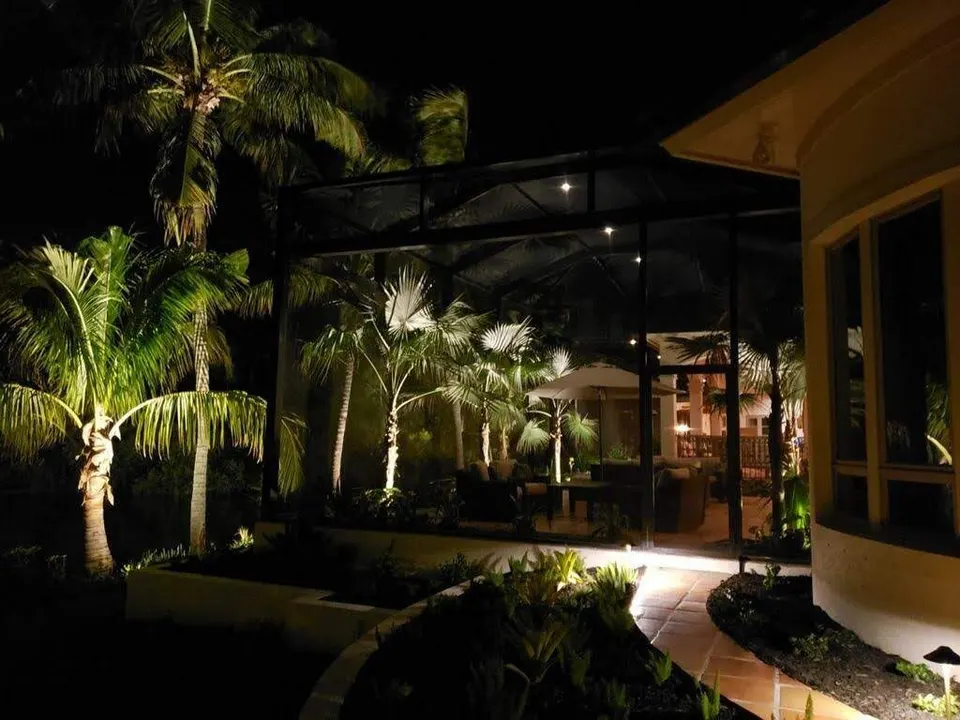
Palms lit beside a pool. Everything in this picture lives in salt air.
Why thin housings pit
A coated fixture is protected by its coating. Beside a pool that coating is rinsed with
chlorinated or salt-system water, baked dry in the sun and rinsed again. When it lifts
at an edge the metal underneath starts to pit, and the staining runs onto the pavers.
Solid brass and copper have no coating to lose. They go dark and stay sound.
Where splash and cleaning reach
The first few feet from the water get splashed every time the pool is used. The whole
deck gets pressure washed, and the acid used on pavers and tile is hard on metal and on
lenses. Where the layout allows, fixtures sit in planters and beds beyond the splash
line and above the level a hose reaches. Where a fixture has to be on the deck, it is
one built to be rinsed.
On a lanai, the connection behind the fixture fails before the fixture does.
Connections and the cage itself
Salt and moisture travel along copper. A connection that is only twisted and taped
wicks water into the cable and the fixtures beyond it dim or fail. Every connection is
sealed. The cage matters too: when a screen is replaced or a frame repaired, cable at
the perimeter gets disturbed, and it is worth having the lighting looked at afterward.
Zones: deck, water and planting on separate control
The deck, the water and the planting want different levels and different hours, so each is its own zone. The deck is lowest and changes through the evening. The pool is on or off, in whatever color. The planting beyond the screen runs latest, because it is also the view from inside the house.
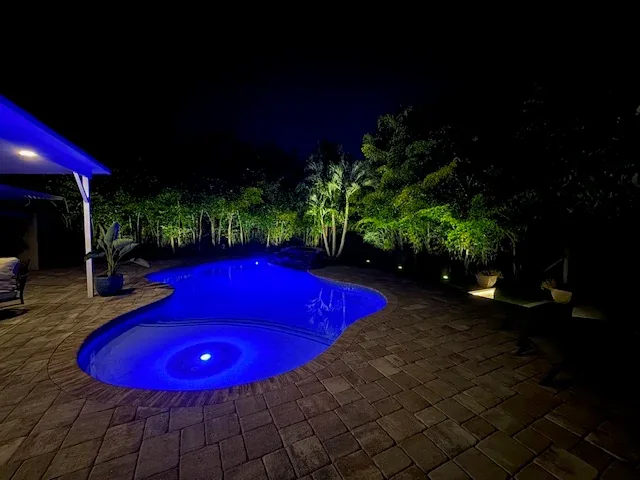
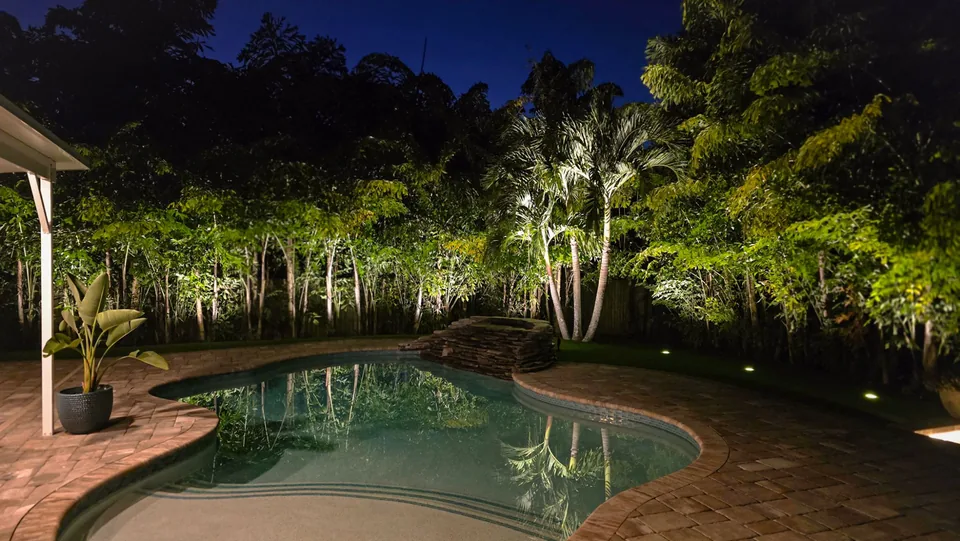
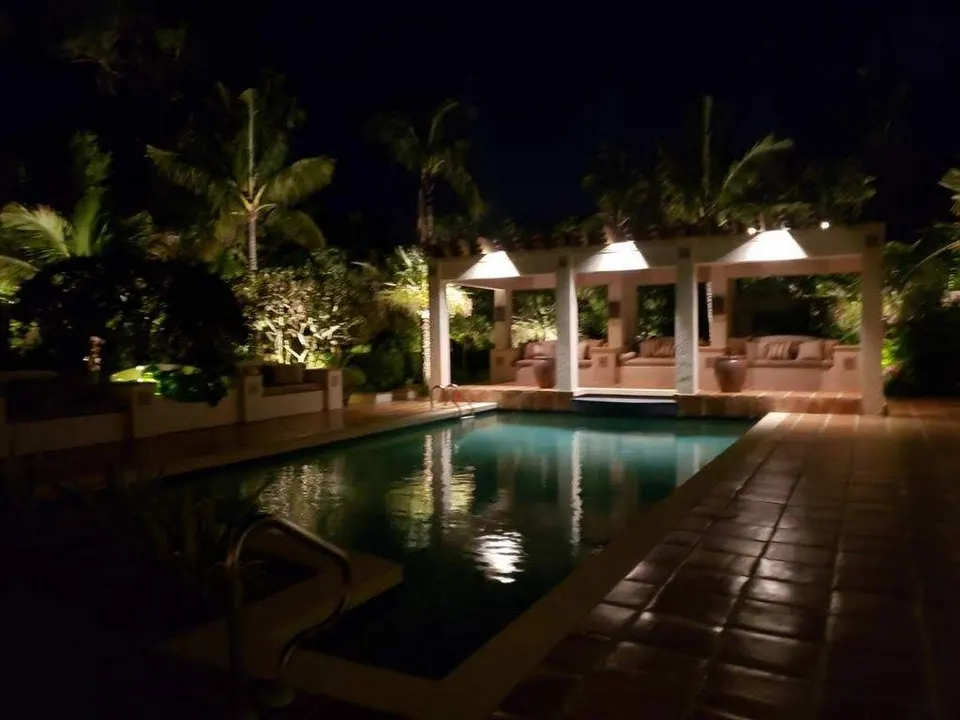
A pool deck lit low, so the water and the pavilion carry the scene.The pool on its own switch: blue here, and the planting stays warm.Planting lit outside the cage, seen through the screen.
The deck
The lowest level on the lanai, and the one that changes most through an evening: up a little when people are arriving and carrying things, down once everyone is seated. It wants its own dimmable zone for that reason.
The water
The pool light, and any color it has, is switched separately from everything else. Some evenings the pool is the centerpiece. Others it is off, and the dark water is the mirror. Neither should mean changing the deck or the planting.
The planting beyond the screen
The last zone on and the last one off. It is what you see through the cage, it is the light that stops the screen acting as a mirror, and it usually runs later than the deck because it is also the view from inside the house.
Who does the work
Who lights the lanai: NightScapes Landscape Lighting, Naples
NightScapes Landscape Lighting has lit pool decks and lanais in Naples since 1998. Todd and Sherry own and run it, outdoor lighting is the only work it does, and its Google Business Profile shows 63 reviews at 5.0. A lanai is designed from the loungers, with the pool light in mind.
The lanais and pools on this page are NightScapes jobs: a cage on a lake, a courtyard
pool lit green, a freeform pool lit blue. We light pool homes across Naples, Marco
Island and Bonita Springs, and through Lee and Collier counties.
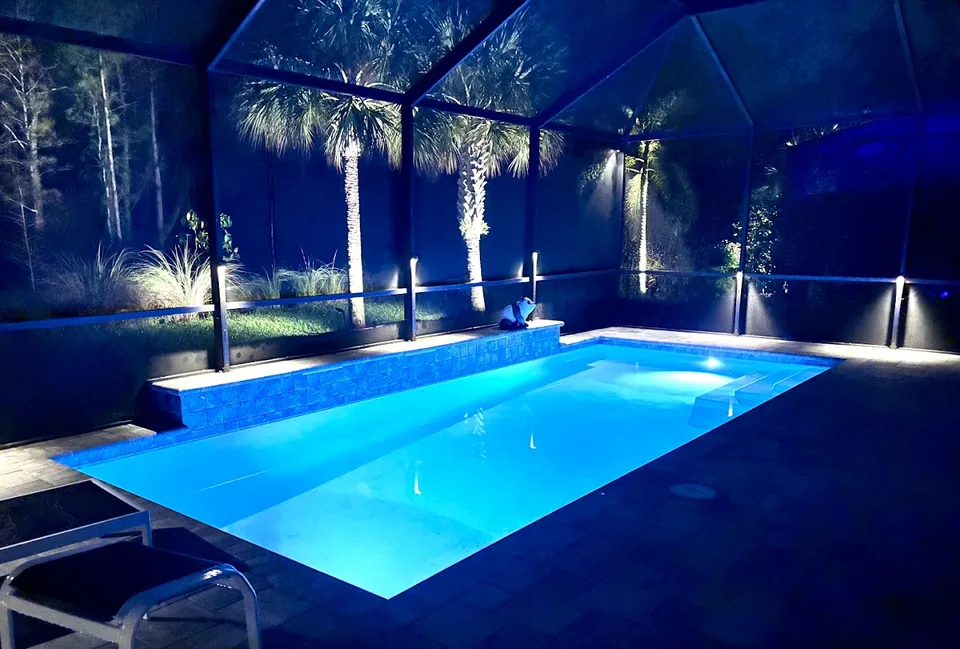
Two NightScapes lanais: low light inside the cage, and the view beyond it lit.
Since 1998
Lighting properties in Naples and Southwest Florida.
Todd and Sherry
Family and locally owned. The owners are the people you deal with.
63 Google reviews
Rated 5.0 on the NightScapes Google Business Profile.
Outdoor lighting only
No side trades, this is the whole business.
Questions we hear
Questions Naples homeowners ask about lanai lighting
What kind of light suits a lanai, what survives the coastal climate, whether lighting can be added to a finished cage, whether an existing transformer will do, what color to use, whether it will glare and what a hurricane does to it. These are the questions people ask about a pool enclosure, with our answers.
NightScapes Landscape LightingOutdoor lighting only, Naples since 1998
Ask us about your lanai. Choose a question, or call and we will answer it on the phone.
What type of light is best for a lanai?
Low, warm, shielded light at the edges, and most of the lighting outside the screen. Inside the cage every fixture is in view and reflects in the mesh, so there are few of them and each sits below seated eye level. The planting beyond the screen is lit a little brighter, which is what lets you see through the mesh.
What lighting works best for the coastal climate in Naples?
Fixtures built from metals that tolerate salt, with sealed connections. Solid brass and copper darken and carry on where painted and plated finishes pit. Beside a pool there is splash and cleaning chemistry as well as salt air, so fixtures are kept out of the splash line where the layout allows.
Can the lighting be added after the lanai has been completed?
Yes. Most of it goes in the planters, the beds and the landscape outside the cage, which can be reached at any time. Cable crosses a paver deck at a joint or along an edge. If the deck or the cage is about to be built or redone, it is easier to plan the runs before the pavers go down.
I already have a transformer for my landscape lighting. Can it be used?
Often, if it has capacity left and the lanai can be reached from it without overloading a run. We check both. A lanai is also a good candidate for its own zones, so the deck, the water and the planting can be set separately, and that can affect the answer.
What color of light is best for a pool enclosure?
Warm white for the deck and the planting, in almost every case. It is comfortable to sit in and it sets off whatever color the pool is showing. Colored light on the planting as well as in the water tends to turn the whole lanai one flat hue. Warm, low and shielded is also the usual approach where insects are a concern.
Will the lighting cause glare?
It should not, and inside a screen cage it is the main thing to get right. Glare on a lanai comes from sources at seated eye level, from reflections in the mesh and from light on a wet deck. Each is designed out by keeping fixtures low, shielding them, and checking the result from the chairs.
How does the lighting hold up in a hurricane?
Low fixtures in beds and planters are out of the wind and usually come through. What does the damage is debris, flooding and anything that falls on them, and a cage that is rescreened or rebuilt can disturb cable at its edges. After a named storm we check the system before it is run. See our storm damage page.
Tell us about the lanai: the cage, the pool, where you sit and what is planted outside it. We come out, sit where you sit, and explain what changes when the light moves outside the screen.