Bonita Beach (shore)
The beach the city’s sea turtle lighting district is measured from. Light seen from any part of it counts.
Bonita Springs guide
Bonita Springs writes its own outdoor lighting rules. On the barrier island they reach homes that are not even on the sand, and they define night as sunset to sunrise. Inland, the questions are the Imperial River, Estero Bay and the clubhouse lot. This guide covers each, with the city's own words.
Tell us about the property
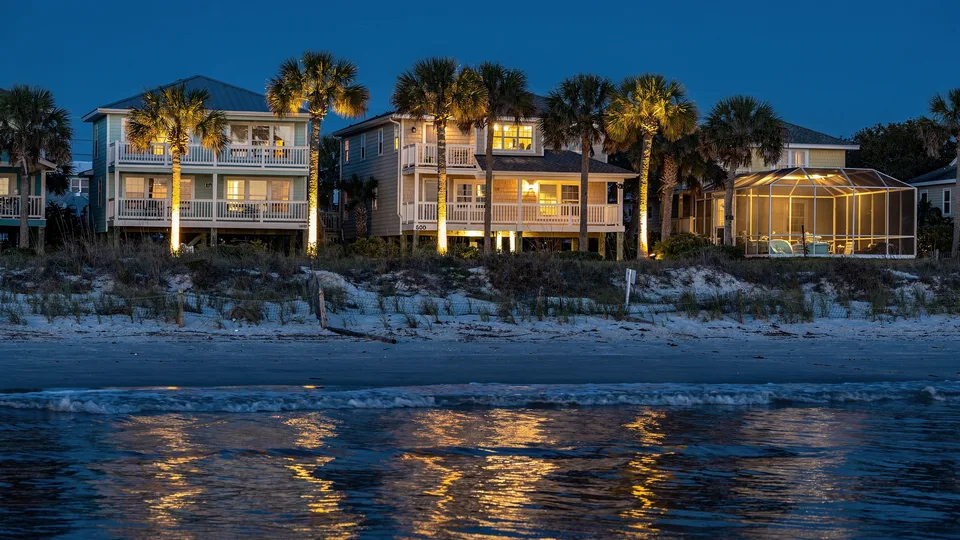
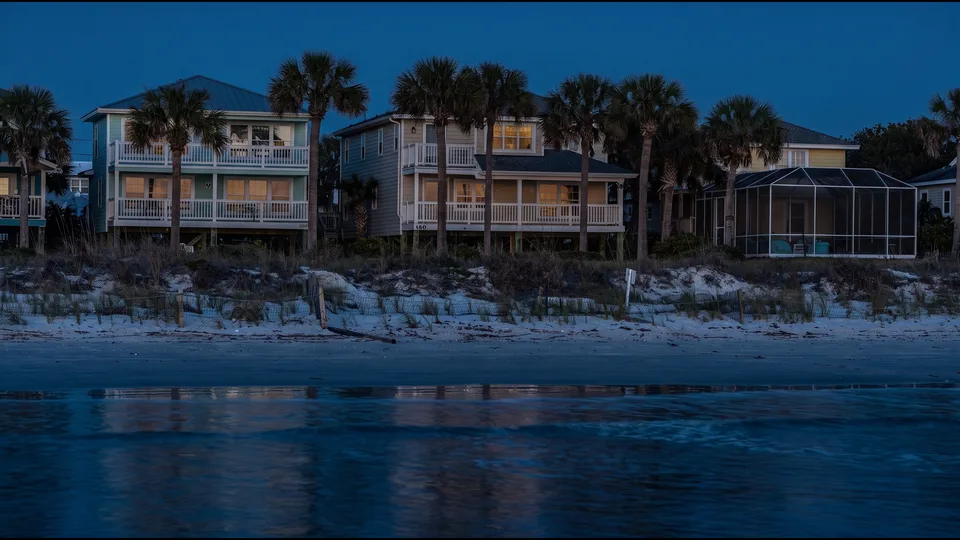
Illustration: beach-visible lighting at right, the same homes kept dark at left
If you live along Hickory Boulevard
In June 2023 Bonita Springs rewrote its sea turtle lighting rules. The code now sets up a sea turtle lighting district covering every property on the city's barrier islands whose light could be seen from any part of the beach, whether or not the lot is on the sand. If you live along Hickory Boulevard, the district is where any lighting plan starts.
The ordinance is No. 23-08, adopted June 21, 2023, and it replaced the city’s earlier turtle rules outright. Its reach is the part most owners do not expect: the district includes "all properties on the barrier islands within the City of Bonita Springs that may produce artificial light directly, indirectly, or cumulatively visible from any portion of the beach, regardless of whether those properties are beachfront properties." A second-row home whose palms glow over the roofline of the first row is in it.
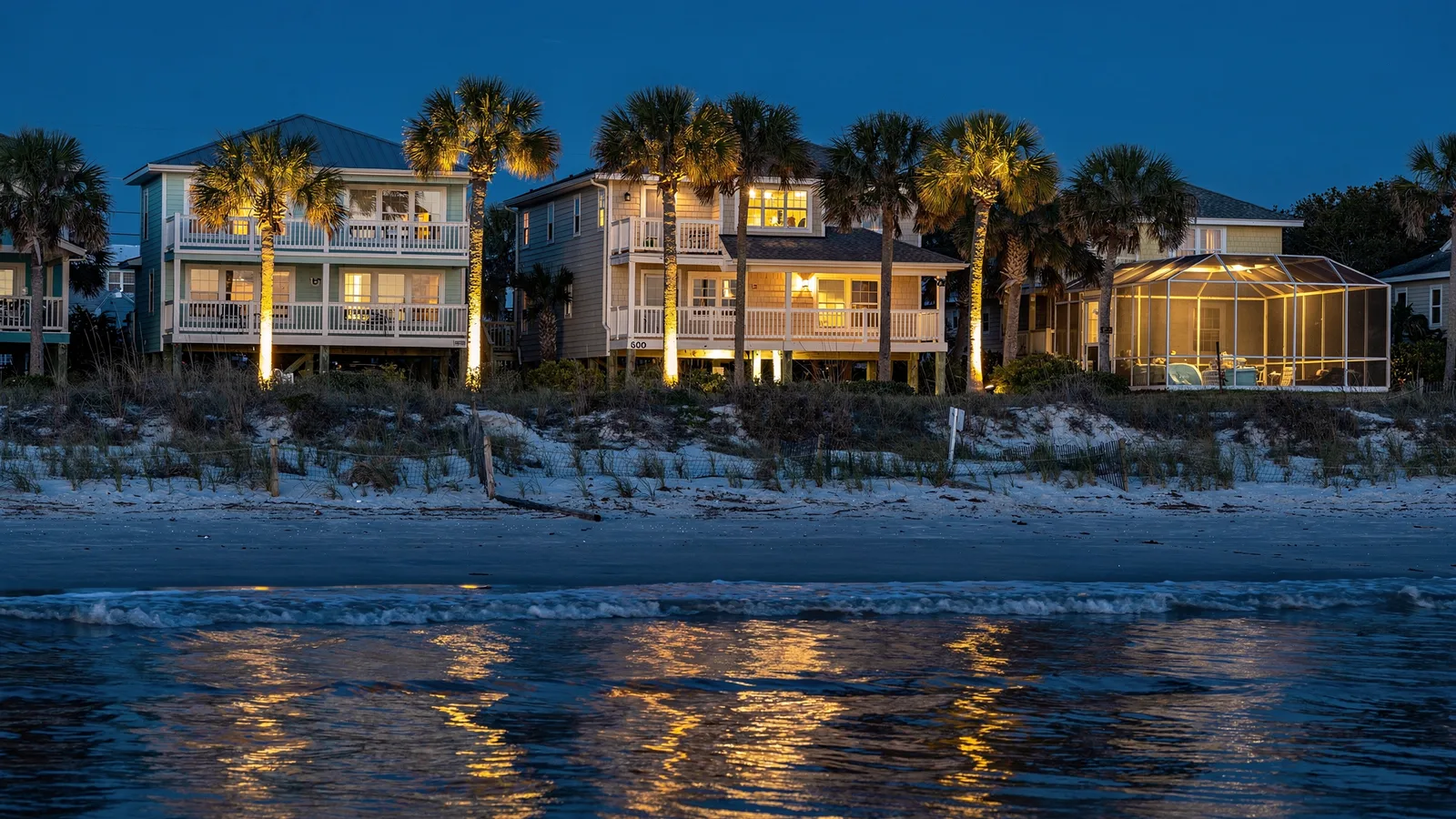
That is why the drawing at the top of this page shows a row of homes rather than one. Light does not have to come from a beachfront lot to reach the sand; a lit pool cage, a balcony and a few uplit palms across the road add up. The city’s word for it is "cumulatively".
This guide sets out what the city’s code says about each part of a property in that district, what changes inland along the Imperial River and Estero Bay, and the separate rule that covers commercial and community lighting. For how the fixtures themselves are chosen and shielded, see turtle-friendly coastal lighting.
Where it applies
Bonita Springs has two lighting stories. On the barrier island, along Hickory Boulevard, the sea turtle district governs anything the beach can see. On the mainland, the Imperial River and the edge of Estero Bay shape where equipment goes and how docks are lit. Each light on this map marks a place that matters to one of them.
The beach the city’s sea turtle lighting district is measured from. Light seen from any part of it counts.
An isolated county access off Hickory Boulevard, inside the barrier-island district.
The southern tip of Bonita Beach. Lee County closed its parking and amenities from September 8, 2026 for Hurricane Ian repairs.
Collier County’s preserve just south, with nesting and recorded disorientations. Same shoreline, different county.
On the western edge of Estero Bay Aquatic Preserve, Florida’s first. Mangrove islands in the bay are rookeries.
Its watershed saw historic flooding in 2017. Where transformers and timers sit matters here.
The river downtown, where the town once called "Survey" grew up along Surveyor’s Creek.
Points placed from nominatim.openstreetmap.org. Map data from Google.
Uplights and the beach
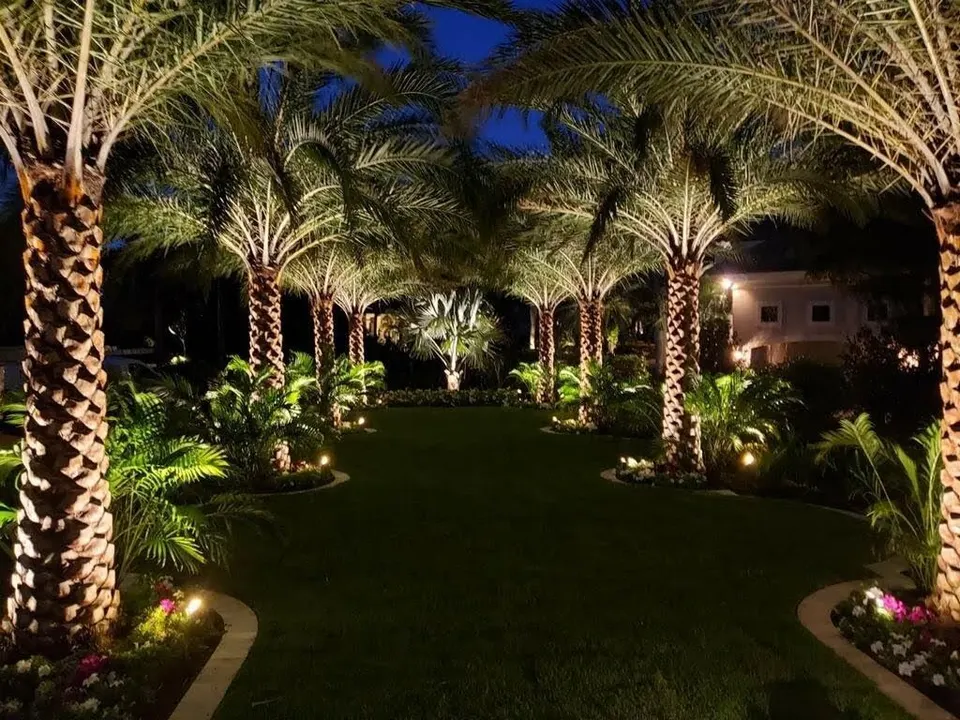
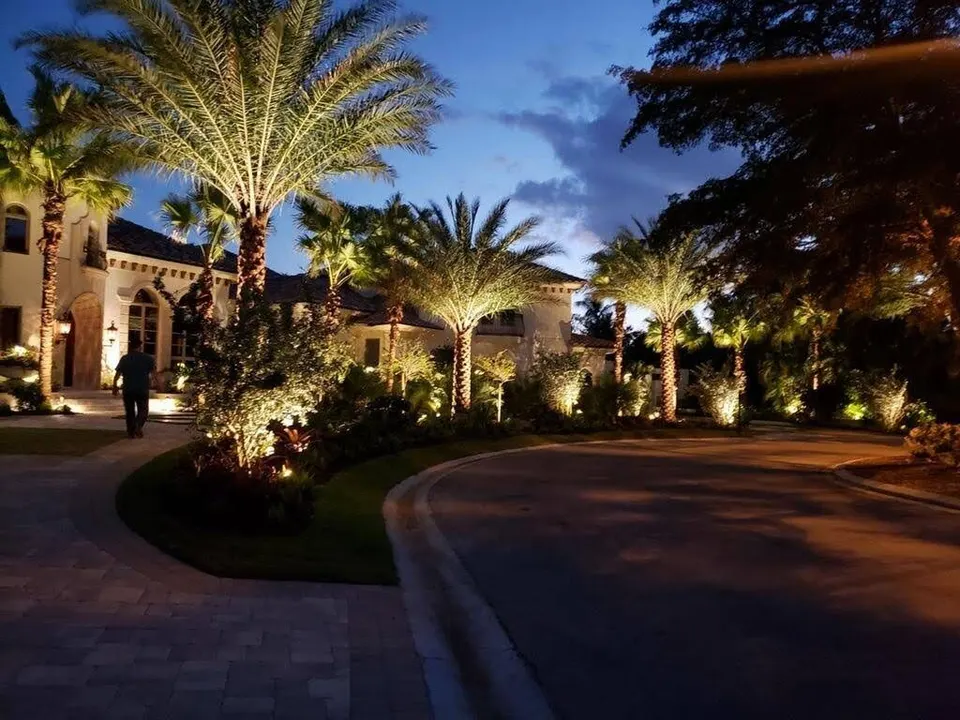
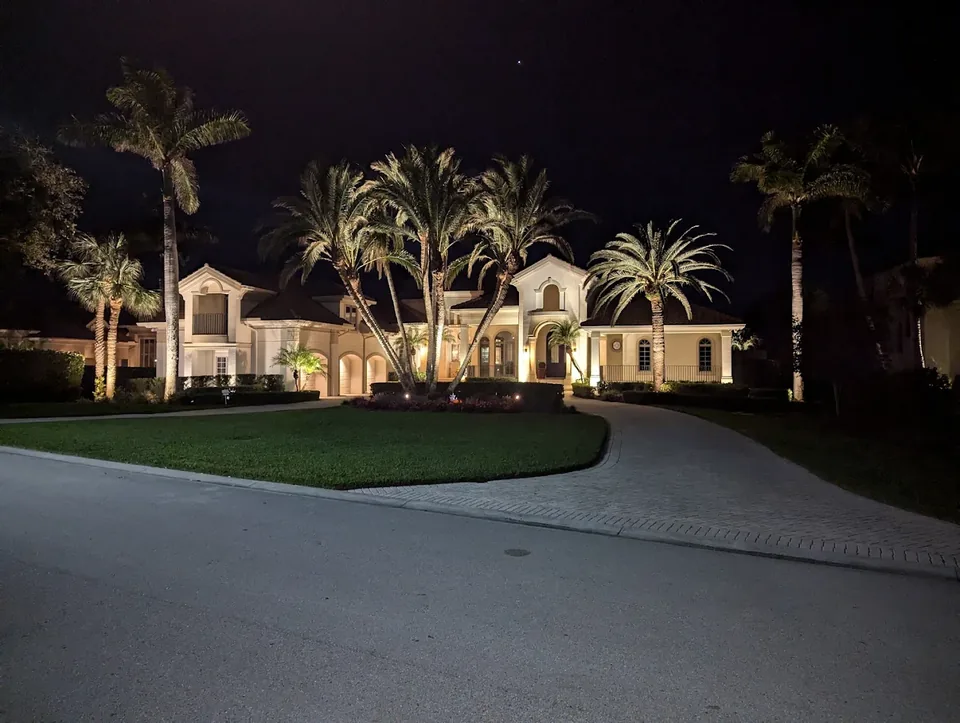
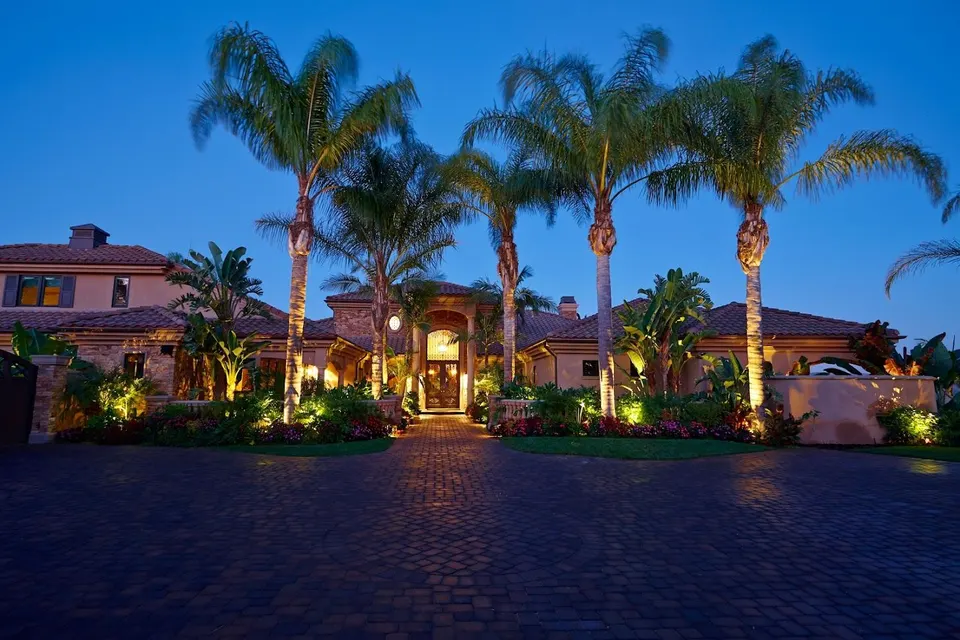
Bonita's code calls landscape lights and uplights non-egress lighting. On the barrier island they are allowed only on the landward side of buildings or other opaque structures, only with long wavelength sources, and only if they cannot be seen directly, indirectly or as a combined glow from anywhere on the beach. Anything that shows from the sand needs to be moved, shielded or removed.
The definition is specific. Non-egress lighting is "decorative lights (e.g. strobe lights, string lights, etc.), balcony lights, landscape lights, and uplights." The rule for it follows: "non-egress outdoor lighting may be installed landward of buildings or other opaque structures provided that they are fitted with long wavelength light sources and are not directly, indirectly, or cumulatively visible from any portion of the beach."
Bonita’s code defines it in its own words: "a lamp or light source emitting light wavelengths of 560 nanometers or greater and absent wavelengths below 560 nanometers." That is a lamp specification, not a color name, so a fixture is chosen by its published spectrum, not by whether it looks amber. A warm white garden lamp is not long wavelength.
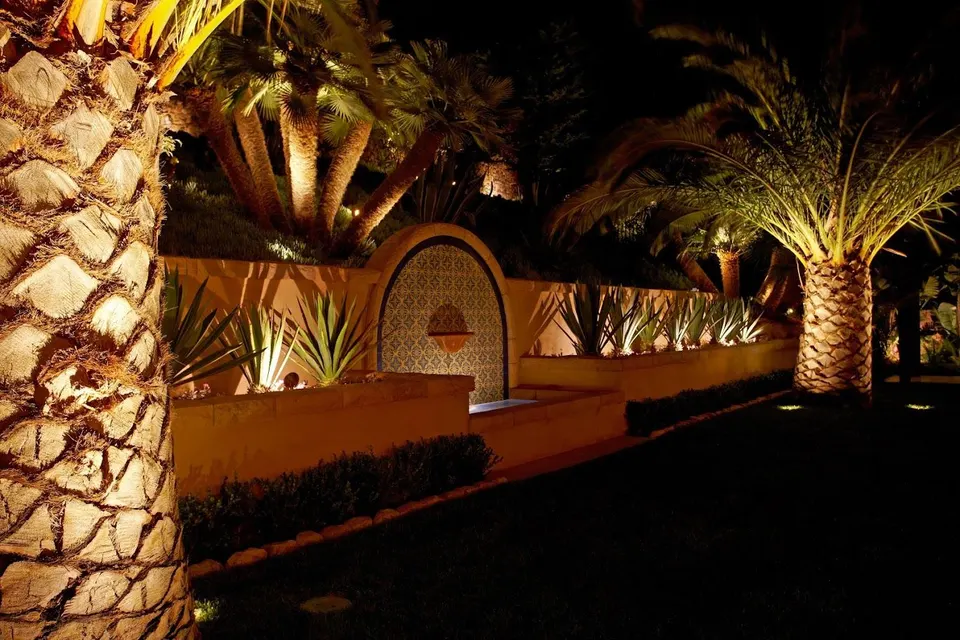
On the street side, behind the house, a garden can still be lit: low path lights within the code’s heights, plantings lit from long wavelength sources, a front entry. On the Gulf side and anywhere visible over the dune, the decorative layer goes. Most beach-island plans end up as two plans, one for the street and one for the sand, and the palms on the sand side are left to the moon. For the palms you keep, see palm uplighting.
Source: City of Bonita Springs LDC Ch. 7, Art. II, Div. 2, Sec. 7-41 and 7-46(c), Municode, read 2026-10-14.
Hours
Many Southwest Florida rules use 9 p.m. Bonita's code defines nighttime as sunset to sunrise during nesting season, which runs May 1 through October 31 and can be extended by the city. Lee County's hours for unincorporated areas and Collier County's 9 p.m. rule next door do not govern a Bonita Springs address. Point at each to compare.
 Illustration
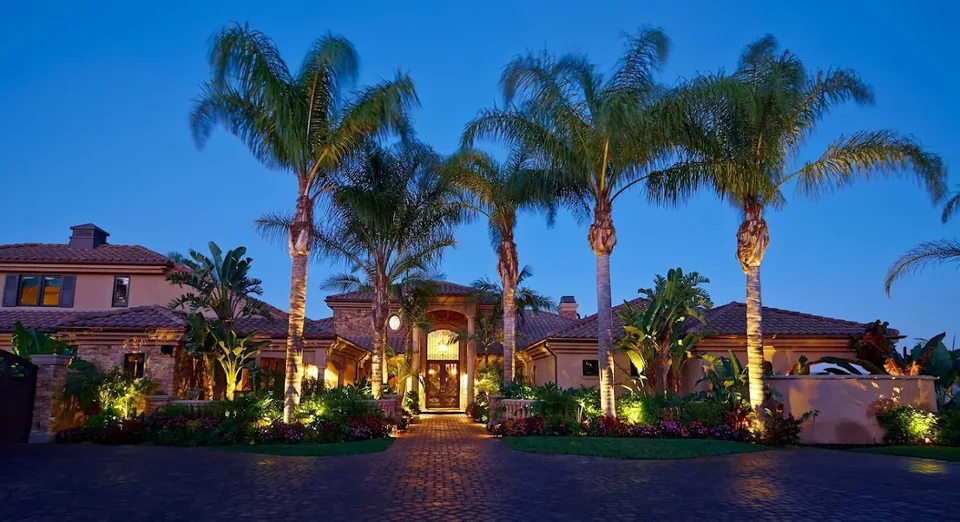
The lanai
For new construction in the district, Bonita requires seaward and shore-perpendicular glass with 45 percent or less light transmittance, underwater pool lights mounted horizontally in the wall and hidden from the beach, and fire tables shielded so the flame cannot be seen. Tiki-torch style fire posts are not allowed in nesting habitat during the season. Inspect the lanai below.
The code asks two things of underwater lights in the district: "Be mounted horizontally in the wall" and "Not produce light that is directly, indirectly, or cumulatively visible from any portion of the beach". Deck lighting around the pool is held to long wavelength and full shielding. The screen cage matters as much as the fixtures: a lit enclosure on the Gulf side reads from the beach as one large lamp.
New construction needs glass or film with an "inside to outside light transmittance value of 45 percent or less" on the seaward and shore-perpendicular sides. That is the builder’s job, but it changes the lighting plan: interior light leaks less, so exterior lighting does not need to compete with it.
"Bonfires, bonfire pits, and tiki torch like fire posts are prohibited within seaturtle nesting habitat during sea turtle nesting season." Gas fire tables on the seaward side must be shielded so the flame is not seen. A fire feature placed behind the house, inside the lanai’s solid walls, avoids the problem. See pool and lanai lighting for how the rest of the lanai is lit.
Source: Bonita Springs LDC Sec. 7-45(e), 7-46(f) and 7-48, Municode, read 2026-10-14.
Inspected after dark
Before a certificate of occupancy is issued for new construction in the district, Bonita Springs inspects the lighting after dark with every light turned on. For existing homes, the code lists fixes such as repositioning fixtures, 270-degree beachside shields and long wavelength lamps. A good plan is one that would pass that night inspection, not one that only looks right on paper.
The code puts it plainly: "lighting of new construction must be inspected by the city after dark and with all lighting turned on". The list to the right is what that inspection is reading, drawn from the city’s own sections. For an existing home, Sec. 7-50 sets out the fixes in order, starting with the cheapest: move the fixture, shield it, change the lamp. Our retrofit and redesign pages cover how that work is done.
Source: Bonita Springs LDC Sec. 7-41, 7-45, 7-46 and 7-50, Municode, read 2026-10-14.
Ask about a Bonita Springs planWhat the night inspection readsNightScapes Landscape Lighting
Every light on, seen from the sand.
Next door
Just south of Bonita Beach Park sits Barefoot Beach Preserve, a Collier County park on one of the last undeveloped barrier islands of the coast. Collier County's nesting table lists 300 nests and 34 entries under Disoriented for Barefoot in its latest season. Those are the neighboring county's numbers, but the beach is continuous, and so is the glow from shore.
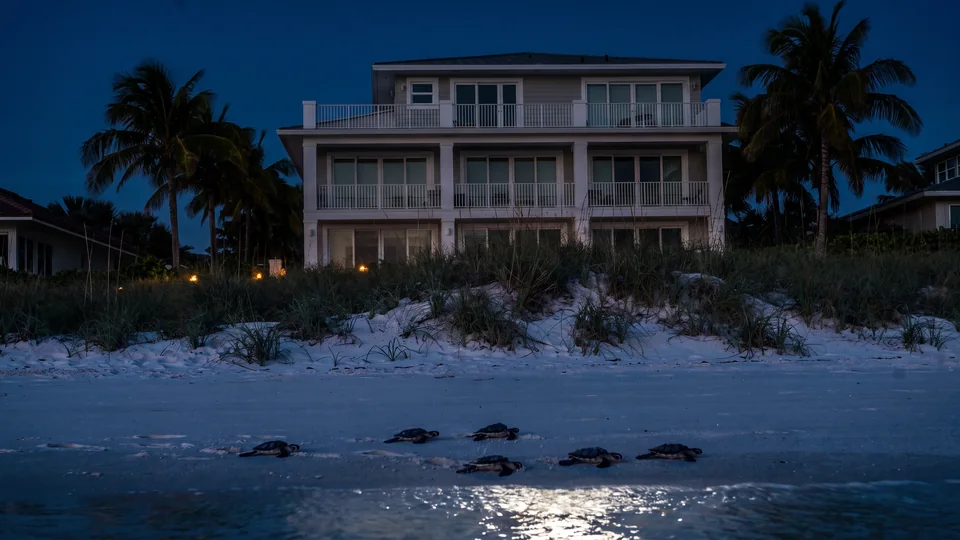
Collier County Parks describes the preserve as "one of the last undeveloped barrier islands on Florida’s Southwest coast," and its own page notes the protected gopher tortoises that live there. A disorientation, in a nesting table, is a nest whose hatchlings were drawn the wrong way, usually toward light. The 34 recorded at Barefoot are the reason the county line makes little difference to a hatchling: the glow it follows is whatever is brightest on the horizon.
We do not quote Bonita Beach’s own nest numbers because we did not find a published count for it. What the Barefoot figures show is that this stretch of coast is nested on, and that light from shore still turns hatchlings around.
Sources, read 2026-10-14: Collier County Parks, Barefoot Beach Preserve; Collier County Parks, sea turtle activity update (the table prints no year; the file is dated November 2025).
Inland
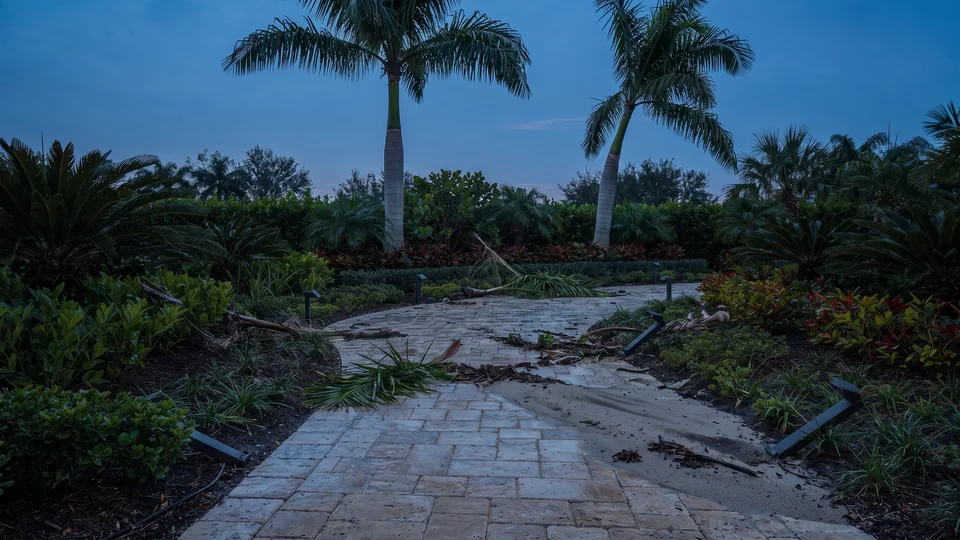
In 2017, back-to-back storms brought historic flooding to the Imperial River watershed, with water in some areas 6.5 feet above earlier levels, the city reports. It has since bought out 13 flood-prone homes. For river-area yards, keep transformers, timers and connections above expected water, and ask the city's floodplain manager for your lot's elevation.
The city’s stormwater page describes back-to-back storms in 2017 and "historic flooding within the Imperial River Watershed area." Hurricane Irma "made landfall in Bonita Springs as a Category 3 storm on September 10, 2017," and the city’s voluntary buyout "has allowed for 13 homeowners to sell their flood-prone properties to the City." It adopted an Imperial River Basin Management Plan in November 2012, before any of that.
Low-voltage fixtures live in the beds and are built to sit in wet ground. The transformer and the timer are not. On a river lot, the equipment goes high on a wall or post, the connections are sealed, and the run from the transformer is planned so a flooded bed does not take the whole system with it. That is our judgment, not a code requirement; your lot’s flood elevation comes from the city, not from us.
On the beach side, Hurricane Ian is still visible: Lee County closed Bonita Beach Park’s parking and amenities from September 8, 2026 for repairs, and says its beaches "have not been restored to pre-Hurricane Ian conditions." For what to check after a storm, see putting lighting right after a storm and transformer and timer repair.
Sources, read 2026-10-14: City of Bonita Springs, Stormwater and Drainage and Voluntary Home Buyout Program; Lee County Parks, Bonita Beach Park and Bonita Beach accesses.
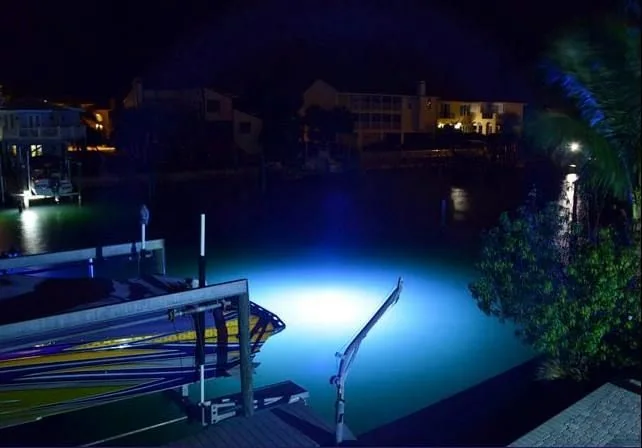
The bay side
Estero Bay Aquatic Preserve, created in 1966 as Florida's first, borders Bonita Springs, and its western edge includes Big Hickory and Little Hickory islands. Its mangrove islands are bird rookeries, and its shallows hold seagrass and oysters. For bay-side docks, light the walking surface and steps with shielded fixtures aimed down, and keep beams off the water and the mangroves.
Florida’s Department of Environmental Protection describes the preserve’s western border as including "Big Hickory Island and Little Hickory Island" and its "mangrove islands that serve as bird rookery habitat." DEP does not publish a lighting rule for the bay. The general guidance on birds and light, which is written for buildings, asks for less upward and decorative light; our wildlife-friendly lighting page sets out what it does and does not say.
For a dock on the bay side, that means the same restraint as the beach side, for a different reason: step and deck lights recessed or hooded, aimed at the boards, and no floodlight reaching across to the mangroves. Underwater dock lights are a separate decision, covered on underwater lights at a dock, and best kept on a timer.
Source: Florida DEP, Estero Bay Aquatic Preserve, read 2026-10-14.
Commercial and HOA
Single-family and two-family homes are exempt from Bonita's general outdoor lighting section, but commercial sites are not. It caps light at 0.5 footcandle at the property line and 0.2 onto neighboring homes, requires motion lights to shut off within five minutes, and bars floods aimed at the sky or the shoreline. Community associations planning common-area lighting should start there.
Eagles
Bonita Springs protects bald eagle nests with its own ordinance. Nesting season runs October 1 to May 15, and designated buffers, which average 660 feet from a nest, must stay mostly in their natural state. The ordinance says nothing about lighting, but trenching and fixture work inside a designated buffer is a question for the city before any work starts.
0 of 4
Nest, buffer, season and the city’s answer are known before anything is dug.
The city’s answer about digging inside the buffer is the one to have in writing.
If a project is near a known nest, the city is asked before work starts. That is the city’s call, not ours.
The eagle article defines the season as "the period from October 1 to May 15" and says buffers "may range in any distance averaging 660 feet from a nest." We read the whole article for a lighting provision and found none, so we will not tell you that lighting harms eagles or that the city restricts it near a nest. What the ordinance does restrict is change inside the buffer, and running cable means digging. Source: Bonita Springs LDC Ch. 7, Art. III, Municode, read 2026-10-14; also Sec. 3-269 for the section above. History: City of Bonita Springs.
Who does the work
NightScapes Landscape Lighting has lit Southwest Florida properties since 1998, from Naples north into Bonita Springs and Fort Myers. Todd and Sherry own and run it, outdoor lighting is the only work it does, and its Google Business Profile shows 63 reviews at 5.0. This guide is written from the city's code and public pages, each linked where it is used.
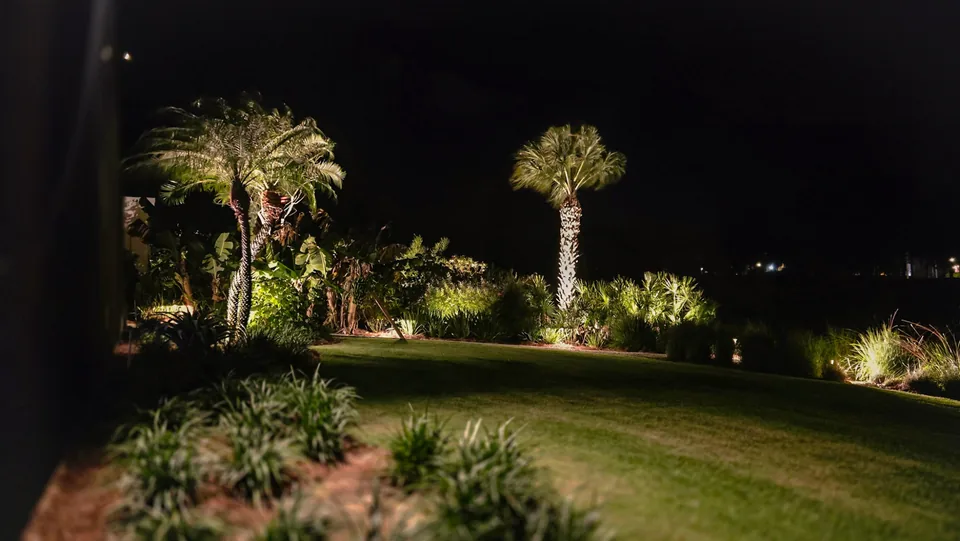
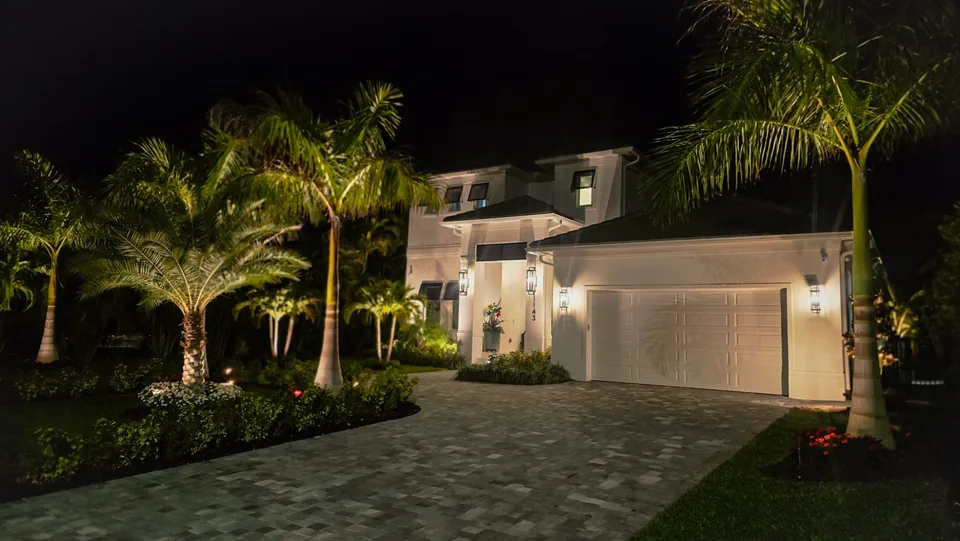
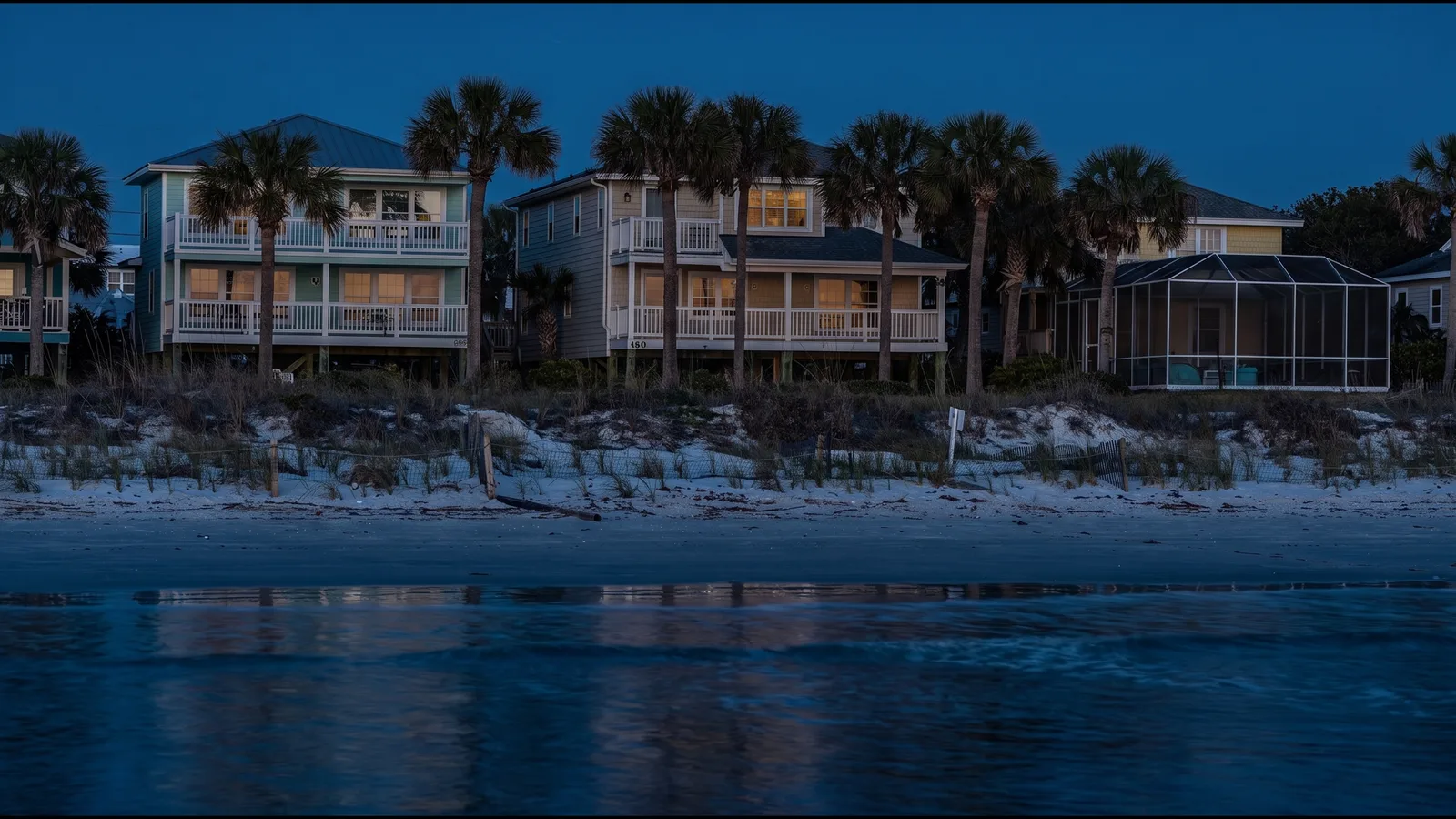
The photographs on this page are of lighting and places in general, not of particular Bonita Springs homes, and the drawings are labeled as illustrations. Where a rule comes from Lee County or Collier County rather than the city, the page says so, because that difference is the most common mistake in Bonita lighting plans.
Ask about a Bonita Springs plan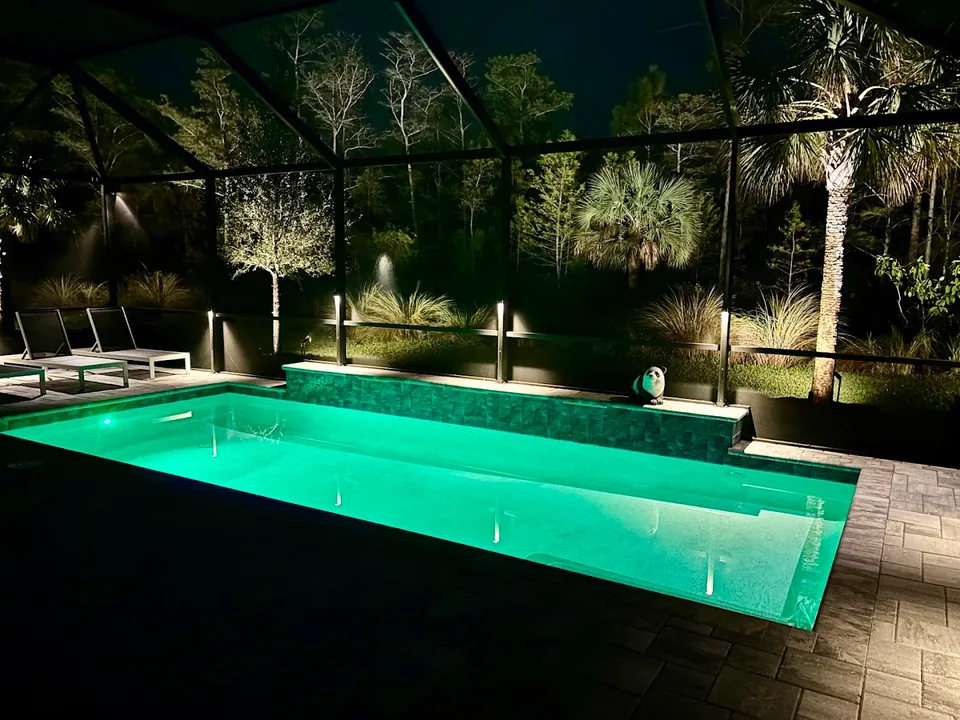
Questions we hear
Whether a home off the beach is in the turtle district, which hours apply, whether uplights can stay, whether inland homes are regulated, who fixes street lights, how to light a flood-prone river yard, and what the rules say about fire tables. Every answer is drawn from the city's code or the city's own pages.
 NightScapes Landscape Lighting Outdoor lighting only, Naples since 1998
Choose a question
Ask us about lighting in Bonita Springs. Choose a question, or call and we will answer it on the phone.
Possibly. The city’s sea turtle lighting district takes in every property on its barrier islands that may produce light visible from any part of the beach, "regardless of whether those properties are beachfront properties." A home across Hickory Boulevard can be inside it if its lights, or their combined glow, show from the sand.
Bonita does not use a 9 p.m. cutoff. Its code defines nighttime as sunset to sunrise during nesting season, May 1 through October 31, which the city can extend. The rule is about lights not being visible from the beach at night, so shielding and placement matter as much as a timer.
Bonita calls landscape lights and uplights non-egress lighting. In the district they may stay only landward of the building or another opaque structure, with long wavelength sources, and only if no part of the beach can see them. Uplights on the Gulf side, or showing over the dune, have to be moved, shielded or removed.
The city’s general outdoor lighting section, Sec. 3-269, covers commercial developments and exempts single- and two-family homes. The sea turtle division covers the barrier islands. An inland home off the islands is generally outside both, though a community association may have its own architectural rules, which were not public for this guide.
The city’s own FAQ sends street light problems, and power outages, to Florida Power and Light. Street lights are the utility’s equipment, not part of a landscape system. If your landscape lights went dark at the same time as an outage, have the transformer and timer checked once the power is back.
Keep the transformer, timer and connections above the water you can expect, use sealed connections, and get your lot’s flood information from the city’s floodplain manager. Fixtures can sit low in the beds; the power equipment should not. The city reports water in parts of the watershed reached 6.5 feet above earlier levels in 2017.
On the seaward and shore-perpendicular sides, fire pits and gas fire tables must be shielded so the flame cannot be seen from the beach. Bonfires and tiki-torch style fire posts are prohibited in sea turtle nesting habitat during nesting season. Plan the lanai so the fire feature sits behind the building or a solid wall.
Free Consultations and Estimates
Tell us the address, whether it is on the island or the mainland, what is lit now and what you would like to see at night. We look at it with you, from the street and, on the island, from the sand.
Tell us about the property