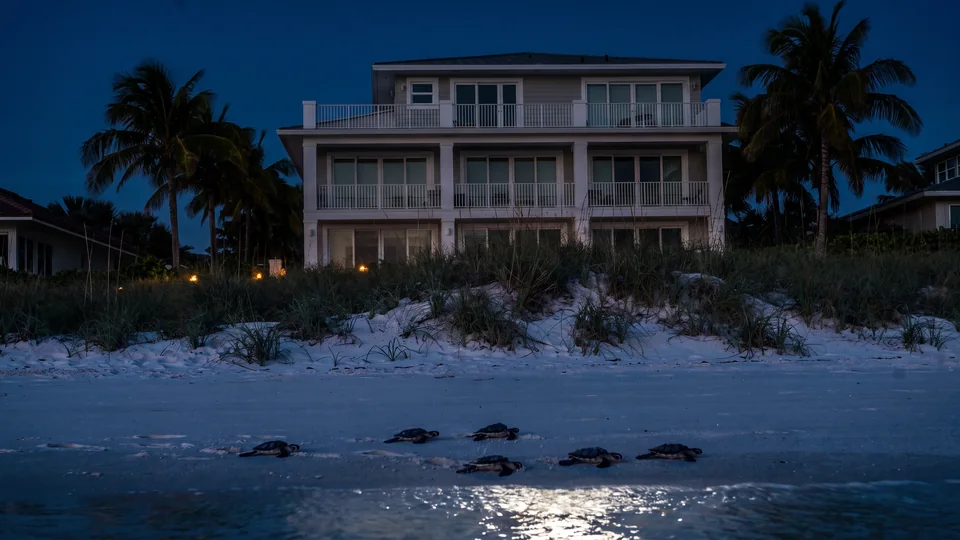
Unshielded white light
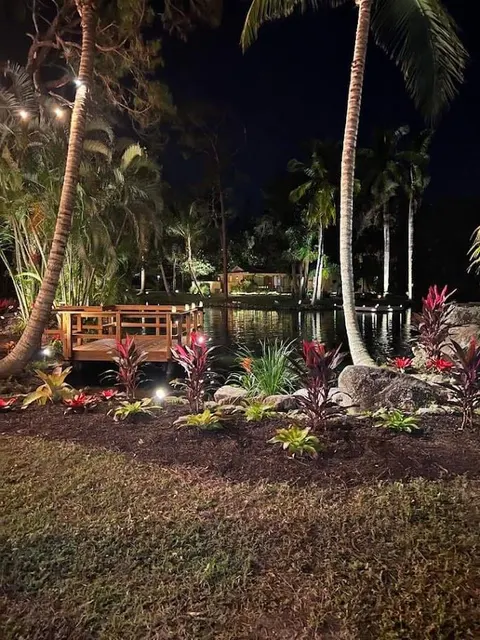
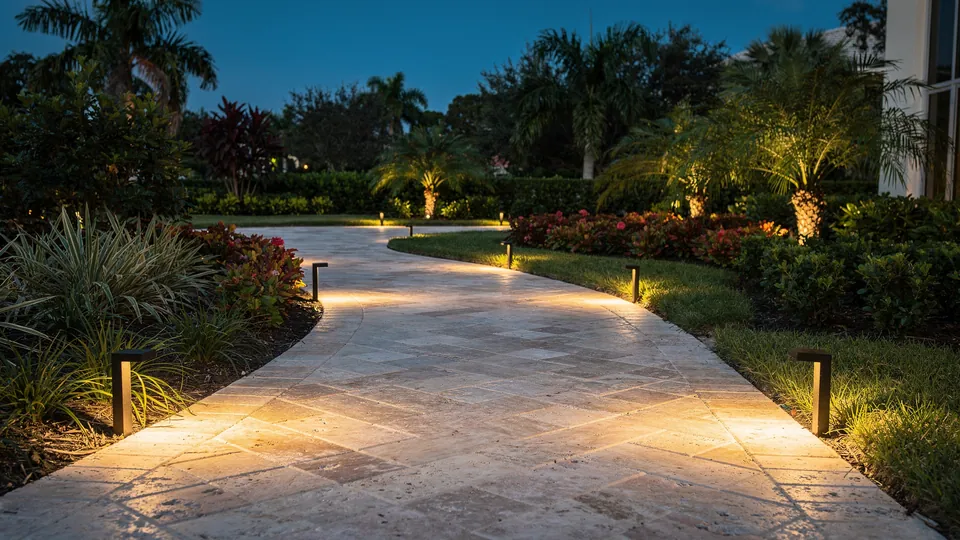
Path lights with the lamp in view, white light, and the palms beyond uplit. From the beach every one of these is a point of light, and the lit fronds are a bright surface. This is the starting point on many coastal properties.
Specialty
On a beachfront lot the question is not how the house looks from the street. It is what can be seen from the sand. Light that reaches the beach is changed, hidden or switched off, and the rules for it differ from one address to the next.
Tell us about the property
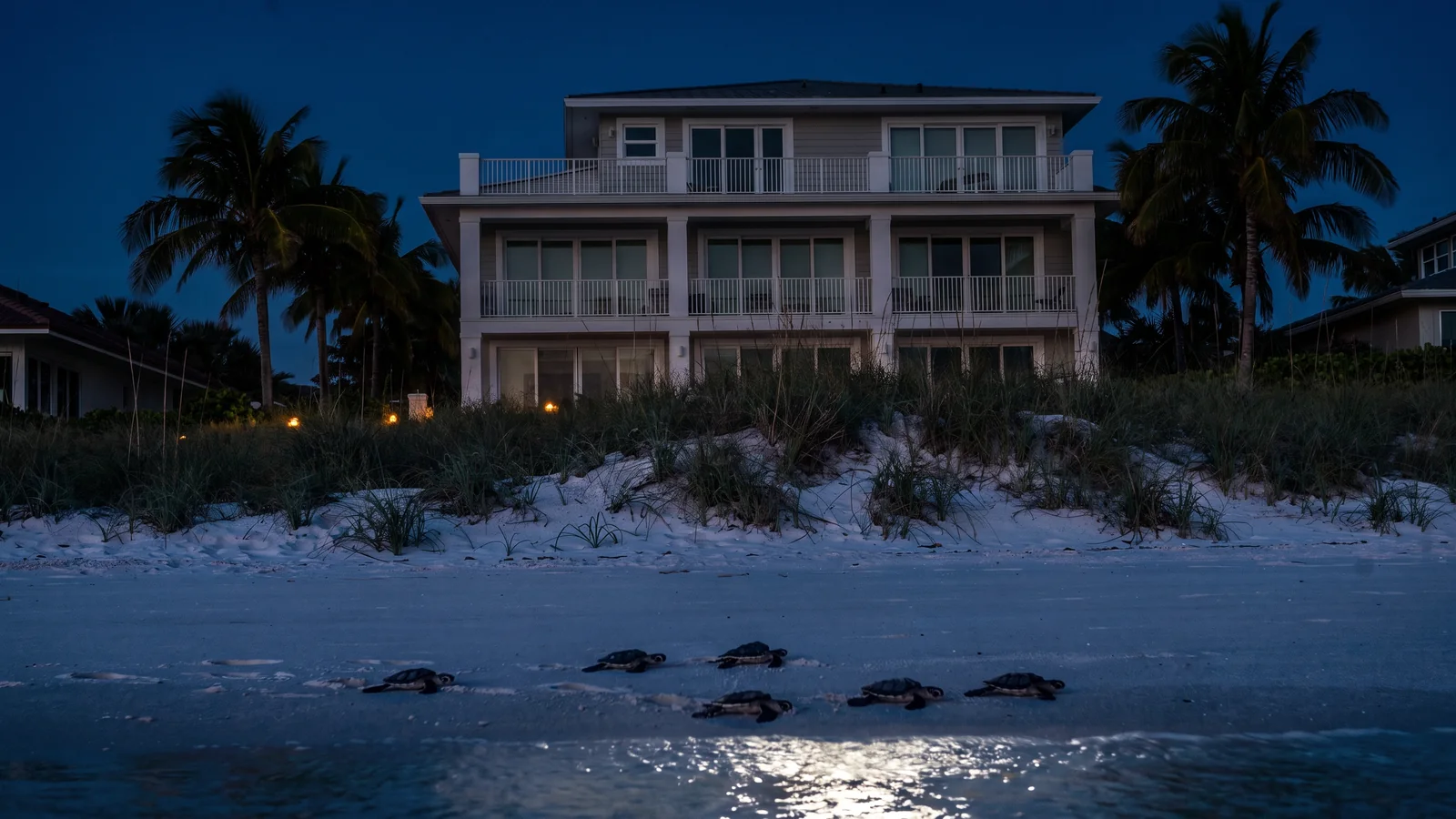
Illustration: lights on the beach at right, the same lot kept dark at left
If your property faces the beach
If your property faces a nesting beach, what matters during the season is any light that can be seen from the sand: fixtures, glowing lenses and the surfaces they light. That light is switched off, lowered, shielded or changed to long-wavelength sources, as the rules for your address require. The first step is finding it.
Florida’s Fish and Wildlife Conservation Commission (FWC) asks beachfront owners to follow three rules together: keep lighting low, keep it shielded, and keep it long wavelength. In its own words, "All three must be used in combination to be effective, as they are all equally important!" Local codes in Collier County, the City of Naples, Marco Island, Sanibel and Lee County then set their own requirements, and they do not all say the same thing.
Most of them set the season at May 1 through October 31; the City of Naples notes that nesting "can begin as early as April 15." Where Collier County’s and the City of Naples’ beach sections apply, they go further than most homeowners expect: "Floodlights and landscape or accent lighting shall be prohibited."
So on a beachfront lot this is mostly a job of taking light away and putting the rest of it right, not of adding effects. This page shows how the light is found and changed, and which source says what.
The method
The only reliable way to know what the beach sees is to stand on it. After dark, walk the beach side of the property, look back at the house, and list every visible source and every lit surface, up and down the shore. That list, not a drawing, is what changes are made from. Try it tonight and tick what is true.
0 of 6
Keep the list. The walk is worth repeating each season, after planting is trimmed or a storm takes it out, and after anything new is added on the beach side.
Each line you left unticked points at one. It is switched off, lowered, shielded or changed to long-wavelength light, as the rules for your address require.
We walk the beach side with owners, list every source and surface, and say what we would change and what is yours to switch. Ask about a beachfront lot.
Owners who have received a notice usually have a list already. Ours tends to be longer, because it includes surfaces as well as fixtures, and the walk is repeated after every change.
Keep it low
Height decides what can be seen over a dune, a seawall or a hedge. A light close to the ground is hidden by almost anything between it and the beach; the same light on a post or a wall is not. FWC asks that fixtures be mounted as low as possible and still do their job, at the lowest output needed. Stand on the sand below and look back.
0 of 5 sources in view
FWC’s lighting page puts it in two lines: "Fixtures must be mounted as low as possible and still be appropriate for the needed purpose," and "Bulb must produce the lowest wattage/lumens necessary for the needed purpose." Both are about the same thing: the less light there is, and the closer to the ground it sits, the less of it reaches the sand.
The primary sources do not agree on a single height, and we do not pick one for them. FWC’s guidelines show a ground-mount maximum of 12 inches in an example table. FWC’s list of certified path lights carries a caveat of a maximum mounting height of 24 inches. The state model ordinance says bollard lights are not to exceed 42 inches, Marco Island’s code says pathway fixtures are not to exceed 42 inches, and Sanibel treats landscape and path lights of three feet or less separately. Which applies depends on the address and the fixture.
The closer to the ground, the more there is between the light and the beach.
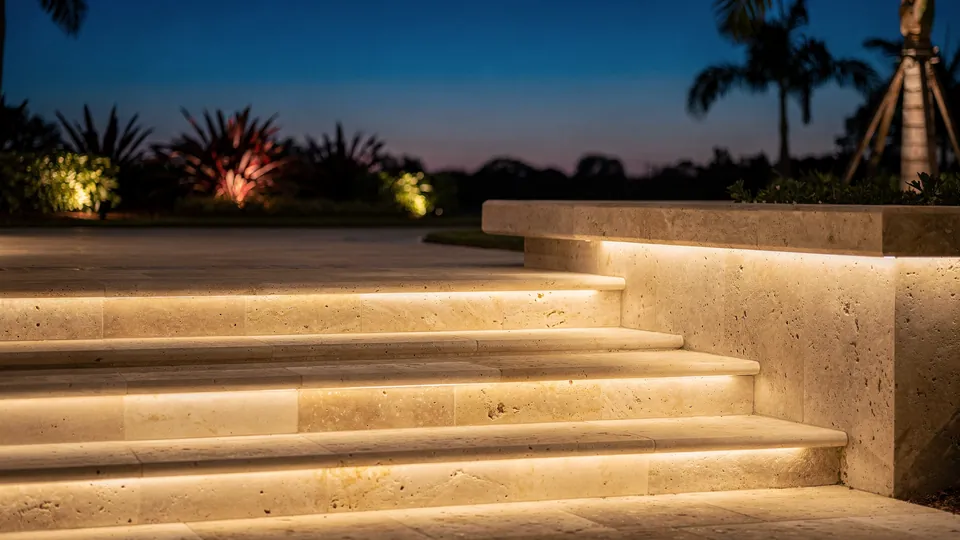
Path and step lighting near the ground, which is the light people genuinely need at night, can usually be kept. Light up in a canopy, on a wall or on a post is the light most often seen from the beach and the first to be lowered, shielded or removed. See low, shielded path lights.
Sources, read 2026-10-13: FWC, Sea turtle lighting; FWC, Sea turtle lighting guidelines; FWC, Certified path lights; Florida Model Lighting Ordinance; Marco Island Code ch. 54, art. V; Sanibel Code ch. 126, art. XIV, div. 4.
Keep it shielded
A shield hides the lamp, bulb or glowing lens from the beach so light leaves in one direction. FWC asks that fixtures be completely downward-directed. Aim matters as much as the fixture, because a lit wall, window or pool can be seen from the sand too. Planting helps, but cannot be relied on alone. Point at each.
Keep it long
FWC asks for light sources that produce only long wavelength light, which its guidelines put at 560 nm or greater: amber, orange or red. Its certification criteria rule out color-changing and RGB fixtures, even set to amber. Drag the handle through the changes on one coastal walk, from white and unshielded to off.
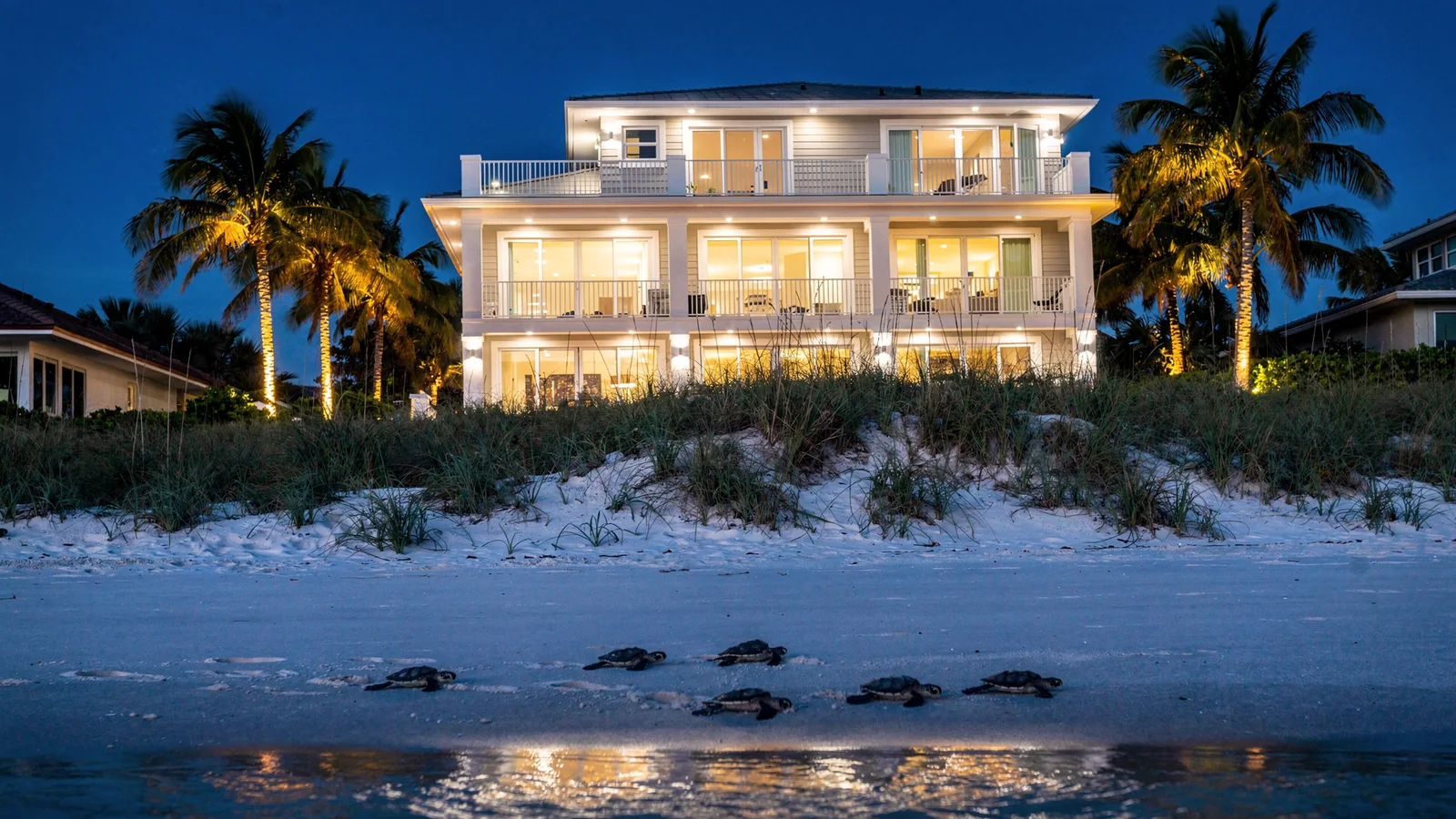
Path lights with the lamp in view, white light, and the palms beyond uplit. From the beach every one of these is a point of light, and the lit fronds are a bright surface. This is the starting point on many coastal properties.
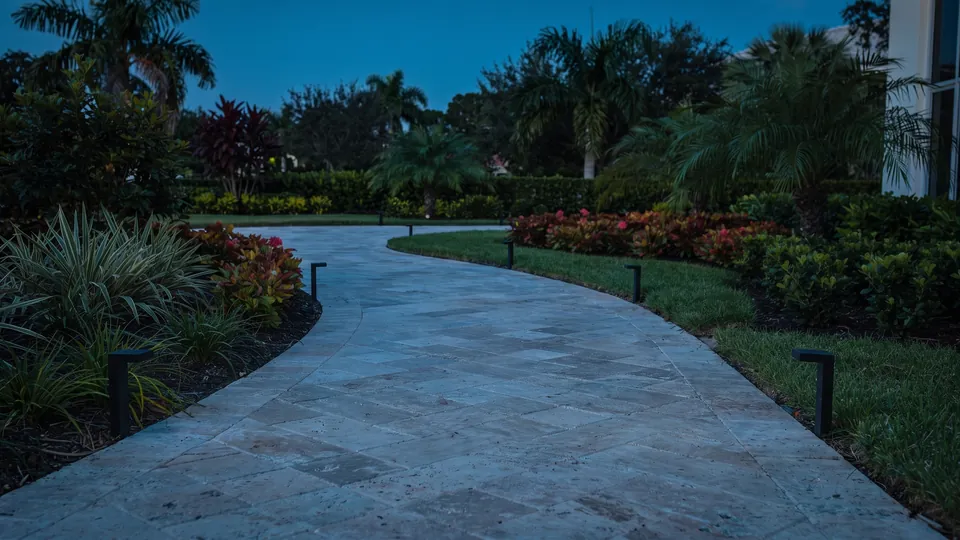
The same walk with the lamps hidden and the output turned down. The uplighting on the vegetation is off: FWC advises against uplighting vegetation where it is visible from the beach. Much less reaches the sand, but the light is still white.
Now the remaining light is long wavelength: FWC words it as 560 nm or greater, which is amber, orange or red. It is enough to walk by and it is the kind of light the guidance is written around. All three together, as FWC says they must be.
Some local codes set an hour after which lights visible from the beach must be off during the season, as an alternative to hooding or positioning them. Which hour, and whether it applies, depends on the address. A seaward zone on a schedule handles it.
Illustration only. The amber shown is a picture of long-wavelength light, not a measured color. Wavelength is a property of the light source; it cannot be added with a filter on a white lamp and still meet FWC's description of a long wavelength source.
Beyond the landscape
Landscape fixtures are often not the main problem. FWC's own list of questions covers balcony lights, pool lights, interior lights, parking areas and utility poles. Some of those we can change, some are the owner's to switch, and some belong to an association or the utility. We say which is which.
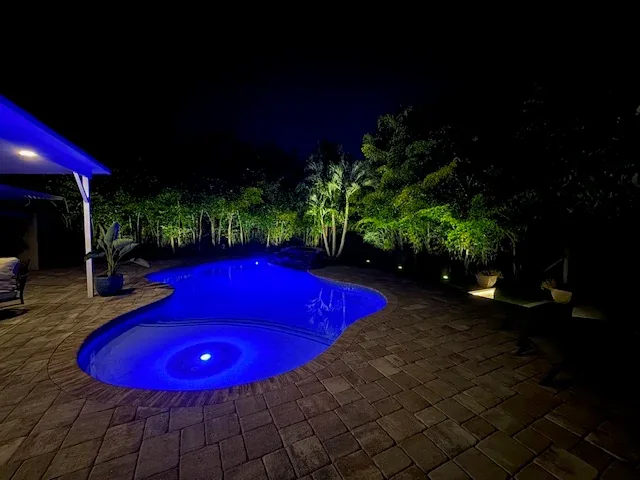
A lit pool is a large, bright, reflective surface, and on a Gulf-front lot it is often the closest thing to the beach. FWC lists pool lights among the questions owners ask. The pool light can usually be switched off for the evening, and the deck lights around it are kept low and shielded. See pool and lanai light that spills through the screen.
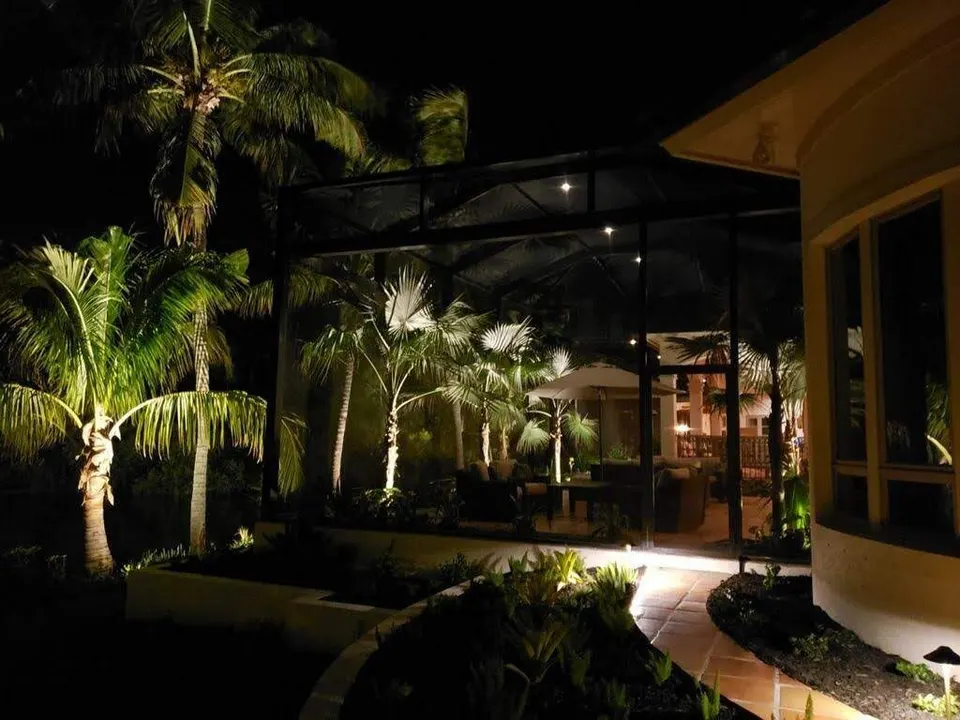
A screened lanai lit from inside is a glowing box from the outside, and the mesh does little to hold light in. Lowering the lanai lights, keeping them shielded and aimed away from the beach side, and drawing shades all help. These are mostly the owner’s switches.
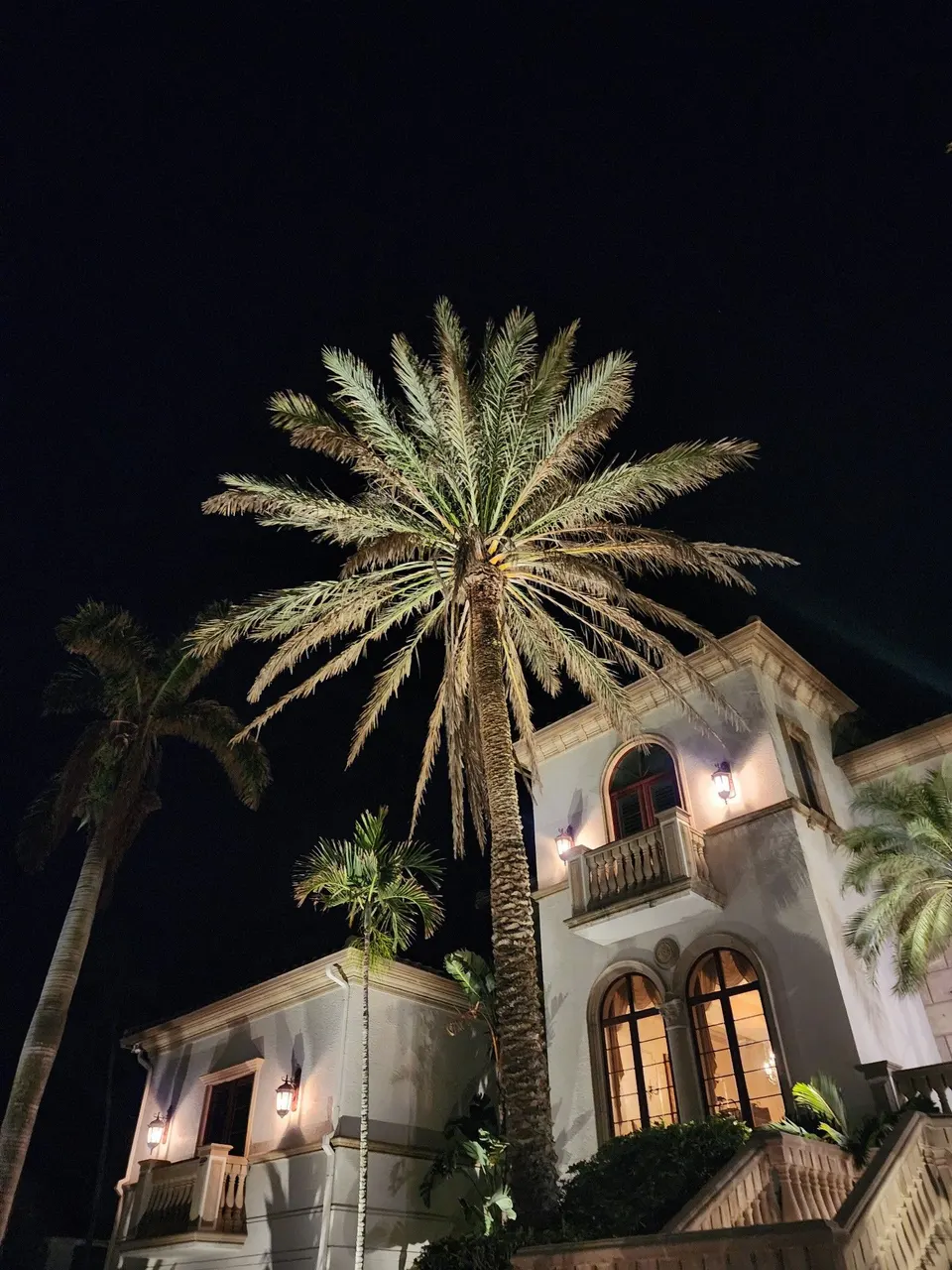
Light from a second-floor balcony or window travels over the dune and the planting that hide everything at ground level. FWC lists balcony lights and interior lights among its questions. Balcony fixtures can be replaced with low, shielded, long-wavelength ones; interior light is a matter of shades and habits.
FWC also lists parking lots and utility pole lights. On a private lot the pole light belongs to the utility and a parking area to the owner or the association. We can tell you what we see from the beach and who controls it; we change only what is ours to change.
Control
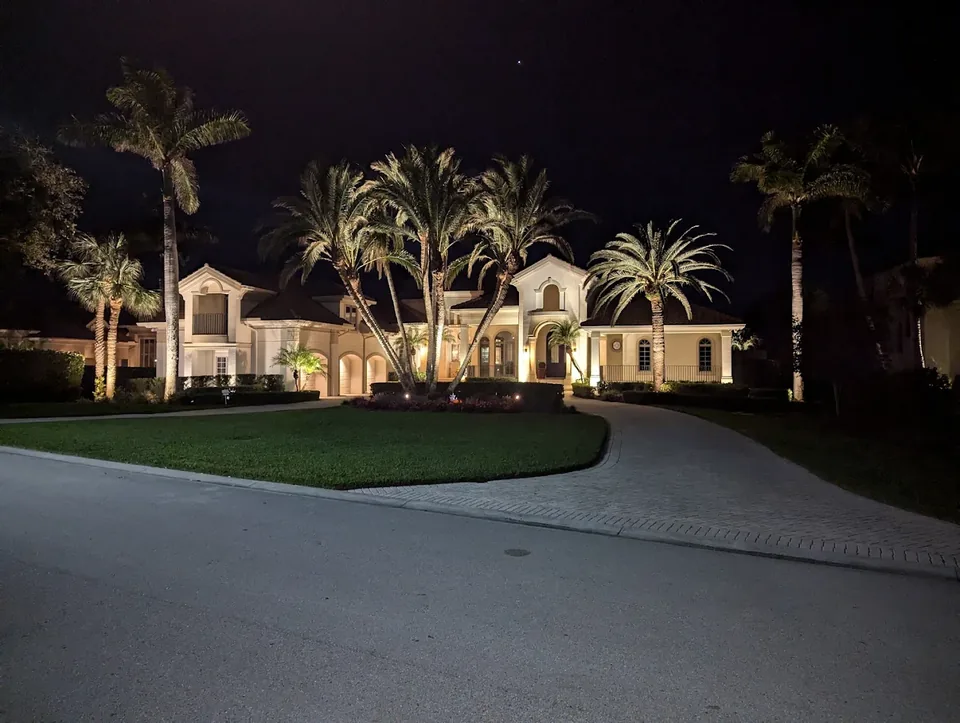
On most beachfront lots only part of the lighting can be seen from the sand. Those fixtures go on their own zone, so for the season they can be switched off, dimmed or put on a schedule while the street side of the property stays exactly as it is. It is the simplest way to live with the rules.
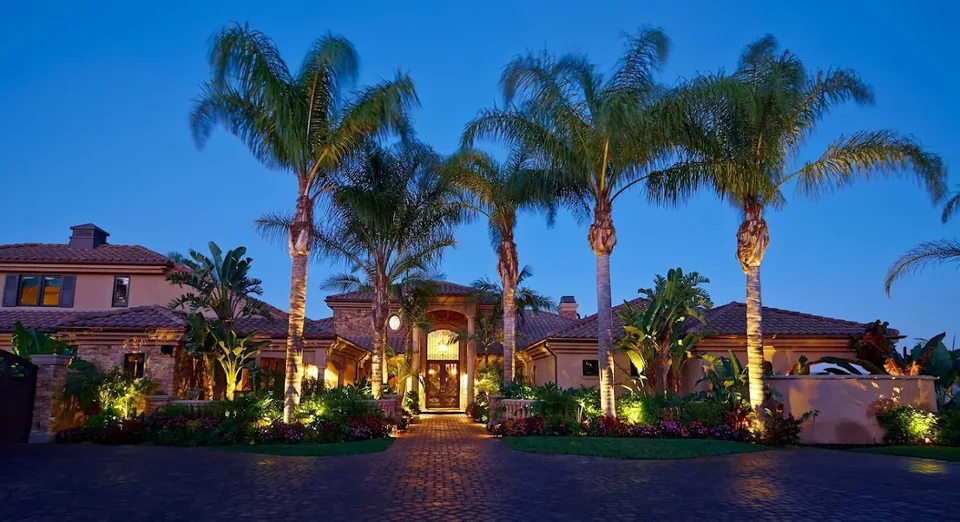
Anything the beach walk found: fixtures on the beach side of the house, uplights on palms that show over the dune, lights on balconies and decks facing the water. The street side, the drive and the entry usually stay on their own zones, unaffected.
Whatever the local rule for that address asks. Where the code sets an hour after which beach-visible lights must be off, the zone runs on a schedule that switches it off then. Where light has to be removed from view altogether, the zone simply stays off from the start of the season to the end, and comes back on after.
How a property is divided into zones, and how levels and schedules are set on each, is on our page about putting the seaward fixtures on their own zone.
Per address
Collier County, the City of Naples, Marco Island, Sanibel, unincorporated Lee County and Bonita Springs each have their own sea turtle lighting rules, and they differ on hours, heights and wording. Which one applies depends on the address and on how close it is to the beach. We read the section that applies before designing.
Where Land Development Code 3.04.02 B applies: "Outdoor lighting shall be held to the minimum necessary for security and safety. Floodlights and landscape or accent lighting shall be prohibited." For existing development with lights visible from the beach, "All lights shall be turned off after 9:00 p.m. between May 1 and October 31 of each year", or fitted with a hood or positioned so neither the light source nor lit reflective surfaces can be seen from the beach.
Section 52-61 uses the same words about landscape and accent lighting. For existing development, "All lights shall be extinguished between 9:00 p.m. and sunrise from May 1 to October 31 of each year", or hooded or positioned so they are not visible from the beach. The city’s own page adds that "landscape and accent lighting should be off or disabled during nesting season."
Marco Island’s code says "All exterior lights shall be turned off after 9:00 p.m. during turtle nesting season," with an exception for turtle friendly long wavelength, low, shielded lighting. Sanibel’s citywide standards say "Uplighting is prohibited." Unincorporated Lee County defines the nesting season as running "from 9:00 p.m. until 7:00 a.m. during the period of May 1 through October 31 of each year."
The city or county that issued a notice is the authority on what it means for your property, and its code is the text that applies. We read it, design to it and show you what we read. We do not interpret it for you as a lawyer would, and we do not describe any fixture as certified unless that exact model and option is on FWC’s list.
Sources, read 2026-10-13: Collier County LDC 3.04.02; City of Naples Code Sec. 52-61; City of Naples, Sea turtles; Marco Island Code ch. 54, art. V; Sanibel Code ch. 126, art. XIV, div. 4; Lee County LDC ch. 14, art. II, div. 2; FWC certification criteria.
Who does the work
NightScapes Landscape Lighting has worked on coastal and beachfront properties in Naples since 1998. Todd and Sherry own and run it, outdoor lighting is the only work it does, and its Google Business Profile shows 63 reviews at 5.0. On a beachfront lot the work starts on the sand, looking back at the house.
We work along the coast from Naples to Marco Island and up through Bonita Springs, Fort Myers, Sanibel and Captiva, where the rules are different from one address to the next. We read the section that applies to your property before we design anything, and we show you what we read.
Most of what we change on a beachfront lot is taken away or hidden. Where light is needed for people to move around safely at night, we make it low, shielded and long wavelength. For seeing the rest of the property without flooding it, see seeing the property without flooding it, and for the whole design, a full landscape lighting design for a coastal property.
Ask about a beachfront lot Questions we hear
What to do about a notice, whether lights are needed for safety, whether palm uplighting can stay on, whether an amber setting on a color fixture counts, what wavelength means, which months apply and what to do about interior light. Every rule in these answers is quoted from a source named on this page.
 NightScapes Landscape Lighting Outdoor lighting only, Naples since 1998
Choose a question
Ask us about a beachfront property. Choose a question, or call and we will answer it on the phone.
Start by finding out which ones. Go down to the beach after dark, look back at the property and list every light and every lit surface you can see, including the pool, the lanai, balconies and windows. Then each one can be switched off, shielded, lowered or changed to long-wavelength light. We do that walk with owners and tell you what we would change and what is yours to switch.
FWC asks that question for a reason: many lights on a beachfront lot are not. The ones that are, such as a path or steps people use at night, can be made low, shielded and long wavelength. Where Collier County and City of Naples sections apply, outdoor lighting is to be held to the minimum necessary for security and safety.
Not if the beach can see it. FWC advises against uplighting of vegetation in areas visible from the beach, Collier County and the City of Naples prohibit landscape or accent lighting where their sections apply, and the City of Naples page asks that it be off or disabled during nesting season. Uplights on the street side of the house may be a different matter.
Not under FWC’s certification criteria, which say that RGBs and color change options are not acceptable. What FWC describes is a light source that produces only long wavelength light. A fixture that can also make white or blue light is not that, whatever it is set to.
FWC’s guidelines say 560 nm or greater, which is amber, orange or red. Its certification criteria say greater than 560 nm and absent wavelengths below 560 nm. Some local codes use one wording and some the other, and the Collier County and City of Naples sections we read state no wavelength. We do not quote any other figure as the rule.
Most of the local codes we read set nesting season at May 1 through October 31. The City of Naples web page notes that nesting can begin as early as April 15. Which dates and which hours apply depends on where the property is, so it is checked per address.
Interior light that shines out through windows facing the beach counts as light visible from the beach. FWC lists it among its questions. It is managed with shades, blinds or tinted glass and by keeping beach-facing rooms dimmer at night, which is the owner’s side of the job rather than ours.
Close to this
Free Consultations and Estimates
Tell us the address and whether you have received a notice. We read the rule that applies, walk the beach side with you, and tell you what we would change.
Tell us about the property