Landscape lighting in Naples that leaves room for night wildlife
Birds migrate through Naples at night, fireflies signal in the dark, bats and frogs feed after sunset. Lighting can share a property with them. It takes fewer fixtures, lower and shielded, on a timer, and an honest look at which lights are decoration.
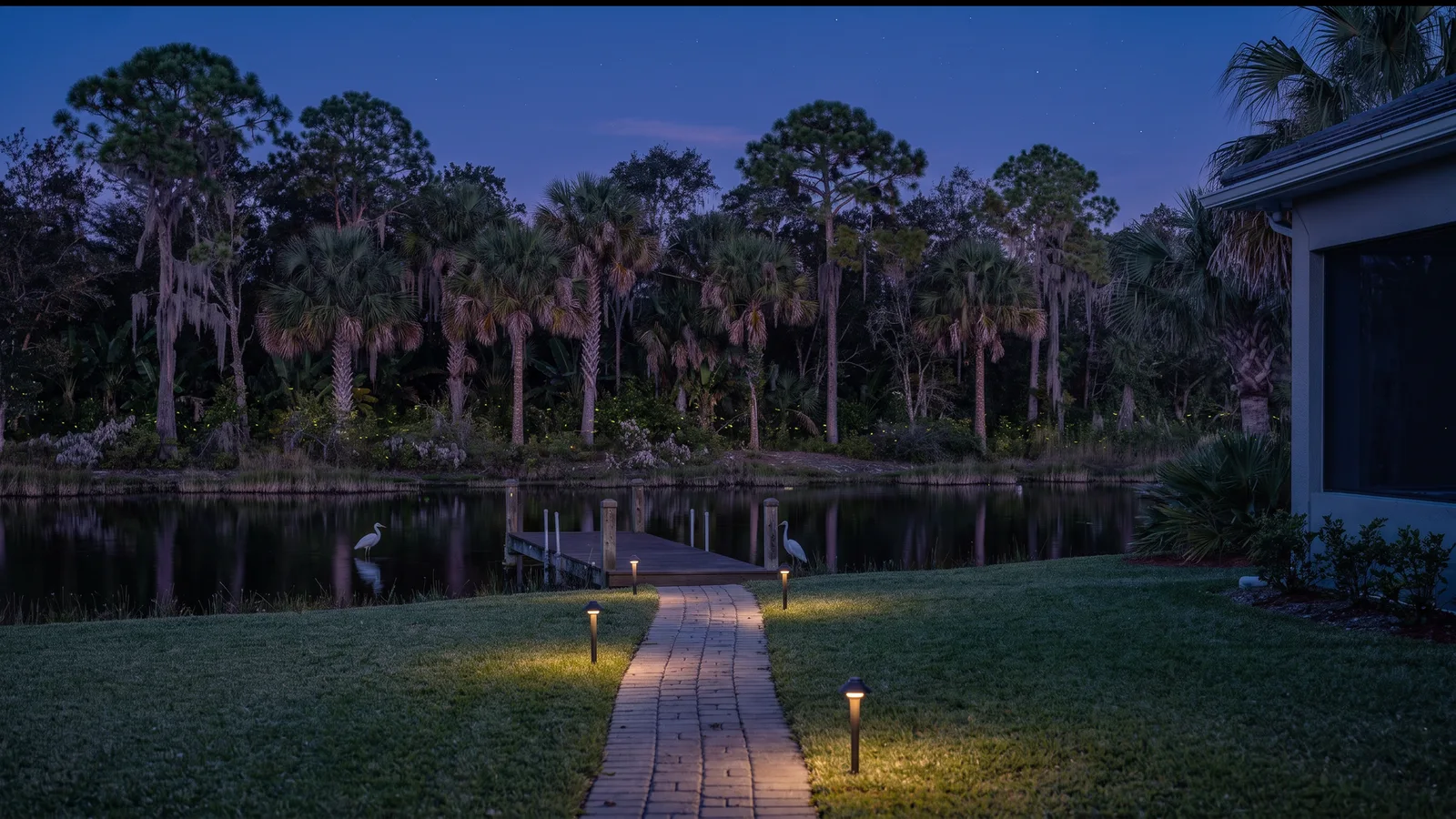
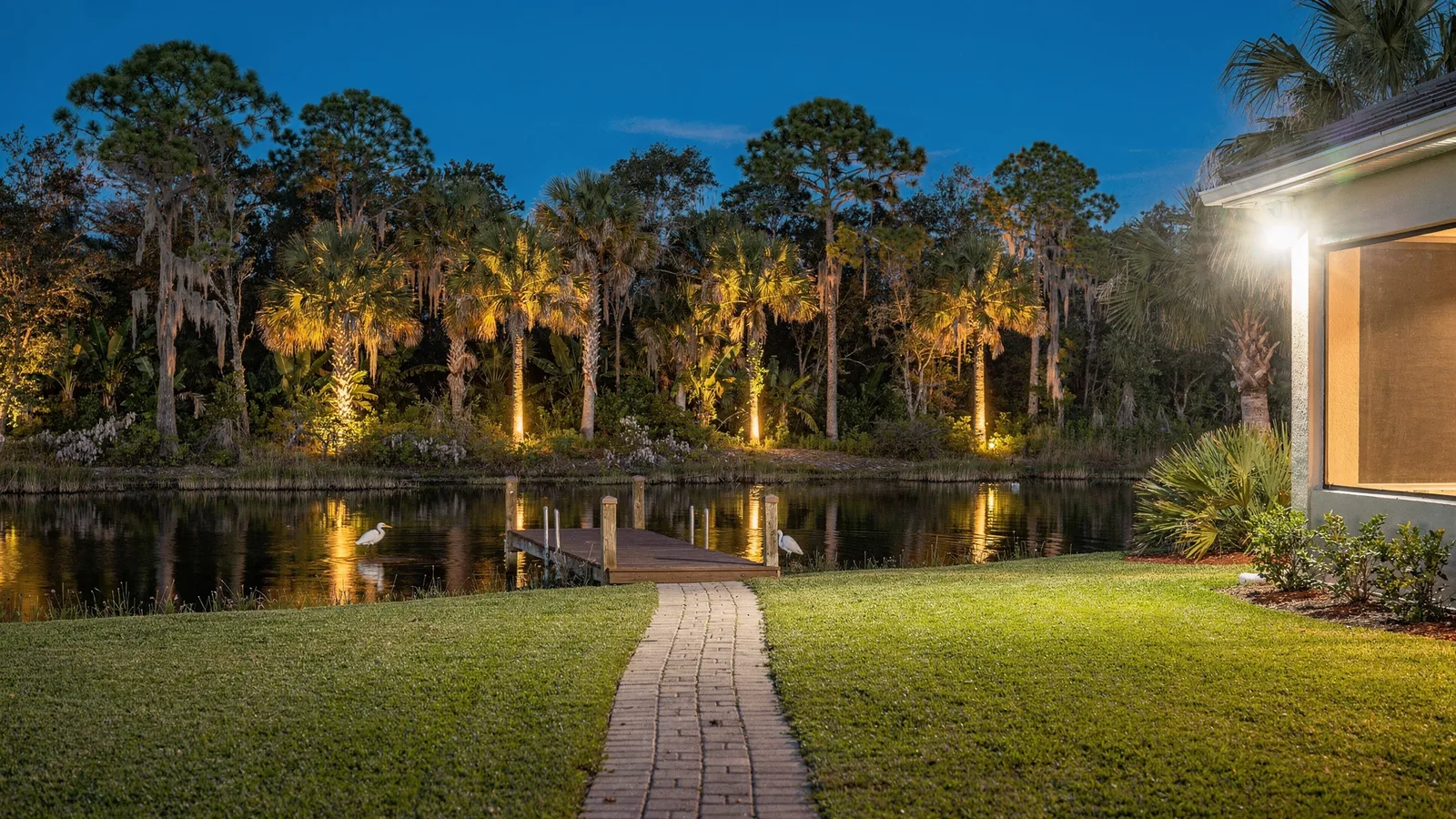
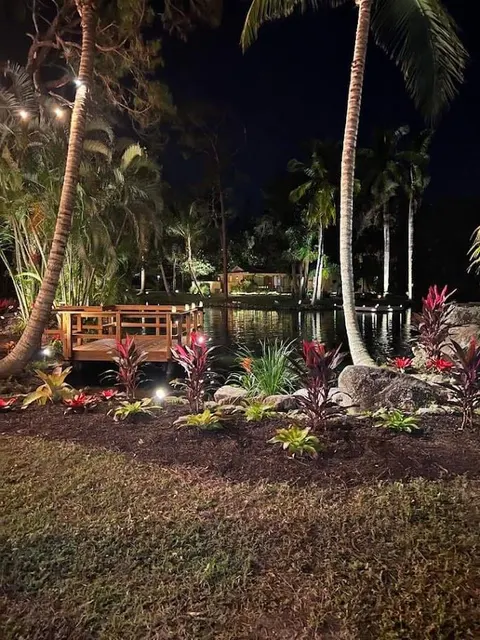
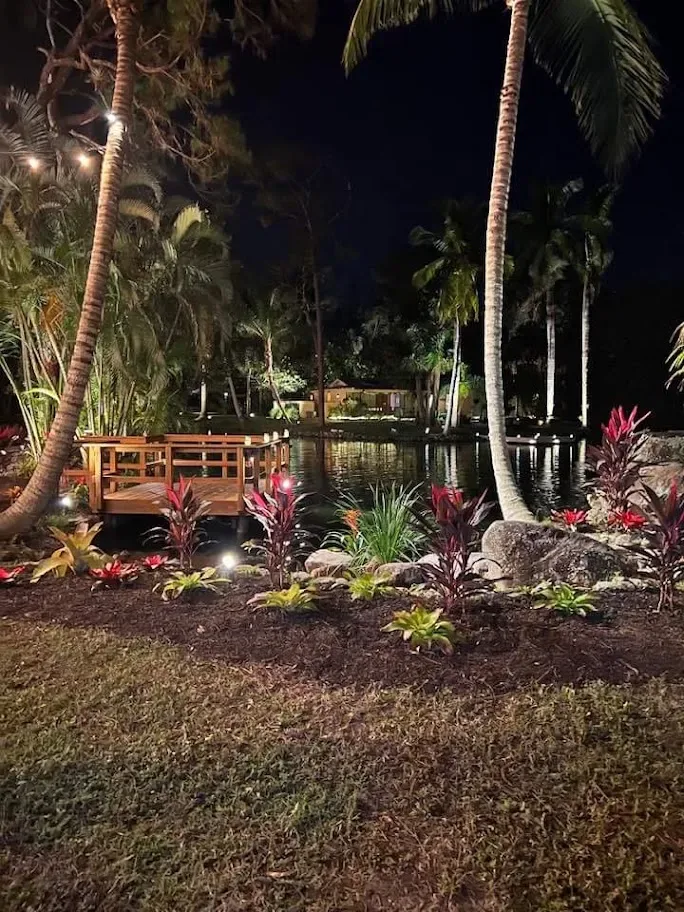
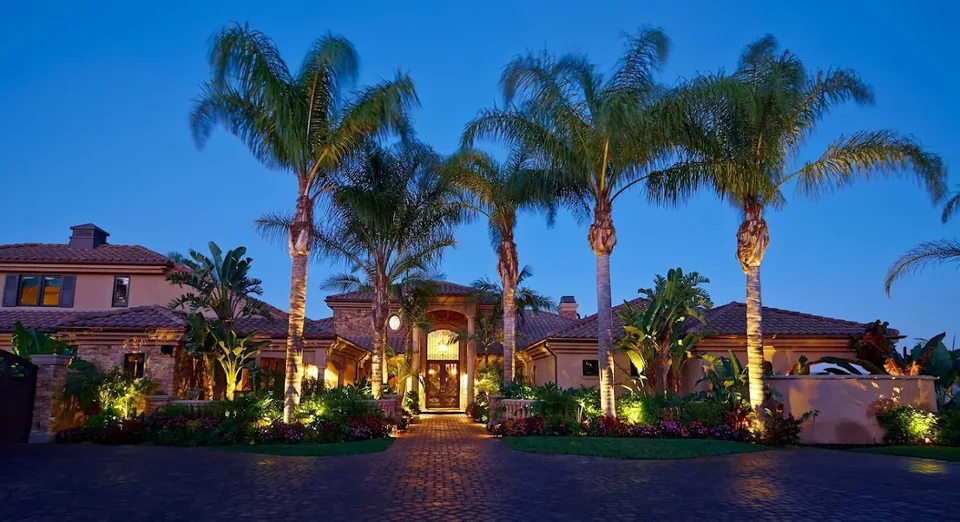
Illustration: the preserve edge uplit and floodlit at right, lit low and timed at left
If you want the garden lit and alive
What outdoor light does to the animals in a Naples yard after dark
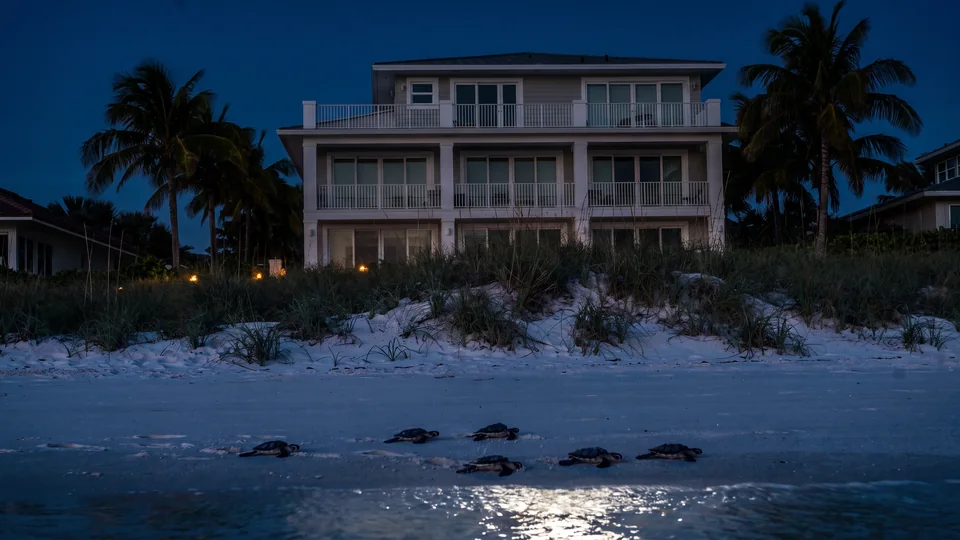
If you want your garden lit without driving away what lives in it, start with what light does. FWC says artificial light attracts some animals, like moths and frogs, repels others and shifts day and night patterns, and it calls lighting a form of habitat loss. On a beachfront lot, sea turtles add rules of their own.
FWC puts the scale plainly: "artificial light causes disruption of behavior, injury, and death to thousands of migrating birds, sea turtles and other reptiles, amphibians, mammals, and invertebrates." It describes light that "attracts some organisms (moths, frogs, sea turtles)," trapping or exhausting them, and light that extends the day for songbirds.
None of that means a property cannot be lit. It means the lighting is planned with the night in mind: less of it, lower and better shielded, for fewer hours, in warmer light. Most of what that takes is good lighting practice anyway, and the rest is a choice about decoration, which this page is honest about.
Sea turtles have their own rules and their own page: turtle-friendly coastal lighting. This page is about everything else that uses a Naples yard after dark.
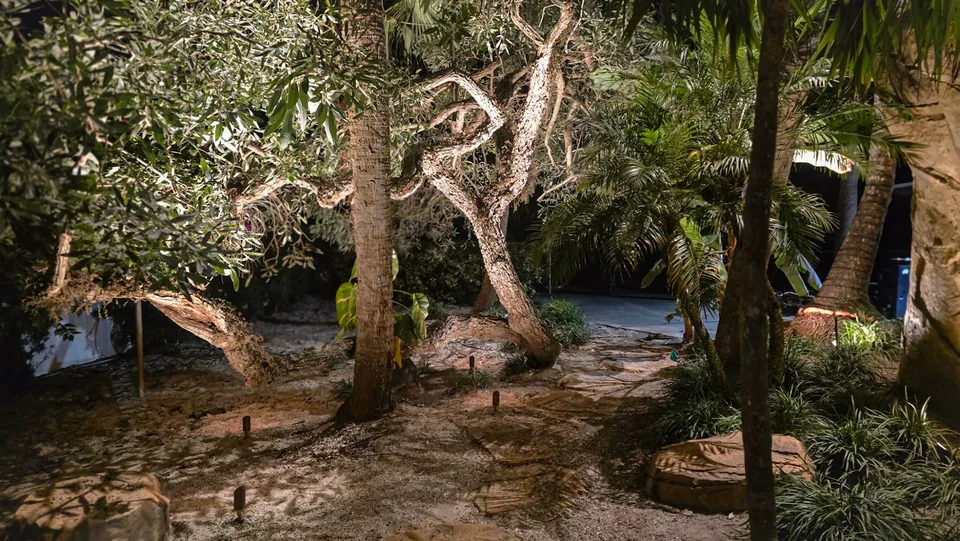
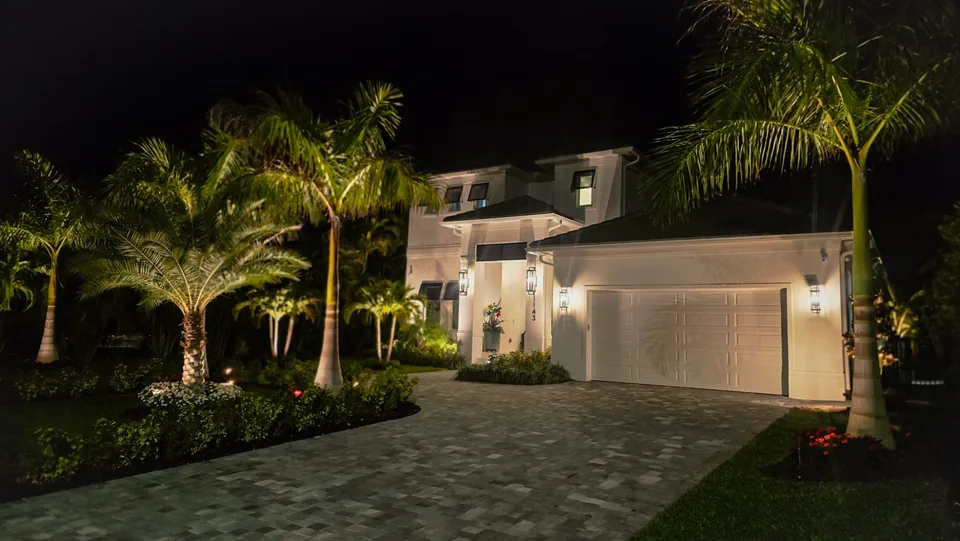
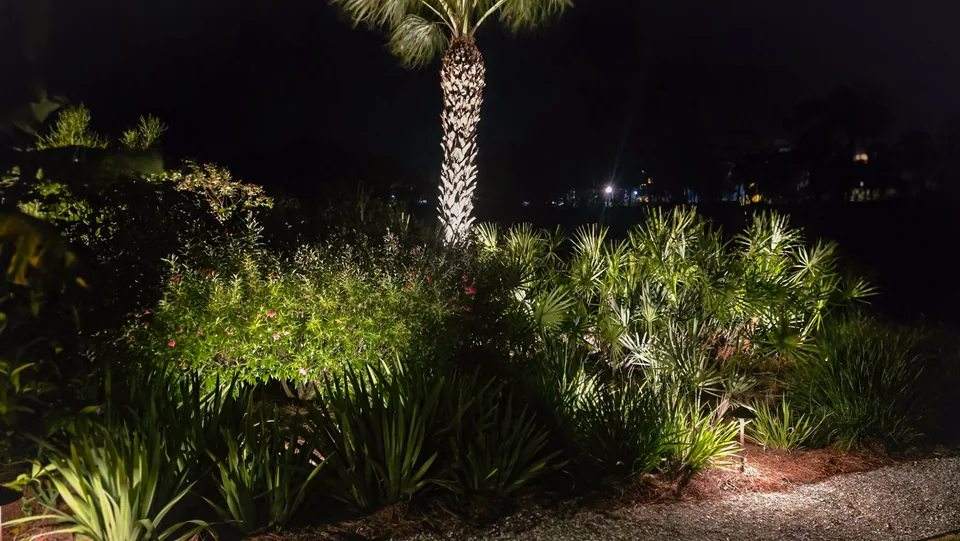
A NightScapes garden walk: low path light that stays on the ground.
Attracts
Moths, frogs, geckos and migrating birds are drawn to light (FWC).
Repels
Some bats avoid lit areas and lose out to those that feed there (FWC).
Shifts
Longer lit evenings change songbird and firefly behavior (FWC, UF/IFAS).
Wildlife-friendly lighting design
The design order that matters: fewer, lower, shielded, timed, then color
Every wildlife source we read gives the same order of work: first remove light that has no purpose, then mount what stays low, shield it so the source is hidden, put it on a timer or sensor, and only then think about color. This garden starts fully lit. Scroll through the order.
First, and strongest
Fewer: remove what has no purpose
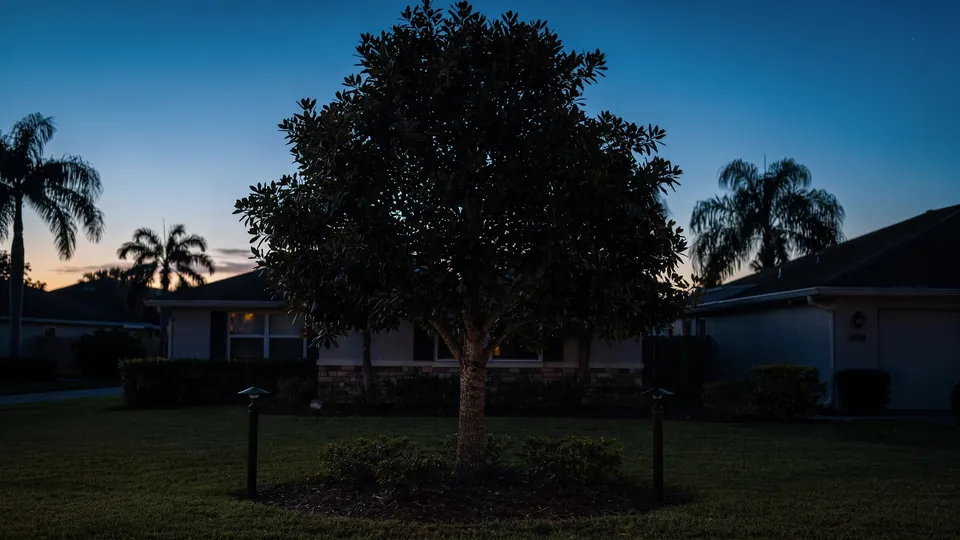
The 2024 review of insect-friendly lighting found the strongest evidence for removing unnecessary light. Xerces puts "tree lights and facade lighting" first among the lights to remove, and USFWS asks for no upward spot and flood lights during bird migration. Here the uplight on the tree is the one that goes.
Gone
The decorative uplight on the canopy.
Kept
The two path lights people actually need.
Second
Lower and shielded: hide the source
FWC says keeping light low and fully shielded, so bulbs and glowing lenses are not visible, "cuts down on the amount of glare and light visible to the animals." The path lights stay, turned down and shaded so they light the ground and nothing above it.
Changed
Output down, shades that hide the lamp.
Why
Less light reaches anything that is not the path.
Third
Timed: light only when it is used
USFWS recommends motion sensors so lights come on only when people are present, and DarkSky’s principles say to use light only when it is needed. Late at night, this garden is dark until someone walks the path.
Changed
A curfew, and a sensor on the path.
Why
Hours of darkness are what most night animals need.
Last, and least certain
Then color, with a caveat
Only then is color chosen. DarkSky advises 3000K and below and FWC says long wavelength light seems dimmer to many night animals, but a 2024 review found color changes generally ineffective in practice, and one study found red light drew migrating bats. Warmer helps some animals. It is not a substitute for the steps before it.
Birds that migrate at night, and what lit trees and uplights do to them
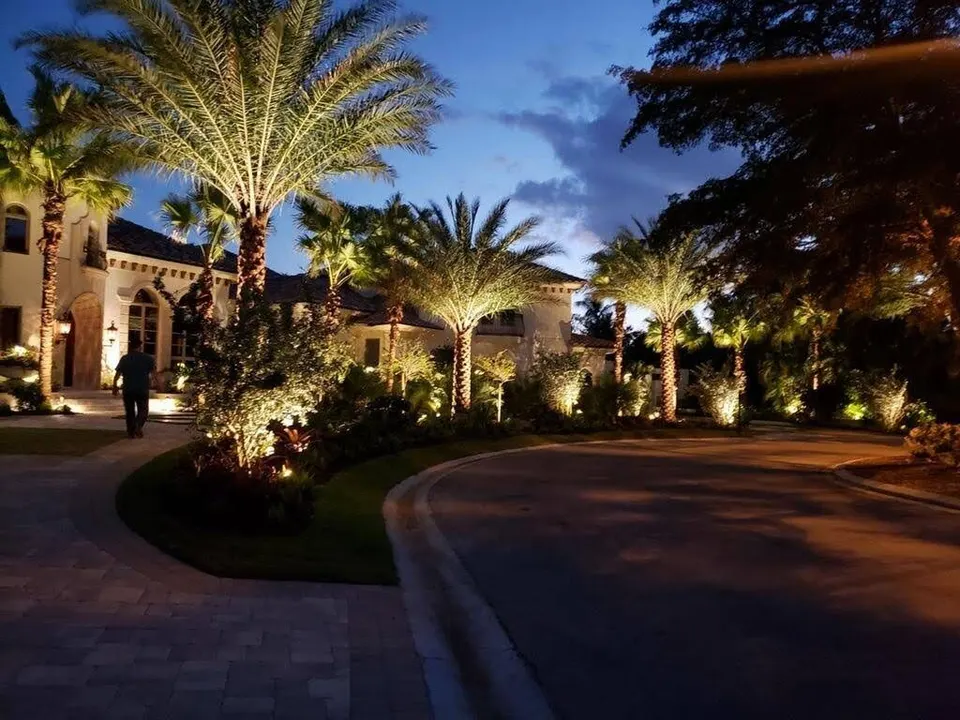
Most migrating birds travel at night, steering by moon and stars. Bright light can draw them in and trap them, especially in bad weather. USFWS asks for upward spot and flood lights to be switched off during migration, and Audubon Florida asks people to turn out as many lights as possible. Sources disagree on the months.
Uplit palms are exactly the lighting USFWS asks to switch off in migration.
What light does to a migrating bird
FWC says artificial lights can "trap" migratory birds "by bleaching their visual
pigments, causing them to lose sight of the horizon and circle within the cone of light."
USFWS adds that birds "are frequently attracted to lighting, especially during inclement
weather events in the migration season." Low cloud and rain push birds lower, which is
when lit trees and buildings matter most.
What USFWS and Audubon ask
USFWS asks for exterior lighting to be fully shielded and for decorative lighting to be
eliminated during migration, specifically "upward directed spot- and flood-lights." It
also recommends motion sensors, and it is honest that these measures "will not eliminate
collisions." Audubon Florida’s advice is simpler: "Turn out as many lights as possible
during migration season."
Uplighting is decorative. During migration, decoration can wait.
Which months
Sources do not agree, and none is written for Naples. USFWS gives early April through late
May and mid-August through early November. Tropical Audubon’s Lights Out Miami gives
March 15 to May 15 and August 15 to November 15. Audubon notes fall migration can start
"as early as July" for some birds. We found no Lights Out program for Southwest Florida.
So a migration schedule is set with you, not from one quoted window.
Beach-nesting terns, skimmers and plovers: what FWC asks, and what it does not say
FWC lists four beach-nesting birds as state Threatened and asks people to keep at least 300 feet away, to avoid fireworks on beaches and to plan rooftop work around breeding season. Its guidelines for these birds name disturbance, habitat loss and predation as the threats, not landscape lighting. Point at each.
Illustration
What FWC asks of people
Point here to read what FWC says
The birds
FWC lists the American oystercatcher, snowy plover, black skimmer and least tern as state Threatened.
Distance
"Give beach-nesting birds at least 300 feet of space."
Clean and dark
FWC asks for beaches kept "clean and dark" for turtles and waterbirds.
Fireworks and rooftops
Point here to read what FWC says
Fireworks
FWC says the noise and light of personal fireworks can have catastrophic effects on nesting birds.
Rooftops
Rooftop work in breeding season may need a permit where these birds nest.
For us
Rooftop lighting work near a colony is planned outside breeding season.
What FWC does not say
Point here to read what FWC says
The threats it names
Human disturbance, habitat loss, habitat alteration and predation.
Not named
Its guidelines for these birds do not list fixed landscape lighting as a threat.
So
Anything visible from the beach is handled under sea turtle rules instead.
Insects
Moths, fireflies and the porch light: insects and outdoor lighting
Light draws many insects out of their habitat and holds them there, and fireflies, which signal with light, flash less where it is bright. The Xerces Society's first step is to remove cosmetic lights such as tree and facade lighting. Warmer color helps in some studies and not in others, so it comes last.
Drawing: a door, a lantern and a garden edge at night. The moths and fireflies are drawn to show the idea; their numbers are not data.
The Xerces order, one step at a time
Light draws insects in
FWC says "even one artificial light source can disrupt normal flight activity" and draw insects out of their habitat, and DarkSky calls it "a fatal attraction". Insects that circle a light all night are not feeding, mating or pollinating, and they are easy prey for whatever waits at the edge of the beam.
Fireflies talk in light
UF/IFAS Extension says fireflies "avoid areas with high volumes of artificial lights," and that more light around dusk means fewer fireflies. DarkSky reports a Maryland study that found almost 50 percent fewer flashes per minute in artificial light. A firefly’s flash is how it finds a mate; a lit garden drowns it out.
The first step: cosmetic lights
The Xerces Society’s firefly guidance starts with "Remove lights that only serve a cosmetic purpose, such as tree lights and facade lighting." Its next steps are to place landscape lighting "low to the ground" and shield lights so they point down. That is the design order at the top of this page.
Color: helpful, and disputed
DarkSky advises 3000K and below, Xerces suggests warm or red LEDs, and a Smithsonian study in Peru found amber-filtered LEDs drew far fewer insects than white. But a 2024 review of the evidence found changing color "generally ineffective in practice." Warmer light is worth choosing; it is not the main fix.
Bats, frogs and geckos
Bats, frogs and geckos around lit walls, lakes and lanais
Some bats feed at lights and others avoid them, and the endangered Florida bonneted bat's federal habitat rule values darkness. Frogs gather at lights to forage, and the invasive Cuban treefrog waits on lit walls. Geckos feed at light too. The answer is the same: lower, shielded, on a curfew. Point at a number on this lanai.
Point at a numberTap a number
Bats
FWC says some bats feed in lit areas, while others avoid them and are outcompeted.
The bonneted bat
Its federal critical habitat rule values "sufficient darkness"; most of one unit is in Collier County south of I-75.
If we find a roost
We work around it. FWC says exclusion devices need a permit April 16 to August 14.
Frogs and toads
FWC says the effects of light on frogs are not well studied; lights may alter nest hiding and calling, and some frogs gather at lights.
Near water
DarkSky notes glare can affect the wetland habitat where frogs call to breed.
For us
Light at a lake or pond edge is kept low and aimed away from the water.
Geckos and treefrogs on lit walls
FWC says geckos are drawn to light to feed; UF/IFAS describes invasive Cuban treefrogs waiting on lit walls.
Why it matters
A lit wall becomes a feeding station, and the insects it draws are the bait.
For us
Walls are washed at low level, shielded, on a curfew.
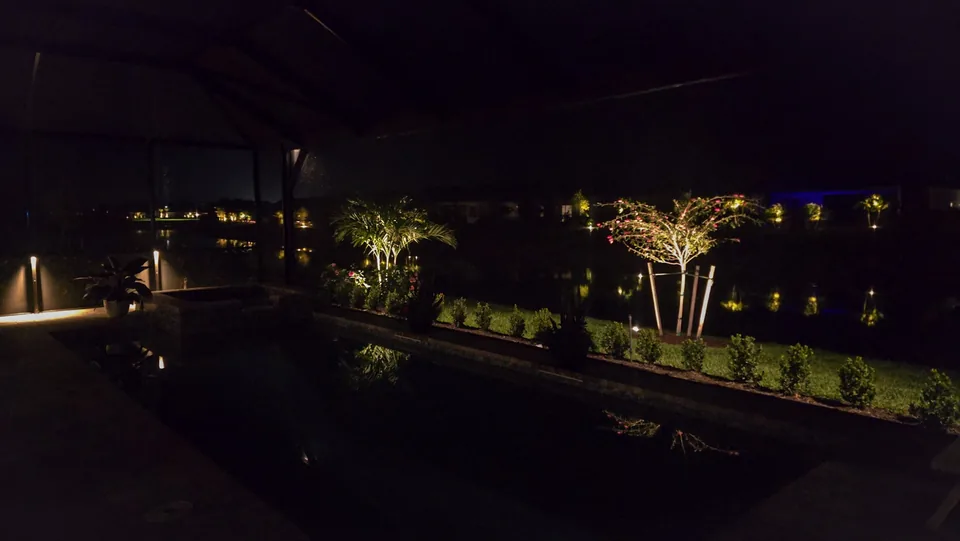
A NightScapes lanai looking out over a lake. The points mark where each animal is usually found around a lit property, not animals in this photo.
On the water
Docks and canals: light at the waterline
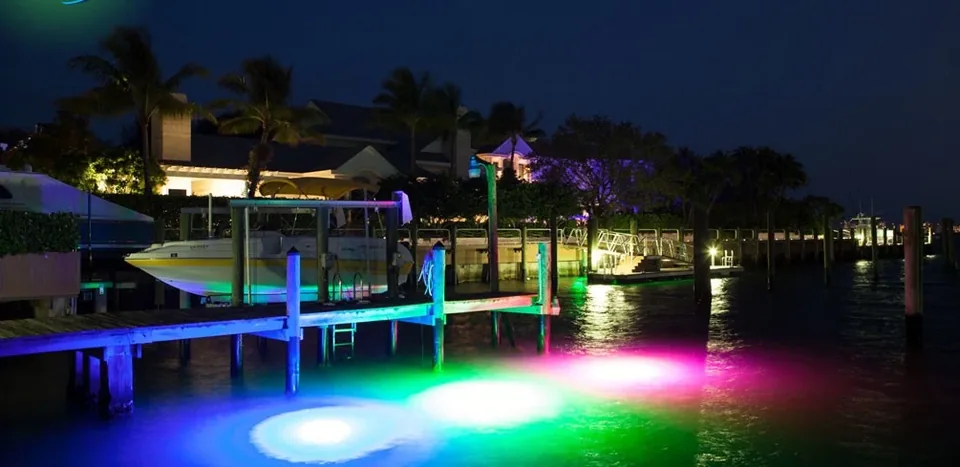
Light at the water changes what happens beneath it. A peer-reviewed study that placed LED spotlights under a wharf found fish predatory behavior was much higher under the lights than on unlit nights. We found no agency guidance on dock lights and manatees, so we say nothing about them. Dock lighting is kept shielded and modest.
Underwater lights at a dock are chosen for what owners want to see, and the evidence on what they do to the water is thin. The honest position is to keep them modest, aimed down and on a schedule rather than all night. Fixtures, color and placement are covered under underwater lights at a dock.
A lit dock changes the water beside it, for better or worse.
Local rules
Rules beyond sea turtles in Lee and Collier: Sanibel, Big Cypress, and what is not regulated
Outside sea turtle protection, wildlife lighting is mostly guidance, not law, in this area. Sanibel's citywide standards aim to minimize disturbance of wildlife and keep its dark sky. Big Cypress is an International Dark Sky Place. We found no Collier, Naples or Lee County rule for birds, bats or insects.
Rules vary by address; most wildlife guidance here is voluntary.
Sanibel
Sanibel’s outdoor lighting standards apply citywide, and their stated purpose includes
minimizing glare, light trespass and skyglow and minimizing disturbance of wildlife. The
code quotes the Sanibel Plan: "In order to maintain the dark sky of this nonurban
community, minimize outdoor lighting." It also states "Uplighting is prohibited," with a
limited exemption for low landscape and path lights.
Big Cypress
The National Park Service describes Big Cypress National Preserve as an International
Dark Sky Place whose night skies "provide important habitat for nocturnal wildlife." It
is a reminder of how dark the land east of Naples still is.
FWC’s wildlife lighting program
FWC frames its Wildlife Lighting Certification Program around wildlife in general, but it
points to the sea turtle guidelines for the criteria, and it marks the program closed.
Its list of certified communities has two entries, neither in Collier or Lee. We do not
call any of our work certified.
Collier, Naples and Lee
Beyond sea turtle protection, we found no county or city rule in Collier County, the City
of Naples or unincorporated Lee County that regulates lighting for birds, bats or insects.
What protects them on most Naples properties is the owner’s choice. For anything visible
from the beach, see turtle-friendly coastal
lighting.
Who plans it: NightScapes Landscape Lighting, Naples
NightScapes Landscape Lighting has lit Naples properties since 1998 and lists responsible wildlife lighting practices among its commitments. Todd and Sherry own and run it, outdoor lighting is the only work it does, and its Google Business Profile shows 63 reviews at 5.0. A wildlife-friendly plan starts with which lights are needed.
We will say plainly what the sources say, including that decorative uplighting is the
first thing they ask to reduce. Most owners do not want to give it up, and few need to:
the answer is usually fewer uplights, lower levels, an earlier curfew and a seasonal
schedule, so the property is lit when people are enjoying it and dark when they are not.
We work across Naples, Marco Island, Bonita Springs, Fort Myers, Sanibel and Captiva,
through Lee and Collier counties. For color, see how color temperature is
specified.
Lighting properties in Naples and Southwest Florida.
Todd and Sherry
Family and locally owned. The owners are the people you deal with.
63 Google reviews
Rated 5.0 on the NightScapes Google Business Profile.
Lee and Collier counties
Naples, Marco Island, Bonita Springs, Fort Myers, Sanibel and Captiva.
Questions we hear
Questions Naples homeowners ask about wildlife-friendly lighting
Whether LEDs attract bugs, whether any light avoids it, whether FWC certification matters, whether green dock light draws fish, whether Florida has fireflies, how to make a yard better for them, and whether to turn lights off for migrating birds. Every fact in these answers is from a named source.
NightScapes Landscape LightingOutdoor lighting only, Naples since 1998
Ask us about lighting and wildlife. Choose a question, or call and we will answer it on the phone.
Do LED lights attract bugs?
Many insects are drawn to light, and research reviewed in 2018 found short, bluer wavelengths disproportionately attractive to many insects. Warmer LEDs draw fewer in some studies. But a 2024 review found color changes generally ineffective in practice. The bigger difference comes from fewer lights, lower, shielded and on a timer.
Is there a light that does not attract bugs?
Not one that attracts none. Dim, low, shielded, warm light on a timer or motion sensor attracts far fewer, which is what the Xerces Society recommends for moths and other insects. Sanibel’s code even defines a yellow "bug" type bulb as one designed to reduce insect attraction. Less light, for fewer hours, is the most reliable answer.
Is FWC wildlife lighting certification important?
FWC’s Wildlife Lighting Certification Program describes itself in terms of wildlife in general, but it points to the sea turtle lighting guidelines for its criteria, and FWC marks the program closed. So it is most relevant on the beach side of a property. We do not describe any of our work as certified.
Does green underwater light attract fish?
Dock light makers say green carries furthest in canal water and draws bait; that explanation comes from sellers. One peer-reviewed study under a wharf did find artificial light changed fish feeding behavior. We found no agency guidance on dock lights and manatees. Underwater lighting is covered on its own page.
We have fireflies in Florida?
Yes. UF/IFAS Extension describes fireflies in Florida and notes that they avoid areas with a lot of artificial light, especially around dusk. A dark garden edge, low and shielded path lights and a curfew give them the best chance on a lit property.
What can we do to make the yard better for fireflies?
Follow the Xerces order: remove purely decorative lights, especially tree and facade lights; keep the lights that stay low and shielded; turn off as many as you can, as early as you can. Darkness at dusk, when fireflies flash, matters most.
Should we turn off outdoor lights for migrating birds?
Audubon Florida asks people to turn out as many lights as possible during migration, and USFWS asks for upward spot and flood lights to be switched off then. Sources give different months, so we set a migration schedule with you rather than quote one window. A zone for the uplights makes it easy.
Ready to light the property and leave room for the night?
Tell us about the property: whether it is near water, the beach or a preserve, what is lit now, and which lights you would miss. We walk it with you and explain what fewer, lower and timed would look like.