Hideaway Beach
The north end of the city’s sea turtle lighting district. FEMA’s flood layer reads Zone VE, 11 feet, at this point.
Marco Island guide
Marco Island writes its own outdoor lighting rules. Every lot in the city answers to a one-footcandle limit at the property line, uplights must hide their lamps and the code even names the snook light. Along the Gulf, a sea turtle district runs from Cape Marco to Hideaway Beach. And on many lots, owl burrows decide where a crew may park.
Tell us about the property
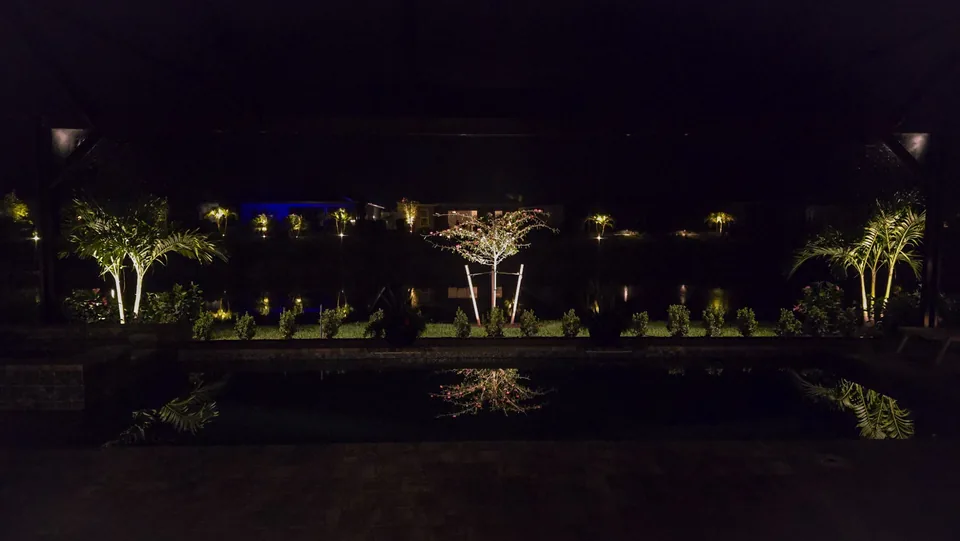
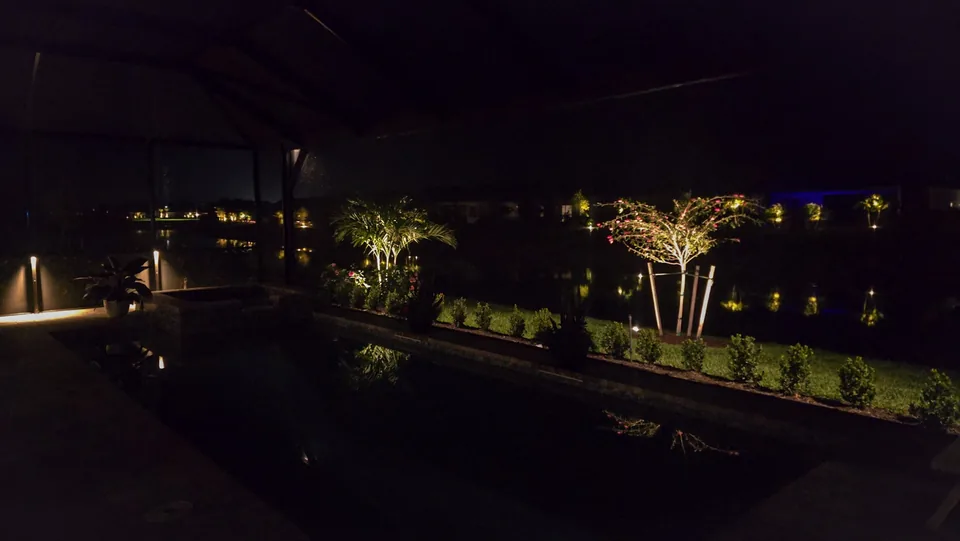
Photograph: a lanai and lake edge at night, shown for the lighting, not the place.
The citywide rule
Marco Island’s outdoor lighting article says no light source may put more than one footcandle onto a neighboring single-family or multifamily lot, or onto a residential street. It is measured at the property line with a calibrated light meter. In practice that means shielded fixtures, careful aiming and beam spreads chosen so the light stays on your lot, which is also what makes a garden look calm instead of glaring. Try it on the side yard below.
Marco Island has been its own city since residents voted to incorporate in 1997, so its code, not unincorporated Collier County’s, governs a Marco lot. The rule is Chapter 6, Article V, first adopted as Ord. No. 99-7 in April 1999 and amended in September 2024. It opens with its intent: lighting is to be shielded so that “the cone of light shall fall substantially within the perimeter of the property.” Sec. 6-145 then sets the numbers: one footcandle onto a neighboring single-family or multifamily lot, one onto any public right-of-way in residential areas, ten onto neighboring commercial property. Public facilities and street lighting sit outside the article.
Because the rule is read with a meter, not by eye, it changes how a plan is drawn. The reading at the lot line is the sum of everything that reaches it, so beam spread and aim matter as much as the number of fixtures. On a narrow canal lot, a wide flood in the side yard can cross the line before it reaches the hedge it was meant for. Modern Marco opened in January 1965 as a planned canal community, so homes on one street can carry lighting from very different decades. The schedule at right is what the article asks of each kind of light. Its wattage tiers were written before LED fixtures, and we do not translate them into LED equivalents.
Source: City of Marco Island Code Ch. 6, Art. V, Secs. 6-141 to 6-147, Municode, read 2026-10-14; incorporation per Audubon; 1965 opening per City of Marco Island, both read 2026-10-14.
On the Gulf
If your home faces the Gulf anywhere from Cape Marco to Hideaway Beach, the city's sea turtle article covers any light visible from the beach. Landscape lights and uplights may not be seen from the sand at all. Path lights stay at 42 inches or lower, aimed down, with beachside shields. Nesting season runs May 1 to October 31, and the city manager can extend it.
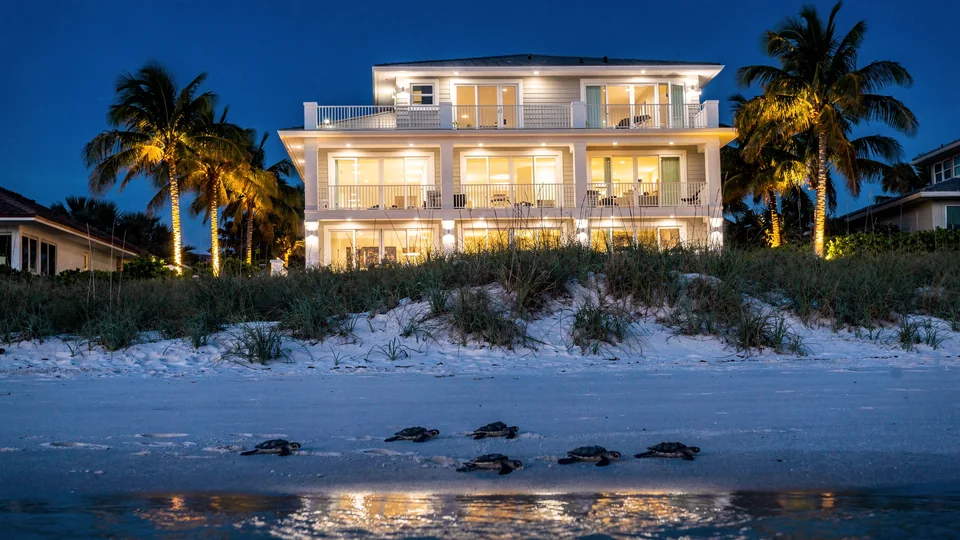
The city’s sea turtle article is Chapter 54, Article V, and its definition is short: “The sea turtle lighting district is defined as all beachfront properties from Cape Marco to Hideaway Beach. Within this district, this ordinance applies to all light visible from the beach.” The test is visibility. For a Gulf-front home or condominium, the question is what can be seen from the sand, not where a fixture sits on the plan.
Hideaway Beach, the north end, is also the name of a city special district, created in 2004 to “improve, renourish, preserve, maintain, monitor and provide public access to the beach property” inside its boundaries. Its powers concern the beach, not lighting; the turtle article is what governs lights there.
The code lists “balcony lights, ceiling fan lights, landscape lights, and up lights” as nonegress lighting, and says “All nonegress outdoor lighting shall not be directly or indirectly visible from any portion of the beach.” Lighting for outdoor areas, which the code says includes pathway, landscape and pool lighting, must be long wavelength, downward directed, full cutoff, fully shielded and mounted as close to the ground as the needed light allows. Pathway fixtures may not exceed 42 inches and use long wavelength lamps and beachside shields. Ponds and fountains on the seaward and shore-perpendicular sides may not throw light the beach can see, and underwater pool lights go in the wall, out of view of the beach.
Marco defines nighttime as 9:00 p.m. to 6:00 a.m. and nesting season as May 1 through October 31, which the city manager can extend by up to 30 days before or after. For existing homes in the district, exterior lights go off after 9:00 p.m. in season, except turtle friendly long wavelength, low and shielded lighting. Long wavelength means 560 nanometers or greater with nothing below 560, and the code adds that lamps reaching it “using filters, gels, or lenses are not permitted.” So an amber lens over a white lamp does not count, and FWC’s own criteria reject color change options. Other places in Southwest Florida use other hours; these are Marco’s.
On a district lot the plan usually becomes two plans: the street side, lit under the citywide article, and the Gulf side, kept dark or held to low, shielded path and step light. FWC adds a caution worth repeating: even fixtures that are low, shielded and long can disorient turtles if there are too many of them. Our turtle-friendly coastal lighting page covers how fixtures are chosen and shielded. We do not describe any fixture or design as approved for turtles.
Sources: City of Marco Island Code Ch. 54, Art. V, Municode (facts ledger F-56 to F-66), read 2026-10-13; Ch. 40, Art. II, Hideaway Beach District, read 2026-10-14; FWC lighting criteria and lighting guidelines, read 2026-10-13.
Where the rules change
Two lighting maps overlap on Marco Island. The whole city sits under the outdoor lighting article, so every lot answers to the one-footcandle limit. The Gulf front from Cape Marco to Hideaway Beach is also inside the sea turtle district. Around the passes, FWC protects nesting birds on Sand Dollar Island and the Caxambas sandbar. Each light on this map marks one of those places.
The north end of the city’s sea turtle lighting district. FEMA’s flood layer reads Zone VE, 11 feet, at this point.
FWC shorebird nesting area, posted March 1 to August 31. FWC gives no lighting rule for these birds; the turtle rules govern beach light.
The water between Marco Island and Isles of Capri, and the name of FWC’s wildlife area at the north end.
A Gulf beach inside the district. A USGS storm tide sensor here recorded 5.20 feet in Irma.
A mid-island Gulf access inside the district. The pin sits on its restroom building, used as a stand-in for the access.
The southern Gulf beach, near the Cape Marco end of the district.
The south end of the district, where beachfront towers stand. The pin is the Belize at Cape Marco point; FEMA reads Zone AE, 9 feet, there.
The bay side near FWC’s Caxambas Pass sandbar. Docks and seawalls here answer to the citywide article, not the turtle district.
Points placed from nominatim.openstreetmap.org. Map data from Google.
Palms and facades
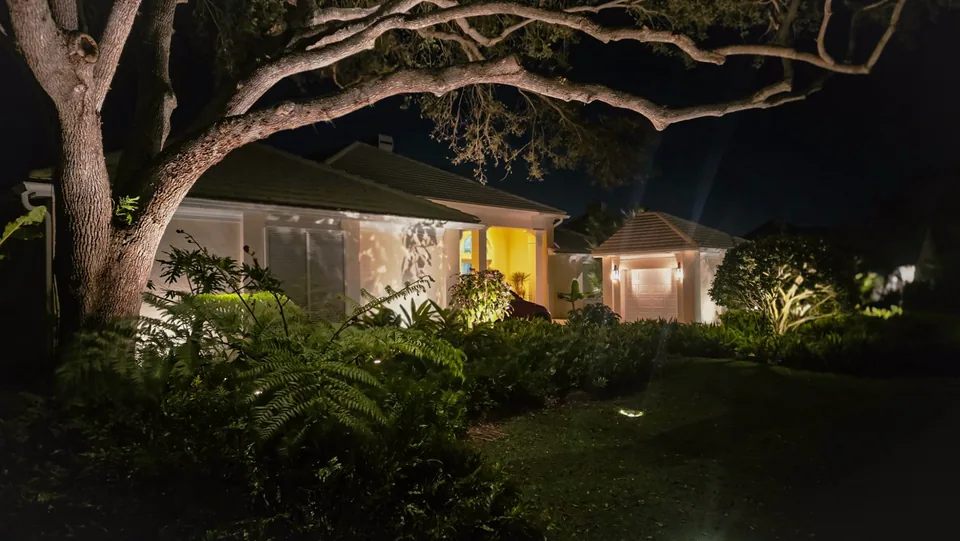
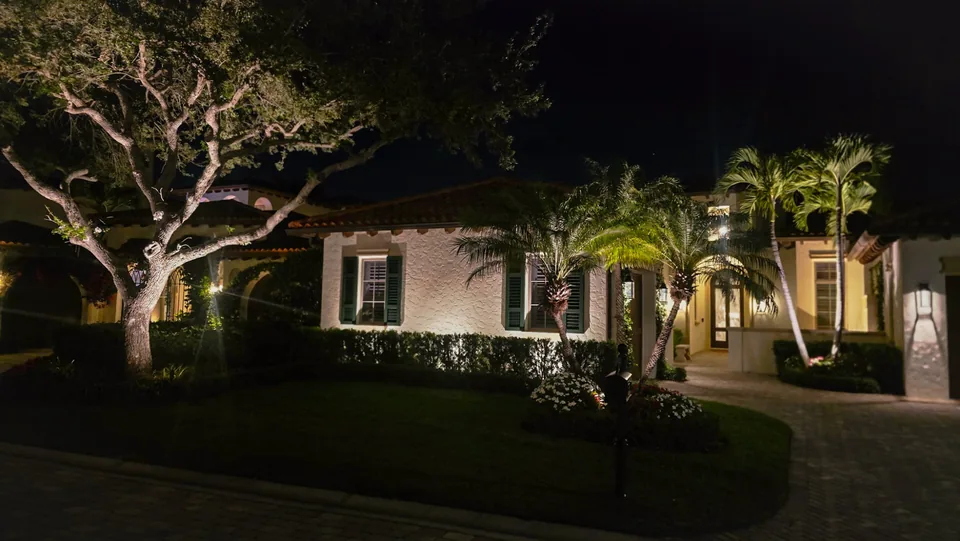
Away from the beach, Marco Island allows uplighting, but every uplight must be shielded so no lit part of the lamp shows from the street or a neighbor's property line. That rules out bare bullet lights pointed at a palm from the lawn edge. Hooded or recessed fixtures, set close and aimed with care, light the trunk and fronds while the glare stays off the street.
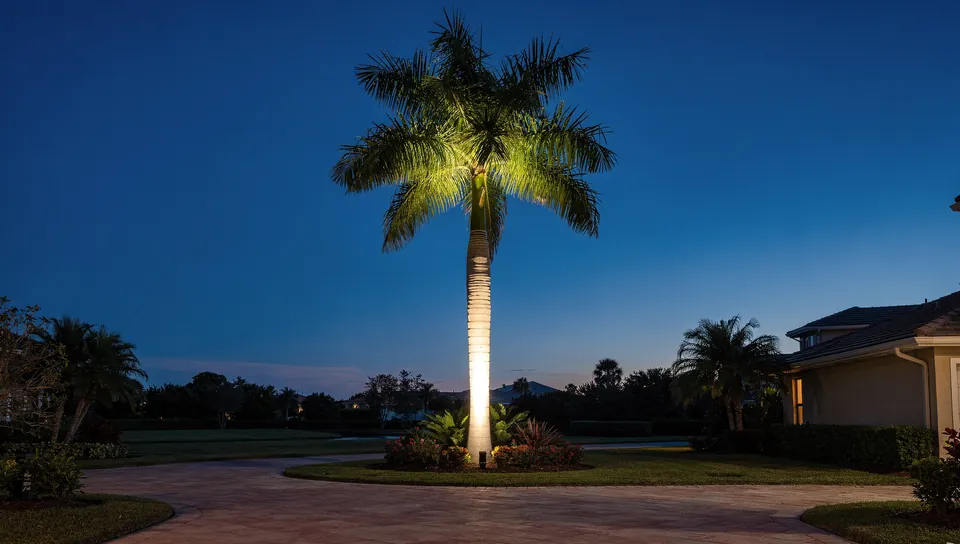
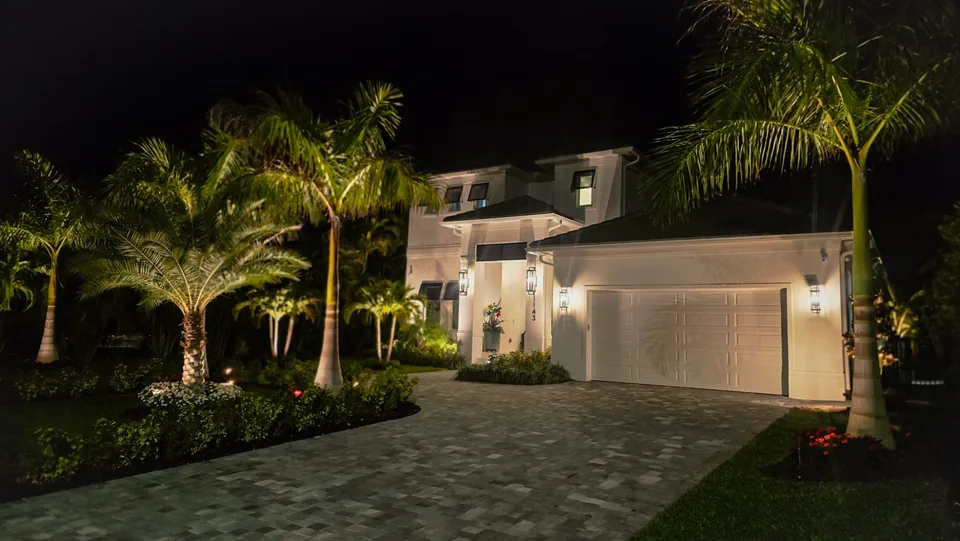
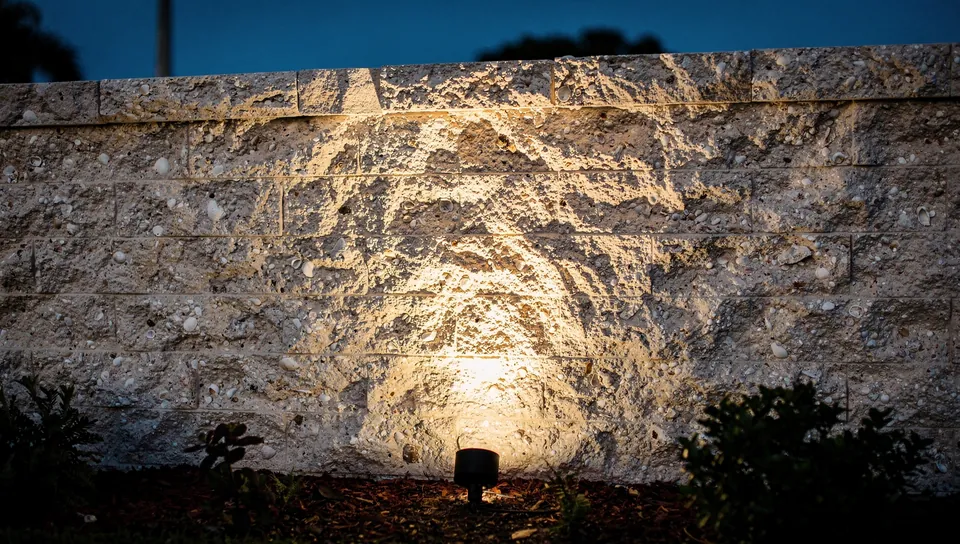
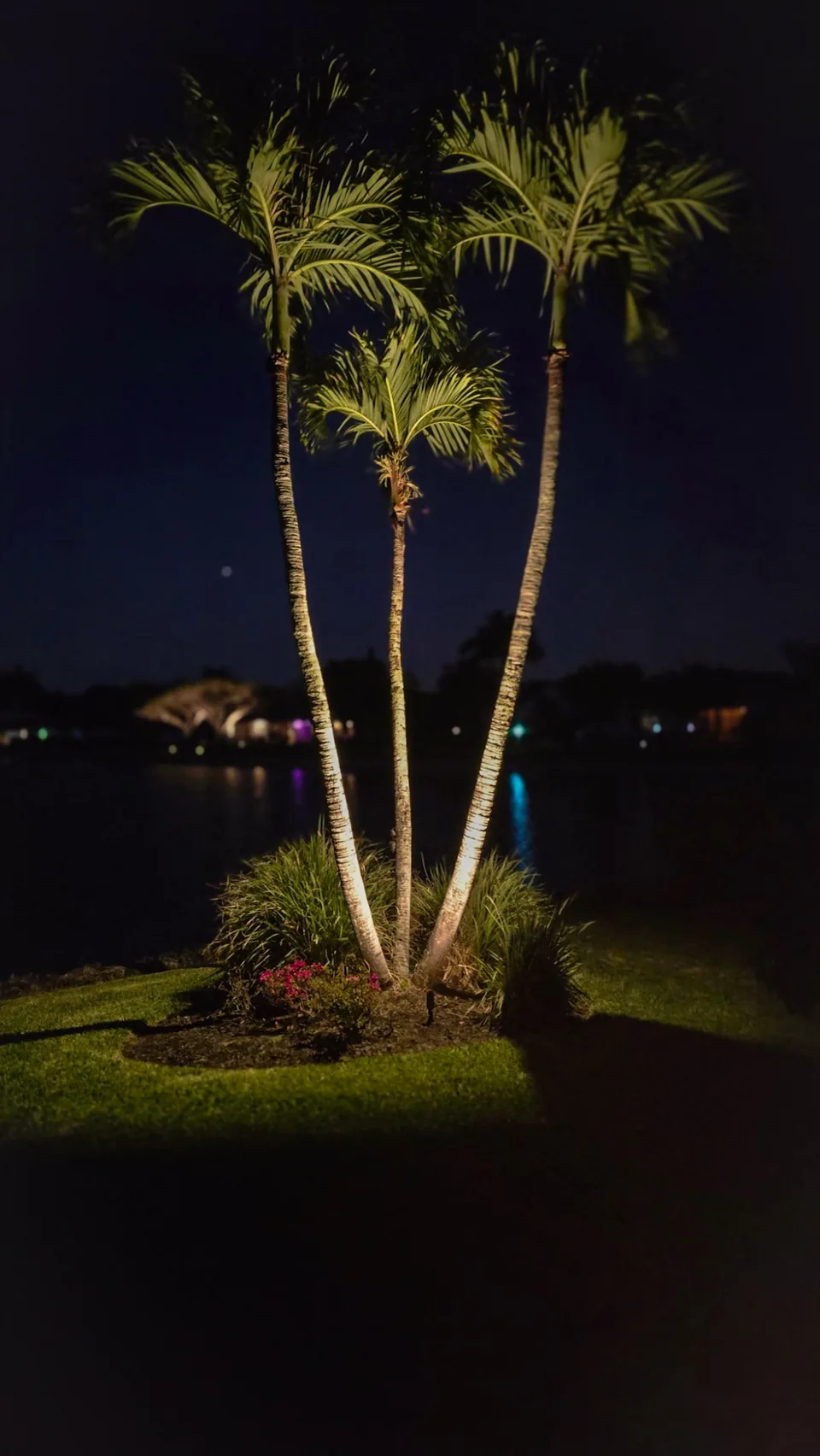
Sec. 6-146 judges an uplight by what someone outside the lot can see. The code says “no illuminated part of the light source shall be visible from any adjoining public right-of-way or property line.” A bullet light set at the lawn edge and tipped back toward a palm usually shows its lamp to every passing car. A fixture moved in toward the trunk, with a hood or a deep-set lamp, puts the light on the palm and keeps the source out of the driver’s eye.
The same test runs along the side and rear lot lines. On a canal street the neighbor’s lanai often looks straight across your side yard, so an uplight near the line is turned with its open face away from them, and a palm close to the line is lit from the side away from it. Whatever spills over still counts toward the one-footcandle cap. On a Gulf-front lot in the turtle district there is a stricter test on the beach side: landscape lights and uplights there may not be seen from the sand at all.
The code’s own definition says uplighting is used “to light up features such as building facades, signs, and trees.” A wall washed with light reads well from the street, which is also where an open lamp is easiest to see. Fixtures set tight to the wall, or recessed in the ground below it, hide the source while the wall takes the light. Our architectural lighting page covers how facades are lit.
One honest caution. The U.S. Fish and Wildlife Service, in guidance written for buildings, names upward directed spot and flood lights among decorative lighting to turn off during bird migration, and it treats fully shielded as meaning zero up light. A shielded uplight meets Marco’s rule and is still an uplight. Fewer of them, aimed tight and on a timer, is the reasonable middle. Our wildlife-friendly lighting page sets out that tension in full.
On the canal
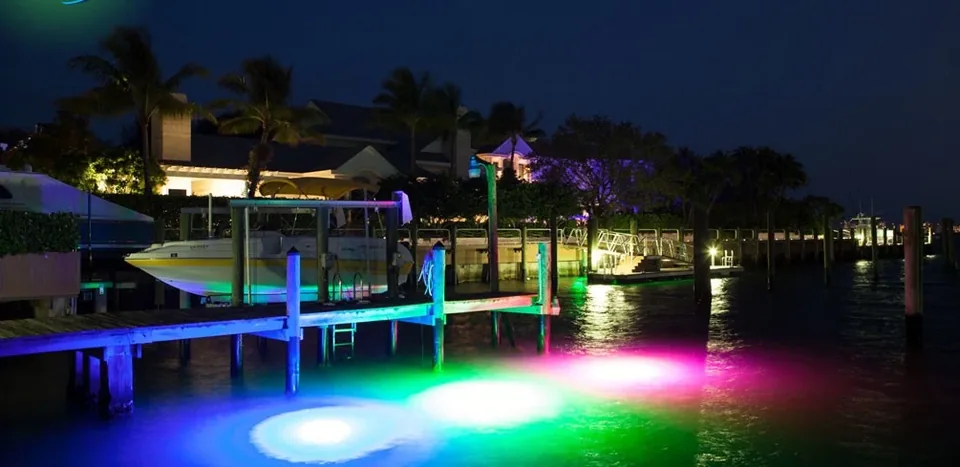
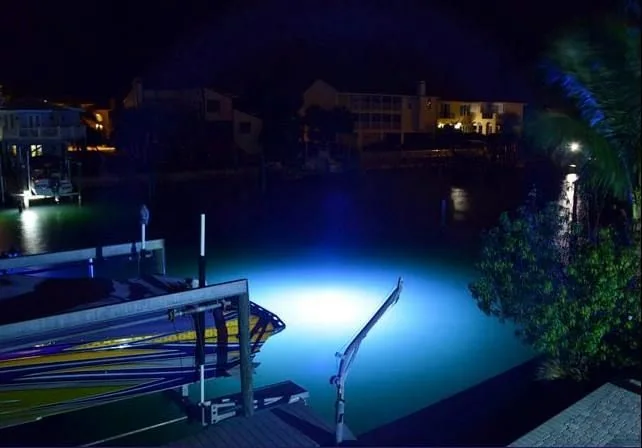
Marco Island's code has its own name for the fish lights many canal homes hang off a seawall or dock: snook lights. The city requires them to be shielded and pointed down at the water. A shielded, downward light is also easier on your neighbors across the canal, who otherwise look straight into it from their lanai. Point at each card to read what the code says.
Before the first trench
Marco Island bans vehicles and equipment within 33 feet of a burrowing owl burrow and 25 feet of a gopher tortoise burrow, and it reminds landscaping crews of the rule by name. Owl nesting season runs February 15 to July 10, and not every burrow is marked. Before any trenching for wire, walk the lot, flag burrows and route the work around them.
The city’s listed species article names the burrowing owl and the gopher tortoise among “the most commonly found listed species on Marco Island,” and Sec. 18-144 is blunt about crews: “operation and parking of any vehicles or equipment is prohibited within 33 feet of burrowing owl burrows and within 25 feet of gopher tortoise burrows.” It also says contractors and lawn and lot maintenance companies “shall accept full responsibility for the actions of their employees”.
On June 10, 2026 the city reminded “contractors, businesses, landscaping professionals, and residents” of that rule, gave owl nesting season as February 15 to July 10, called both animals State Threatened and warned that “Not all Burrowing Owl burrows are marked”. FWC’s burrowing owl guidelines, revised in August 2025, expect disturbance within 10 feet of a potentially occupied burrow at any time of year, or within 33 feet during the breeding season, to cause take.
Why it comes up so often here: Audubon reported in 2020 that hundreds of pairs nest across the island in empty lots, front yards, parking lots and medians, that a local team knew of burrows on some 392 properties, and that close to 95 percent of nests were on empty parcels. Those are 2020 figures, not a current count. For a lighting job, the point is that the vacant lot beside you, or your own side yard, may hold a burrow.
What we will not say: no source we read connects artificial light to burrowing owls, for good or harm. FWC’s guidelines use the word only for light equipment such as weed trimmers. On Marco, the owl question is the trench, the truck and the trailer, not the fixture.
Sources, read 2026-10-14: Marco Island Code Ch. 18, Art. V, Municode; City of Marco Island notice, June 10, 2026; FWC burrowing owl guidelines and approval release; Audubon, 2020.
The north end
Sand Dollar Island is part of FWC's Big Marco Pass Critical Wildlife Area, where least terns, black skimmers and Wilson's plovers nest, and nesting areas may be posted closed from March 1 to August 31. FWC gives no lighting rule for these birds. Its beach lighting advice is about sea turtles, so the turtle district rules are what govern Gulf-facing lights here.
FWC lists three Critical Wildlife Areas on or beside Marco Island. Big Marco Pass, 456 acres, is “Locally known as Sand Dollar Island” and “hosts hundreds of nesting shorebirds during the breeding season, including state-threatened black skimmers”; its submerged mudflats are posted year-round. The ABC Islands, on the northwest side, are three mangrove islands and their waters, 68 acres closed to the public all year. Its focal species are herons, egrets and brown pelicans, and FWC records nesting and roosting there by state-listed little blue and tricolored herons. Caxambas Pass is a 2-acre sandbar that “provides habitat for nesting seabirds and shorebirds”; when it is posted, no boat may land.
None of those pages gives a lighting rule for the birds. FWC asks people on the shore to help by “keeping beaches clean and dark,” but the reason it gives for turning lights off is sea turtles, and its one statement tying bright light to nesting birds is about personal fireworks. So we will not tell you a garden light harms a skimmer. What FWC does say, in general, is that “Artificial lighting is another form of habitat loss,” and that keeping light low and fully shielded cuts the glare and light animals can see.
On the Gulf, the turtle district governs. On the pass and bay side, the citywide article does: shielded fixtures, one footcandle at the line, snook and dock lights aimed down. Beyond the rules, our own advice for a lot facing the mangroves or the open pass is to leave the water and the shoreline edge unlit. That is judgment, offered as judgment, not a requirement. For deck and seawall light that stays on the boards, see deck and dock lighting.
Sources: FWC Critical Wildlife Areas, Big Marco Pass, ABC Islands and Caxambas Pass, read 2026-10-14; FWC beach-nesting release and light pollution page (ledger F-206, F-207, F-227), read 2026-10-13.
Coconut palms
Marco Island treats any coconut palm infected with lethal yellowing as a public nuisance that must come out, and it runs an inoculation program for susceptible palms. If a coconut palm is the centerpiece of your lighting plan, ask whether it is being inoculated, and set the fixture and its cable so they can serve a replacement tree planted in the same spot.
0 of 5
Asked, anchored, cabled for the next palm, shielded and kept off the beach side.
Asking about the tree first is the step that saves a buried run later.
Sec. 18-171 declares an infected coconut palm a public nuisance that must come out. Know its status before it anchors a design.
The article is Sec. 18-171, and its words are plain: “Any tree infected with PLY, including without limitation, all species of coconut palm trees and any tree that is a carrier of the disease, is hereby declared a public nuisance.” PLY is palm lethal yellowing. The same article sets up the inoculation program and requires infected or carrier trees to be removed. For the palms you do light, see tree and palm uplighting. Sources: Marco Island Code Ch. 18, Art. VI, Sec. 18-171, Municode, read 2026-10-14; FWC sea turtle lighting page (ledger F-18), read 2026-10-13.
Water and wind
Hurricane Irma made its final landfall near Marco Island in 2017, and Ian left a 4.7 foot high water mark on the island in 2022. The city says every property is in, on or near a Special Flood Hazard Area. Before a design is final, ask where the transformer, the timer and the connections will sit relative to your lot's flood elevation.
The National Hurricane Center’s report on Irma says it “made its final landfall near Marco Island, Florida” on September 10, 2017, that the Marco Island Police Department reported a gust of 113 knots, and that there was “heavy tree and power pole damage in Marco Island, Golden Gate, and portions of Naples.” A USGS storm tide sensor at Tigertail Beach recorded a 5.20 foot storm tide. For Ian in 2022, the report says only a few high water marks were collected, “with a maximum of 4.7 ft AGL on Marco Island,” and the same sensor shows a 7.38 foot storm tide.
The city’s floodplain page states that every property on the island is “in, on, or near a Special Flood Hazard Area,” and that Marco holds a class 5 rating in FEMA’s Community Rating System. FEMA’s flood layer, read at single points, shows Zone AE with a 10 foot base flood elevation at the city’s center point, AE at 9 feet at Cape Marco and VE at 11 feet at Hideaway Beach. Those are point readings, not your lot’s zone. The city’s floodplain staff can give you that.
Low-voltage fixtures sit in the beds and are made for wet ground. The transformer, the timer and the connections are not. On Marco we would settle where they sit against your lot’s flood elevation before anything else, keep connections sealed, and plan the runs so one flooded zone does not take the whole system down. That is our judgment, not a code requirement.
Marco has six miles of Gulf beach. FEMA, writing about building connectors and fasteners, says airborne salt “is greatest near breaking waves and declines rapidly in the first 300 to 3,000 feet landward of the shoreline,” which puts the beachfront homes and towers from Cape Marco to Hideaway Beach in the heaviest band. After a storm, see storm damage repair and transformer and timer repair.
Sources, read 2026-10-14: NHC Irma report and Ian report; City of Marco Island floodplain management and history; FEMA flood hazard layer point queries. FEMA Technical Bulletin 8 (ledger F-158), read 2026-10-13.
Listed species
The city's listed species ordinance names the bald eagle among the species most commonly found on Marco Island, and Audubon reports a monitored nest on land Collier County bought for preservation in 2023. We found no agency lighting rule for eagles. The practical point is the same as for owls: know what lives on or next to your lot before work starts.
The city’s listed species article names what a permit applicant must survey for as “the most commonly found listed species on Marco Island”: the burrowing owl, the gopher tortoise, the osprey, the bald eagle, and a list of beach-nesting and migratory coastal birds that includes the American oystercatcher, black skimmer, least tern, piping plover, red knot, snowy plover, reddish egret, roseate spoonbill, tricolored heron and little blue heron.
Audubon reported in November 2023 that Collier County approved buying 3.22 acres of preservation land on Marco Island under its Conservation Collier program, and that a volunteer had monitored a bald eagle nest on one of the parcels since 2019. The same land is home to burrowing owls and gopher tortoises. The article does not say where the parcels are, and we do not map them.
We found no agency lighting guidance for eagles, and we will not write one. What the list does tell a homeowner is that a Marco lot may sit beside animals the city expects to be surveyed for. The useful steps are the ones that apply to owls: know what is on or next to the lot, keep crews and equipment where the city’s rules allow, and ask the city when you are unsure what applies. For lighting choices around any wild edge, our wildlife-friendly lighting page sets out what the agencies do and do not say.
Sources, read 2026-10-14: Marco Island Code Ch. 18, Art. V, Sec. 18-143, Municode; Audubon Florida, November 2023. Migration guidance: USFWS (ledger F-214, F-215), read 2026-10-13.
Who does the work
NightScapes Landscape Lighting is a Naples company that has done outdoor lighting, and only outdoor lighting, since 1998. Todd and Sherry own and run it, Marco Island is part of the area it serves, and its Google Business Profile shows 63 reviews at 5.0. This guide was written from Marco Island's own code, FWC pages and federal storm reports, each linked where it is used.
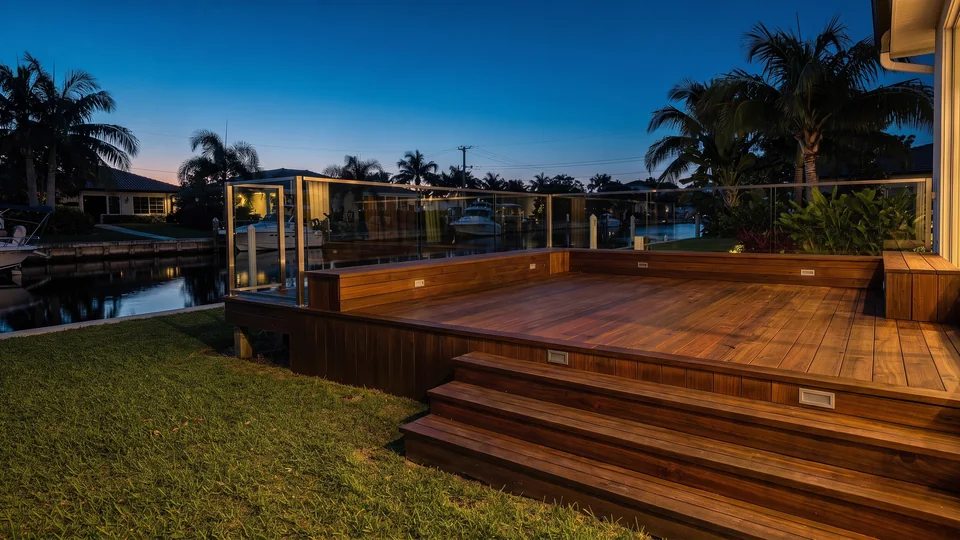
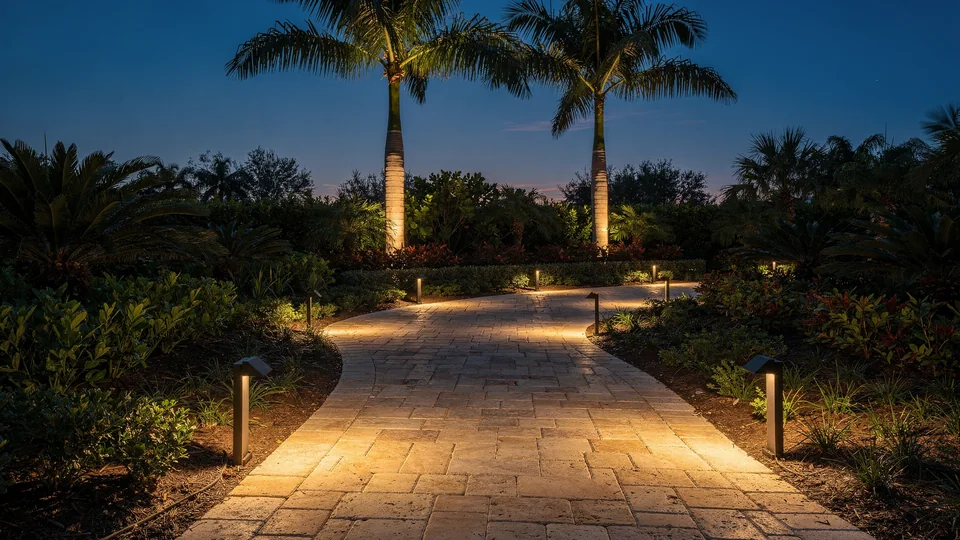
The photographs here show lighting, not particular Marco Island homes, and the drawings are labeled as illustrations. Where a rule is Marco’s own, the page says so; where it comes from FWC or Collier County, it says that instead. On an island with its own code, that difference is the first thing to get right.
Ask about a Marco Island plan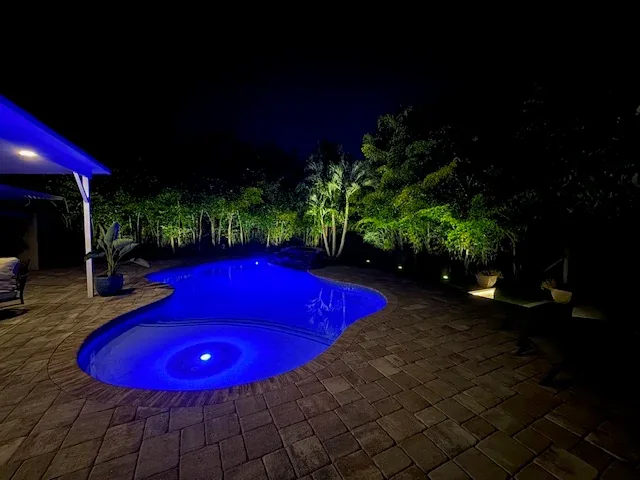
Questions we hear
These are the questions Marco Island's own code and the agencies' pages raise: rules away from the beach, uplights on Gulf-front lots, turtle hours, snook lights, an owl burrow next door, how the footcandle limit is checked, Sand Dollar Island's birds and where a transformer should sit. Each answer is drawn from those sources.
 NightScapes Landscape Lighting Outdoor lighting only, Naples since 1998
Choose a question
Ask us about lighting on Marco Island. Choose a question, or call and we will answer it on the phone.
Yes. Marco Island’s outdoor lighting article applies citywide, not only on the beach. It caps light falling on a neighboring residential lot or a residential street at one footcandle, measured at the property line, and it requires uplights to be shielded so no lit part shows from the street or property line. Floodlights and snook lights must be shielded and aimed down.
Not where the light can be seen from the beach. Inside Marco Island’s sea turtle lighting district, landscape lights and uplights count as nonegress lighting, which may not be directly or indirectly visible from any part of the beach. Palms on the street side may be uplit if the fixtures are shielded as the citywide article requires. Ask for a beach-side view check at night.
Marco Island defines nighttime as 9:00 p.m. to 6:00 a.m., and nesting season as May 1 through October 31, which the city manager can extend by up to 30 days. In the beachfront district, existing exterior lights must be off after 9:00 p.m. in season unless they are turtle friendly long wavelength, low and shielded. Other jurisdictions use different hours.
Marco Island’s code defines a snook light as a light on a dock or seawall meant to attract fish, and its lighting schedule lists snook lights as needing both a shield and a downward aim. So a dock light is not banned by that article, but an open, sideways light aimed across the canal does not meet it. Shield it and point it at the water.
Work can be planned around it. Marco Island prohibits operating or parking vehicles and equipment within 33 feet of a burrowing owl burrow, and FWC expects disturbance within 10 feet at any time, or 33 feet in nesting season (February 15 to July 10), to cause take. Keep crews, trucks and trenching outside those distances and call the city with questions.
The code says light intensity and glare are measured in footcandles at the property line, using a direct reading from a portable light meter that is factory tested and calibrated. The limits are one footcandle on neighboring single-family or multifamily lots and on residential streets, and ten footcandles on neighboring commercial property.
FWC protects Sand Dollar Island as the Big Marco Pass Critical Wildlife Area for least terns, black skimmers and Wilson’s plovers, but no FWC guidance we read gives a lighting rule for these birds. FWC’s reason for dark beaches is sea turtles. On Gulf-facing Marco lots, the city’s sea turtle district rules are the ones that govern beach-visible light.
Plan for it. The city says every property on the island is in, on or near a Special Flood Hazard Area, Irma’s final landfall was near Marco Island, and Ian left a 4.7 foot high water mark on the island. Ask your designer where the transformer, timer and connections will sit relative to your lot’s flood elevation, and check your lot’s zone with the city.
Free Consultations and Estimates
Tell us the street, whether the lot faces the Gulf, a canal or the bay, what is lit now and what you would like to see at night. We look at it with you, from the street, from the lot line and, on the Gulf, from the sand.
Tell us about the property