Putting landscape lighting right after a storm in Naples
After a storm the lighting is the last thing on anyone's mind, and the first temptation is to switch it on and see what works. Don't. It is put right in order, from the power outward, and the order is what keeps it safe.
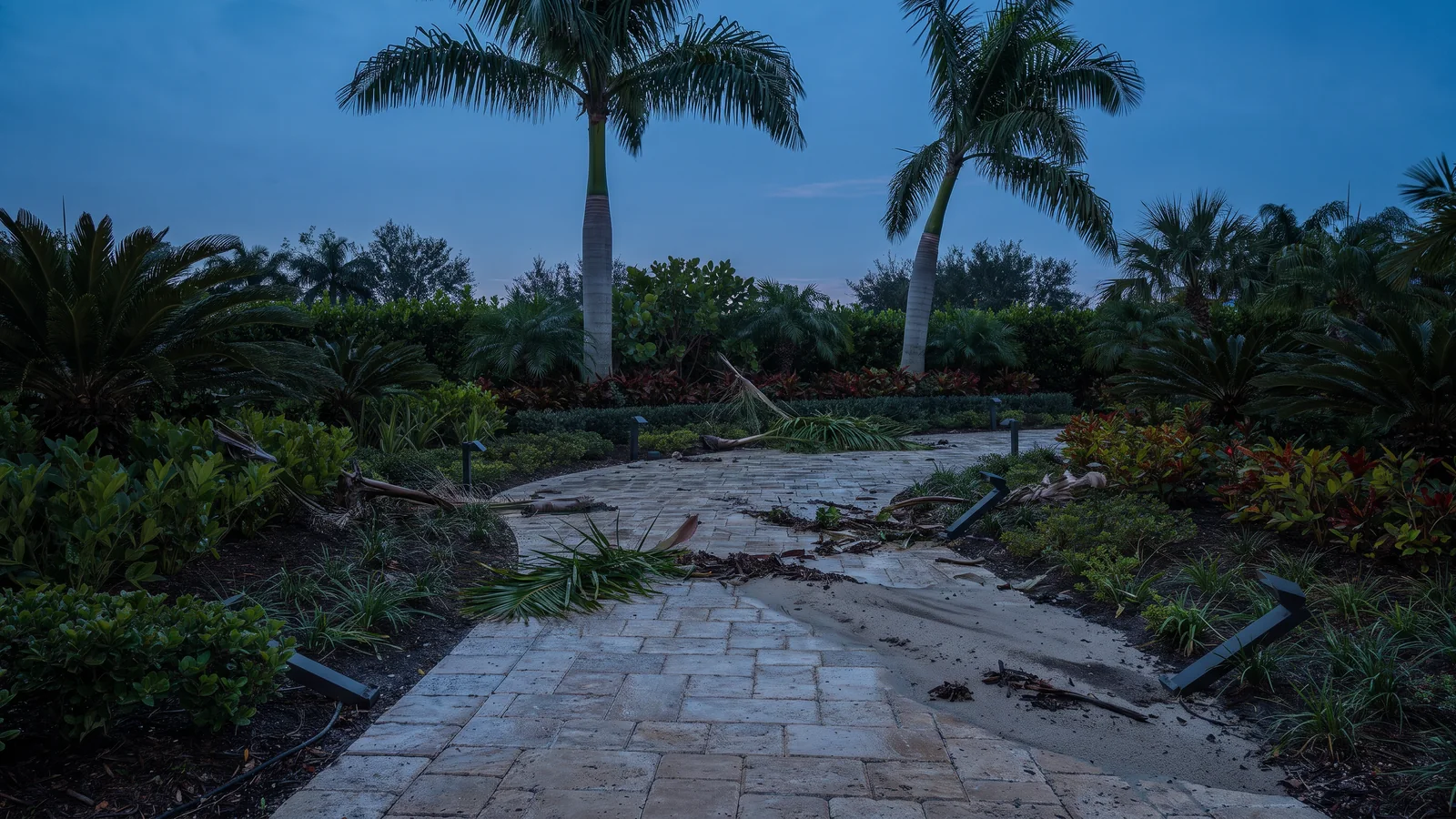
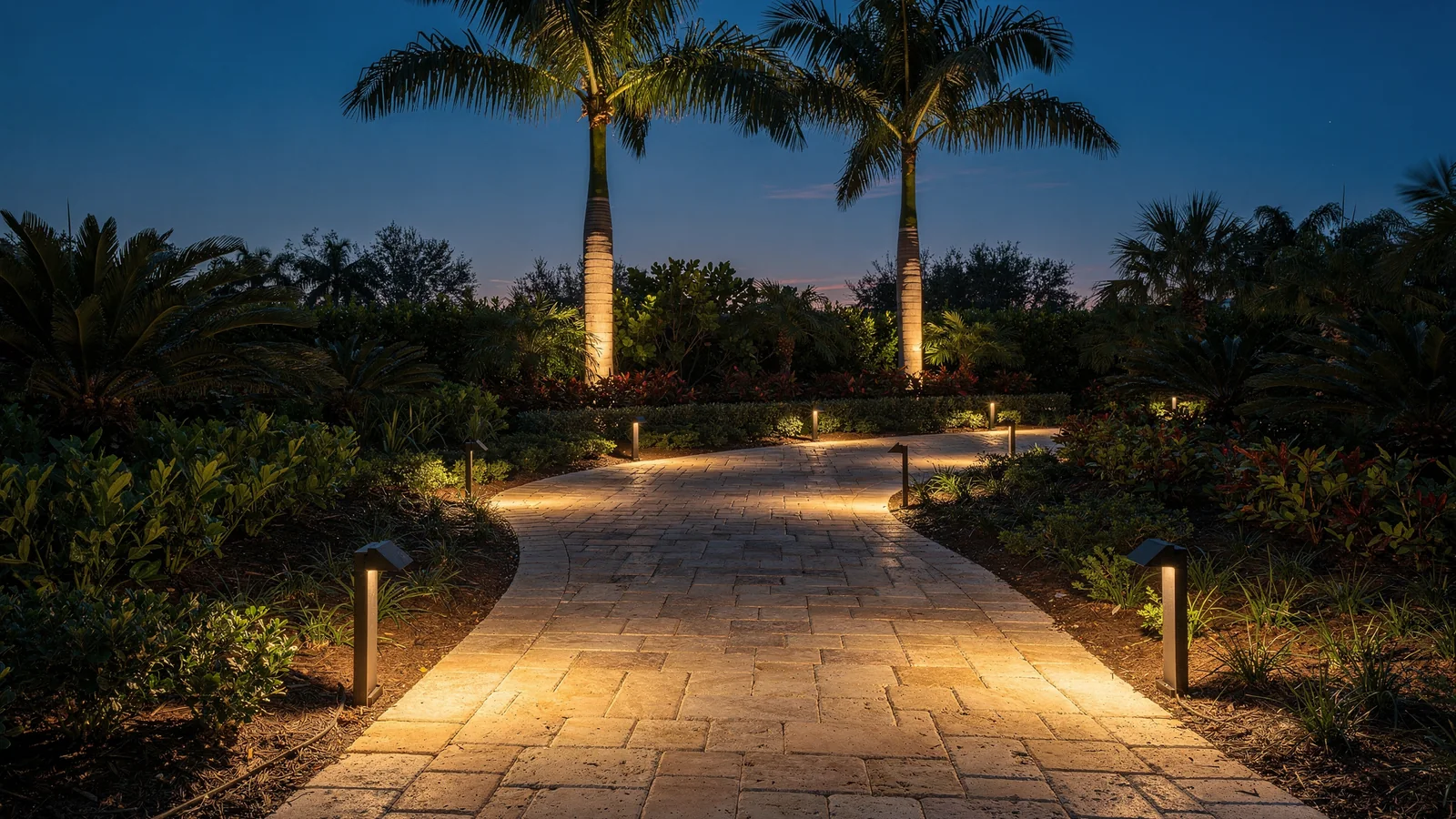
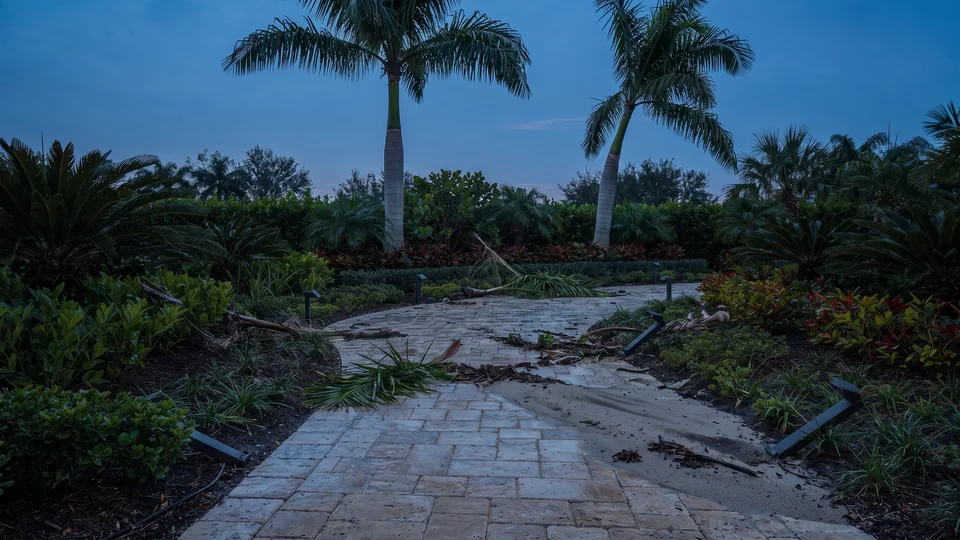
Illustration: after the storm at left, put right at right
If a storm has just passed
What to do about the lights in the first days after a storm
If a storm has just come through and the lights are out or acting strangely, leave the system off, especially if the transformer or its outlet got wet. Walk the property in daylight and note what moved, what is under water or sand, and where cable is showing. Do not reset a tripped outlet to see what happens.
A landscape lighting system is low voltage at the fixtures, but the transformer that feeds it plugs into the house supply. If floodwater, rain driven by wind or a surge reached that outlet or the transformer, switching on is the one thing not to do. A tripped ground fault outlet after a storm is a device doing its job.
What helps most in the first days is a careful look in daylight and some notes. Which fixtures are leaning or flat, which are buried, which are under water, where the cable has come up, and how high the water got near the transformer. Photographs, dated, are better still, especially for an owner who is away and relying on someone else to look.
Then the system is put right in a fixed order, from the power outward. That order is the middle of this page.
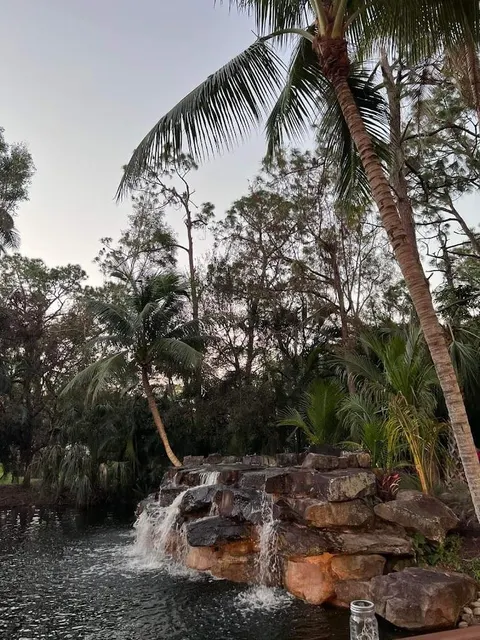
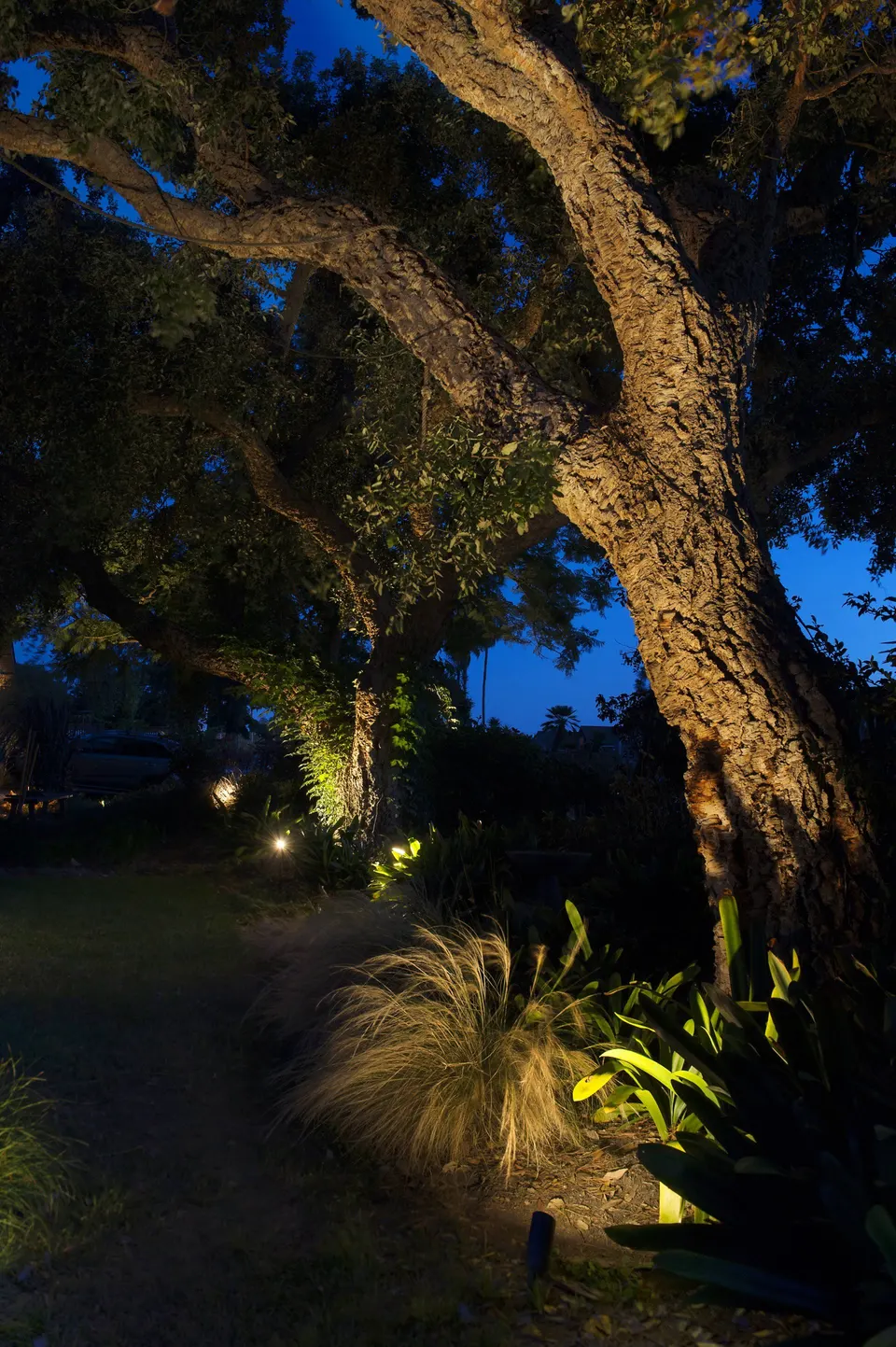
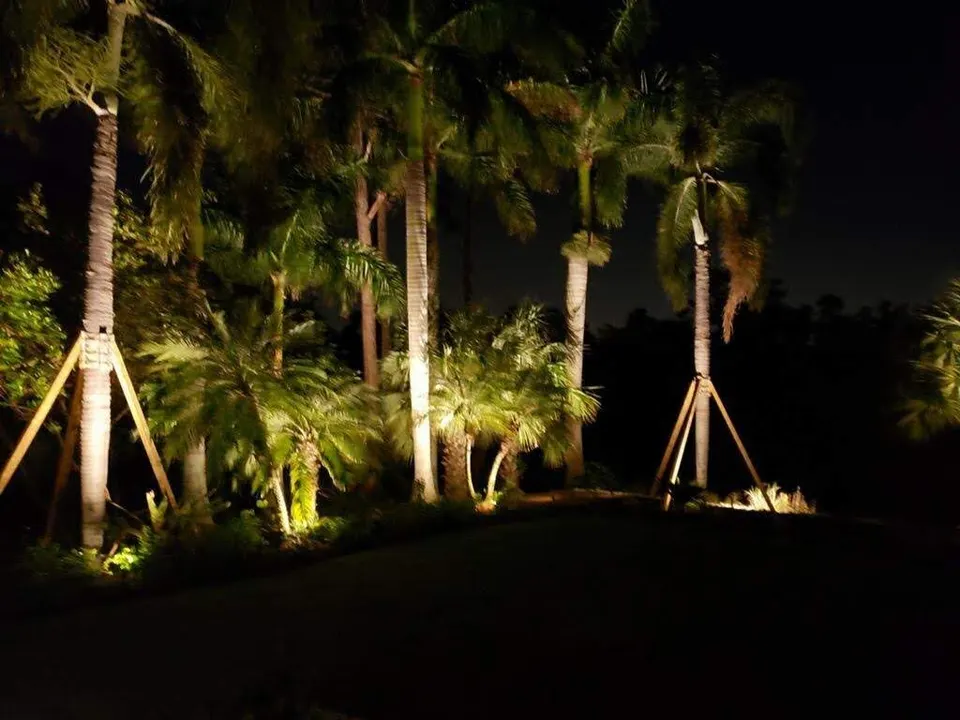
A coconut palm over a pond. After a storm, everything near water is checked first.
Do
Leave the system off, walk it in daylight, note and photograph what you see.
Do not
Reset a tripped outlet, switch on to test, or handle exposed cable.
Then
Have it checked from the power outward, before it is relied on.
Wind damage
What wind does
Wind damage to a lighting system is mostly mechanical and easy to see. Debris and fronds land on fixtures, saturated ground lets stakes lean, a tipping tree lifts cable with its roots, tree-mounted downlights turn, and moving sand and mulch bury low fixtures. Note it all; move little until it is checked. Point at each.
Illustration
Debris on fixtures
Point here to see what to look for
What happens
Fronds, branches and roof debris land on fixtures, crack lenses and bend stems.
What to look for
Fixtures under debris, cracked glass, heads knocked flat.
Leave it?
Clear what is on top. Do not stand a broken fixture back up and switch on.
Illustration
Stakes pulled and fixtures knocked flat
Point here to see what to look for
What happens
Saturated ground lets stakes lean. A tree that tips lifts the cable with its root plate.
What to look for
Fixtures pointing at the sky or the house; cable showing at the surface.
Leave it?
Note it and leave exposed cable alone until the system has been checked.
Fixtures in the trees
Point here to see what to look for
What happens
Limbs shift, downlights turn, and the cable running up the trunk is pulled or snagged.
What to look for
A downlight aimed at the house, or cable hanging from a limb.
Leave it?
Yes. Tree work after a storm is for the arborist first, then us.
Buried by sand and mulch
Point here to see what to look for
What happens
Wind and water move sand and mulch, and low fixtures disappear under it.
What to look for
Path lights and well lights you can no longer find.
Leave it?
Mark where they are. They are dug out during the repair, not before.
Flood damage
What water does, and why salt is different
Rain flooding and storm surge do different damage. Fresh water gets into sockets and splices and mostly dries out, and parts that dry clean can often return to service once checked. Salt water leaves its salt behind on terminals and connections, and it keeps corroding them long after the water has gone. Raise the water on the lot below.
Illustration, not to scale. Drag the water up or down on the drawing, or use the slider.
Rain flooding
Fresh water from rain and runoff gets into sockets, fixtures and splices that were never
meant to be submerged. Much of it dries out, and parts that have dried and are not
corroded can often return to service once checked. Fixtures that held water against the
lamp, or have fogged lenses, need opening.
Storm surge and salt water
Salt water is different. When it drains away, the salt stays behind on sockets, splices
and terminals and keeps working on them. FEMA notes that ocean salts "accumulate on metal
surfaces and accelerate the electrochemical reactions that cause rusting." A part that
looks dry can be corroding inside. Anything a surge reached is treated as salt damaged
until it is opened.
Salt keeps working after the water has gone.
Why damp lasts
FEMA also notes that "the longer a surface remains damp," the higher the corrosion rate.
After a storm the ground stays wet for days and enclosed fixtures stay damp longer. That
is why water damage often shows weeks later, as a run that flickers or a fixture that
finally goes dark.
A damaged system is restored from the power outward, never by switching on and seeing what lights. Each step makes the next one safe and tells it where to look. Scroll through the order on this illustration, from everything off to everything aimed.
First
Power made safe
The outlet and the transformer’s supply are checked before anything is energized. If water reached them, they stay off until they are inspected, and anything damaged is replaced.
Checked
Outlet, cover, ground fault device, cord.
Lights on
None yet.
Second
Transformer and controls
The transformer, its terminals and its timer or controller are opened and checked for water, salt and surge damage. Only when the cabinet is sound does any run get power.
Checked
Terminals, breaker, timer, photocell.
Lights on
The first run, to test it.
Third
Main runs and splices
Each run is brought up and measured. Cut cable, flooded splices and corroded connections are found and remade, run by run, until each section of the property is powered.
Checked
Every splice the water reached.
Lights on
Section by section.
Fourth
Fixtures
Fixtures that held water, cracked or bent are opened, dried, repaired or replaced. Buried ones are dug out and reset at grade.
Checked
Lenses, sockets, seals, stems.
Lights on
Nearly everything.
Last
Aim reset, and a record made
Only then is the system re-aimed against whatever the storm left standing. Everything that was found and done is written down, so the next storm starts from a known state.
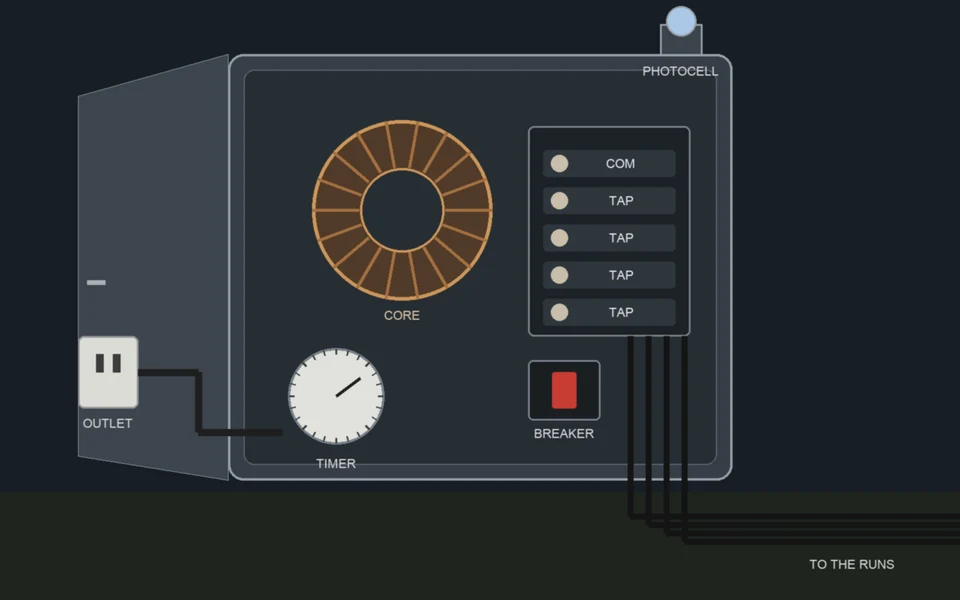
The transformer is the part of the system tied to the house supply, so it is checked first and never switched on wet. How high it was mounted, and whether water reached it, decide what happens next. A ground fault device that trips is doing its job. A soaked transformer is not energized to see what happens.
Illustration of a transformer cabinet and its outlet.
Where it was mounted
Transformers are usually mounted on a wall or post near an outdoor outlet. If the water
line came up to it, or near it, it is treated as flooded. If the water stayed well below
and the cabinet is dry inside, it may be fine, and it is still opened and looked at
before power goes back on.
The ground fault device
Outdoor outlets are usually protected by a ground fault device that cuts power when
current leaks where it should not, which water makes likely. If it trips after a storm,
that is protection working. Resetting it again and again, or bypassing it, removes the
one thing standing between a wet fault and the house supply.
A tripped outlet after a storm is not a problem to be reset. It is a warning to be heeded.
Repair or replace
A transformer that sat in salt water usually has corrosion at its terminals and is often
replaced. One that stayed dry may only need its connections cleaned and tightened. The
cabinet in detail is on
a transformer cabinet that took on water.
Sometimes the lighting survives and the landscape does not. A thinned canopy, a tree that is gone or a hedge that no longer screens a fixture changes what the light falls on and who can see it. Fixtures are re-aimed, relocated or retired, and sometimes the layout itself needs rethinking.
A canopy that thinned in a storm needs its light reset.Fixtures follow the trees that are still standing.What a hedge hid, the street can now see.
Lost canopy
A tree that lost half its crown no longer carries the light it was aimed at. Uplights reach a thinner canopy and look harsh; moonlights in it have less to shine through. The fixtures are re-aimed, lowered, or moved to the tree that took its place.
Trees that are gone
Where a tree was removed, its uplights now aim at a gap and any downlight in it has no home. Those fixtures are relocated to what is left, or retired, and the run is tidied so nothing is left powered in an empty bed.
New sight lines
With planting gone, fixtures that were hidden can now be seen from the street or the water, and lamps that were shielded by a hedge face straight at a neighbor. Those are re-aimed or re-shielded first. If the layout no longer makes sense, it is time for reworking the layout around the trees that are left.
For your records
What to photograph and write down before anything is moved
Before anything is cleared, moved or repaired, a few photographs and notes are worth having: where the transformer is and how high the water came, which fixtures are out of position or missing, where cable is exposed, and which fixtures are holding water. Date them. They help the repair, and they are your own record.
0 of 6
Ready to send
That is the whole list. Send it with the photographs, and the repair starts from what you saw rather than from a guess.
Nearly there
Worth finishing before anything is cleared. The transformer and any exposed cable matter most.
Start with the transformer
Where it is and how high the water came. Then walk the property in daylight with a phone and work down the list.
For an owner who is away, this is the list to send to whoever is looking at the property.
Priorities
What can wait and what cannot
After a storm, exposed or energized damage comes first, then anything in a walking path, and only then how it looks. Aim, lenses and appearance are real and can wait until the system is safe and working. Answer three questions about what you can see, and see where it falls.
Question 1 of 3
Did water reach the transformer or the outlet it plugs into?
Question 2 of 3
Is any cable showing above ground?
Question 3 of 3
Is anything broken, knocked over or buried where people walk?
Where each answer leads
Our answer
First: anything energized or exposed
A wet transformer, an outlet that took water, or cable showing where people walk. It is a safety matter before it is a lighting matter. Leave the system off and keep people away from exposed cable until it is checked.
Path and step lights knocked over or buried, broken glass at a fixture. People will walk there in the dark before the lights are back, so mark them or move debris clear by daylight.
Aim, lenses, levels and the overall picture. It matters, and it can wait until everything else is safe and working. It is set at the end of the repair.
Who puts it right: NightScapes Landscape Lighting, Naples
NightScapes Landscape Lighting has worked on landscape lighting in Naples since 1998, through every storm season since. Todd and Sherry own and run it, outdoor lighting is the only work it does, and its Google Business Profile shows 63 reviews at 5.0. A storm repair is done in order, from the power outward.
We work on the coast and inland across Naples, Port Royal, Aqualane Shores, Royal
Harbor, Pelican Bay, Grey Oaks and Marco Island, and through Lee and Collier counties.
Waterfront systems take the worst of it; for docks and anything below the waterline see
fixtures on the dock and below the waterline.
Lighting properties in Naples and Southwest Florida.
Todd and Sherry
Family and locally owned. The owners are the people you deal with.
63 Google reviews
Rated 5.0 on the NightScapes Google Business Profile.
Lee and Collier counties
Naples, Marco Island, Bonita Springs, Fort Myers, Sanibel and Captiva.
Questions we hear
Questions Naples homeowners ask after a storm
What to do with the lights right after a hurricane, whether LED survives flooding, what to do if the system was flooded, what a red light or a tripping transformer means, whether lightning ruined the lights, and when hurricane season is. Safety comes first in every answer.
NightScapes Landscape LightingOutdoor lighting only, Naples since 1998
Ask us about storm damage. Choose a question, or call and we will answer it on the phone.
What should I do with my outdoor lights right after a hurricane?
If the transformer or its outlet got wet, leave the system off. Walk the property in daylight and note what moved, what is under water or sand, and where cable is showing. Do not reset a tripped outlet or switch the system on to see what works. Then call, and tell us what you found.
Can LED outdoor lighting withstand flood water?
Fixtures built for wet locations are sealed against rain and splash, and some are made to be submerged. A flood is different: water can reach splices, sockets and the transformer, and salt water leaves corrosion behind. LED fixtures may well survive; whether they do is found by checking them, not by assuming.
What if my lighting system was flooded?
Treat it as off until it has been checked from the power outward: outlet, transformer, runs, then fixtures. Fresh water and salt water are different problems, so tell us which it was and how high it came. Anything that sat in salt water is opened, because salt keeps working after the water has gone.
The transformer has a red light or keeps tripping. Is that normal after a storm?
It means something is wrong, and often that the transformer or a ground fault device is protecting itself from a fault, such as water in a run. Do not keep resetting it. A tripping device after a storm is a reason to stop and check, which is the second step in the order on this page.
Lightning struck nearby and the lights stopped. Are they ruined?
Not necessarily. A surge can damage the transformer, its controls or the fixtures, or only one of them. The NWS Miami office calls Florida "the lightning capital" of the United States, so it is a common question here. The system is checked from the cabinet outward before anything is replaced.
When is hurricane season?
NOAA’s National Hurricane Center puts the Atlantic hurricane season at June 1 to November 30. The time to prepare the lighting is before it starts: know where the transformer is and how to switch it off, keep a record of where fixtures were aimed, and fix anything loose.
Tell us what happened: whether water reached the transformer, what you can see out of place, and whether it was rain or surge. We start at the outlet, not at the fixtures.