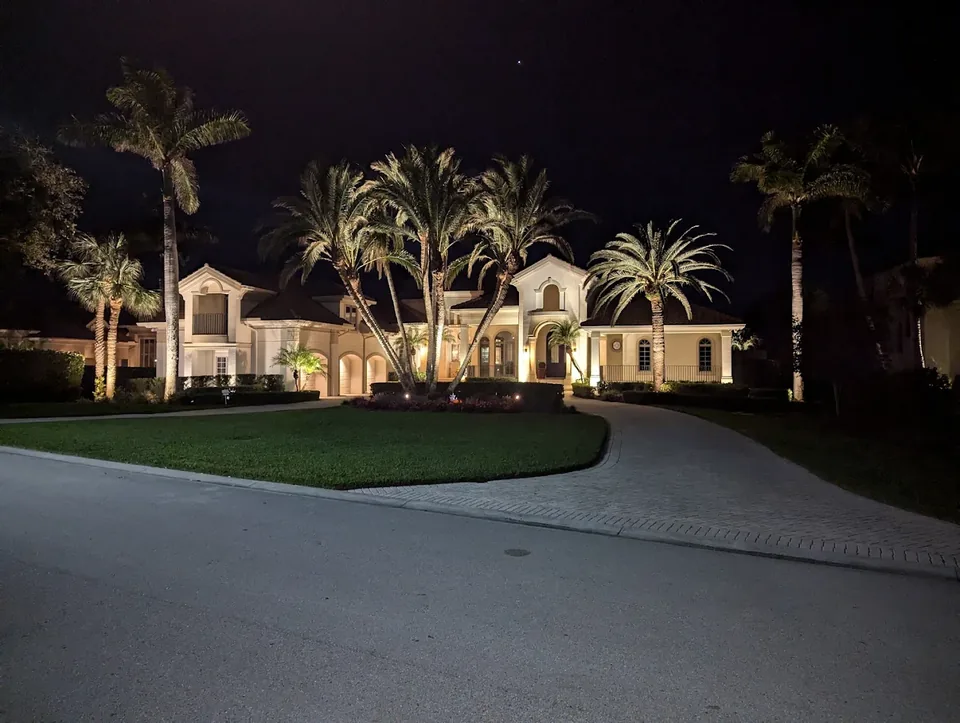
An estate at night seen from its drive, the house and the palms in front of it lit

Design and installation

Driveway, gate and entry lighting for Naples homes

An arrival is seen from a moving car, through a windshield, by someone who may never have been here. It is lit as a sequence: something to find, something to follow, somewhere to stop, and a door to walk to.

Tell us about the arrival

or call (239) 649-6940

NightScapes project

If the drive is a row of dots

Why a driveway lit like a runway is hard to drive

If your drive is lined with evenly spaced lights and guests still creep along it or miss the turn, the lights are the problem. A rank of fixtures at the edge puts a line of bright points in the windshield. A driver steers by edges and by things that stand up, such as trunks, walls and hedges, not by dots.

A drawing from the driver's seat of a drive at night. Lit like a runway, a double row of bright points runs to the bend and the drive between them is black. Lit at the edges, palm trunks, a hedge and the house at the end show the way, and no lamp is in view.
Drawing: a curving drive at night, from the height of a driver's eye. A sketch of the principle, not to scale.
Bright points in view
0
The drive reads ahead
0 ft

A runway. Every fixture is a point of light at bumper height, and the eye goes to them. Between them the paving is black, so the bend shows only where the dots turn.

The runway is what you get when a drive is lit by the foot. Equal gaps, both sides, the same fixture all the way. From a car at night each of those fixtures is a small glare source at about bumper height, and a long row of them does two things. It pulls the eye down to the curb, and it closes the pupil so the dark surface between the lights is harder to read than if they were off.

A drive is easier to follow when the things beside it are lit and the surface is left alone. Lit palms, a washed hedge, a wall, an island, the house at the far end: these tell a driver where the drive goes from a long way off. The paving, darker than everything around it, shows its own edges.

It usually takes fewer fixtures, and none of them is in the way of a tire or a mower. Ask about your drive.

A driver reads
Edges, and vertical things beside the drive. Not points of light.
So light
Trunks, hedges, walls, the island and the destination.
And leave
The driving surface itself as the darkest thing in view.

From the driver's seat

Eye height in a car is not eye height on a path

A driver sits at a different height from a walker, is moving, and has eyes adapted to headlights. A fixture shielded so a person on foot cannot see the lamp can be a bare bulb from a car seat. Every drive is tested from the car, in both directions, with the headlights on and off. Choose where you are.

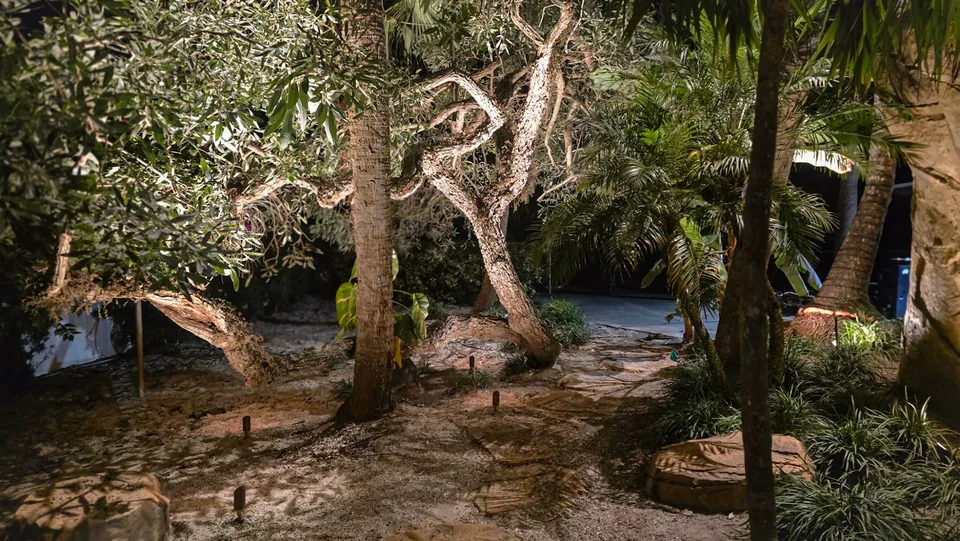
Stepping stones through a tropical garden, low path lights among twisting uplit limbs

On foot

Where the eye is
Standing, above the fixture and close to it, looking down at the ground ahead.
What the shade does
A path light is designed to hide its lamp from someone standing over it. From here you see the pool of light, not the source.
What reads
The surface underfoot and the edge of the walk, a few steps ahead at a time.

The walk from the car is lit for this eye. That is a separate job, covered under the walk from the car to the front door.

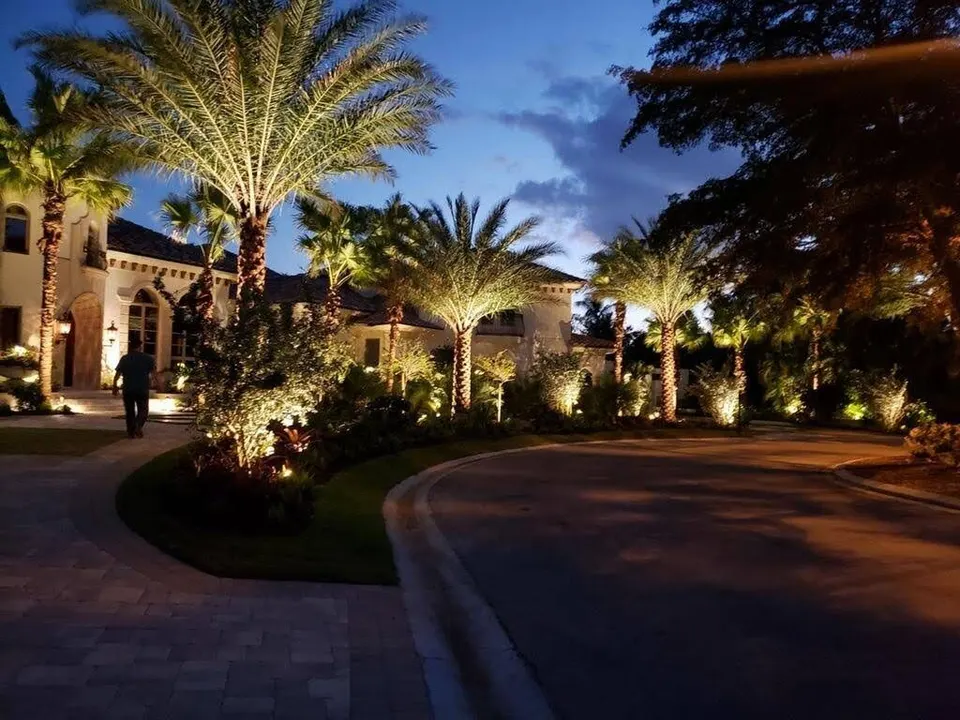
A curving estate drive at dusk seen from the height of a car, palms lit along its edge

In the car, arriving

Where the eye is
Seated, lower than a walker and much further off, moving, with the headlights on.
What the shade does
Come at the same path light along a drive and you are looking under the shade at the source. On a drive that climbs or falls the angle changes again, so a fixture is chosen and aimed for the lowest, furthest eye that will see it.
What reads
Only what is legible beyond the reach of the beams. Headlights flatten everything in front of the car and wash out anything dim, so the guides have to be taller, further ahead or to the side. That is why lit trees and walls work where low fixtures do not.
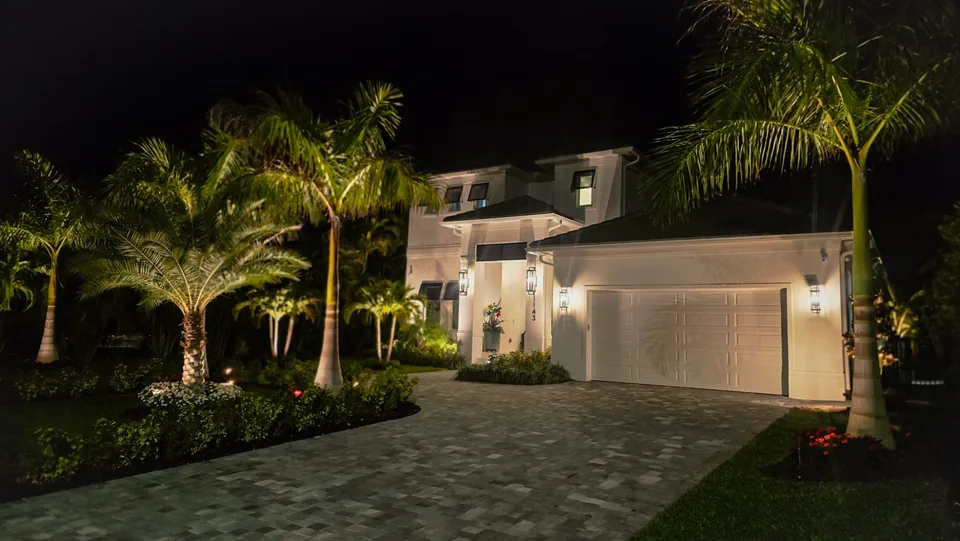
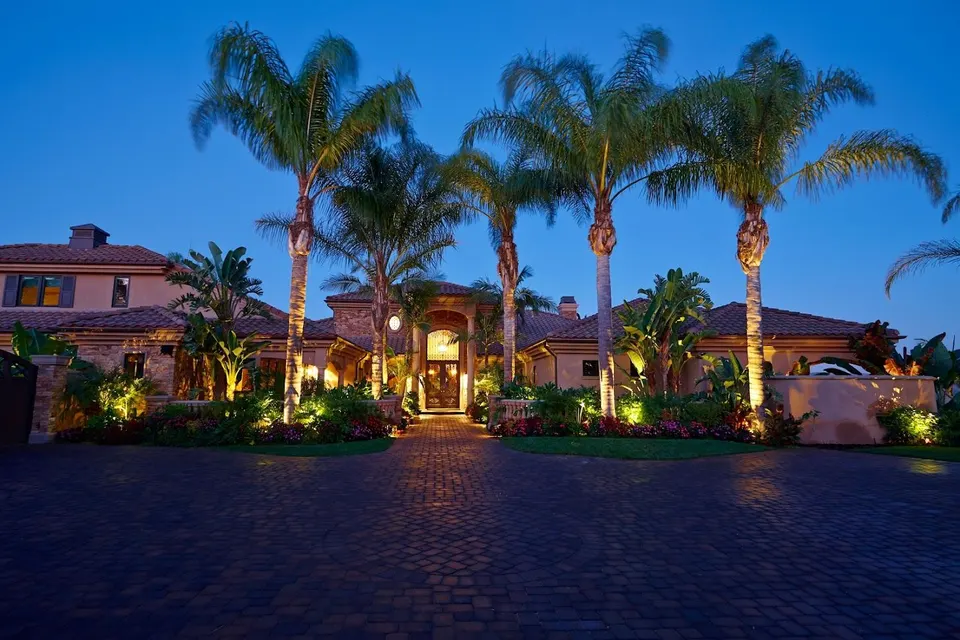
A two-story home at night with palms uplit along a paver drive

In the car, leaving

Where the eye is
Seated again, but facing the street and every fixture that was behind you on the way in.
What the shade does
Leaving is not arriving in reverse. A light aimed away from an arriving guest can be aimed straight at a departing one.
What reads
The mouth of the drive and the road beyond it, which is where a driver most needs to see and most often gets a lamp in the eye.

We drive it both ways, headlights on and off, before anything is fixed.

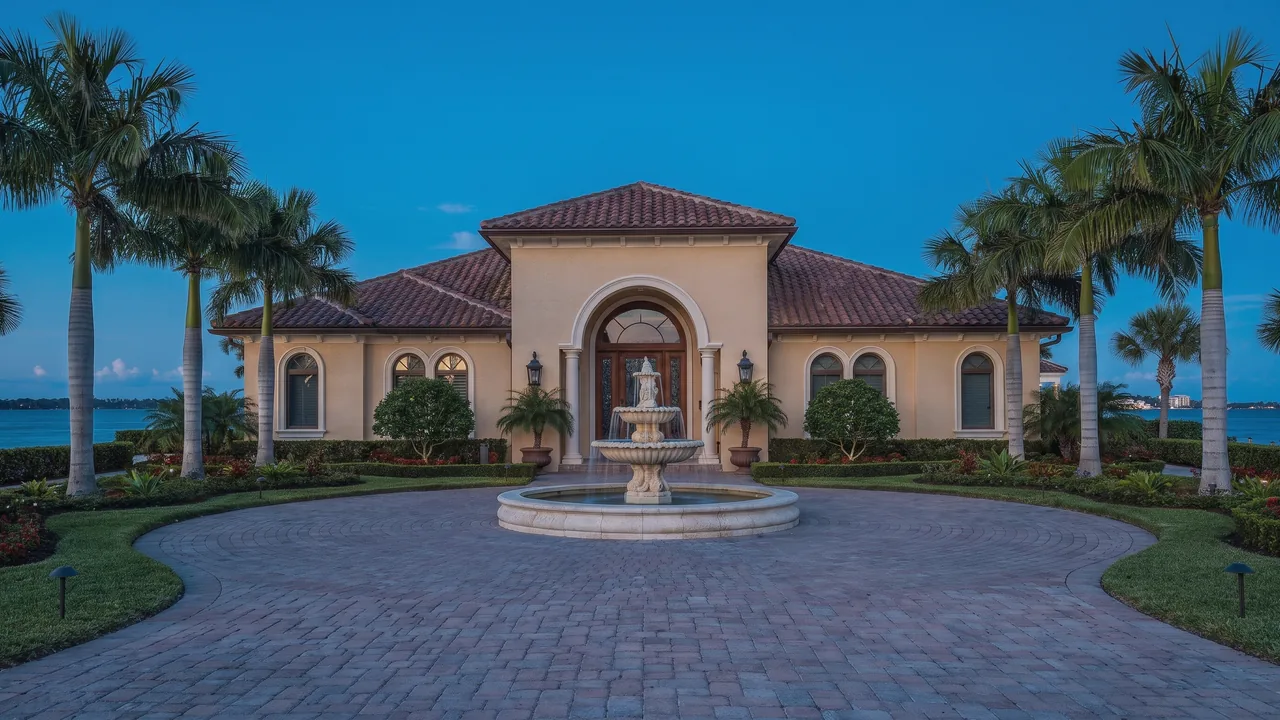
A waterfront house at dusk with a fountain in a paved motor court, framed by palms

Arrival lighting

The arrival sequence: street, gate, drive, court, door

An arrival is five stations, each with one job. From the street the entry has to be found. At the gate it has to be read. Along the drive it has to be followed. In the court the car has to be parked, and from there the door has to be walked to. Scroll, and each station comes on in the order a guest meets it.

Be found

From the street: something to aim for

The first job is to say which entrance is yours, from far enough away to slow down for it. Tall things do that. Lit palms at the mouth of the drive can be seen above hedges and walls long before a column light can.

Lit
The palms or trees either side of the entry, from their bases.
Not lit
Anything aimed out at the road, into the eyes of a driver passing.

Be followed

Along the drive: edges, not dots

A driver steers by the edges of the surface and by what stands beside it. Light on the paving edge and on the planting gives both. The drive itself stays the darkest thing in view, which is exactly why its edges read.

Lit
The margins of the paving and the planting beside them, softly.
Not lit
A row of bright fixtures at the curb, which is the runway.

Be parked in

The court: where the car stops

The motor court has a center and edges, and a driver needs both. Something lit in the middle, here a fountain, gives the turn its axis. The wings of the house mark how far the paving goes.

Lit
The feature at the center and the walls that bound the court.
Not lit
The whole surface at one level, which hides where the edges are.

Be walked to

The door: the end of the sequence

Everything so far has been leading here. The entry is the last thing lit and the brightest, so from the moment the car turns in, the eye has somewhere to go. Seen together, each station is a step quieter than the door.

Ask about your arrival

    At the entrance

    The gate, the columns and the house number

    The gate has three things to light: the opening and its columns, the house number, and the keypad or call box. Each is lit low and shielded, so the entrance can be found and read from the road without a lamp at windshield height. Distance from the house is part of the design. Point at each.

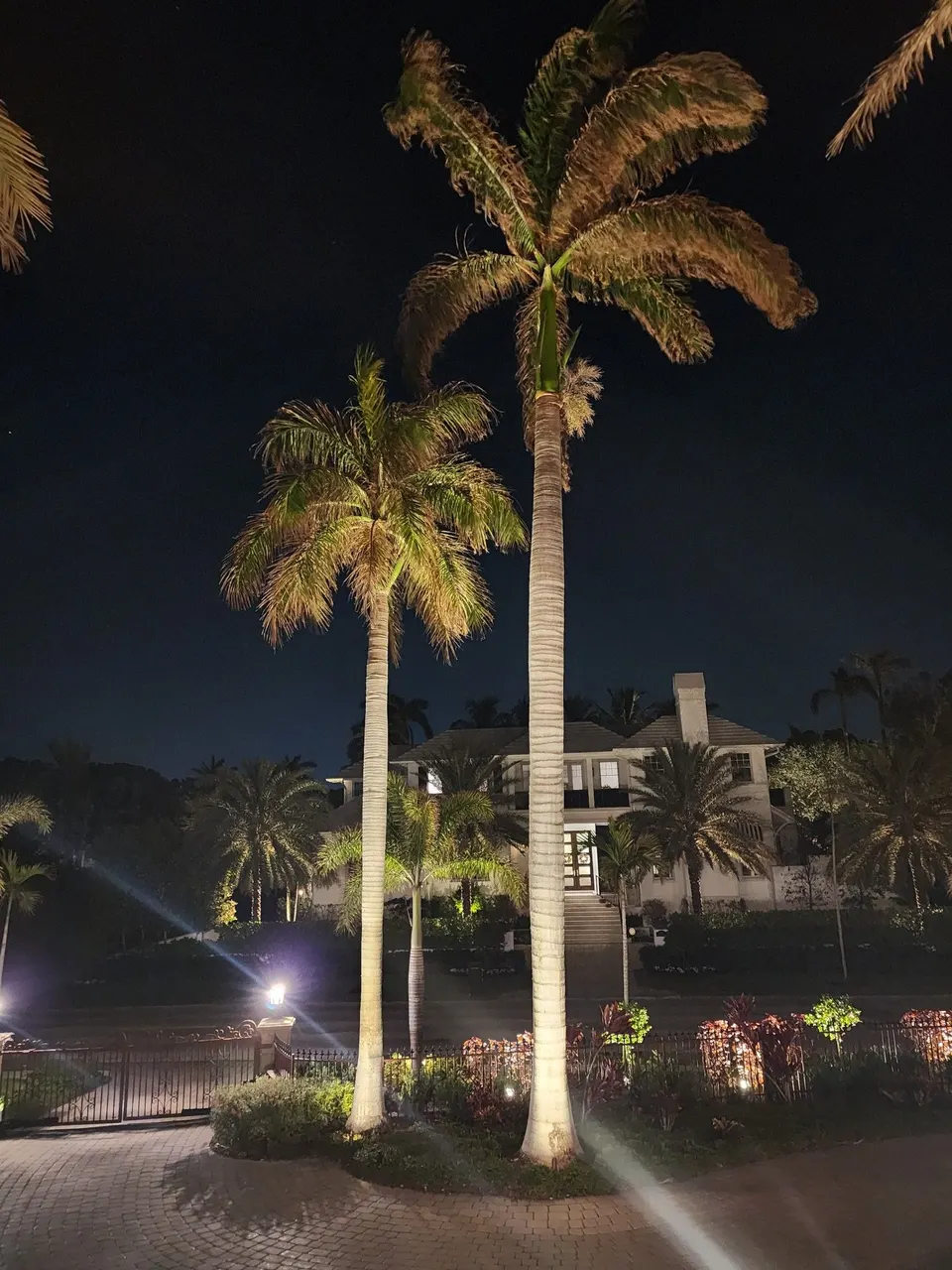
    • Two royal palms uplit beside an entry gate at night, the smooth trunks lit all the way to the crown

      The gate and the columns

      The job
      To show the opening and the piers either side, so a driver knows where the edges are.
      Lit from
      Low at the foot of each column, grazing up the face, shielded from the road.
      Watch for
      A lantern on top of each pier at windshield height. It marks the gate and blinds the driver.
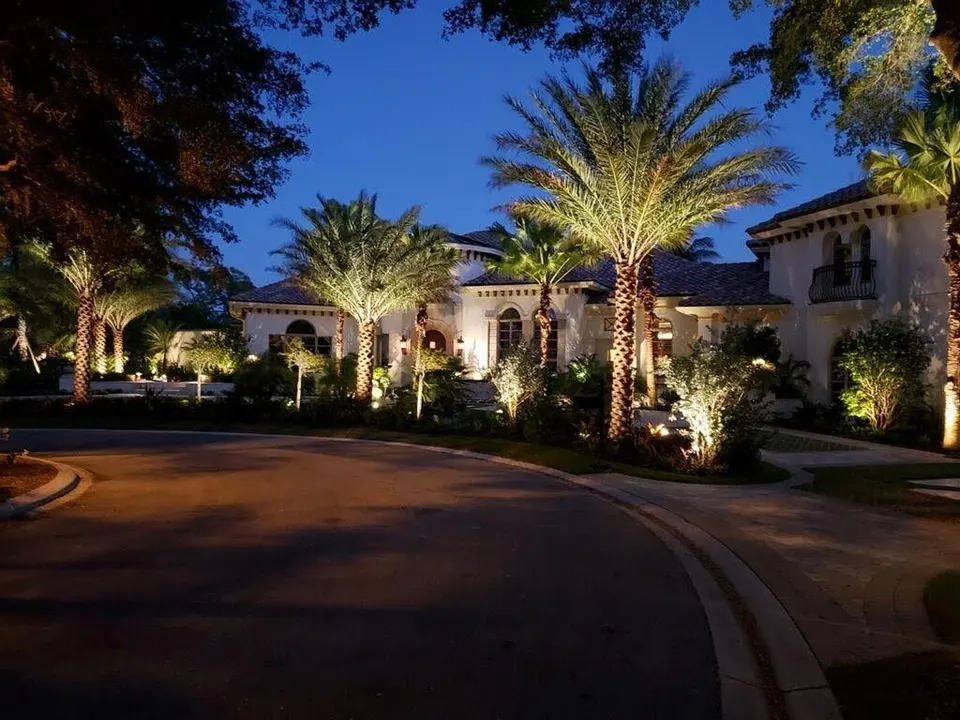
    • A curving drive at night with lit palms in front of a Mediterranean-style house

      The house number

      The job
      To be read from a moving car, by a guest or a delivery driver who has never been here.
      Lit from
      A small, even wash across the number, from above or below, with no hot spot.
      Watch for
      A number lit so brightly it flares, or one hidden behind planting that has grown.
    • A large home at night set well back behind a wide lawn and a long curving drive

      The keypad and the call box

      The job
      To let someone find the keypad and read it from the driver seat, window down.
      Lit from
      A shielded light aimed at the pedestal, low enough to stay out of the mirror.
      Watch for
      How far the gate is from the house. A long low-voltage run is a design question.

    Edges

    Giving the drive walls: palms, hedges and the median island

    A drive is easy to follow when it has sides. Lit palm trunks, a washed hedge or wall and a lit median island give a driver vertical edges that show above headlight level and reveal a bend before the paving does. The island is one of the few places on a drive that has to be lit.

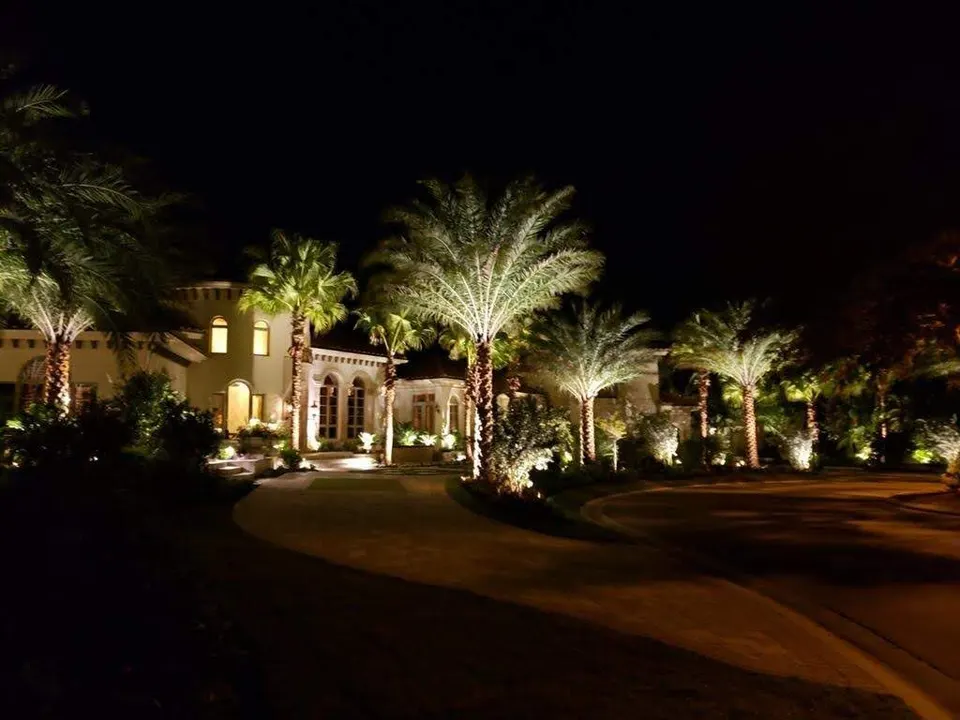
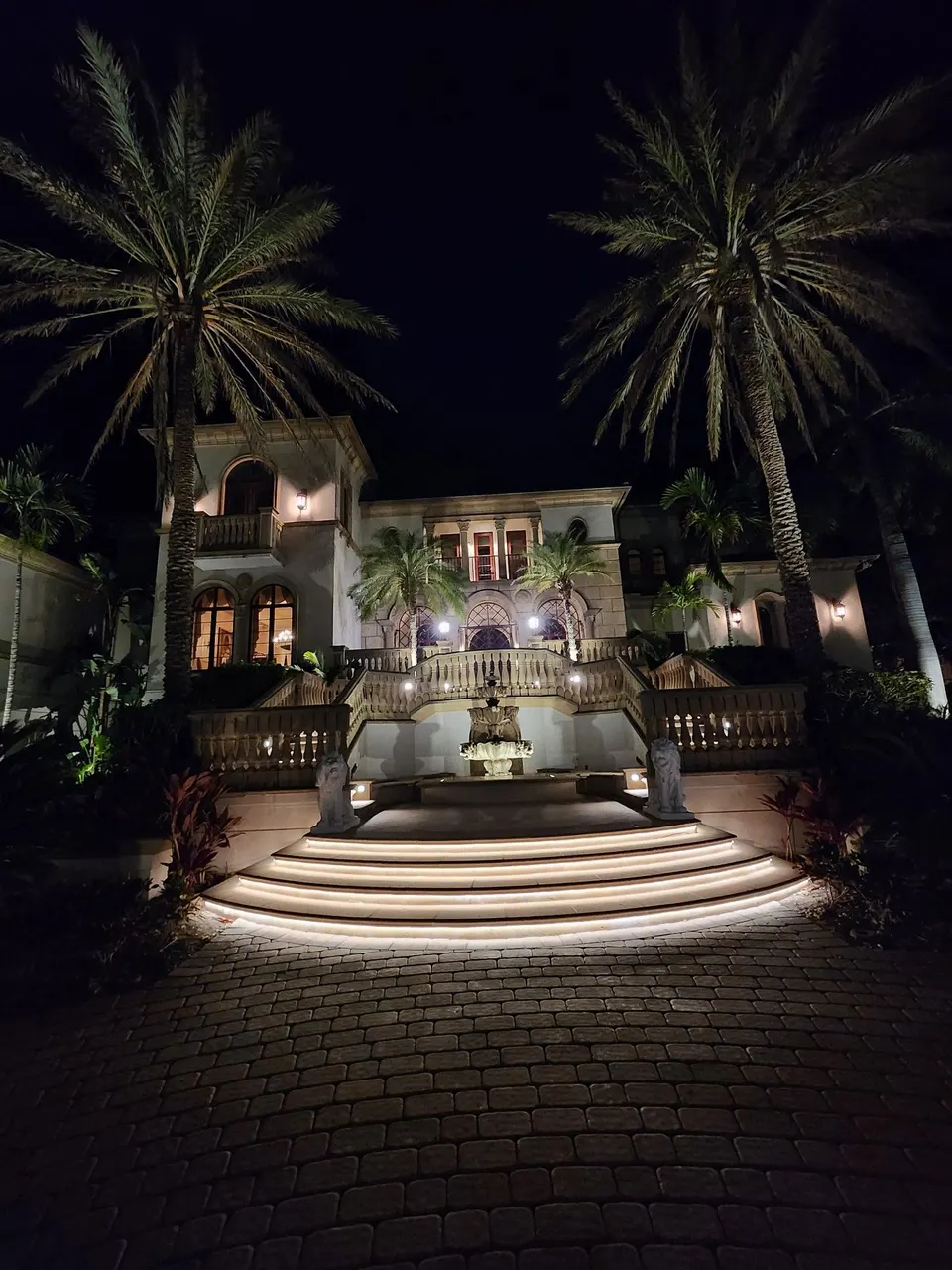
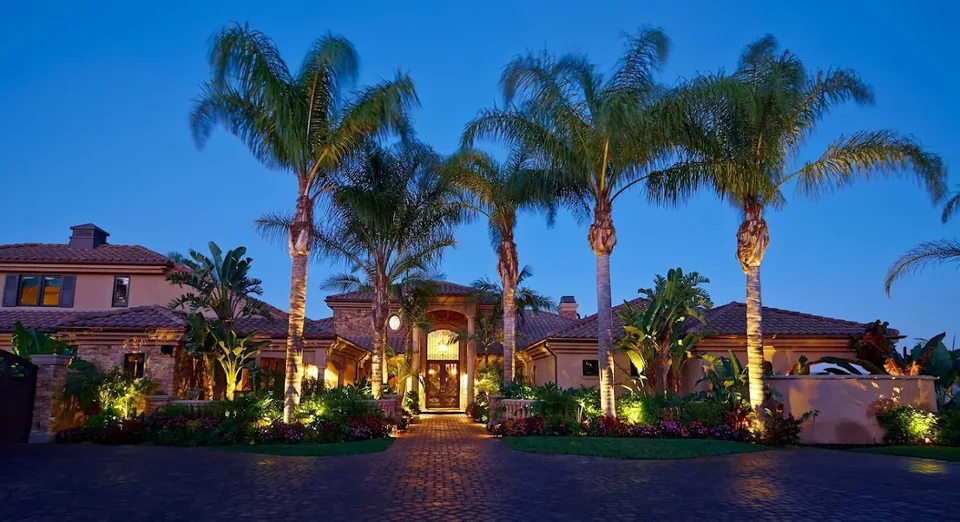
    Date palms uplit along the edge of a curving estate drive at duskAn estate drive at dusk with planting and palms lit along its edgeA paver motor court at blue hour with palms and lit planting islands in front of a houseThe front of an estate at night seen across its drive, palms and house lit
    Palms along a curving drive show the bend before the paving does.Planting washed along the edge of a drive reads as a wall.Planting islands in a paver court, lit so a driver can pass round them.A lit house at the end of the drive is what the car steers for.
    1. Palms down the drive

      A row of lit trunks is the strongest guide a driver can have. They stand above headlight level, they repeat, and they show the line of the drive around a bend before the paving does. Each is lit the same, from the same side. Species by species, that is covered under uplighting the royal palms that line a drive.

    2. Hedges and walls

      A hedge or a low wall beside a drive is a continuous edge, and a soft wash along it does what a dozen path lights cannot: it draws the side of the drive as one unbroken line. The fixtures sit in the bed at its foot, out of sight and out of the way of tires.

    3. The median island

      Many Naples drives split around an island of palms and planting set in the pavers. Lit, it tells a driver which way to pass and gives the court a center. Unlit, it is the thing people clip with a bumper. It is one of the few places on a drive that has to be lit.

    4. The house at the end

      The far end of the drive needs a destination. A lit facade, seen down the length of the drive, pulls the car toward it and makes everything in between feel shorter. It is planned as part of the building: see how the facade reads from the street.

    In the paving

    Fixtures where tires go

    A light set into a driveway has to carry a vehicle, shed water and stay level in sand. A fixture rated for a mower is not rated for a car. In Naples the summer rains leave water standing on pavers and the sub-base is sandy, so the better answer is usually to keep fixtures out of the tire path.

    A paver forecourt at a house at night, lit from its edges and steps
    A paver forecourt lit from its edges, with nothing set in the driving surface.

    Drive-over is a real rating

    In-grade fixtures are made in very different strengths. Some will take a foot. Some will take a lawn tractor. A smaller number are built and rated to be driven over by a car, and fewer still by a delivery truck. Putting the wrong one in a drive gives a cracked lens the first week. When a fixture must sit in the paving, the rating is the first thing settled.

    Water and sand

    A fixture set flush in pavers is in the lowest place on the surface. In a summer downpour it is under water, and afterward it is where the sand and the leaf litter collect. The lens films over and the light dims. Pavers here sit on a sandy base that moves a little over the years, so a fixture that was flush can end up proud of the surface or sunk below it.

    The safest place for a driveway fixture is somewhere a tire will never be.

    Keeping out of the tire path

    Most of the time there is no need for a light in the driving surface at all. The same edge can be drawn from the planting beside it, from the foot of a wall, or from the trees. Where the drive is wide open paving with nothing beside it, a few correctly rated in-grade markers at the margin, outside the wheel tracks, do the job.

    Cable that has to cross under a drive is the other thing to plan early. If the drive is being laid or relaid, a sleeve put under it now saves cutting it later.

    Motor court lighting

    The motor court and the last twenty feet

    The court is where driving stops and walking starts. It needs light where the car is parked, on the side the doors open, and along the short walk to the entry, with the door itself the brightest thing in view. The palms around it give the space its shape. Point at a number on this motor court.

    A paver motor court in front of a house at blue hour, palms and planting lit

    Where the car actually stops

    People park in the same place every time, and that spot needs a different kind of light from the rest of the court: enough to open a door, find a bag and see the ground, without a fixture shining through the glass.

    Lit from
    Spill from the entry and the planting either side, kept off the windshield.
    Checked
    From the driver seat, engine off, headlights off.

    The side the doors open on

    A passenger steps out onto whatever is beside the car. If that is a curb, a planter edge or a change from pavers to grass, it needs to be seen. This is the last twenty feet, and it is where guests in good shoes meet the landscape.

    Lit from
    A low wash on the edge itself, from inside the planting.
    Checked
    From the passenger side, where guests get out.

    The handoff to the walk

    From the car to the door the guest is on foot, and the lighting changes from driving light to walking light. The levels step up toward the entry so the route is obvious without a single sign.

    Lit from
    The walk itself and the steps, lower than the door they lead to.
    More
    Covered on our pathway and step lighting page.

    The brightest thing in the court

    Seen from the car, the door should be unmistakable. It is lit from inside its own arch or porch, so it glows, and everything else in the court is held a step below it.

    Lit from
    Inside the entry, the soffit or the reveal, warm and shielded.
    Checked
    From the gate, where it first comes into view.

    What frames the court

    The palms and tall planting round a court are its walls and ceiling at night. Lit, they give the space a shape and a height. Without them a paved court is a dark floor with a lit house floating at one end.

    Lit from
    The base of each palm, shielded from the car.
    Checked
    That none of them fires toward the drive as you come in.

    Who does the work

    Who lights the arrival: NightScapes Landscape Lighting, Naples

    NightScapes Landscape Lighting has lit drives, gates and entries in Naples since 1998. Todd and Sherry own and run it, outdoor lighting is the only work it does, and its Google Business Profile shows 63 reviews at 5.0. An arrival is designed from the driver's seat, in and out, so nothing shines through the windshield.

    The drives on this page are NightScapes jobs: curving approaches lined with date palms, paver courts with planting islands, gates flanked by palms. We light arrivals across Naples, Marco Island and Bonita Springs, and through Lee and Collier counties, where a long private drive is often the first thing a guest sees.

    For a side yard or a gate that needs to be seen rather than admired, the approach is different: low, even light at the gate and side yards. A community entrance or a boulevard has its own page: community entries and boulevards. The walk from the car is under the walk from the car to the front door.

    Ask about your drive
    A two-story home at night with palms uplit along a paver drive and lanterns at the entry
    Palms along the drive and lanterns at the door.
    Since 1998
    Lighting properties in Naples and Southwest Florida.
    Todd and Sherry
    Family and locally owned. The owners are the people you deal with.
    63 Google reviews
    Rated 5.0 on the NightScapes Google Business Profile.
    Lee and Collier counties
    Naples, Marco Island, Bonita Springs, Fort Myers, Sanibel and Captiva.

    Questions we hear

    Questions about driveway and entrance lighting

    How to light a long drive, whether flush in-ground lights can be driven over, how to keep fixtures clear of the mower, whether low-voltage lighting can reach a distant gate, whether the gate lights can respond to a car, and what belongs on an entry column. Each answer is the one we would give you in the car.

    NightScapes Landscape Lighting Outdoor lighting only, Naples since 1998

    Ask us about your drive. Choose a question, or call and we will answer it on the phone.

    How do I light a long driveway so people can follow it?

    Light what stands beside it, not the surface. Trees, palms, a hedge or a wall along the edge give a driver a line to follow, and they do it from above headlight level. Mark the bends and any island. Then put something lit at the far end. A long drive lit this way needs far fewer fixtures than one lit by the foot.

    Are there in-ground lights that sit flush with the driveway?

    Yes, and they have to be chosen carefully. A fixture rated for a mower passing over it is not rated for a vehicle. One that is to sit where tires go needs a true drive-over rating, a lens that will not pool water, and a base that will not settle in sand. Often the better answer is to keep fixtures out of the tire path altogether.

    Can driveway lights go where they will not be hit by the mower and the edger?

    They should. A fixture at the lawn edge of a drive is in the line of every pass. Set a little way into the bed, behind the edging, it is left alone and still lights the margin of the paving. Where there is no bed, lighting the trees and walls beside the drive avoids the problem entirely.

    My gate is a long way from the house. Can low-voltage lighting reach it?

    Usually, but it is a design question and not a given. Voltage falls along a cable, and it falls further the longer the run and the more it carries. A distant gate may want heavier cable, its own run, or its own transformer near the entrance if there is power there. We measure before we promise.

    Can the lights at the gate come on when a car arrives?

    The lighting can be put on its own zone and triggered, so the entry rises as a car turns in and settles back afterward. It suits a gate that is otherwise dark all night. The controller decides what is possible, which is covered on our smart lighting control page. We light the gate; the gate operator itself is another trade.

    What goes on top of an entry column?

    Often nothing. A lantern on a pier is at windshield height and is the most common source of glare at a gate. If a pier light is wanted for the look, it is small, warm, shielded and dimmed, and the real lighting of the column comes from a fixture at its foot.

    How many driveway lights do I need?

    It cannot be worked out from the length. A straight drive with palms along it may need none on the surface at all. A drive with a bend, an island and a dark court needs light at each of those. Rhythm matters more than count, and the count comes from driving it.

    Ask us on the phone: (239) 649-6940

    Free Consultations and Estimates

    Ready to light your arrival?

    Tell us how long the drive is, whether there is a gate, and what a guest sees first. We walk it with you and design the arrival from the driver's seat, in and out.

    • Edges lit, not dots
    • Nothing in the windshield
    • Free consultation and estimate
    or call (239) 649-6940

    Tell us about the arrival

    or call (239) 649-6940