Amber
Below warm white. It reads as candle or lantern light, flattering on old brick and terracotta and too orange on cream stucco. On a beachfront lot it is chosen for a different reason entirely, covered at the foot of this page.
Specialty
Asking for LED is the start, not the decision. Every fixture still needs a color, a beam, a brightness and a body that will survive salt air. Those four choices are what decide how the property looks.
Tell us about the property
If someone has quoted you LED
If you have been told a system will be LED and assumed that settles it, it does not. LED is the light source. Each fixture still needs four decisions: color temperature, beam spread, output level and what the fixture is made of. Those are what you see at night, and in Naples the last one decides how long it lasts.
LED has replaced halogen in landscape lighting for good reasons. FX Luminaire’s design guide says LED fixtures "consume 30-80% less energy than incandescent lamps," and its lamp table lists an MR-16 LED sold as a 35-watt halogen equivalent drawing an actual 5 watts. The U.S. Department of Energy says LEDs "use at least 75 percent less energy than incandescent bulbs" and last 25 times longer.
None of that tells you whether the house will look good. Two LED systems with the same fixture count can look nothing alike, because one was specified light by light and the other was ordered by the box. The rest of this page walks through the four decisions in the order we make them.
We work with FX Luminaire, the lighting brand of Hunter Industries, and the facts about fixtures on this page are FX Luminaire’s own, quoted with their sources.
LED color temperature
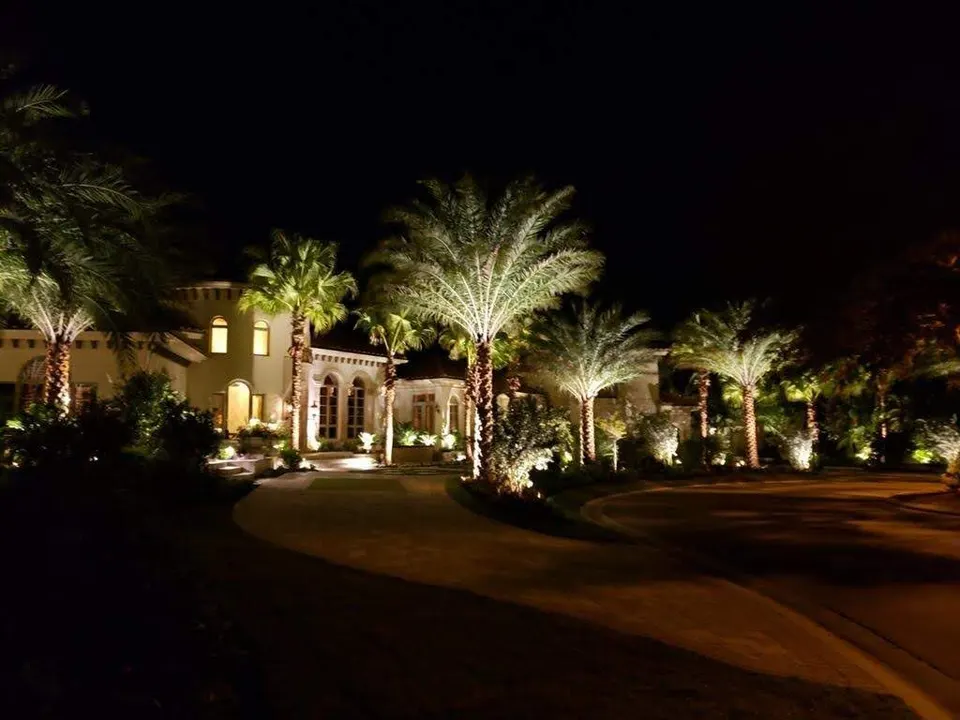
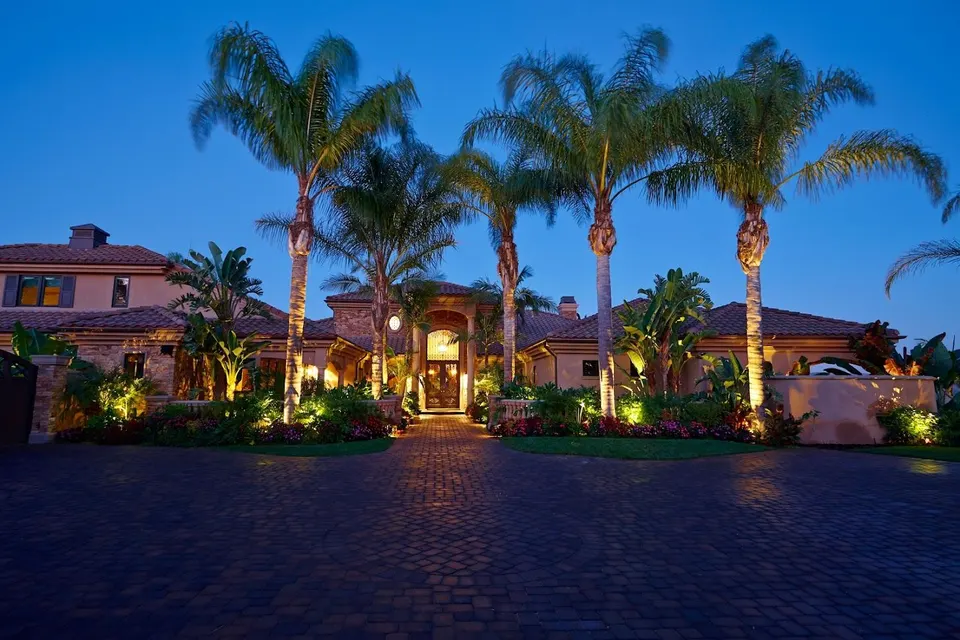
Color temperature, measured in Kelvin, describes how warm or cool white light looks; the U.S. DOE notes it describes the light, not the objects it lights. FX Luminaire labels 2,700 to 3,000K warm and 3,600 to 5,500K cool. On a Naples house, warm keeps stucco cream and palms green. Drag to compare.
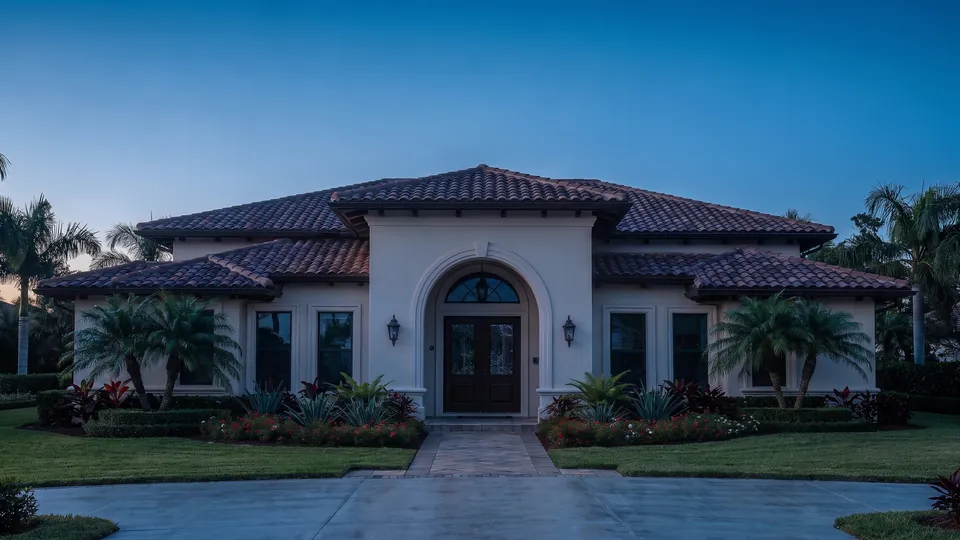
Below warm white. It reads as candle or lantern light, flattering on old brick and terracotta and too orange on cream stucco. On a beachfront lot it is chosen for a different reason entirely, covered at the foot of this page.
FX Luminaire labels 2,700 to 3,000K warm. This is the color most Naples houses look best in: cream stucco stays cream, clay tile stays red, and palms keep their green without going yellow.
Still in FX’s warm band, a little whiter. It suits pale gray and white elevations and silver-leaved planting, and it is a good match where a house has newer, whiter exterior lights already.
FX labels 3,600 to 5,500K cool. On a Naples house it flattens stucco to concrete and turns green planting blue-gray. It has a place on very modern architecture and almost none on a garden.
Illustration: the color is laid over the lit parts of the photograph to show the difference, not measured. Sources, read 2026-10-13: U.S. DOE, LED color characteristics fact sheet; FX Luminaire design guide (2021).
LED beam spread
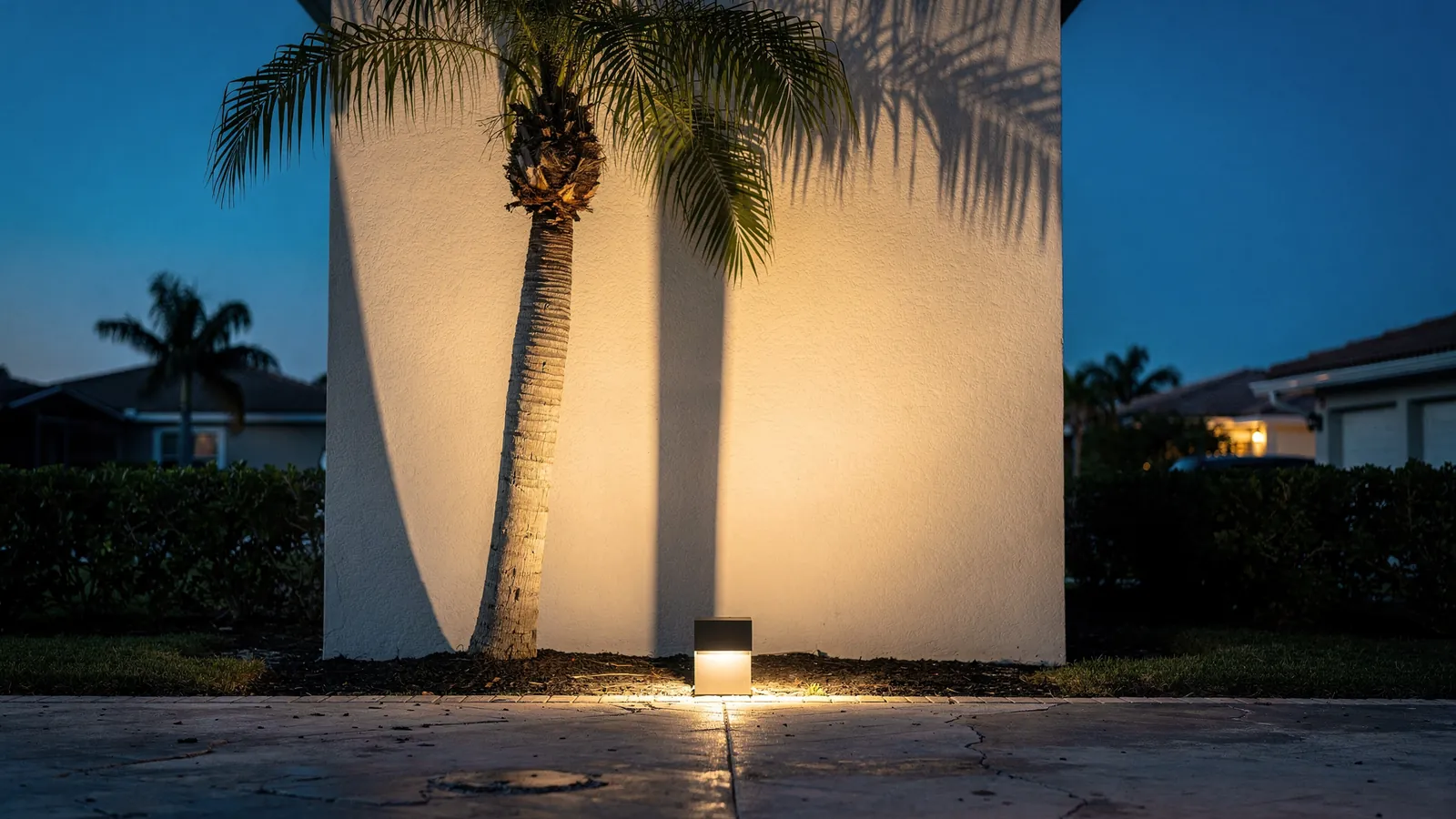
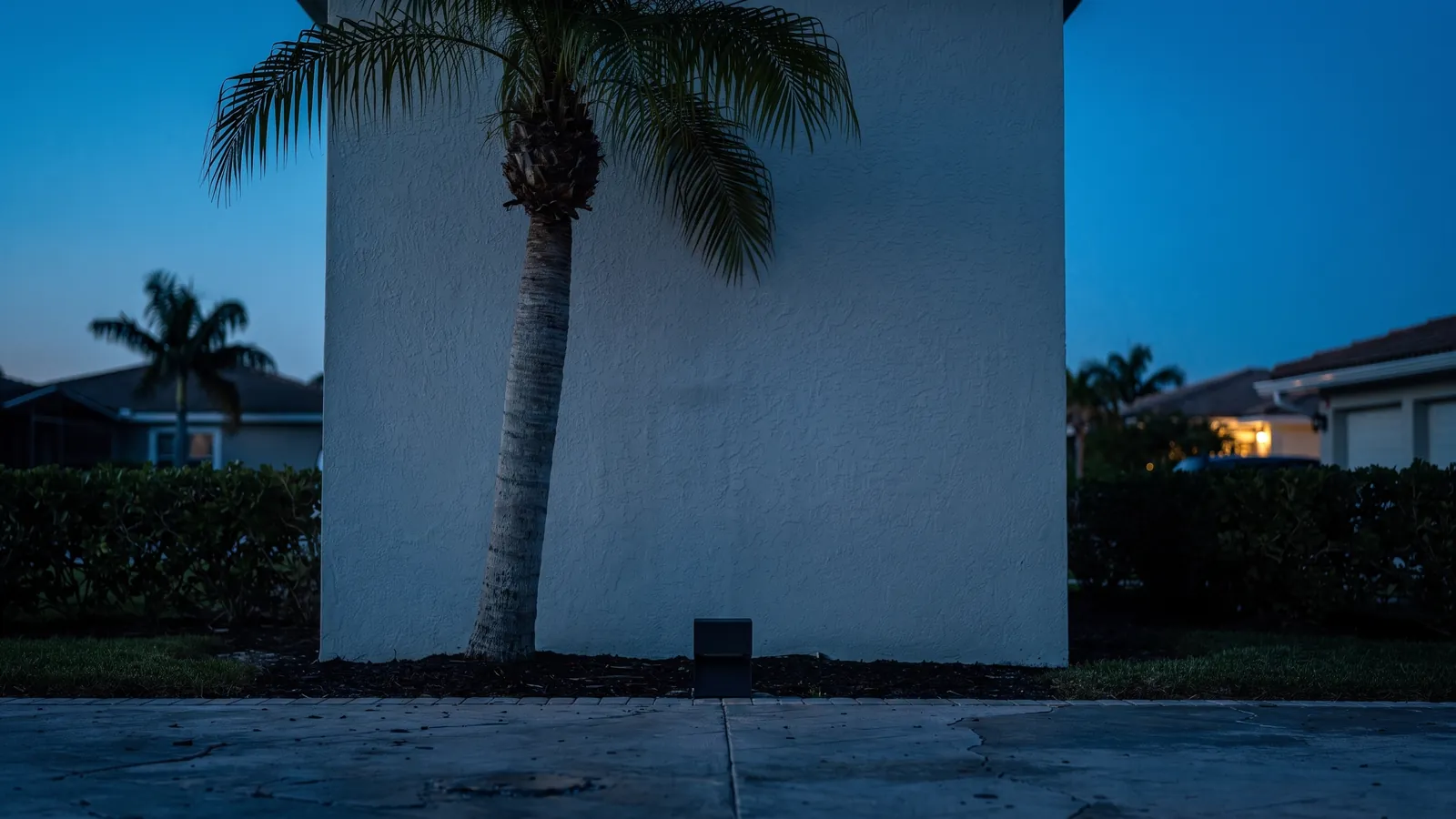
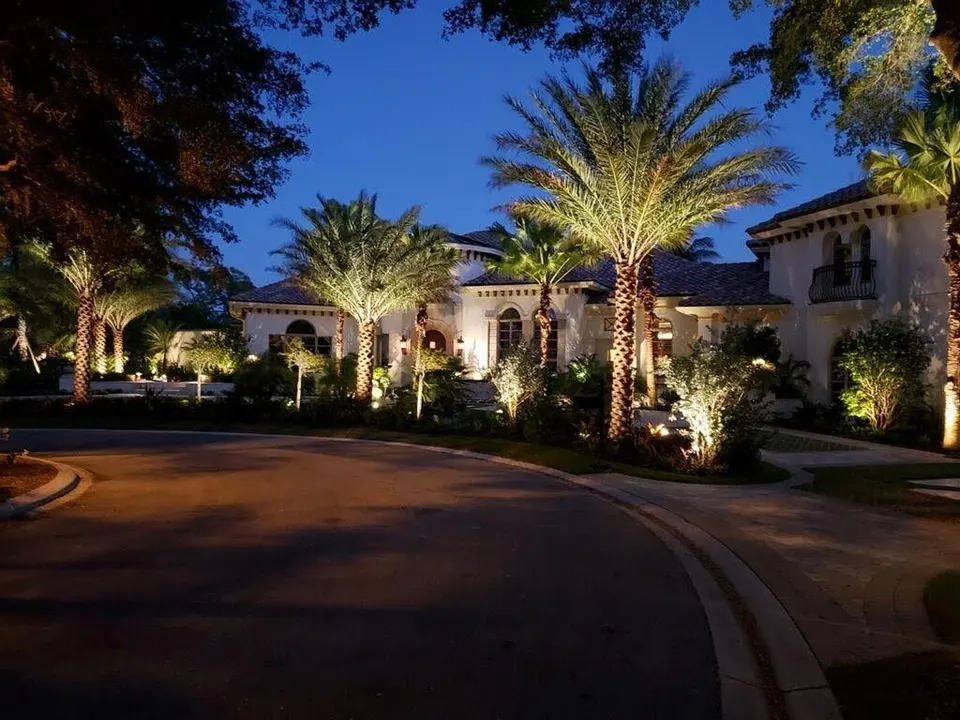
Beam spread is how tightly a fixture holds its light, and it matters as much as color. A narrow beam is a column that can climb a tall palm. A wide beam washes a wall or a canopy at close range. A shaded fixture spills a soft pool downward onto a path. Each is chosen per fixture, for what it lights. Try each on each below.
Output
With LED, watts measure power drawn, not light given, and a lamp sold as a halogen equivalent draws a fraction of the old wattage. Brightness is set fixture by fixture against what it lights and what surrounds it. FX Luminaire says its LED fixtures give the same brightness anywhere between 10 and 15 volts.
Lamps are still sold by the halogen wattage they replace, which is useful for comparing and misleading for anything else. FX Luminaire’s own table lists MR-16 LED lamps sold as 20-watt, 35-watt and 50-watt equivalents drawing an actual 4.0, 5.0 and 7.0 watts. The same document says halogen landscape lights "can take anywhere between 10 and 50 watts of power each, and sometimes more."
Landscape lighting runs at low voltage; FX Luminaire says "a majority of landscape lighting systems operate on 12 V." Voltage falls along a cable, and FX’s guidance is that the input at each LED fixture "should always be between 10-15 VAC", and that its LED fixtures "will all be the same brightness" anywhere in that range. That is a real advantage over halogen, which dimmed with every volt lost. It does not remove the need to design for voltage drop: FX says it is "imperative" even with LED.
Less light, placed exactly, looks brighter than more light placed anywhere.
Less than you think, and different for each fixture. The specimen tree leads, the walls support it, the path is the lowest. We set levels on the property, and on a dimmable system they can be adjusted later without changing a lamp.
Sources, read 2026-10-13: FX Luminaire, Landscape lighting design guide (2021); FX Luminaire, LED system layout; FX Luminaire, LED fixture voltage support note; FX Luminaire, Advantages of LED lighting; U.S. DOE, Guide to energy-efficient lighting.
Fixture type
An integrated fixture has its LED built in, matched to its optics and sealed as a unit, with no lamp to change. An LED lamp fits the socket of a fixture designed for halogen. On new work we specify integrated almost always. In an existing system, sound fixtures can take LED lamps and the rest are replaced. Choose one to compare.
Photograph: FX Luminaire product photograph, as shown on the NightScapes site.
Photograph: FX Luminaire product photograph, as shown on the NightScapes site.
Near the Gulf
Near the coast, salt settles on every fixture and speeds corrosion. Brass and copper weather to a dark patina and keep working; coated finishes protect until they are breached. FX Luminaire describes its brass and copper Premium Level as giving the highest level of protection from the environment. Connections, not bodies, usually fail first.
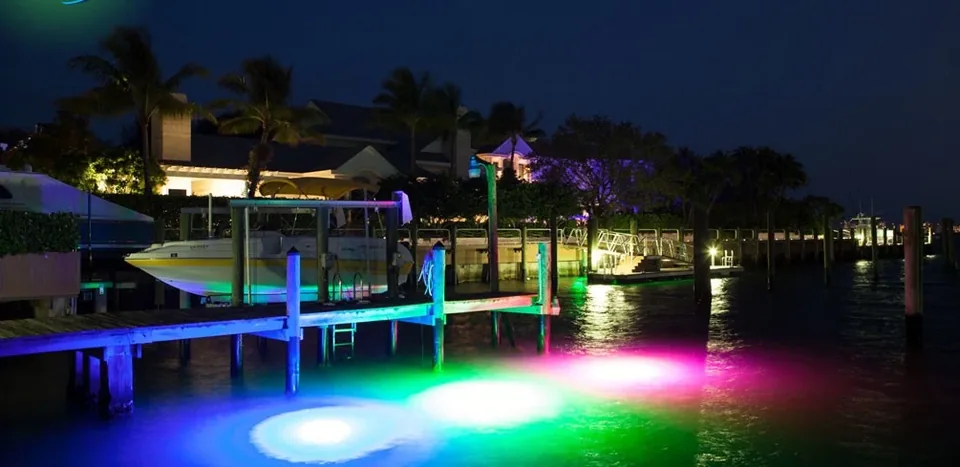
FEMA’s guidance on coastal construction puts it plainly: "Salt spray from breaking waves and onshore winds significantly accelerates the rate of corrosion of metal connectors and fasteners." It notes that airborne salt "declines rapidly in the first 300 to 3,000 feet landward of the shoreline," but that studies have found faster corrosion "as far inland as 5 to 10 miles." Most of Naples is inside that distance.
FX Luminaire offers fixtures in "high-grade brass, copper, or stainless steel for upscale installations, or aluminum fixtures for a more modest look." Brass and copper have no coating to lose; they darken, and can grow the greenish patina FX defines as a thin layer that forms on copper and its alloys. Aluminum depends on its finish. FX describes a two-layer anodized and powder-coated finish on some aluminum fixtures; we still keep aluminum back from the water.
In our experience on Naples properties, the body is rarely the first thing to go. It is the splice in the cable, where water and salt creep into the copper, or the screw that holds a fixture to a dock. FX’s sealed cable entry addresses the first at the fixture; every field connection is sealed as well.
Sources, read 2026-10-13: FEMA, Technical Bulletin 8, Corrosion protection for metal connectors in coastal areas; FX Luminaire, Designer and Standard Series fixtures; FX Luminaire, Technology.
Over the years
An LED fixture does not burn out the way a halogen lamp did. ENERGY STAR says LEDs "typically do not burn out or fail" and defines their lifetime as the point where light output has fallen by 30 percent. So an LED system ages by slowly dimming, while dirty lenses, tired connections and drifting aim take light away far sooner.
That is why matching lamp color when older fixtures are relamped and regular lens cleaning matter more than the LED rating.
Ask about LED lightingAn LED system, over timeNightScapes Landscape Lighting
Sources: ENERGY STAR; FX Luminaire, read 2026-10-13.
Beyond warm white
Most of a Naples property is lit in one warm white. Two exceptions sit beside it. Near a nesting beach, the seaward fixtures may need long-wavelength amber light. And color-capable fixtures can put color on a palm or a pool for an occasion, then return to warm white. Each is a separate zone.
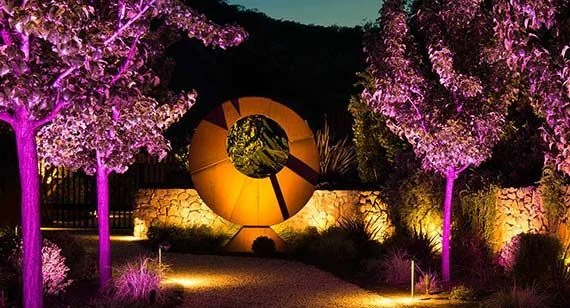
Sea turtle lighting guidance asks for light sources that produce only long-wavelength light, which FWC describes as 560 nm or greater, amber, orange or red. That is a different requirement from a warm white, and FWC’s certification criteria rule out color-changing fixtures set to amber. It is covered in full on our page about turtle-friendly coastal lighting.
FX Luminaire’s color fixtures use red, green, blue and white LEDs to produce, in its words, "up to 30,000 colors." Used well, color is an event: the palms in team colors for a game, the pool in blue for a party, warm white the rest of the year. How a property is divided so color can go on one part while the rest stays warm is on our page about zoning, dimming and color.
Facades, palms and the whole-property picture each have their own pages: grazing and washing a facade, beam spread on a royal palm, and how a whole property is designed after dark.
Who does the work
NightScapes Landscape Lighting has designed and installed landscape lighting in Naples since 1998, through the move from halogen to LED. Todd and Sherry own and run it, outdoor lighting is the only work it does, it is a Hunter Preferred Contractor, and its Google Business Profile shows 63 reviews at 5.0. Each fixture is specified on the property.
We have lit properties here through both technologies, which is useful when you are deciding what to keep from an older system. We work across Naples, Marco Island and Bonita Springs, and through Lee and Collier counties.
We specify on the property, with samples in hand, because the right color and beam for a wall can only be judged against that wall.
Ask about LED lighting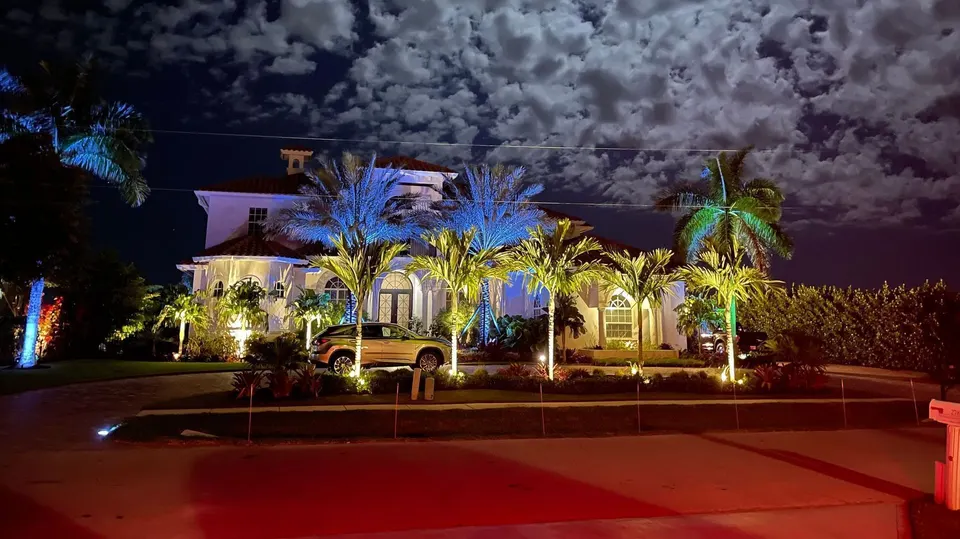
Questions we hear
How bright, which Kelvin, what survives salt air, whether finishes change color, brass or copper or aluminum, how long LED lasts and why use a contractor. Every figure in these answers is quoted from the manufacturer or the government source named on this page, and where those sources disagree with each other, we say so.
 NightScapes Landscape Lighting Outdoor lighting only, Naples since 1998
Choose a question
Ask us about LED lighting. Choose a question, or call and we will answer it on the phone.
Watts are the wrong question with LED. They measure power drawn, not light given, and two fixtures of the same wattage can differ a great deal in output and beam. Brightness is set per fixture, against what it is lighting and what is around it. Most fixtures end up lower than people expect.
It is a small step, and both fall in what FX Luminaire labels warm (2,700 to 3,000K). On cream stucco and clay tile, 2,700K usually looks richer. On pale gray or white walls, or beside newer, whiter house lights, 3,000K can sit better. What matters most is choosing one and using it consistently, so the property does not show two whites.
Fixtures whose protection does not depend on a coating. FX Luminaire describes its brass and copper Premium Level as giving "the highest level of protection from the environment," and both metals weather to a patina rather than flaking. FEMA notes that salt spray "significantly accelerates" corrosion of metal near the coast. Connections matter as much as bodies.
On brass and copper, yes, and it is meant to. They darken, and over time can develop the greenish patina FX Luminaire defines as a thin layer that forms on copper and its alloys due to corrosion. That surface is protective. Painted and powder-coated finishes are meant to stay as they are, and near the Gulf they are the ones to watch.
FX Luminaire offers all three, describing brass, copper and stainless steel for upscale installations and aluminum "for a more modest look." On a property close to the water we lean toward brass and copper, because they weather rather than flake. Inland, a well-finished aluminum fixture can be a sound choice. It is decided by where each fixture will live.
There is no single honest figure. FX Luminaire states 50,000 hours or more on one page, up to 55,000 hours in its 2021 design guide and 72,000 hours on a product page, and ENERGY STAR defines LED life as the point where output has dropped by 30 percent. In practice, lenses, connections and aim need attention long before the LED does.
FX Luminaire, whose products we use, sells them "through a select network of wholesale distributors" and says they are "designed for installation by professional contractors." The fixtures are only half of it. Beam, color, level and position are decided on the property, and that is the work a homeowner is really asking for.
Free Consultations and Estimates
Tell us about the property and what you want lit. We walk the property with you and help you choose the color and beam for your own walls and trees before anything is specified.
Tell us about the property