
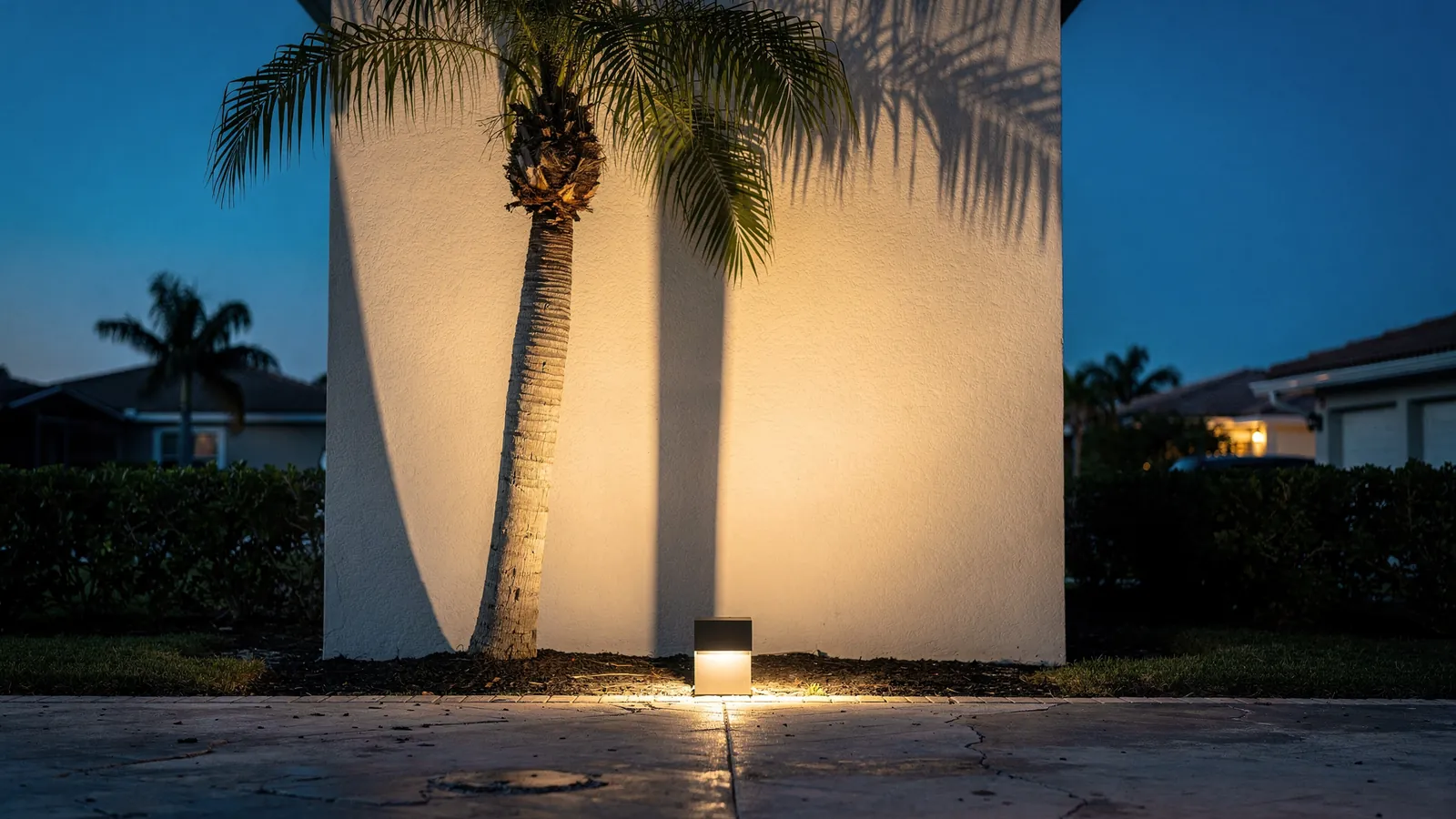
The night it was installed
Every lamp new, the same model, the same color, aimed and balanced. The tree and both path lights read as one system.
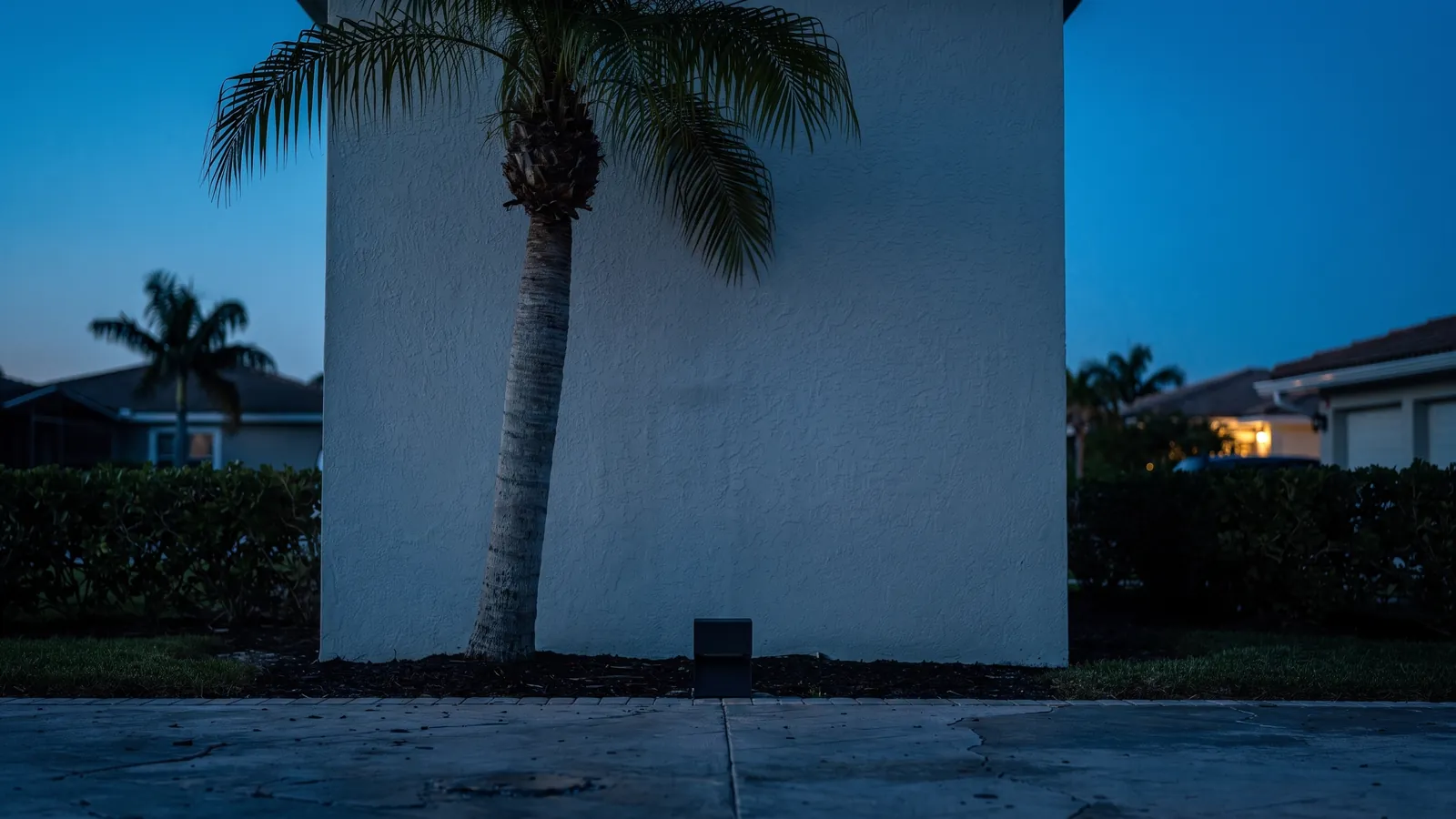
Service and repair
One new bulb in an old system is easy to spot, and it is the only one working properly. Lamps age together and unevenly, so the fix is to replace them by view, matched, not one at a time as they fail.
Tell us about the system
If one light looks different
If you replaced a burned-out bulb and now that one light looks brighter, whiter or bluer than all the others, nothing is faulty. The old lamps have dimmed and shifted color as they aged, and the new one, often a different make, has not. The eye compares neighbors, so the fresh lamp stands out.
Lamps age. Halogen lamps darken inside and fail suddenly. LED lamps fade slowly and their color can drift. Either way, after a few years every lamp in a view is a little different from the day it went in, and from its neighbors.
Replace one, and the difference between new and old becomes the most visible thing in the garden. Replace it with a lamp of a different make, even with the same rating on the box, and the difference is larger again.
That is why lamps are best replaced by group: every lamp in a view at once, matched for model, beam and color, so the view reads as one system again.

Years in service
Halogen and LED age in opposite ways. A halogen filament thins, the capsule darkens and the lamp fails suddenly, sooner if over-voltage is pushing it. An LED fades slowly and its color can drift; ENERGY STAR says LEDs typically do not burn out, and defines their lifetime as a 30 percent drop in output. Drag through the years.
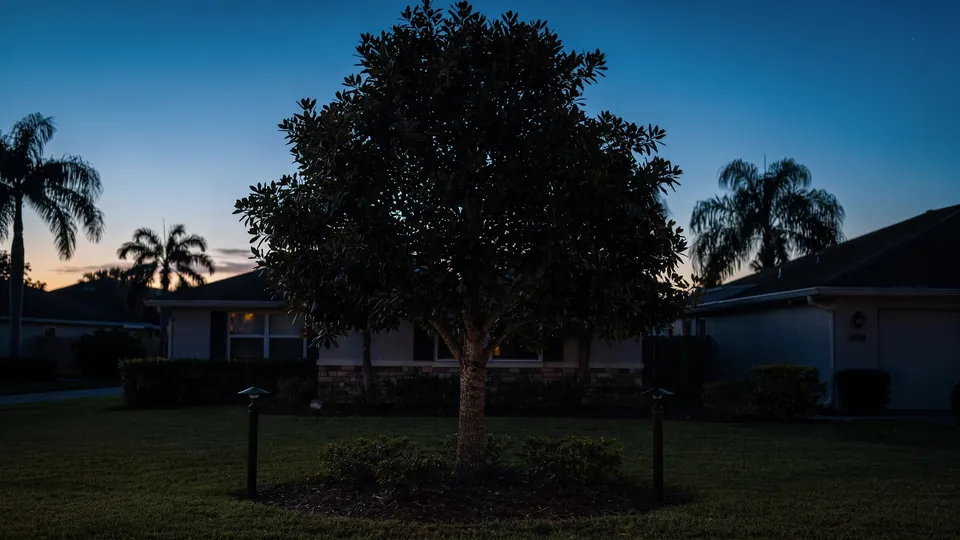
Every lamp new, the same model, the same color, aimed and balanced. The tree and both path lights read as one system.
Nothing has failed, and nothing looks the same. The tree lamp has dimmed a little and drifted warmer; one path light has dimmed more than the other. Each change is small. Side by side, they add up.
The far path light failed and got a new lamp, a different brand from the shelf. It is brighter and whiter than its neighbor, and now it is the thing everyone notices, though it is the only lamp working properly.
Every lamp in the view replaced together, matched for model, beam and color. The view reads as one again, as it did on the first night.
Illustration of one tree and two path lights. The color shifts are exaggerated a little so they show on a screen; on a property they are smaller and still noticeable side by side.
Lamp types
Landscape fixtures take a handful of lamp types: reflector lamps such as MR16 and MR11 that shape their own beam, bi-pin and wedge-base lamps where the fixture shapes the light, and integrated LED fixtures with no lamp to change at all. The old lamp's markings say what to match. Point at each.


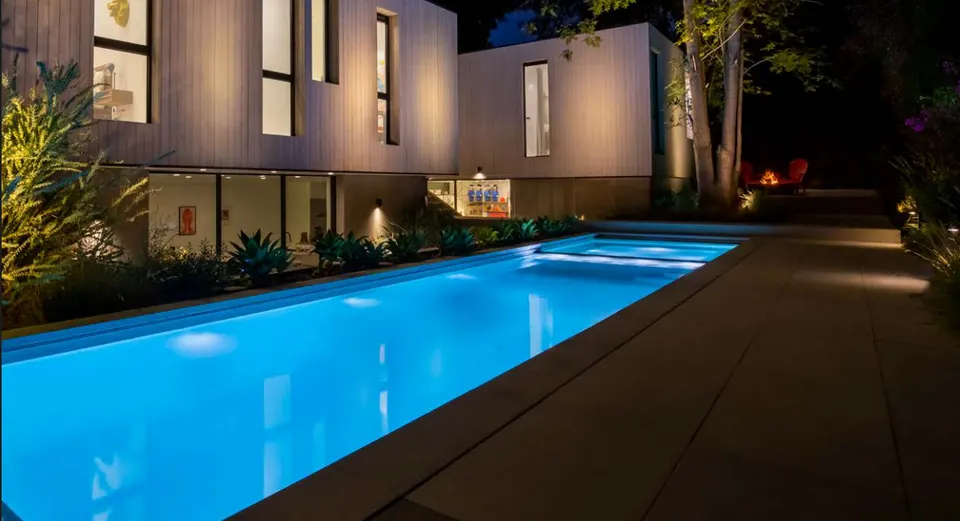
Practice
Group relamping means replacing every lamp in a view at the same time, matched, rather than each lamp as it fails. Lamps that are seen together are replaced together. It keeps a property looking even, and it turns a stream of separate failures into one planned visit. Run the time on one walkway below and compare the two.
A view is a set of lights you see at the same time: the palms along the drive, the front elevation, the beds around the pool, the path from the lanai to the dock. Lamps in a view age together and are compared together, so they are replaced together. A distant bed seen from nowhere else can wait for its own turn.
Replacing lamps one by one keeps every view permanently mismatched: there is always a new lamp among old ones somewhere. It also means more visits for less result. Replacing by view, on a schedule, gives an even property and fewer surprises.
Lamps that are seen together are replaced together.
Lamps pulled from a view while still working are not wasted. Kept and labeled, they make good spares for a less visible part of the same property, where a slightly older lamp will never be compared with anything new.
With halogen, after a few lamps in a view have failed, the rest are not far behind. With LED, when the view has visibly dimmed or one lamp has started to stand out. That judgment is part of the yearly cycle of service visits.
Sources, read 2026-10-13: ENERGY STAR, Learn about LED lighting; FX Luminaire, Advantages of LED lighting; FX Luminaire, Landscape lighting design guide (2021).
Matching
Two lamps with the same Kelvin rating can still look different, because tint varies by maker and by batch. One model from one maker, ideally one batch, across a view keeps the white even. Beam is matched just as carefully, because one step wider or narrower changes what a fixture lights.



Two lamps with the same color temperature on the box can still look different side by side. Color temperature describes how warm or cool white light is; the U.S. DOE notes it "characterizes the color of the emitted light." Lamps can also lean slightly green or pink at the same rating, and batches vary.
The surest way to keep a view even is to use one lamp model from one maker across it, from one batch where possible. Mixing brands is how a row of palms ends up in three slightly different whites.
A lamp one step wider or narrower than its neighbor lights a different part of the tree or wall. On a wall graze it shows first, as an uneven scallop. Beams are matched as carefully as color; see wall grazing, where a mismatched beam shows first.
While it is open
Every relamp is a chance to look inside the fixture. The socket contacts are checked for corrosion and grip, the lens gasket for its seal, and the lens is cleaned, because a cloudy lens takes away more light than an old lamp does. Halogen capsules are handled without bare fingers, which shorten their life.
This is care, not fault finding. A fixture that stays dark with a good lamp goes to a dark fixture that turns out to be a wiring fault.
Ask about relampingWith the fixture openNightScapes Landscape Lighting
Every fixture opened is a fixture inspected.
The choice
Like-for-like relamping stops making sense at some point. Halogen lamps that keep failing point to conversion, often because voltage or heat is shortening them. A failed integrated LED module points to the maker's replacement part or a new fixture. A pitted housing points to replacement. Answer three questions about yours.
Question 1 of 3
What is in the fixture?
Question 2 of 3
How have the lamps in this view been failing?
Question 3 of 3
What does the fixture itself look like?
Where each answer leads
Our answer
The fixture is sound and the lamps have aged together. Every lamp in the view is replaced with matched lamps, and the view looks as it did on the first night.
Matching color and beam →Our answer
Halogen lamps that keep failing are often being shortened by high voltage or heat. The move is to LED, fixture by fixture, with the taps re-measured.
Moving a halogen system to LED →Our answer
A pitted housing, a failed seal, or an integrated module that has failed. The maker’s replacement part where there is one, or a new fixture: a sound body that the next relamp will not have to fight. A fixture that stays dark with a good lamp is traced first.
When a fixture stays dark →Records
A lamp record lists, zone by zone, which lamp is in each fixture: type, beam, color temperature, maker and the date it went in. It is what lets the next relamp match this one exactly, years later, without opening every fixture to find out.

Without a record, matching means guessing, or pulling an old lamp to read it. With one, the right lamps can be ordered before the visit and every view relamped in one pass. On a larger property or a community it is the difference between a system that stays even for years and one that drifts with every replacement.
If you are moving the system to LED, see moving a halogen system to LED fixture by fixture. For what integrated fixtures change, see integrated LED fixtures and how they differ from lamps.
Who does the work
NightScapes Landscape Lighting has looked after Naples landscape lighting since 1998. Todd and Sherry own and run it, outdoor lighting is the only work it does, and its Google Business Profile shows 63 reviews at 5.0. Lamps are replaced by view, matched for model, beam and color.
We work across Naples, Port Royal, Pelican Bay, Grey Oaks, Old Naples and Marco Island, and through Lee and Collier counties. Relamping is one of the plainest jobs we do and one of the most visible: done well, nobody notices anything except that the garden looks the way it used to.
If several lamps blew at once, the cause is usually at the transformer, so that is where we start before any lamp is changed.
Ask about relamping
Questions we hear
Whether to replace the bulb or the fixture, how bulbs are checked and replaced, whether LED brands can be mixed, why lamps of the same rating look different, integrated or socket lamps, how long LED lamps last, and why every bulb might blow in one night. Lamp-life figures are quoted with their sources.
 NightScapes Landscape Lighting Outdoor lighting only, Naples since 1998
Choose a question
Ask us about bulbs and relamping. Choose a question, or call and we will answer it on the phone.
Usually just the bulb, if the fixture is sound: a clean socket, a seal that holds and a body that is not pitted. If the socket is corroded, the seal has failed or the housing is breaking up, a new lamp will not last, and the fixture is rebuilt or replaced instead.
The fixture is opened, the old lamp read for its type, beam and color, the socket and seal checked, the lens cleaned, and a matched lamp fitted. Then the fixture is closed, re-aimed if it moved, and the view checked. If the lamps in that view have aged together, they are all replaced at once.
They will work, but they rarely look the same. Lamps of the same color temperature from different makers can differ in tint and beam, and the eye compares neighbors. Within one view, one model from one maker keeps it even.
Because the number on the box describes how warm or cool the light is, not every aspect of its color. Lamps can lean slightly green or pink at the same rating, and that varies by maker and by batch. Matching model and batch across a view is the cure.
On new work, integrated, almost always, because the LED, optics and seal are designed together and there is nothing to relamp. On an existing system with sound fixtures, LED lamps in the sockets keep good fixtures in service. Both are covered on our LED page.
There is no single honest figure. FX Luminaire states 50,000 hours or more on one page and different figures elsewhere, and ENERGY STAR defines LED life as the point where output has fallen by 30 percent, not burnout. In practice LED lamps fade slowly, which is why a view is relamped as a group.
Many lamps failing at once points to the supply, not the lamps: a voltage surge, a transformer fault or a tap set far too high. Replacing the lamps without finding the cause risks losing the new ones too. That is a job for the cabinet first.
Free Consultations and Estimates
Tell us which lights look different and how long it has been since the lamps were changed. We relamp by view, matched, and check the result.
Tell us about the system