Naples Pier
Built in 1888 and being rebuilt after Hurricane Ian. Its parking lot closes at 11:00 p.m. Placed from FEMA’s own project notice.
Old Naples guide
Old Naples holds the city's only National Register historic district: wood-sided cottages, oyster tabby, streets lined with royal palms since 1888, and the pier at the end of 12th Avenue South. Lighting here is about warmth and restraint on old houses, and about what the beach can see from the Gulf-front blocks.
Tell us about the house
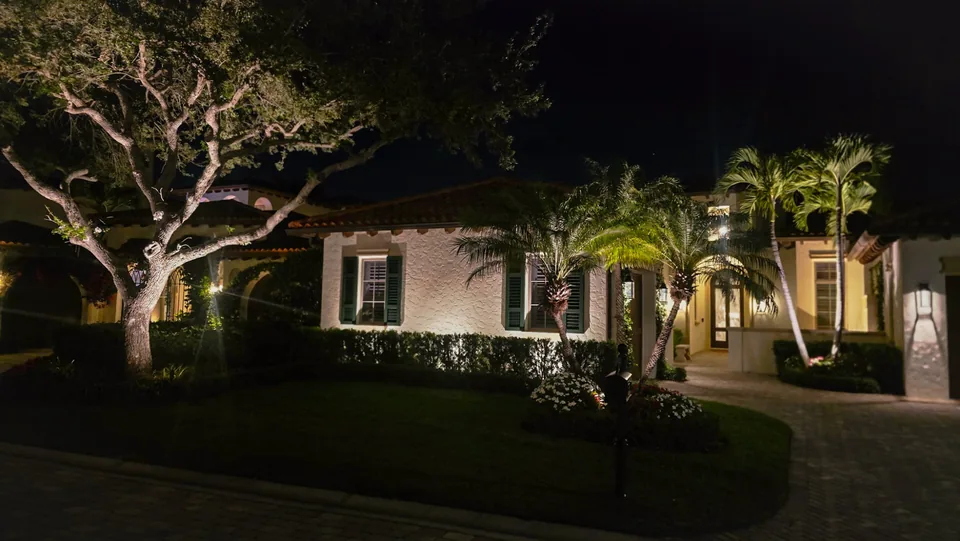
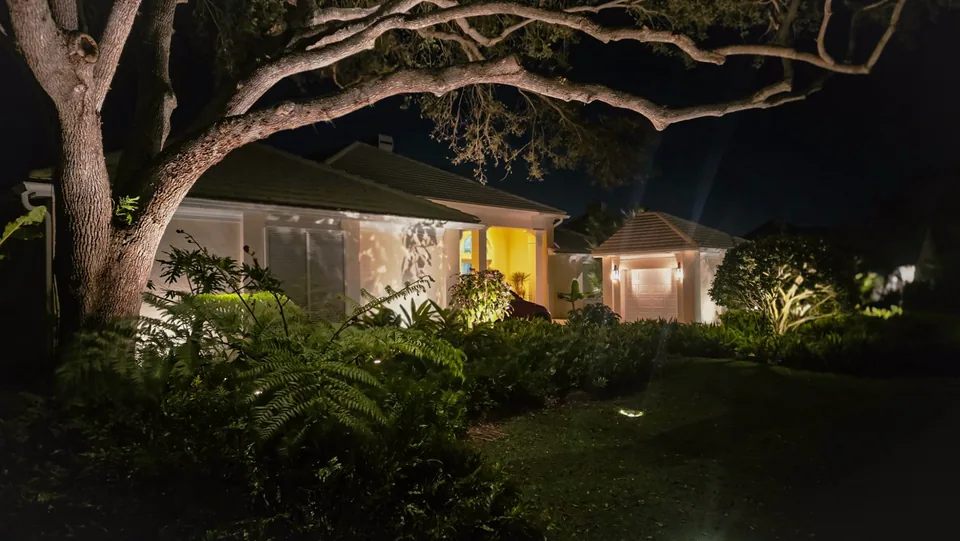
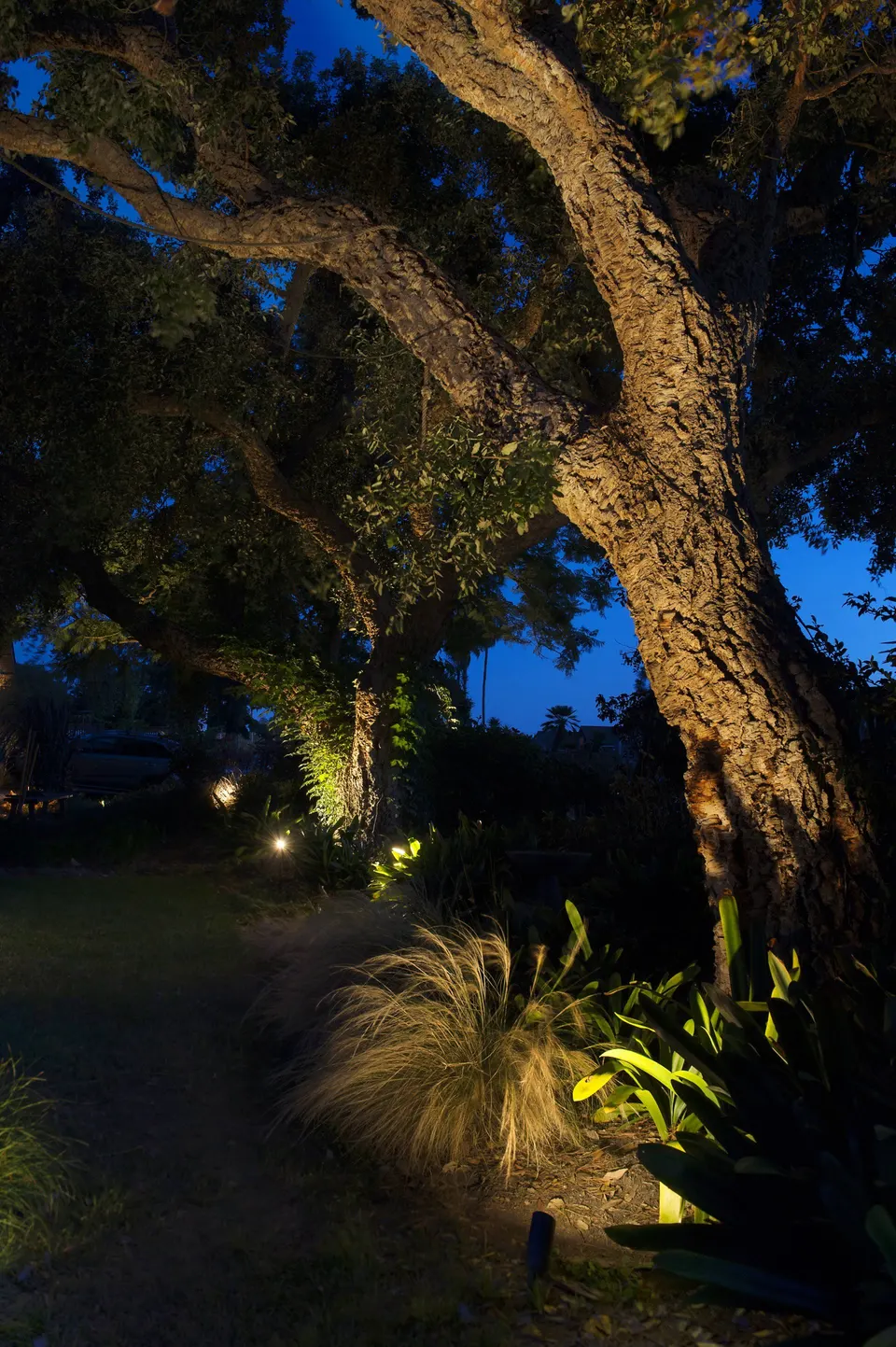
Photograph: a Southwest Florida garden under an oak. Not taken in Old Naples.
The historic district
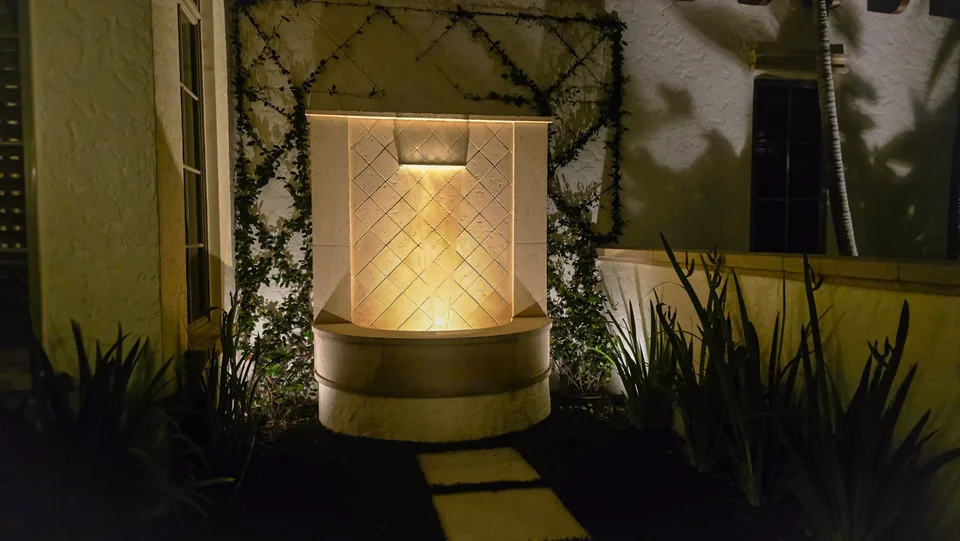
Most houses in the Naples Historic District are frame vernacular cottages with wood siding, large porches and gable roofs, and a few early ones are oyster tabby or oolitic limestone. They read best under soft, warm, low light that grazes walls and porches without glare. Ground-mounted fixtures avoid drilling into original siding. Move the fixture below and watch the siding.
The district’s later documentation says most of its houses "constructed between 1937 and 1964 are in the Frame Vernacular style," with "a variety wood siding, large porches, front and side gable roofs, a variety of roof dormers." Lap siding throws a shadow line under every board when light grazes it from close in, so a fixture set a little back from the wall gives a softer result. Mount it in the bed on a stake, not on the house.
A big front porch is the brightest thing on a cottage at night, and it should be the warmest. A lamp inside the porch ceiling and a pair of low lights at the steps do more than any flood on the lawn. FX Luminaire’s design guide is blunt: "Glare in landscape lighting is unattractive in all circumstances." DarkSky’s guidance is to "Use warmer-color lights where possible." See architectural lighting.
Set the light back from the boards, and keep it warm.
The 1987 nomination says the district "is architecturally significant through its use of native building materials such as oyster tabby and oolitic limestone." In 1888 "a contract was let for the construction of three tabby cottages," and Palm Cottage is the one restored as a house museum. Rough stone like that is made for a grazing light at its foot, the opposite of siding. Drilling into it to hang a fixture is the thing to avoid.
The district documentation notes that "Additions are often located to the rear of the property or are hidden by extensive vegetation, limiting their visual impact upon the public facade." Lighting can keep it that way: light the planting in front, and let the newer wing behind it stay in its shadow. No historic lighting review was found in the city code, so ask the Planning Department before work on a contributing house.
Sources: National Register nomination and Additional Documentation, read 2026-10-14; FX Luminaire design guide and DarkSky lighting principles, read 2026-10-13.
Since 1888
The 1888 founders lined the town's main roads with royal palms brought from the Everglades. University of Florida extension gives royal palms a height of 50 to 70 feet and warns that their large falling leaves can damage property. Keep fixtures out of the frond-drop zone where you can, use shielded fixtures, and keep palm light out of view of the beach.
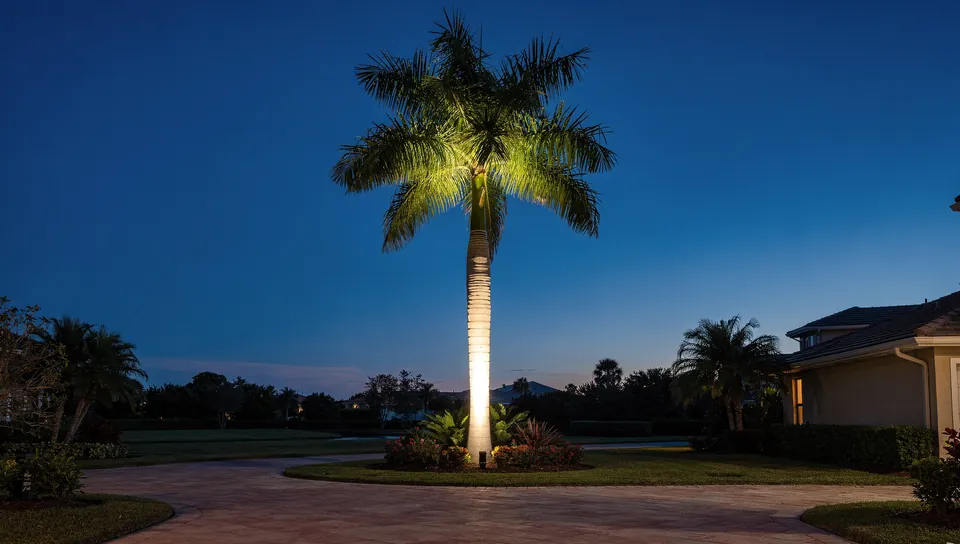
The 1987 National Register nomination describes the town’s first building season plainly: "The main roads were lined with foot paths and Royal palms transplanted from the Everglades." Those avenues are the reason an Old Naples street reads the way it does at night, a line of pale trunks and dark heads, and the reason so many owners want to light the palm in front of their own house.
UF/IFAS says the royal palm "quickly grows" to 50 to 70 feet, with a "smooth light gray trunk up to 2 ft. in diameter." It also says old leaves "will cleanly drop off by themselves, at a rate of about one leaf per month," and that a leaf can be 10 to 15 feet long and weigh up to 50 pounds fresh, so that falling leaves "can cause injury to people and damage to property." A fixture at the base of the trunk is directly under that. Set it a few feet out in the bed, aimed up the trunk, and choose a fixture with a sturdy shroud.
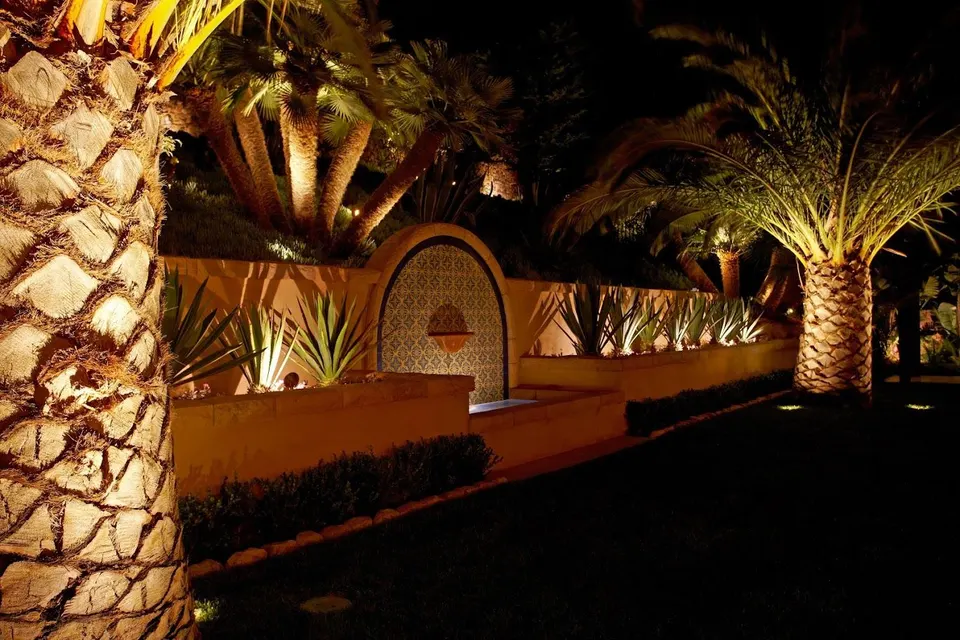
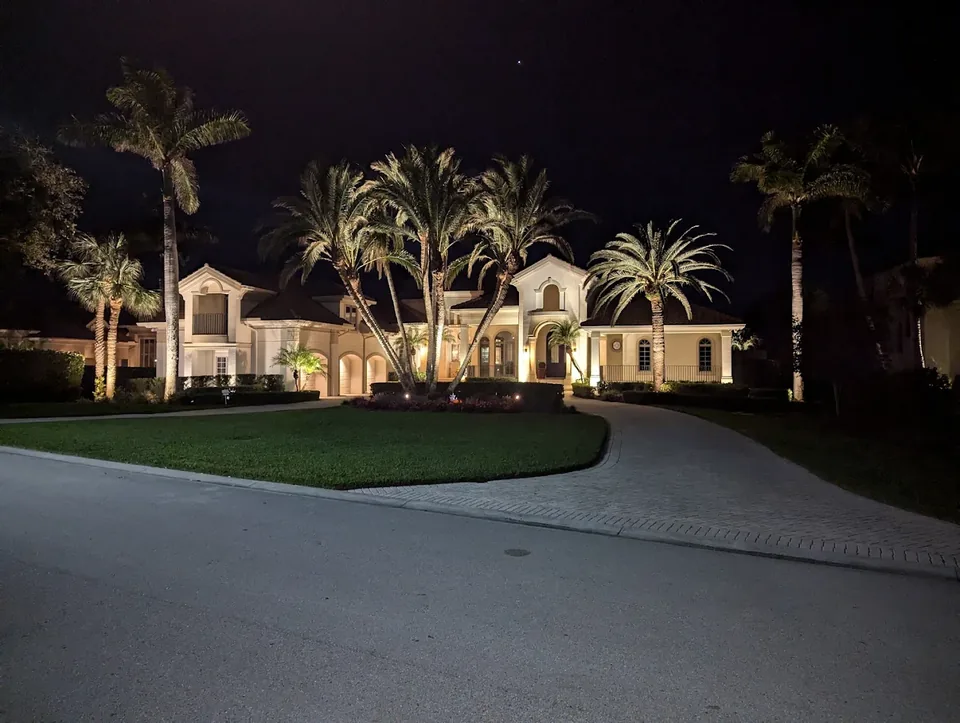
Royal palms "are moderately tolerant of salt spray, but they are intolerant of high salt concentrations in their root zone," UF/IFAS says, and much of Old Naples is a few blocks from the Gulf. On the inland streets, uplighting a palm is a design choice, held to the city’s glare rules: shielded, aimed at your own property, nothing in a driver’s eyes. On the Gulf-front blocks it is different. FWC advises: "Don't use decorative lighting (such as runner lights or uplighting of vegetation) in areas that are visible from the beach," and where the city’s turtle section applies to new work, accent lighting is prohibited. Uplighting also points light at the sky, which DarkSky’s guidance asks you to avoid, so we will not call it dark sky anything. For the palms you do light, see tree and palm uplighting and moonlighting for canopy light aimed down.
Sources: National Register nomination, Naples Historic District (PDF page 10, read by eye), read 2026-10-14; UF/IFAS, Roystonea regia, read 2026-10-13; FWC, lighting guidelines, read 2026-10-13; DarkSky, lighting principles, read 2026-10-13.
On the map
The National Park Service describes the Naples Historic District as roughly bounded by Ninth Avenue South, Third Street, Thirteenth Avenue South and the Gulf of Mexico. That puts the beach ends at 9th, 10th, 11th, Broad, 12th and 13th Avenue South along its Gulf edge. Homes there can be within 300 feet of mean high water, where the City of Naples sea turtle lighting rules apply.
Built in 1888 and being rebuilt after Hurricane Ian. Its parking lot closes at 11:00 p.m. Placed from FEMA’s own project notice.
An 1888 tabby cottage, now a house museum, and the anchor of the historic district’s south end.
A beach end with restrooms and a pier bypass during the rebuild. The pin marks the street, not the exact path.
The Gulf-front row, where the city’s sea turtle lighting section reaches homes that the beach can see.
A historic shopping street with walkers at night, where glare into the sidewalk is the problem to solve.
A 12.84-acre park with lighted courts, open until 10:00 p.m. Inland, away from the beach-visible zone.
Points placed from naplesgov.com, nominatim.openstreetmap.org. Map data from Google.
Old Naples, and the district inside it
Old Naples is larger than the historic district. The Old Naples Association's map runs from about 7th Avenue North to about 14th Avenue South, Gulf to Tamiami Trail and Naples Bay. The National Register district sits inside it, roughly 9th to 13th Avenue South. The city's own plan speaks of the Historic District within Old Naples.
The National Park Service lists the Naples Historic District as NRIS 87002179, published December 17, 1987, "Roughly bounded by Ninth Ave. S, Third St., Thirteenth Ave. S, and Gulf of Mexico." The 1987 boundary justification draws its south end at Palm Cottage, "on the north side of Twelfth Avenue South," so the two documents do not agree to the block. That is why this page says roughly 9th to 13th Avenue South and leaves the exact line to the city.
The Old Naples Association describes itself as "a nonprofit 501(c)4 civic organization dedicated to preserving the small-town character, charm and quality of life in Old Naples," established in 1978. Its map has no written boundary, so its edges are approximate too. It is a civic association, not a deed-restriction HOA, and it publishes no design rules.
The city’s list of beach accesses puts six street ends along the district’s Gulf edge: 9th, 10th and 11th Avenue South, Broad Avenue South (restrooms), 12th Avenue South (closed for the pier rebuild) and 13th Avenue South (restrooms). The city has 40 accesses along a coastline "that spans nearly 9 miles." A house a few lots back from one of these ends may still be in view of the sand down the street, and that is what the turtle section asks about.
Sources, read 2026-10-14: National Park Service, NRIS 87002179; nomination PDF (PDF page 15, read by eye); Old Naples Association, About and boundary map; City of Naples Comprehensive Plan, City Vision; beach accesses; beach information.
12th Avenue South
The pier at the west end of 12th Avenue South dates to 1888 and is being rebuilt after Hurricane Ian, with reopening planned for July 2027. Its parking lot closes from 11:00 p.m. to 5:00 a.m. Homes near the pier face the same beach the turtle rule is written for, so beach-facing light should be low, shielded and off late, as the 9:00 p.m. seasonal rule requires for beach-visible lights.
 Illustration
The Gulf-front blocks
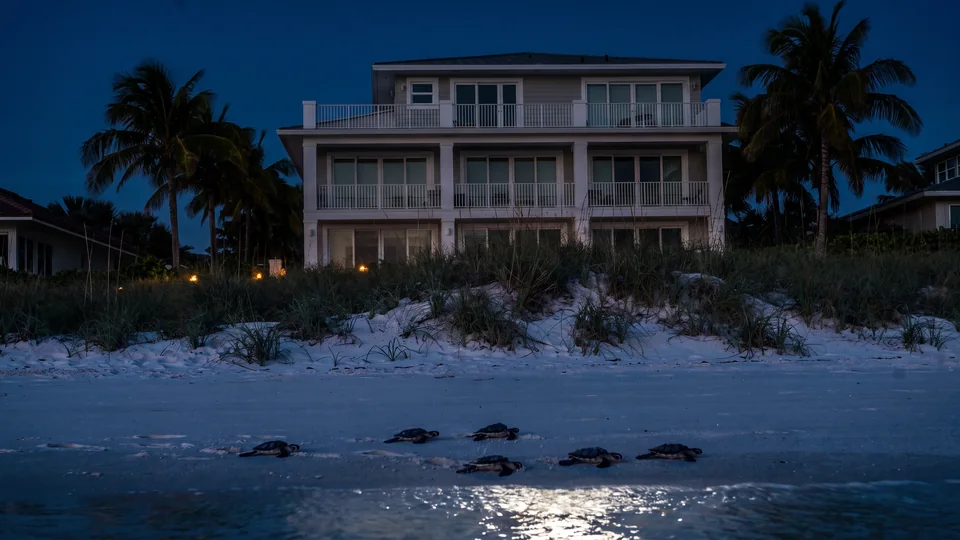
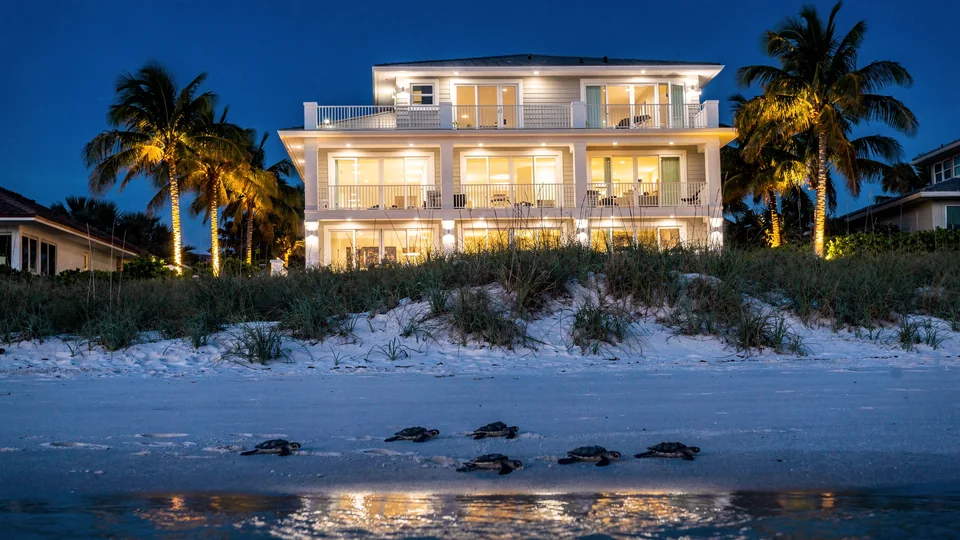
City of Naples Sec. 52-61 applies where lighting is within 300 feet of the line of mean high water or can be seen from the beach. In Old Naples that means the Gulf-front blocks along Gulf Shore Boulevard and the beach ends, not the inland streets around Cambier Park. Where it applies, floodlights and landscape or accent lighting are prohibited for new work.
Old Naples is inside the City of Naples, so this is the city’s section, not Collier County’s. The section reaches a light either way: by distance from the water, or because someone on the sand can see it. For a cottage a block back from Gulf Shore Boulevard, the question to ask is the second one, and it is answered by walking down a beach end at night and looking back. For new work in reach, outdoor lighting is held "to the minimum necessary for security and safety." For homes already built, beach-visible lights go off at 9:00 p.m. from May 1 to October 31, or get a hood or a new position so "the light sources or any reflective surfaces illuminated by such sources are not visible from the beach."
The city’s web page goes further than the code and asks that "landscape and accent lighting should be off or disabled during nesting season," and says the season "can begin as early as April 15," earlier than the code’s May 1. It names loggerhead as "The primary nester along Naples beaches," green as "A common nester," and leatherback as an "Occasional visitor." The comprehensive plan commits the city to reviewing exterior and landscape lighting plans for properties seaward of the Coastal Construction Control Line. Fixtures and shields are on our coastal lighting page.
Sources: City of Naples Sec. 52-61, Municode, and the city’s sea turtle page, read 2026-10-13 (ledger F-49 to F-53, F-83); Comprehensive Plan Policy 2-8, read 2026-10-14.
Where Sec. 52-61 reachesNightScapes Landscape Lighting
Distance or sight, light by light.
Planting and switching
The City of Naples says dune plants may shield residential lighting from nesting turtles, and its sea turtle page asks owners to keep landscape and accent lighting off in nesting season. On the Gulf-front blocks of Old Naples, native dune planting plus timers that switch beach-side light off by 9:00 p.m. from May through October works with both the code and the city's advice.
On a contributing lot
For contributing buildings in the city historic district, demolition permits wait 180 days from a complete application so alternatives can be considered. The code also bars clearing, site preparation and removal of landscaping on that property before the permit takes effect. If a lighting project is part of a larger rebuild on a historic lot, plan landscape work around that hold.
0 of 5
The lot, the timing and the question nobody wrote down are all settled. Plan the garden and the light together.
The permit timing and the written answer from Planning are the two that matter most on a contributing lot.
Ask the City of Naples Planning Department whether the building is contributing and whether anything about the fixtures needs a look.
Sec. 16-116(c): permits to demolish or remove contributing buildings "will not be issued until the expiration of 180 days," and "No work may be commenced or completed related to demolition or removal of structures including clearing, site preparation, and removal of landscaping on the subject property until after the effective date of the permit." Sources, read 2026-10-14: City of Naples Sec. 16-116(c) and 16-112(b), Municode; National Register nomination, Additional Documentation, Section 7.
Apartment and condominium buildings
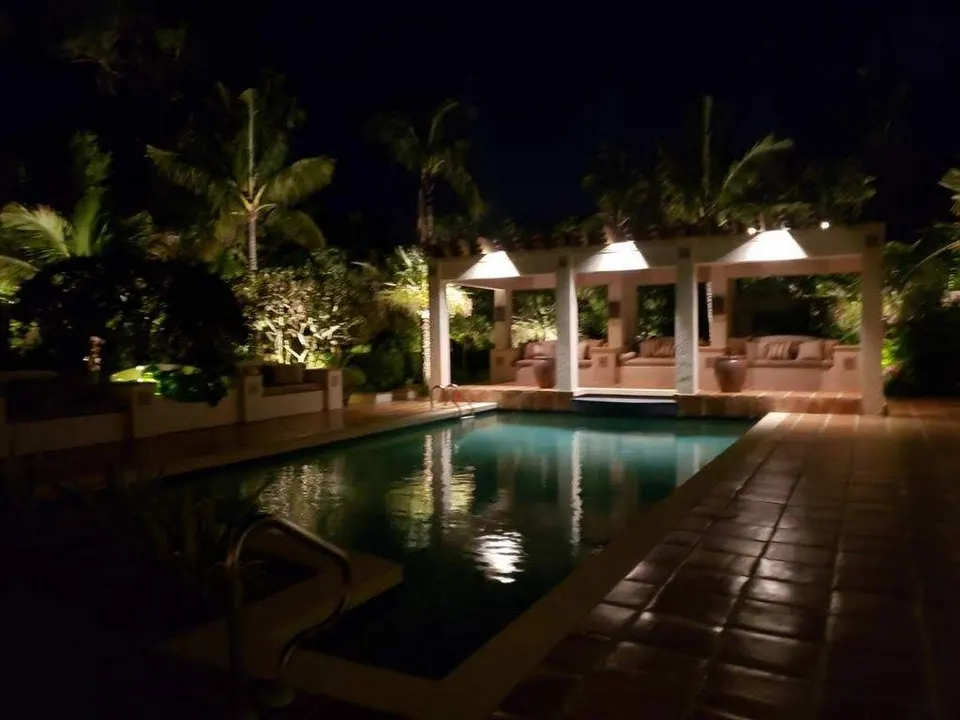
City of Naples Sec. 56-89 lets multifamily buildings use exterior lighting at grade and at the first habitable floor, aimed at the street-facing facade, plus landscape lighting at grade. Lighting on the facade or roof above the first habitable floor is not allowed, though balconies, walkways and pool areas are exempt and holiday lighting is allowed from November 15 to January 15.
The nomination describes the district’s south side this way: "Large scale contemporary apartment buildings south of Twelfth Avenue South define this edge of the district." Those buildings, and others across Old Naples, light under a citywide section written for multifamily property. It allows light at grade and at the first habitable floor directed at the facade, and adds that "Lighting may also be utilized at grade to enhance landscape features." Facade and roof lighting above that floor is not allowed.
For a building’s grounds that points to a plan built from the ground up: palms and planting lit at grade, the entry and lobby face lit at the first floor, walkways and the pool area lit for use. Each building’s own association may have rules of its own, and those are not public, so start there. See commercial and HOA lighting.
Sources, read 2026-10-14: City of Naples Sec. 56-89, Municode; National Register nomination, PDF page 15.
A walking neighborhood
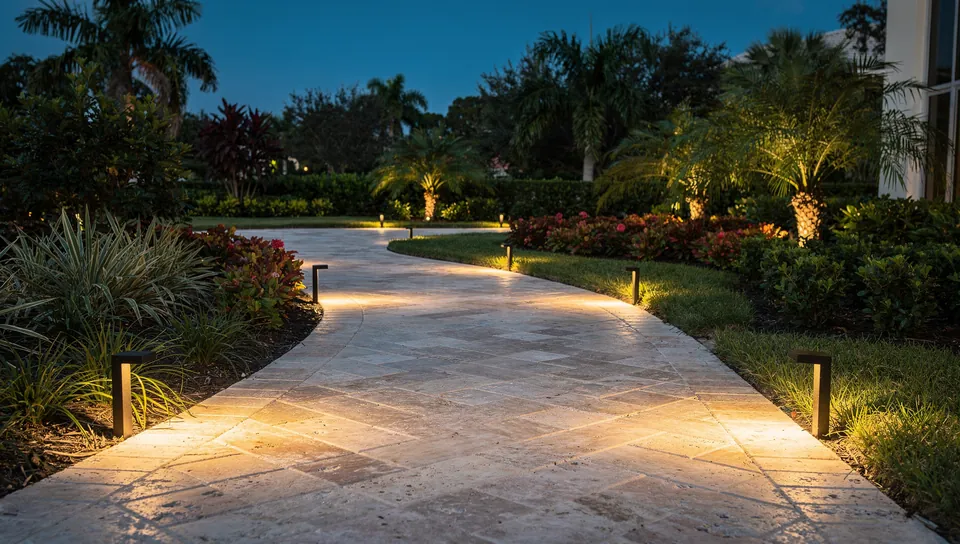
Old Naples is a walking neighborhood, with Third Street South, Fifth Avenue South and Cambier Park close by. City code bars light that shines into the eyes of drivers or pedestrians and requires fixtures to be shielded and aimed at your own property and the abutting sidewalk and street. Low, shielded path and entry lights keep the sidewalk lit without glare.
The city’s comprehensive plan names "the Third Street South Shopping District and the Crayton Cove Shopping District" as limited commercial areas, and the 3rd Street overlay has the city "act in reliance on approvals given by the association," the 3rd Street Association. The historic district’s boundary was drawn "to include two historic commercial buildings, the Mercantile Building (1177 Third Street) and the Naples Company Building (1148 Third Street)." Fifth Avenue South has its own overlay, whose purpose includes that "no significant additional traffic impacts will be added to surrounding residential neighborhoods." Cambier Park, "just South of the prestigious 5th Avenue South," covers 12.84 acres, has lighted shuffleboard and basketball courts, and is open 7:00 a.m. to 10:00 p.m. These overlays govern commercial matters, not the lighting of your house.
For a home on one of these blocks, the rule that matters is the citywide one. Sec. 16-285(b)(23): "Nonvehicular light sources that shine into the eyes of drivers of vehicles or pedestrians which could impair safe traverse are prohibited." Sec. 22-38 asks that fixtures "provide a full cutoff at the property line." With people walking past at night, a bright wall pack on a porch post or a spotlight aimed down the drive is the most common way to get this wrong.
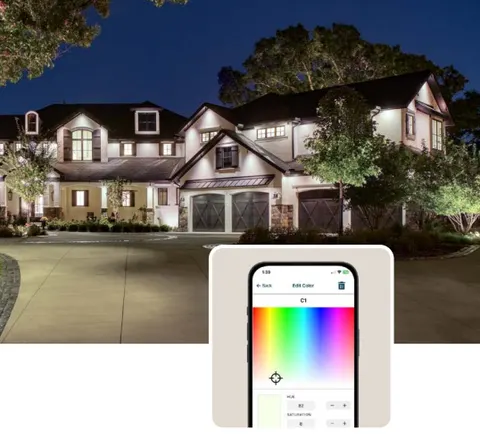
Shaded path lights set back in the bed, step lights in the risers, an entry light that hides its lamp, and driveway light kept on the paving rather than the street. DarkSky’s principle is "Direct light so it falls only where it is needed." See path lighting and driveway and entrance lighting, and smart lighting control to dim the front late in the evening.
Sources, read 2026-10-14: City of Naples Comprehensive Plan, Future Land Use Element; Sec. 58-1101, 58-1131, 16-285 and 22-38, Municode; Cambier Park; nomination, PDF page 15.
Who is writing
NightScapes Landscape Lighting is a Naples company that does outdoor lighting. This guide was built from the National Register nomination for the Naples Historic District, the City of Naples code and plan, the city's pier and beach pages, and the Old Naples Association's own description of itself. Every source is linked where it is used, with the date it was read.
The photographs here were not taken in Old Naples, and the drawings are marked as illustrations. Where the sources disagree, as the National Register documents do about the district’s south line, or the city’s code and web page do about when nesting season starts, the page gives both rather than choosing one. Where we found nothing, as with a historic lighting review or the rebuilt pier’s lights, we say so.
FEMA’s flood map, read at points through the neighborhood, puts Gulf Shore Boulevard South and 8th Avenue South in zone AE at 9 feet, the west end of Broad Avenue South at 8 feet, and the beach in zone VE at 13 feet. FEMA also says salt spray "declines rapidly in the first 300 to 3,000 feet landward of the shoreline." Both shape where a transformer is mounted and how often a system near the Gulf is looked over.
Sources: FEMA National Flood Hazard Layer, read 2026-10-14; FEMA Technical Bulletin 8, read 2026-10-13; FX Luminaire design guide, read 2026-10-13; City of Naples dune plants, Naples Pier, pier rebuild, FEMA pier notice and Sec. 42-53, read 2026-10-14.
Ask about an Old Naples planTodd listened to everything that I wanted.
Questions we hear
Historic approval for lighting, whether the Old Naples Association sets rules, lighting a Gulf Shore Boulevard yard in summer, the pier's reopening, uplighting royal palms, what condominium buildings may light, and the birds at the pier. Each answer comes from the city's code and pages or the National Register record.
 NightScapes Landscape Lighting Outdoor lighting only, Naples since 1998
Choose a question
Ask us about lighting in Old Naples. Pick a question, or call and we will talk it through.
No historic lighting review was found in the City of Naples code. The city defines its historic district by the National Register listing and holds demolition of contributing buildings for 180 days, but no rule read covers fixtures. Before work on a contributing house, ask the City of Naples Planning Department and keep the answer in writing.
No. The Old Naples Association describes itself as a civic organization, established in 1978, that represents residents and property owners. It publishes a boundary map but no deed restrictions or design rules. Condominium buildings in Old Naples may have their own association rules, which are not public, so ask your building’s association.
If the lights are within 300 feet of mean high water or visible from the beach, City of Naples Sec. 52-61 applies. Existing homes must turn beach-visible lights off from 9:00 p.m. to sunrise, May 1 to October 31, or hood or reposition them. New construction within 300 feet is stricter: landscape and accent lighting are prohibited there.
The City of Naples says the rebuilt pier is on schedule to reopen in July 2027. Its parking lot closes from 11:00 p.m. to 5:00 a.m. by city code. The pier’s own lighting design was not published in the pages read, so nothing here describes it. For nearby homes, the beach-visible lighting rules stay the same.
Away from the beach, the city code does not bar it, as long as fixtures are shielded and do not glare into the street or onto neighbors. Royal palms reach 50 to 70 feet and drop heavy fronds, so place fixtures with care. On Gulf-front lots where Sec. 52-61 applies, accent lighting is prohibited for new work.
Under Sec. 56-89, multifamily buildings may light at grade and at the first habitable floor, aimed at the street-facing facade, and may light landscape features at grade. Lighting on the facade or roof above the first habitable floor is not allowed. Walkways, stairs, pool areas and balconies are exempt, and holiday lights may run from November 15 to January 15.
No source read says so. The pier’s rules bar feeding birds, and FEMA lists marine wildlife viewing among the pier’s uses, but neither names species or mentions lighting. The lighting rules that apply along this beach are written for sea turtles. Keeping beach-side light low, shielded and off late follows those rules and the city’s advice.
Free Consultations and Estimates
Tell us the street, whether the house is a contributing cottage, a newer home or a condominium, and how close it sits to the beach. We will start from the house itself, its porch and its palms, and from what the sand can see.
Tell us about the house