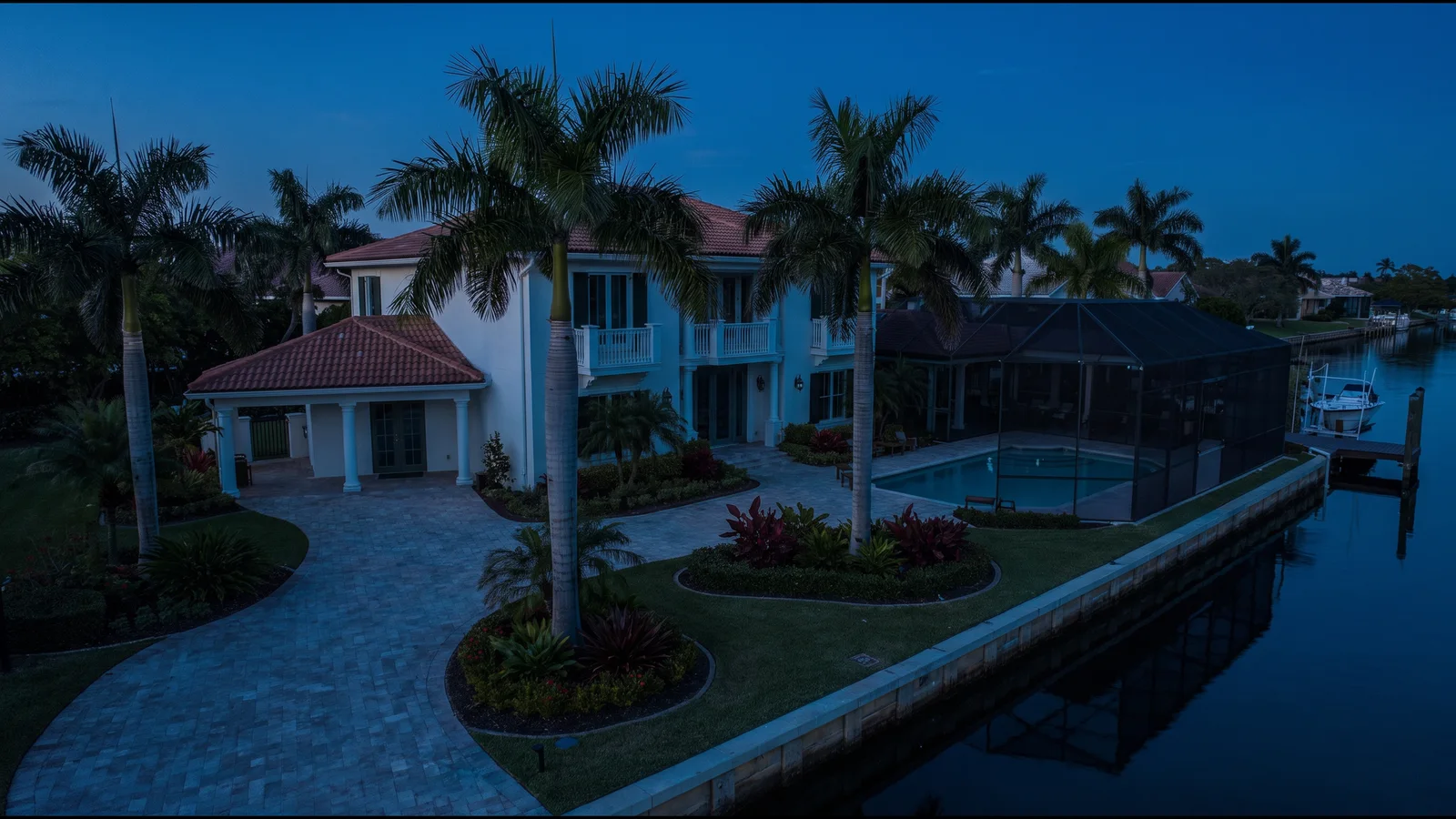
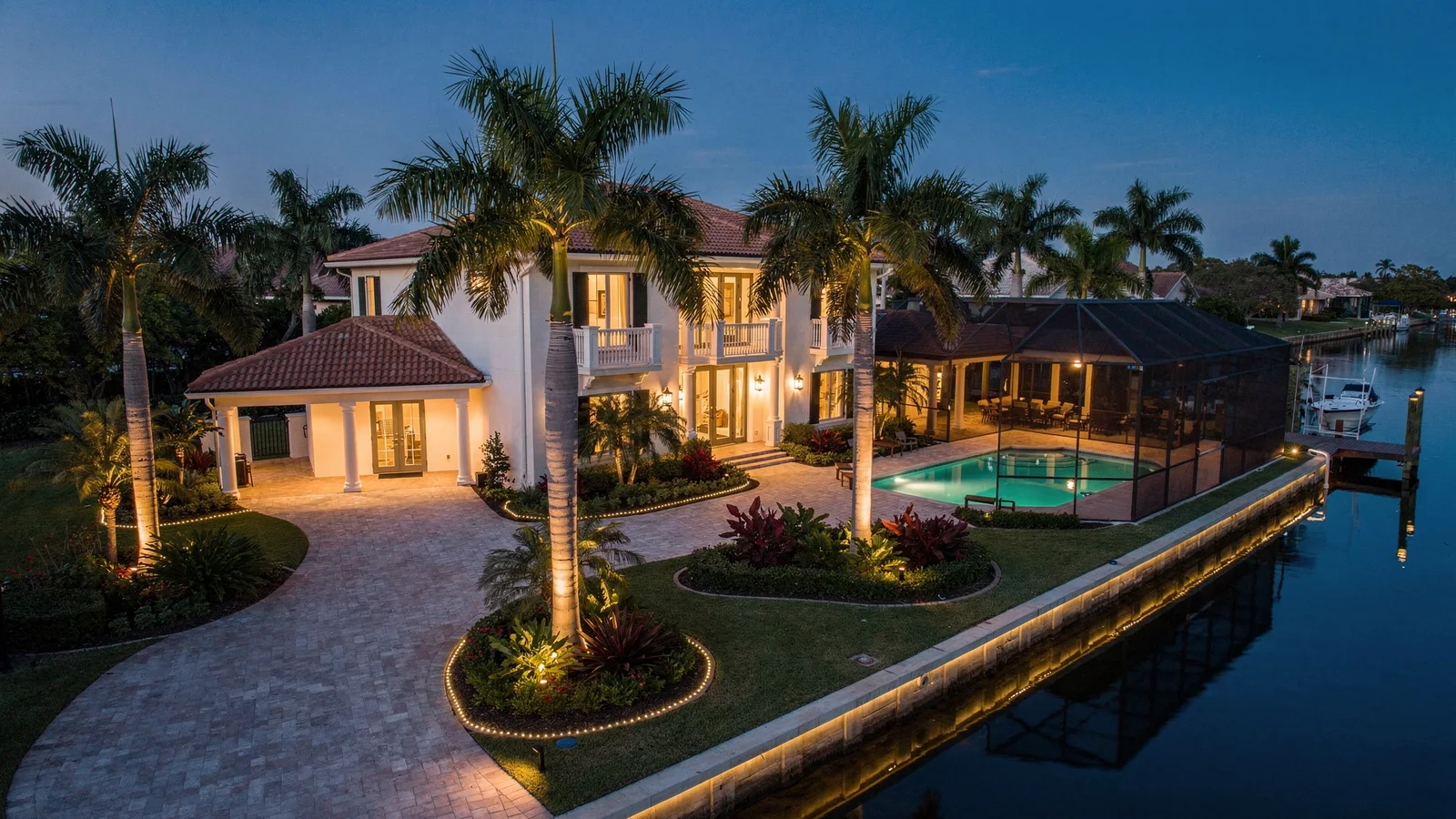
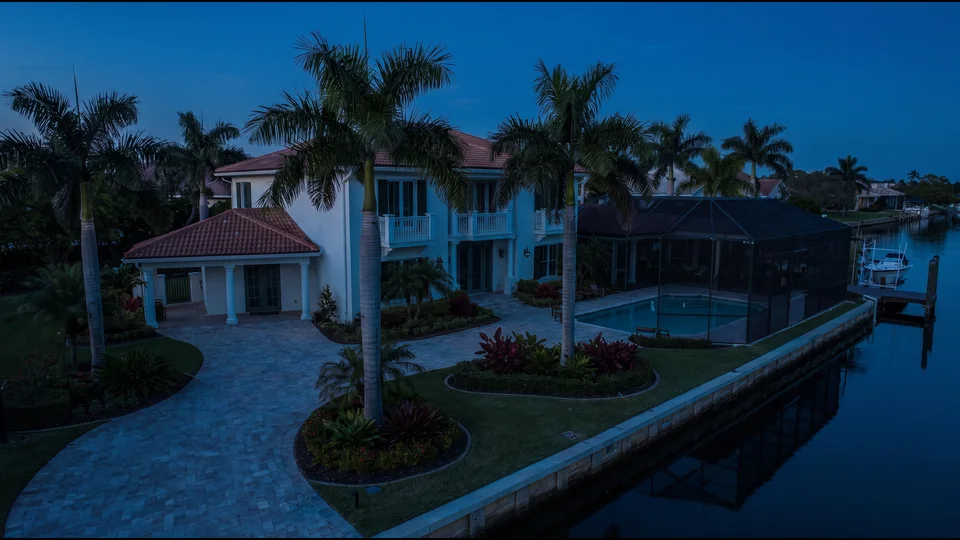
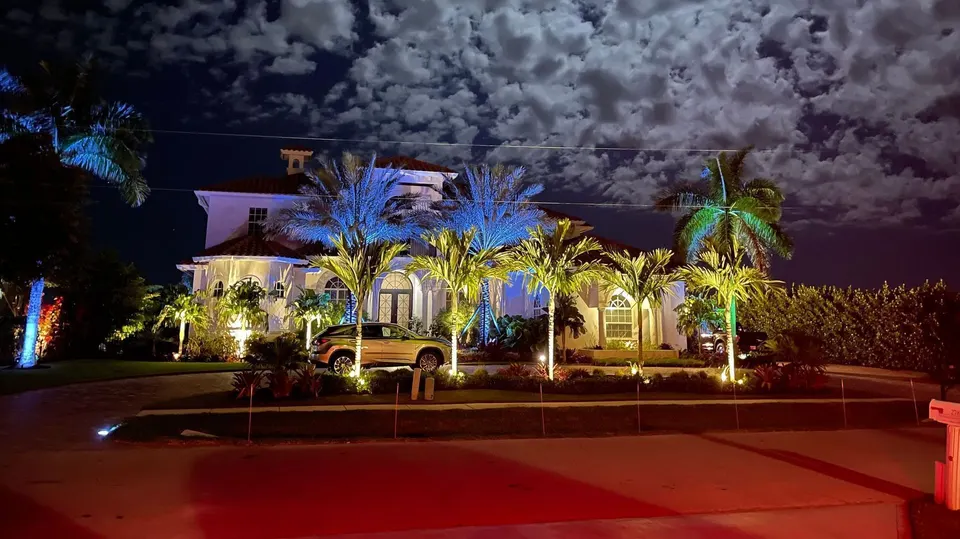
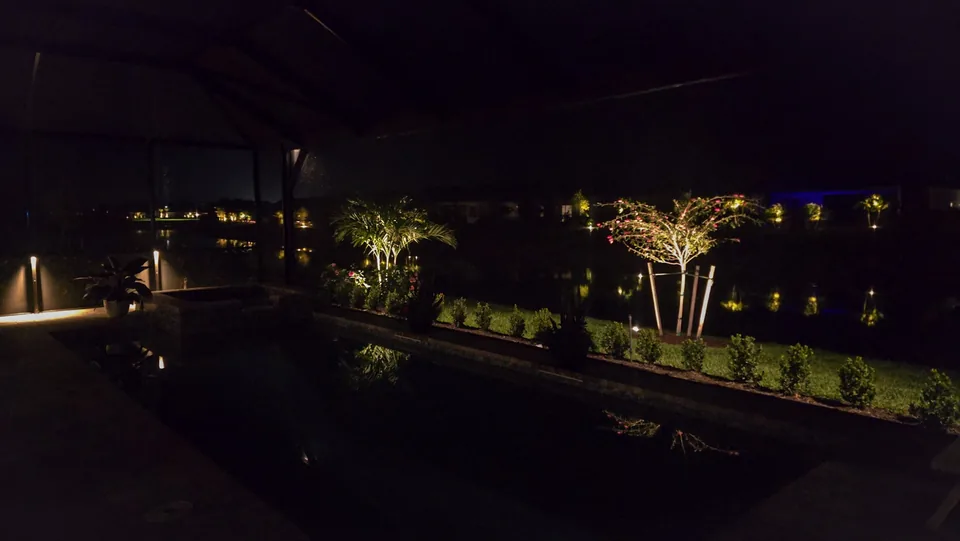
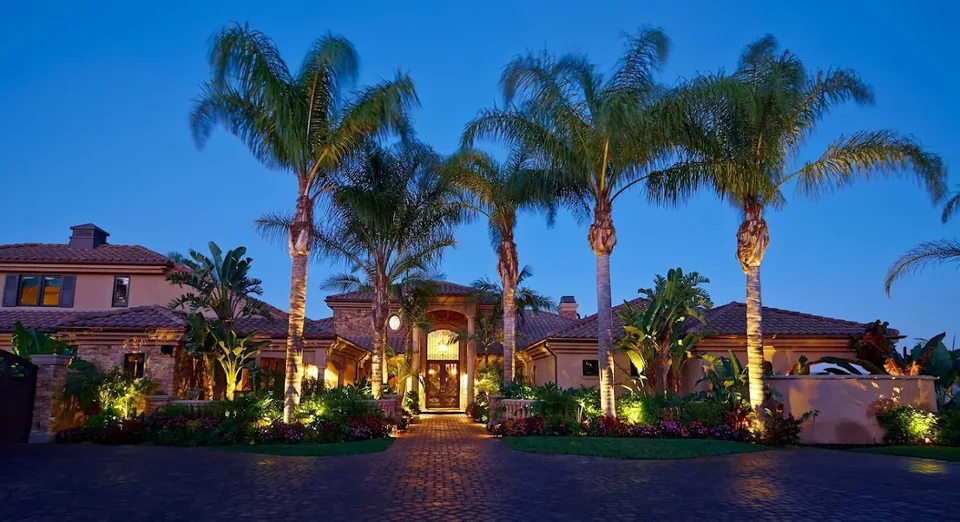
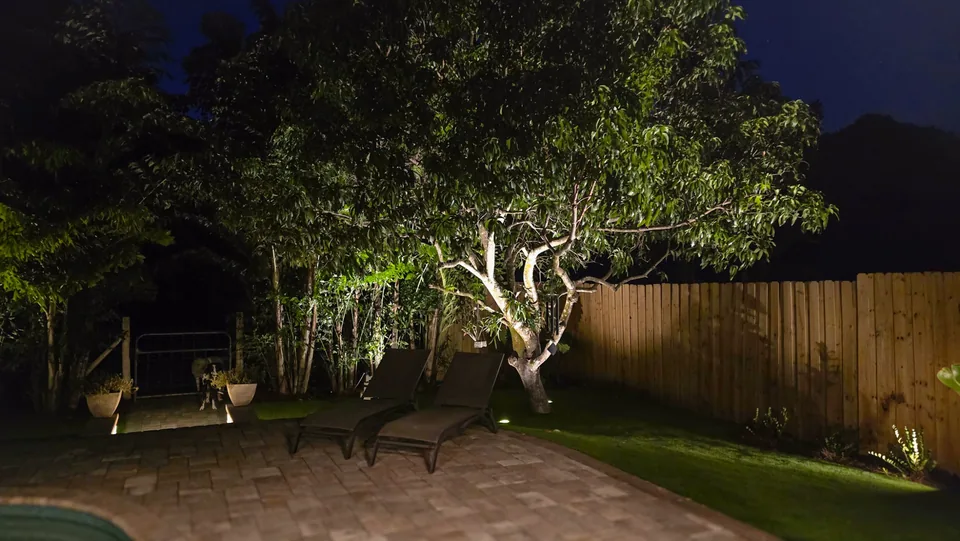
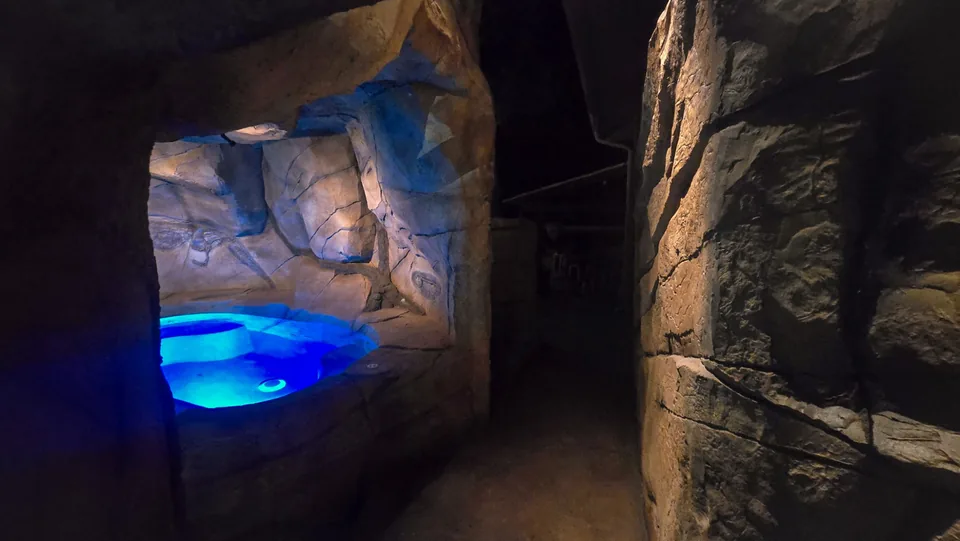
Illustration of one waterfront property, at dusk and lit
If you want the whole property to look right
Landscape lighting in Naples, designed as one scheme
If you want your property to look right after dark, it has to be designed as one scheme, not bought a fixture at a time. At the consultation, we decide what the view should be from the street, the entry, the lanai and inside the house, and then choose the fixtures that make that view.
Lighting is the one improvement you only ever see at night, which is why it is so often bought the wrong way round. Fixtures get added one at a time, each solving the thing in front of it, and a few seasons later the property has twenty lights on it and no scheme: bright patches, dark gaps, and a glare source wherever you happen to sit.
A design starts from the other end. The view comes first, then the zones that make it, then the fixtures, the runs and the transformer. Everything on this page is a part of that order, and each part has its own page when you want the detail.
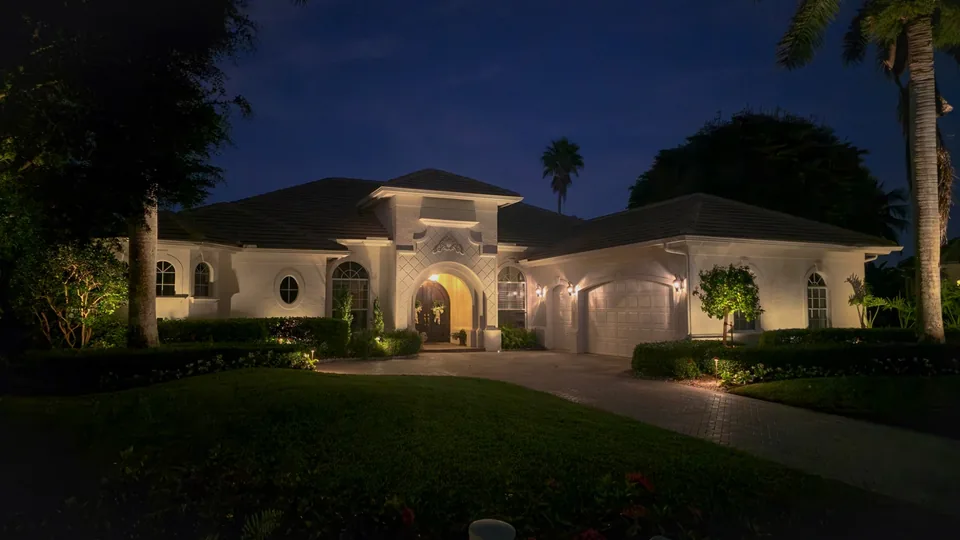
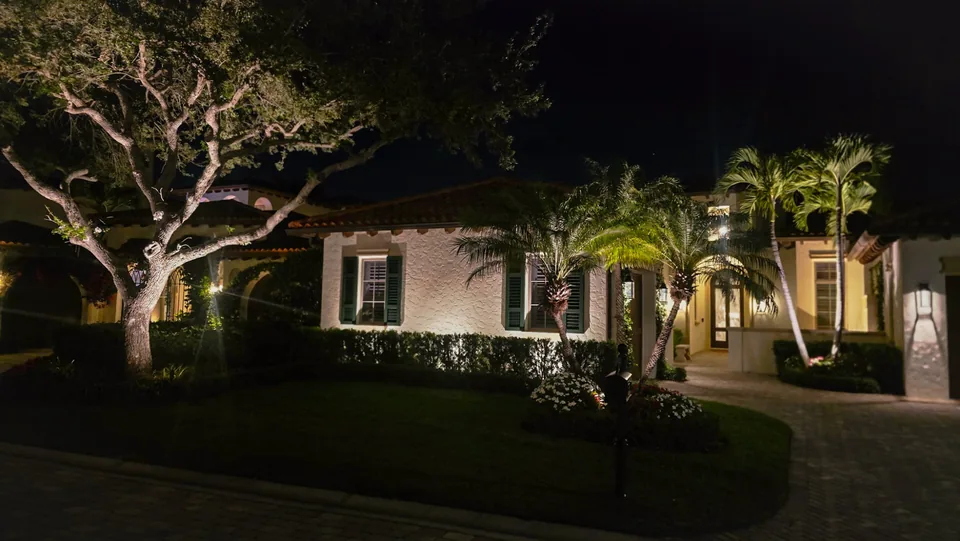
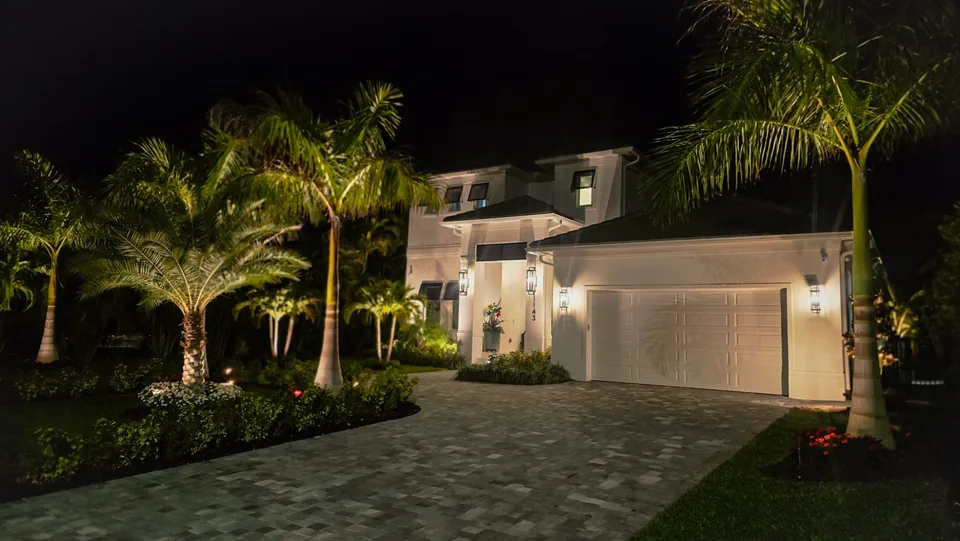
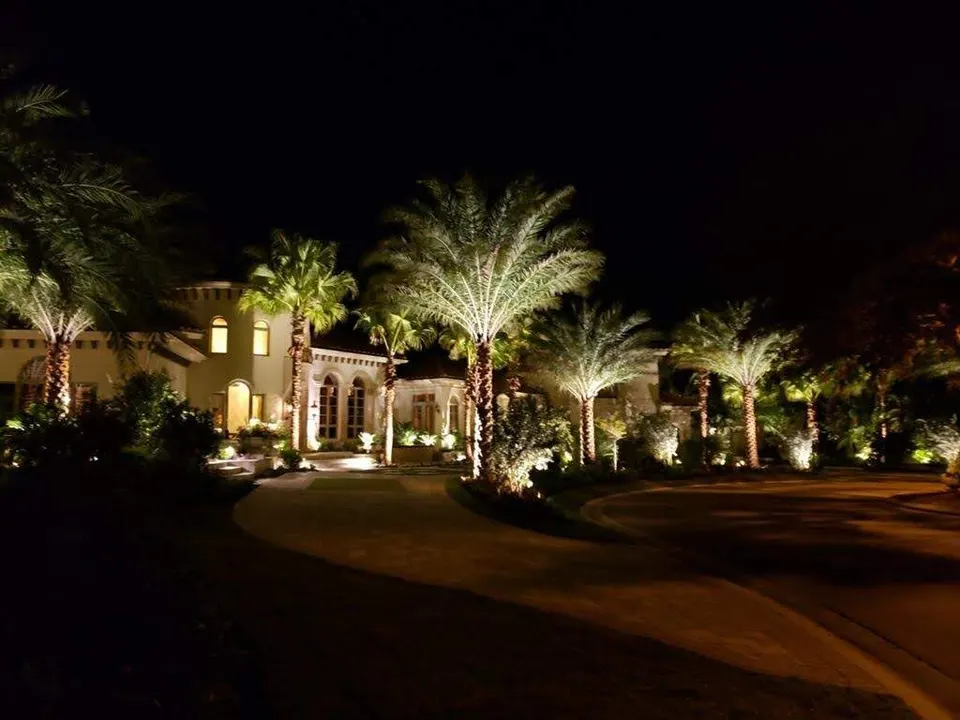
Entry, facade, planting and drive, lit as one scheme.
Since
2006, outdoor lighting only.
Owners
Todd and Sherry.
First step
A free consultation at your property.
Designed as one scheme
A property lights in six zones
This is what "one scheme" means in practice. Each zone does a different job, carries a different amount of light, and can be switched and dimmed on its own. Here is one property at dusk with nothing on. Scroll, and it comes up a zone at a time, in the order a design is actually built.
Zone one
Arrival: the drive and the front door
The only part of the scheme most visitors ever see, and the only part that has to work at twenty miles an hour. The drive edges read, the entry reads, and nothing shines at the car. See driveway and entrance lighting.
Zone two
The house: columns, walls and entry
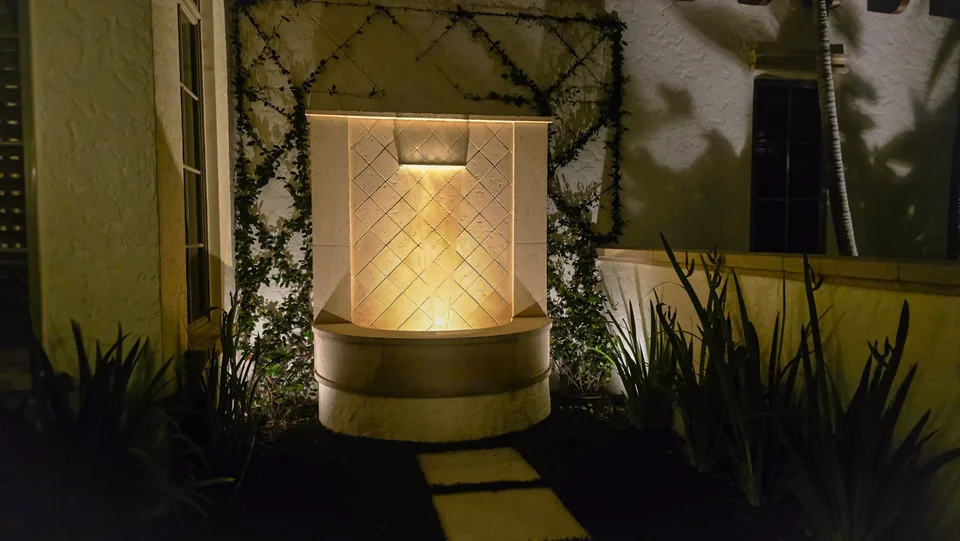
Grazed from close in so the stucco keeps its texture instead of flattening into a bright wall, and kept off the windows so nobody inside is lit from outside. See architectural lighting.
Zone three
Canopy: the palms set the scale
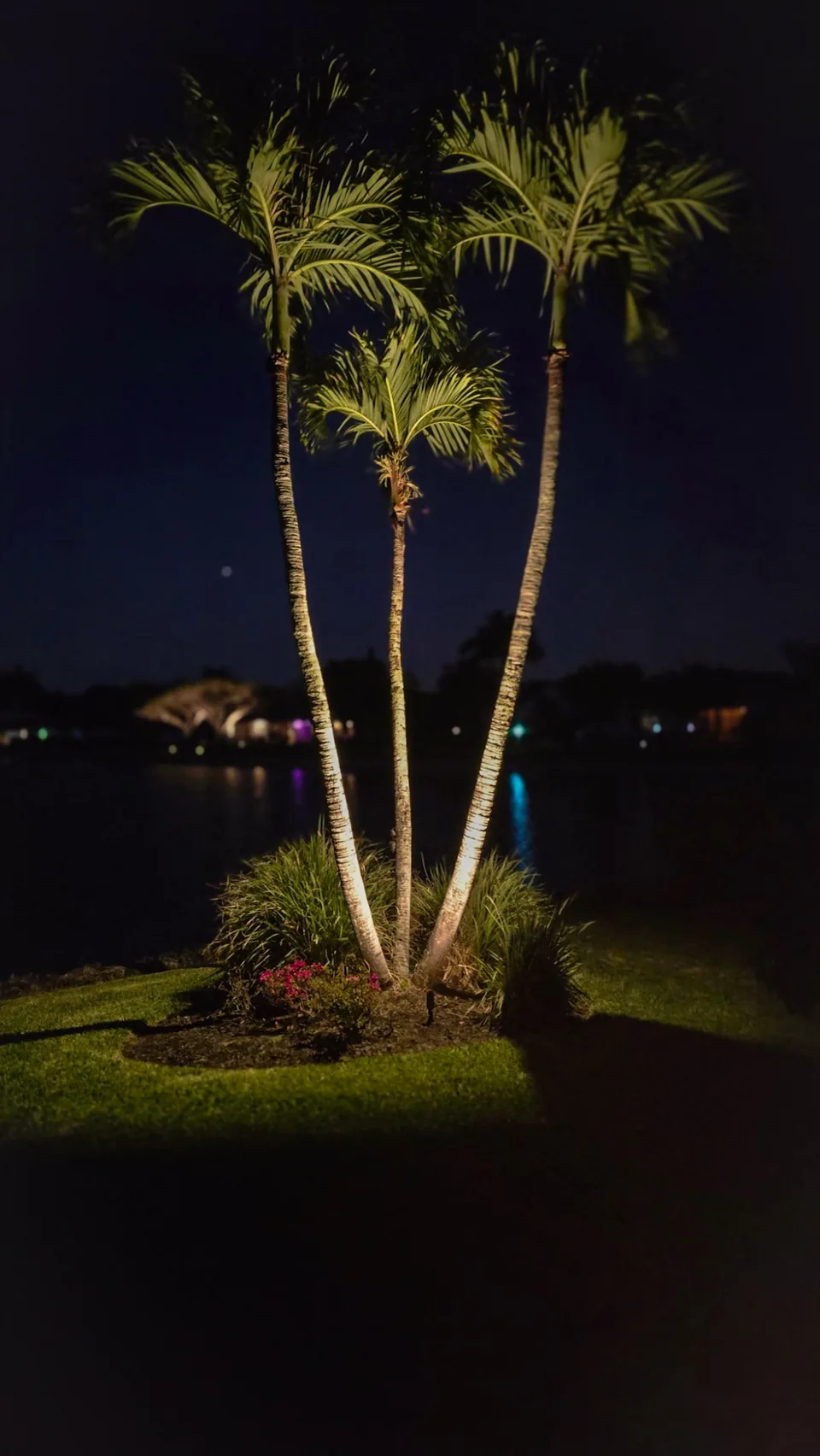
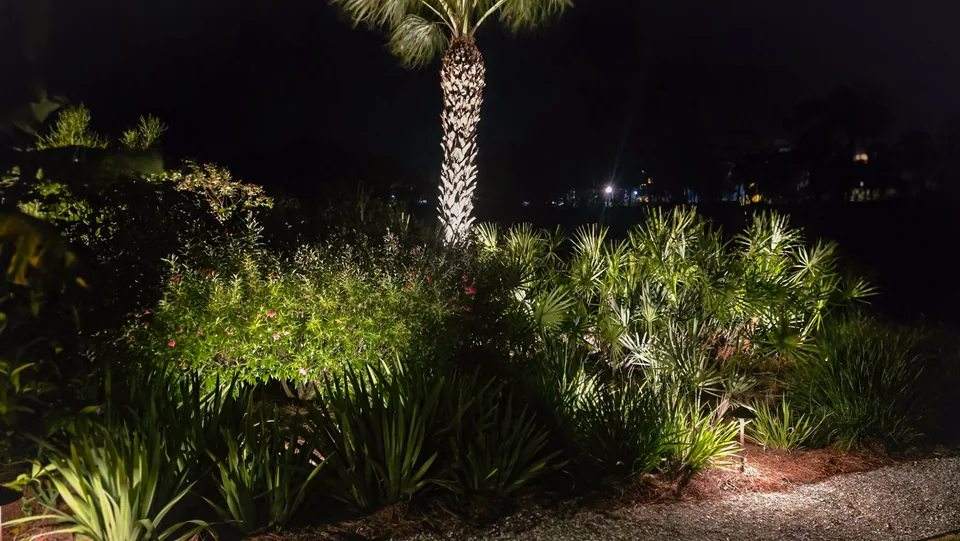
Palms and specimen trees, lit from the base. The tallest thing on most Naples properties, and the one that tells you how big everything else is. Each palm is aimed on its own. See palm and tree uplighting.
Zone four
Beds and walks: low and quiet
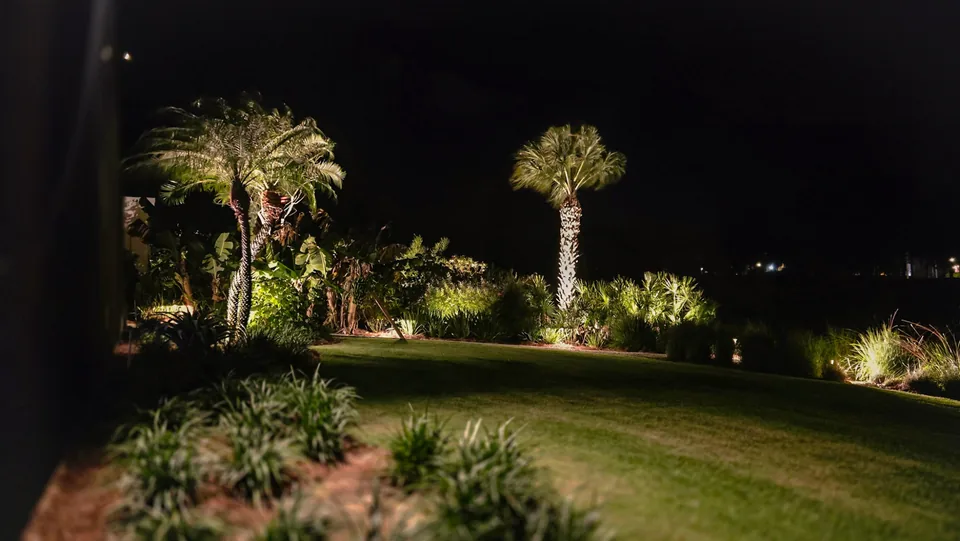
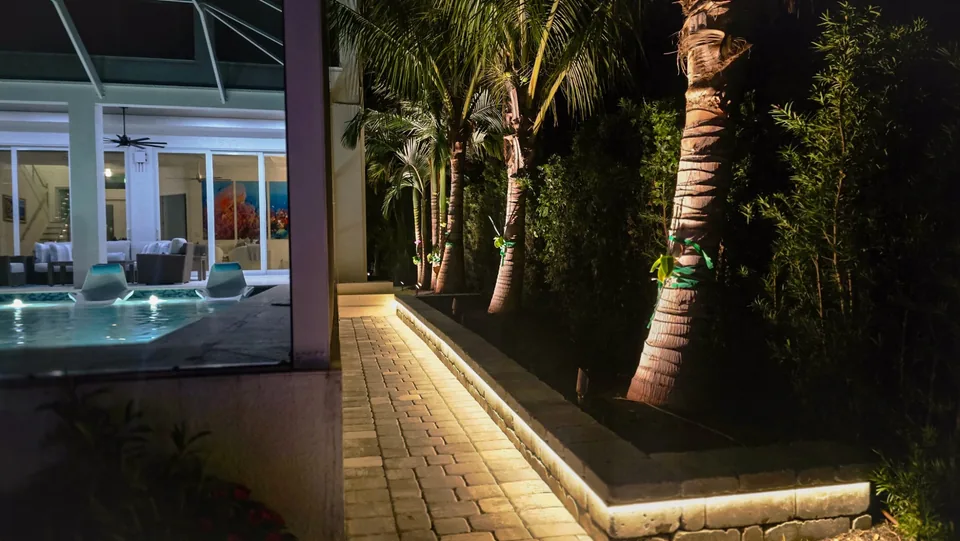
Low light into the planting and across the walks. Enough to read the edge of a step and the color of a bromeliad, never so much that the fixtures become the feature. See garden lighting and path lighting.
Zone five
Pool and lanai: the outdoor room
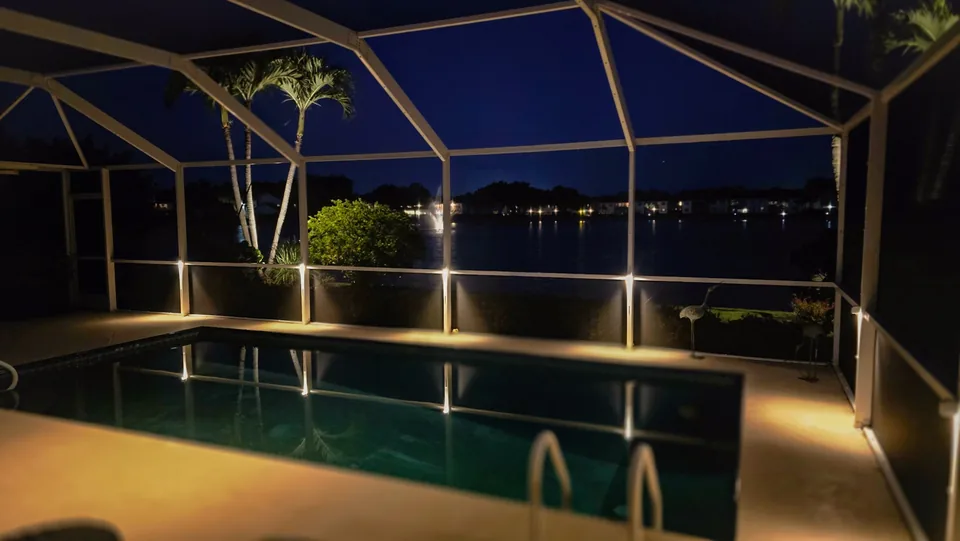
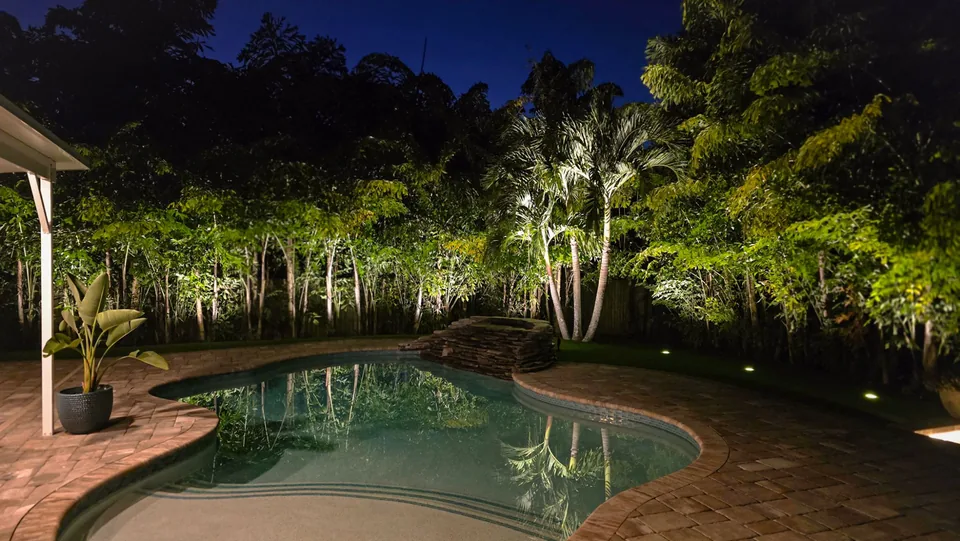
Warm, low and shielded, because this is where people sit and look back at everything else. The screen cage reflects any source inside it, so most of the light stays outside the screen. See pool and lanai lighting.
Zone six
Water's edge: the seawall and the dock
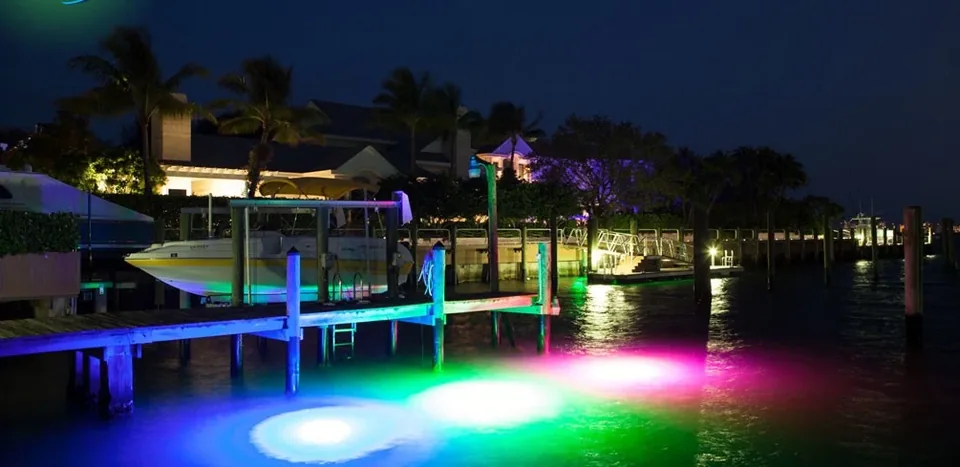
It extends the property past the lawn, and it is the one zone the neighbors across the canal also see, so it is aimed and shielded at the waterline. See deck and dock lighting and underwater lighting.
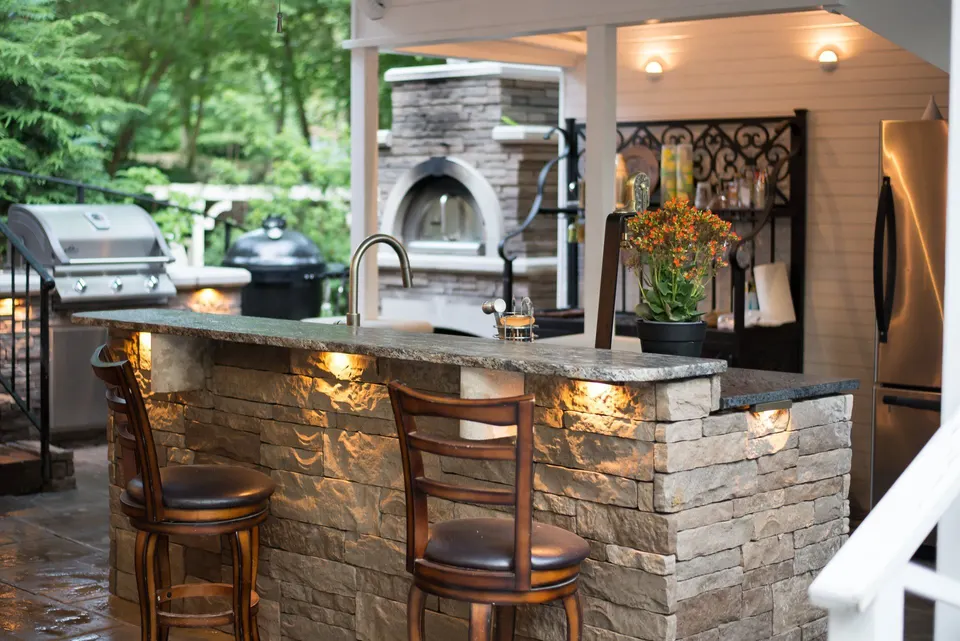
Most full-property schemes draw on several of these at once: the house, the palms and trees, the planting, the walks, the drive, the pool, the water, the dock and the outdoor rooms. Each one is its own craft with its own page. Point at a photograph to switch it on, and choose one to read how it is done.
Photographs of finished NightScapes lighting. Locations are not given.
What a design has to resolve
Six decisions that separate a lit garden from a good one
None of these are visible in a catalog, and all of them are settled before anything goes in the ground: the beam, where the fixture sits, the glare, the color, the zones and the runs, and the aim. Each light on this photograph points at one of them. Choose one.
Point at a numberTap a number
Fixture and beam spread
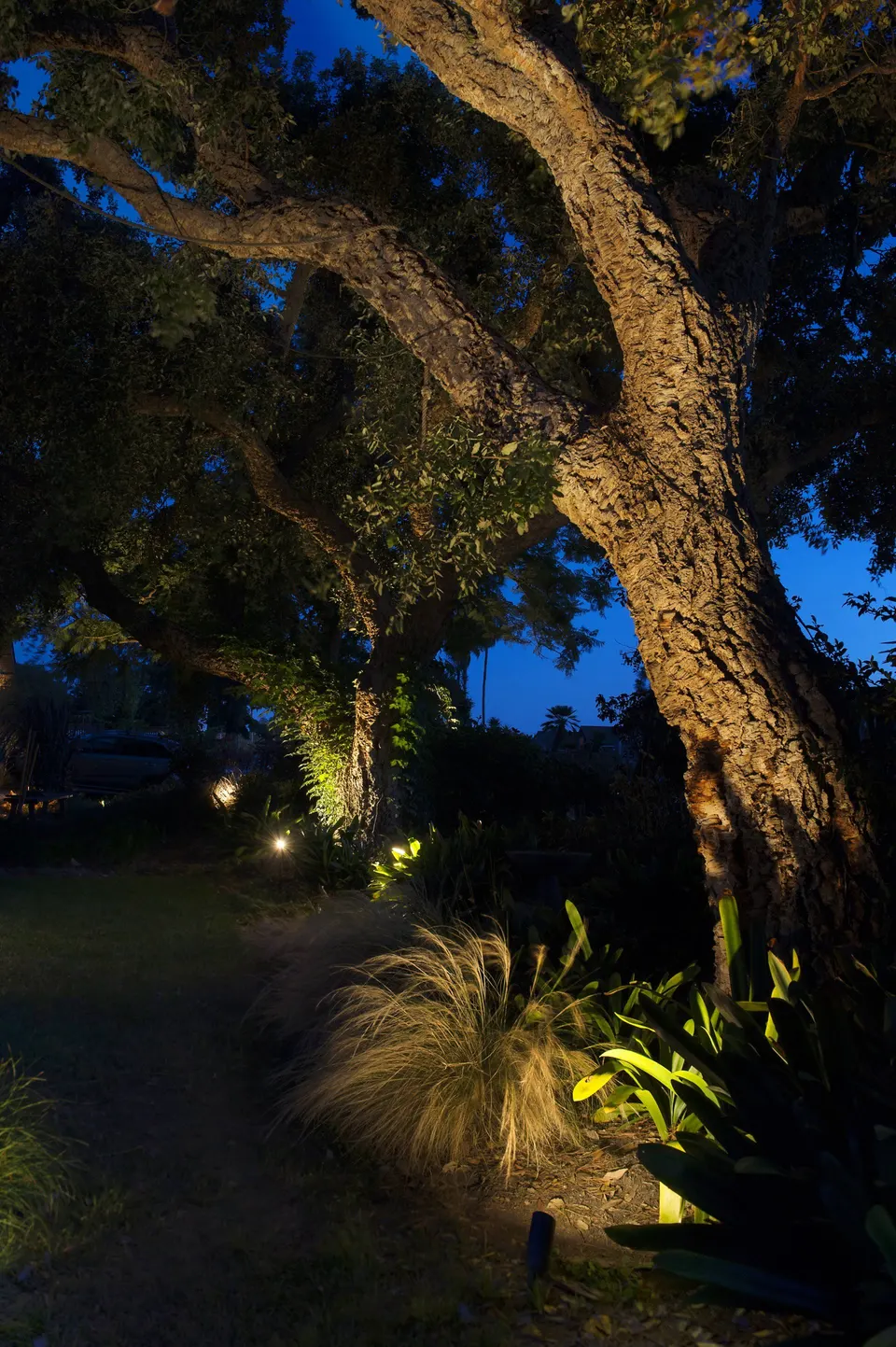
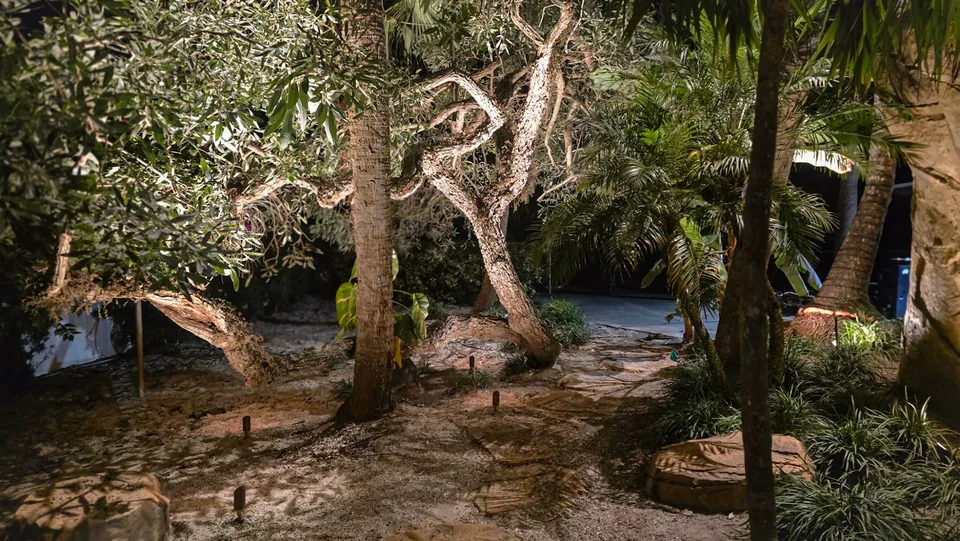
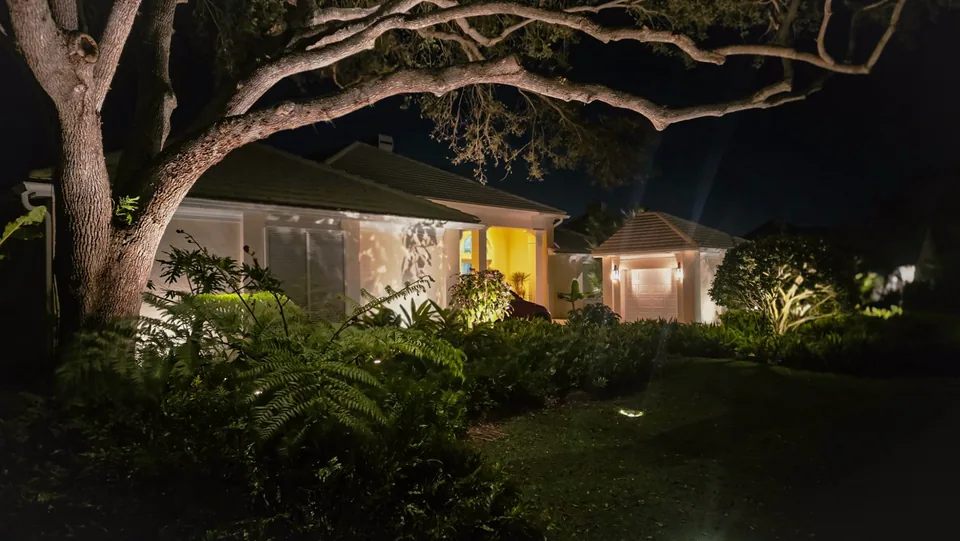
A live oak and a clipped hedge do not take the same light. Look at the trunk on the left: a beam that climbs the bark and carries on into the limbs, instead of a wide flood that would light the leaves and lose the structure. Choosing the beam before the fixture is what keeps a garden from looking like a row of spotlights.
Narrow
Holds a column up a trunk and into a crown.
Wide
A soft wash for planting that will not scallop.
Placement and angle
The shadows of leaves on the wall happen because a fixture sits in front of the planting and light passes through it. Move that fixture behind the shrub and the wall goes flat. The same fixture reads as beautiful or as a nuisance depending on where it sits and how far it is turned.
Across a surface
Shows its texture.
Straight at it
Flattens it.
Glare control
You should see what is lit, not what is lighting it. A fixture set in the lawn is a bright point from some angles, which is why every source is shrouded, set back from the sight lines people actually use, and kept off windows and off the neighbor. A system you have to squint past has failed even if every plant is lit.
Checked from
The door, the drive, the lanai and inside looking out.
Color temperature
The entry glows warm, and the wall and the oak are lit in the same warm family. Warm light flatters stucco, bark, shell and tile, which is most of what a Naples property is made of. Holding one temperature across a property is what makes it read as one scheme rather than a collection of separate purchases. See how color temperature is specified.
Transformer, zones and wire runs
The shrub at the far right is lit as brightly as the plants by the door, which is the point. Voltage falls along a run, so a run that is too long or too light leaves the far fixtures dimmer. Splitting a property into zones solves it, and it is what lets the front, the pool and the dock run on different schedules.
See
Zoning, dimming and color, and transformer and timer repair.
Aiming for the view
The limbs overhead are lit because each head was aimed for the view from the places people stand, not for the plant in front of it. A fixture placed without that view in mind is a guess.
A finished NightScapes garden, photographed after dark.
Why zoning matters
One evening, dusk to sunrise
A property does not need the same light at eight in the evening and at one in the morning. Zones are what let it change: everything up at dusk, the full scheme while people are outside, the features stepping back late, arrival only through the night, and off at sunrise. Drag through one evening on the same property.
Dusk
8 pm
11 pm
Late
Sunrise
Everything comes up
The whole scheme lights as the sun goes, on an astronomic timer that tracks the season instead of a fixed clock.
The entertaining hours
Full scheme. Pool, lanai, canopy and water, because this is when the property is being used and looked at.
It steps back
The pool and the water drop out and the palms dim. The facade, the entry and the walks stay, so the house still reads from the street.
Arrival only
Drive, entry and steps. Enough to come home to safely, and almost nothing running.
Off
The same astronomic trigger in reverse, so nothing is burning through the morning.
Drag through the night
Illustration. Times are how an evening is usually set, run on an astronomic timer or zone by zone from a phone with smart control and dimming.
Where people start
Three ways people come to us
Very few properties start from nothing. Most of this work is one of three things: a property with no lighting, a system that has stopped working, or a system that has been added to for years and lost its shape. They are planned differently, and the second and third rarely need starting again. Choose one.
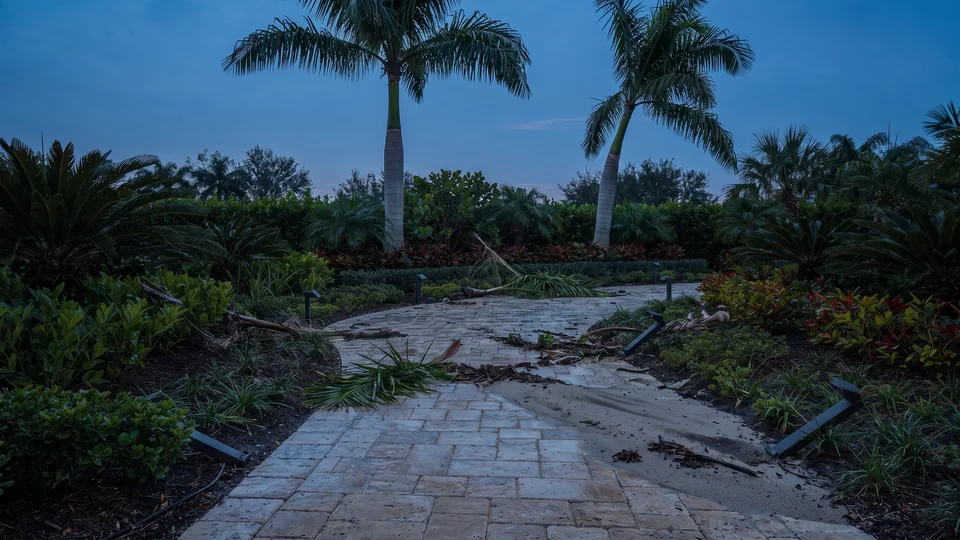
Illustration: a property before any lighting.Illustration: a system that has gone dark.Many fixtures, one scheme.
A property with no lighting at all
New construction, or a house that has simply never had a system. This is the easiest case to get right, because nothing has to be worked around: the zones, the runs and the transformer position are decided together, and the scheme is designed as a whole before a single fixture is chosen.
A system that has stopped working properly
Sections gone dark, a transformer that trips, fixtures corroded through, a timer nobody can set any more. Often the design is sound and the failure is in the connections or the wire. That is lighting repair, and it is worth establishing before anybody talks about replacing a system.
A system that has been added to for years
The most common property in Naples: lighting put in at construction, then extended whenever something new was planted. The fix is rarely to start again. It is redesign and expansion: keep what is serviceable, re-zone it, replace what has failed and re-aim the whole property. If the old runs are halogen, that is the moment for the retrofit to LED.
On this coast
Built for salt air
Southwest Florida is hard on outdoor fixtures in a way inland installations never have to answer for. Salt carries inland on the wind, irrigation runs over the same heads every day, and the ground stays wet all summer. Thin housings chalk, pit and finally fail at the lens seal, and the system goes dark one fixture at a time.
So the parts nobody looks at matter most: the connections, the depth of the runs, the gauge of the wire and where the transformer is mounted. Those decide whether a scheme still looks the way it did on the first night three seasons later. When one does go dark, lighting repair starts with exactly these.
What survives a Naples summerNightScapes Landscape Lighting
HousingsSolid metal that weathers, not thin coated shells that chalk and pit.
Lens sealsWhere most coastal fixtures finally fail and go dark.
ConnectionsSealed against wet ground, because summer soil stays wet.
Run depthDeep enough that edging, planting and irrigation work miss it.
Wire gaugeSized to the run, so the far end is as bright as the near.
TransformerMounted above water and out of the irrigation throw.
Checked on every install, before the trench is closed.
Coastal
Naples is not one place
The same house lights differently four streets over
No two houses light the same way. Salt, water, canopy and who else can see the property all change what a design needs, which is why every system we install is a custom design. Our neighborhood guides set out the conditions place by place, from Port Royal to Old Naples. Point at each.
Gulf front
Point here to see what changes
The coast
Salt on the wind every day. Housings and connections decide how long a system lasts.
The beach
Beach-visible lighting carries nesting-season rules that differ by city and county.
So
What applies to the address is confirmed before anything is specified.
Bay, canal and dock
Point here to see what changes
The water
A seawall and a dock read twice, because the surface mirrors them.
The view
Lighting is seen across the water by neighbors who did not choose it.
So
Aiming and shielding at the waterline matter more here than anywhere.
Golf and gated
Point here to see what changes
Review
Many of these communities run an architectural review process.
The street
A scheme twice as bright as the houses either side is the one that draws a letter.
So
The street side is designed to sit inside the range the street already has.
Old Naples
Point here to see what changes
The lots
Smaller, with mature canopy and short sight lines.
The trap
Big royal palm technique on a tight lot makes a cottage street look like a car park.
So
Sources are tucked into planting, and light comes down through the canopy.
Who does the work
Who you are actually hiring: NightScapes, Naples
NightScapes Landscape Lighting has designed and installed outdoor lighting in Naples since 2006 (Todd since 1998). It is family owned and run by Todd and Sherry, outdoor lighting is the only work it does, and its Google Business Profile shows 63 reviews at 4.9. A property we installed 20 years ago is still running on its original lighting, and many of our customers are repeat customers.
That matters more than it sounds like it should, because landscape lighting is a trade people
enter and leave quickly. It is added as a sideline by a landscaper or an electrician, the person
who learned the craft moves on, and the company that installed your system two years ago cannot
service it today. Done as a sideline it is a wiring exercise: the fixtures go where the planting
is, they get switched on, and nobody designs the property as a whole.
We have been in business this long because we only install quality. Doing only this since
2006 means knowing how a royal palm takes light differently from
a live oak, which materials survive this coast, how a scheme has to change as planting fills in,
and what a property looks like from the road at nine at night. We work across Naples, Fort Myers, Marco Island, Bonita Springs, Sanibel Island and Captiva Island, on new
systems, on keeping existing ones right, and on the work nobody
plans for after a storm. Read the
reviews or see the work.
Not only does my house look great, but my back lanai is beautiful at night.
Lighting properties in Naples and Southwest Florida.
Todd and Sherry
Family and locally owned. The owners are the people you deal with.
63 Google reviews
Rated 4.9 on the NightScapes Google Business Profile.
Outdoor lighting only
No side trades, this is the whole business.
We've used Todd for more than 20 years.
Questions we hear
Questions Naples homeowners ask about landscape lighting
What a design includes, whether the system is low voltage, whether we work with lighting you already have, how it is controlled, whether we light beachfront and waterfront properties, and whether we do anything besides outdoor lighting. Choose a question, or call and we will answer it on the phone.
NightScapes Landscape LightingOutdoor lighting only, Naples since 2006
Ask us about landscape lighting. Choose a question, or call and we will answer it on the phone.
What does a landscape lighting design include?
A walk of the property with you, a decision about what the view should be from the street, the entry, the lanai and inside the house, and then a scheme: which features are lit, how, in which zones, and where the transformer and runs go. The consultation and the estimate are free.
Is landscape lighting low voltage?
Most landscape systems are. A transformer steps household power down to low voltage and sends it along buried runs to the fixtures. That is what makes it practical to light a whole garden, and it is why the run lengths and wire sizes matter: voltage falls over distance, so the design has to account for it.
Can you work with the lighting I already have?
Yes. Most properties already have something. Often the design is sound and the failure is in the connections or a few fixtures, which is repair. If the system has been added to for years, the usual answer is to keep what is serviceable, re-zone it and re-aim the property as one scheme.
How is the lighting controlled?
Usually on an astronomic timer that follows sunset and sunrise through the year, with zones so the front, the pool and the dock can run on different schedules. It can also be run from a phone, with scenes and dimming. See smart lighting control, and zoning and dimming.
Do you light beachfront and waterfront properties?
Yes, and those are the properties where the rules differ most. A beach-visible lot carries sea turtle lighting rules that change by city and county, and a canal lot is seen by the neighbors across the water. Our turtle-friendly lighting page and our neighborhood guides set out what applies where.
Do you do anything besides outdoor lighting?
No. Outdoor lighting is all we do, and we have done it here since 2006, and Todd since 1998. That is the whole reason the work looks different: the craft of lighting a palm, an oak or a seawall, and of building a system that survives this coast, sits in one place.
We come out, walk the property with you and give you a personal design: which zones, which features, and what stays dark. Tell us what you want lit and we will call you back.