Inside the cabinet: transformer, timer and photocell repair in Naples
When a whole system goes dark, or comes on at the wrong time, the answer is usually in one box beside the house. Supply, transformer and controls each fail in their own way, and each tells you which one it is.
If your transformer hums, gets warm or keeps shutting off, it may be doing exactly what it should. A breaker that trips, or a ground fault outlet that cuts out, is protection responding to a fault somewhere else. Three things live at the cabinet, the supply, the transformer and the control, and each fails in its own way.
A dark system sends people to the fixtures first. Often the fixtures are fine and the problem is in the cabinet beside the house: an outlet that has tripped, a transformer that is overloaded, a timer that has lost track of time, a photocell that thinks it is still day.
The order of checking matters. Supply first, because without power nothing else can be tested. Then the transformer and its breaker. Then the timer or photocell that switches it. Only if all three check out does the search move into the yard, which is covered on our symptom-by-symptom troubleshooting for the whole run.
A hum on its own is not a diagnosis. Neither is heat. What matters is what changed, and when.
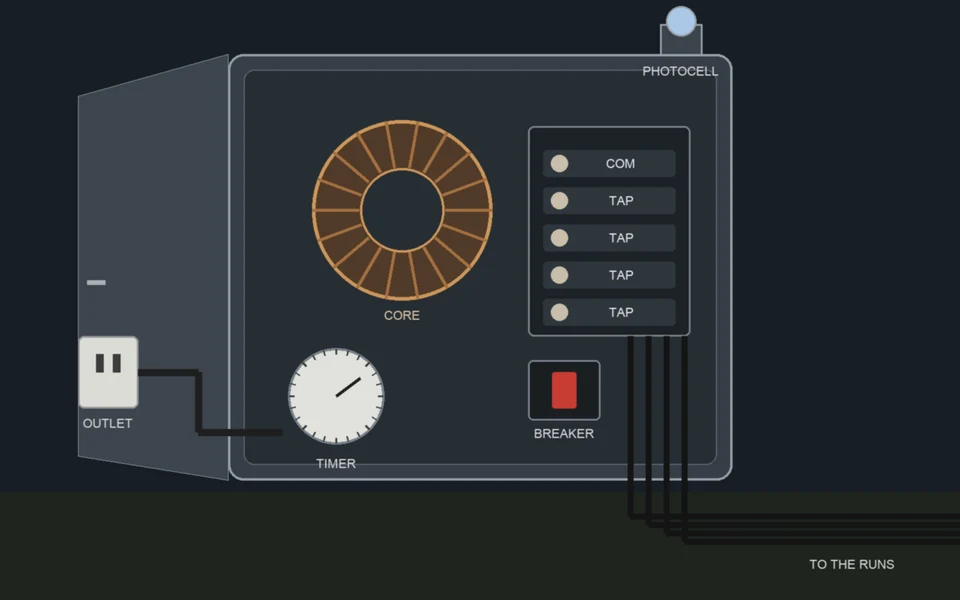
Illustration of a transformer cabinet: supply, transformer and controls.
Supply
The outlet, its ground fault device and the cord. Checked first.
Transformer
The core, the taps and its own breaker. Checked second.
Control
The timer, the photocell or the controller. Checked third.
The parts
What is inside the cabinet
A landscape lighting cabinet holds a handful of parts: the outlet and cord that feed it, the core that steps the voltage down, the common and voltage taps the runs connect to, a breaker on the low-voltage side, and a timer or photocell that switches it all. Point at a number to see what each does.
Point at a numberTap a number
The outlet and the cord
The transformer plugs into an outdoor outlet, usually protected by a ground fault device. If that device has tripped, or the outlet has failed, nothing downstream gets power, and the transformer is not the problem.
Fails by
A tripped ground fault device, a corroded outlet, a damaged cord.
Checked
First, before the cabinet is even opened.
The core
The heavy coil that steps line voltage down to low voltage. FX Luminaire describes the job as converting "120 V in North America" to "low-voltage current (12 V)." A healthy magnetic core makes a low, steady hum.
Fails by
Overheating from overload, or damage from water or a surge.
Checked
For heat, smell, discoloration and output voltage.
The common and the voltage taps
Each run connects between the common terminal and one of several taps, each giving a slightly different voltage, so a long run can be fed a little more to make up for what it loses along the cable.
Fails by
Loose or corroded lugs; a run on the wrong tap.
Checked
Every lug tightened; voltage measured at the far fixture.
The secondary breaker
Many landscape transformers have their own breaker or fuses on the low-voltage side. When a run is overloaded or shorted, it trips, and the lights on that side go out while the transformer itself is fine.
Fails by
Tripping from a short or overload in the yard, or wearing out.
Checked
Which one tripped, and why, before it is reset.
The timer
The clock that switches the system on and off: a mechanical dial, a digital timer, or an astronomical controller that tracks sunset. Each keeps time differently and each loses it differently.
Fails by
Wrong time after a power cut, a dead backup battery, lost settings.
Checked
Time, date, location and schedule against the actual sunset.
The photocell
A light sensor that switches the system on at dusk. FX Luminaire notes that a photocell "needs to see the ambient outdoor light level," which is why where the cabinet sits matters.
Fails by
A clouded or shaded lens, or seeing a nearby light and thinking it is day.
Checked
Covered to simulate dusk, and its view of the sky.
Out to the runs
The cables leaving the cabinet feed the yard. If the cabinet checks out and a run is still dark, the fault is out there: a cut cable, a failed splice, a shorted fixture. That search is a different job.
Fails by
Damage in the yard, which shows up at the cabinet as a trip.
Next
Covered on our lighting repair page.
Illustration, not a specific make of transformer. Layouts vary between manufacturers.
Voltage
Voltage taps, and why there is more than one
Voltage falls along every cable, so a long run arrives at its last fixture with less than it left with. Taps let each run start a little higher to make up for it. A run is assigned to a tap by measuring at the fixture under load, not by guessing, and settings that suited halogen can over-feed LED after a conversion. Try a run below.
An example run, worked out with Ohm's law for example loads on one cable size. It shows the idea; the only real answer is a meter at your last fixture. Targets: FX Luminaire, 10 to 15 VAC at each LED fixture and 10.5 to 11.5 V per halogen lamp.
What a tap does
FX Luminaire explains voltage drop simply: "The greater the resistance of the circuit,
the higher the voltage drop." A transformer with several output taps lets a long or
heavily loaded run start at a higher voltage; FX says its "12 V to 15 V multi-tap outputs
minimize voltage loss." Short runs go on a lower tap, long runs on a higher one.
Measured at the fixture
The only reliable way to choose a tap is to measure the voltage at the far end of the run
with the lights on. FX says the input at each LED fixture "should always be between 10-15
VAC," and that its LED fixtures give the same brightness anywhere in that range. Its
layout guidance aims at a narrower band, 10.5 to 11.5 volts per lamp, "for maximum light
output and fixture life."
A tap is chosen with a meter at the last fixture, never by guesswork.
FX’s own documents differ
The tap voltages themselves vary by unit, and FX Luminaire’s own documents do not
agree on its PX transformer: its 2021 design guide lists 11, 12, 13 and 14 volt taps,
while the current product page describes 12 to 15 volt outputs. We go by the unit in
front of us and the meter, not a figure from a page.
After a conversion
A halogen run was often put on a high tap to push enough voltage to the far end. After
converting to LED it draws far less and loses far less, so the same tap can now deliver
more than the fixtures want. Every run is measured again after a conversion; see
converting older halogen fixtures.
Every transformer has a rated capacity, and the fixtures on it add up to a connected load. When a run shorts or the load is too high, something trips. Three different devices can trip, the ground fault outlet, the house breaker and the transformer's own breaker, and which one it was says where to look. Answer four questions.
Question 1 of 4
What has gone dark?
Question 2 of 4
Look at that outlet. Has its test or reset button popped out?
Question 3 of 4
Did it happen after rain, a storm or the irrigation running?
Question 4 of 4
Once reset, does it trip again soon after the lights come on?
Where each answer leads
Our answer
The ground fault outlet
What trips it is current leaking where it should not, often because water has got in. Look for moisture at the outlet, the cord or the transformer. Do not keep resetting it: it is protecting the house supply.
Our answer
The house breaker
What trips it is a fault or overload on the line side, or another load sharing the circuit. The problem is in the supply, or more is on that circuit than it should carry. Do not assume it is the lighting until the circuit has been looked at.
Our answer
The transformer’s own breaker
What trips it is a short or overload on a low-voltage run out in the yard: a cut cable or a failed fixture drawing too much. Do not reset it repeatedly. Find the run that trips it.
When only some lights are out, the cabinet is usually fine and the fault is on one run: a connection, a cable, a fixture. That is traced along the run rather than at the box.
A magnetic transformer makes some sound; a low, steady hum is normal. What matters is change. A louder hum, a rattle, real heat or a smell each say something different, from extra load to loose laminations to a terminal that is arcing. A loose terminal that has scorched is the case where the unit is replaced, not adjusted.
If you smell burning at the cabinet, switch the system off at the outlet and leave it off.
A steady low humNormal for a magnetic transformer under load.
A louder hum than beforeOften more load than it used to carry, or loosening inside.
A buzz or rattleLoose laminations or a loose mounting. Worth a look.
Hot to the touchOverload, or poor ventilation in a crowded spot.
A burning smellSwitch it off. Often a loose terminal arcing.
Discoloration at a lugHeat from a poor connection. The usual case for replacement.
Listen, feel, smell, then measure.
Checked
Controls
Timers: mechanical, digital and astronomical
A timer switches the system on and off, and each kind keeps time differently. A mechanical dial stops in a power cut and runs late afterward. A digital timer holds time on a battery that eventually dies. An astronomical controller calculates sunset itself, as long as its date and location are right. Point at each.
Mechanical dial
Point here to see how it fails
Keeps time by
A motor turning a dial with pins or tabs for on and off.
Loses it when
The power blinks. A dial stops during an outage and runs late afterward.
Also
Never follows the season. Set for winter, it is wrong by summer.
Digital timer
Point here to see how it fails
Keeps time by
An electronic clock, usually with a backup battery.
Loses it when
The battery dies and the power goes out, or the clock change is missed.
Also
Some can be set to astronomical time; many owners never set it.
Astronomical controller
Point here to see how it fails
Keeps time by
Calculating sunrise and sunset; FX describes timing "based on latitude and longitude."
Loses it when
Its date, time or location is wrong, so it computes the wrong sunset.
Also
Schedules and scenes on these are covered on our smart control page.
Controls
Photocells: what they can and cannot see
A photocell switches the lights on when it gets dark, so it has to see the sky and nothing else. FX Luminaire notes that it needs to see the ambient outdoor light level. A clouded lens, a shrub grown over it, or a nearby light shining on it all fool it, and the lights come on late, early or never.
A photocell near a lit lanai can mistake it for daylight.
What fools it
Anything that makes it brighter or darker than the actual sky. A security light, a lit
window, or even one of the system’s own fixtures aimed its way can keep the lights off
or make them cycle. A shaded, dirty or overgrown lens makes it think dusk came early.
The covered-sensor test
Covering the photocell with a hand or a cap at the right time of day should switch the
system on after a short delay. If it does, the photocell works and the problem is what it
can see. If it does not, the photocell or what it switches is at fault. Response times
differ between makers, so a short wait is part of the test.
Where it belongs
FX Luminaire says transformer location "is also important when using a photocell," for
exactly this reason. A cabinet tucked into a dark corner of a lanai or behind a hedge is
a bad home for one. Many systems now use an astronomical timer instead and avoid the
problem entirely; see schedules, scenes and app
control.
The decision
Repair, replace or move the cabinet
A transformer is repaired when the fault is a connection, a breaker or a control and the core is sound. It is replaced when it has been flooded, struck by a surge or scorched at a terminal. And sometimes the right repair is to move the whole cabinet somewhere drier, higher and with a clear view of the sky.
Cabinets near salt water need their terminals looked at most often.After a storm, the cabinet is checked before the yard.Where the cabinet hangs decides how long it lasts.
Salt and corrosion at the lugs
Near the water, salt reaches the inside of a cabinet and corrodes the terminals. Cleaned and tightened early, the transformer carries on. Left until the lug discolors from heat, the terminal block and often the transformer are replaced.
Surge damage
Lightning nearby can damage the transformer, its controls or both. The NWS Miami office calls Florida "the lightning capital" of the United States. A surge-damaged unit is tested part by part; often the controller has failed and the core is fine, or the reverse.
When moving the cabinet is the fix
A transformer mounted where irrigation soaks it every morning, or low enough for flood water to reach, will keep failing whatever is replaced inside it. Sometimes the right repair is a new location: higher, drier, with the photocell able to see the sky.
Who does the work
Who opens the cabinet: NightScapes Landscape Lighting, Naples
NightScapes Landscape Lighting has worked on Naples landscape lighting systems since 1998. Todd and Sherry own and run it, outdoor lighting is the only work it does, it is a Hunter Preferred Contractor, and its Google Business Profile shows 63 reviews at 5.0. At the cabinet, the supply is checked first, then the transformer, then the controls.
We work across Naples, Marco Island and Bonita Springs, and through Lee and Collier
counties, where salt, irrigation and lightning are the usual enemies of a transformer.
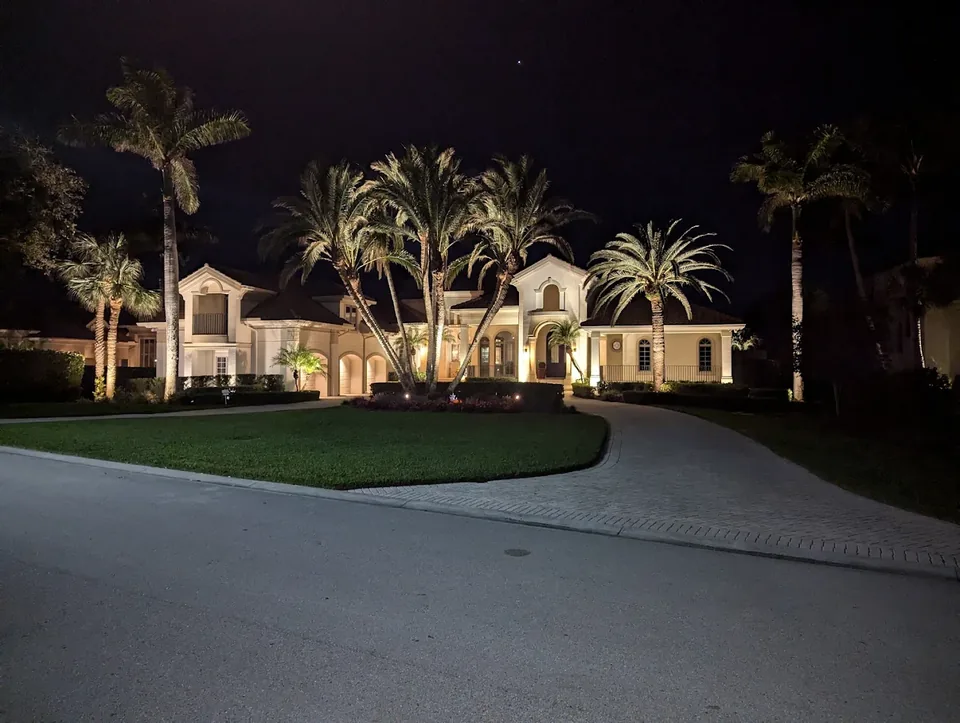
A NightScapes system: every light on this drive starts at a cabinet like the one above.
Since 1998
Lighting properties in Naples and Southwest Florida.
Todd and Sherry
Family and locally owned. The owners are the people you deal with.
63 Google reviews
Rated 5.0 on the NightScapes Google Business Profile.
Hunter Preferred Contractor
Hunter Industries is the maker of FX Luminaire fixtures and Luxor controllers.
Questions we hear
Questions Naples homeowners ask about transformers and timers
Why a transformer keeps tripping, whether the dusk to dawn timer has failed, what a hum, rattle or heat means, why lights cycle on and off, why they shut off after a couple of hours, and whether a bad transformer can simply be swapped. Each answer starts at the cabinet.
NightScapes Landscape LightingOutdoor lighting only, Naples since 1998
Ask us about your transformer or timer. Choose a question, or call and we will answer it on the phone.
Why does my landscape lighting transformer keep tripping the breaker?
Because something is drawing more than it should, and the breaker is doing its job. Which device tripped tells you where to look: the ground fault outlet points to moisture, the transformer’s own breaker points to a short or overload on a run in the yard, and the house breaker points to the supply. Resetting it repeatedly without finding the cause is the one thing not to do.
Could it be the dusk to dawn timer that went bad?
It could. A timer that has lost its time, its date or its settings will switch the lights at the wrong hours or not at all, while the transformer is perfectly healthy. Covering a photocell, or checking a timer’s clock against the actual time, quickly shows whether the control or the power is at fault.
My transformer hums, rattles and runs hot. What is wrong?
A low, steady hum is normal. A louder hum, a rattle or a lot of heat usually means it is carrying more load than it was sized for, or something inside has loosened. A burning smell or a discolored terminal means switch it off: a loose connection is arcing, and that is usually a replacement.
The lights come on at dusk, run a few minutes, shut off and repeat. Why?
A pattern like that often points to protection cycling: something trips, cools or resets, and comes back on. It can also be a photocell seeing the system’s own light and deciding it is daytime. Both are found at the cabinet, by watching which part switches off and when.
The lights stay on for a couple of hours and then shut off. Is that normal?
It is normal if that is how the timer is set: many systems run from dusk for a few hours by design. If it is not what you want, the timer or controller is reset. If the hours are random, the clock or the photocell is the suspect.
If the transformer is bad, can I just replace the transformer?
Sometimes. But a transformer usually fails for a reason: overload, water, salt or a fault on a run. Replacing it without finding that reason often means replacing it again. We check the load, the runs and the location before recommending a new unit, and size any replacement for the system as it is now.
Ready to find out what the cabinet is telling you?
Tell us what the system is doing: dark, tripping, humming, or on at the wrong hours, and where the transformer is mounted. We start at the outlet and work outward.