Gordon Pass
Port Royal’s southern edge, where the Rookery Bay reserve begins. Piers on the pass may run past 25 feet to reach depth.
Port Royal guide
Port Royal has its own zoning district, and it talks about light directly: how tall a lit entry column may be, which walls may not carry a fixture, how piers sit on the riprap. Add the Gordon Drive beachfront and the association's deed restrictions, and lighting here is planned around rules most of Naples never meets.
Tell us about the property
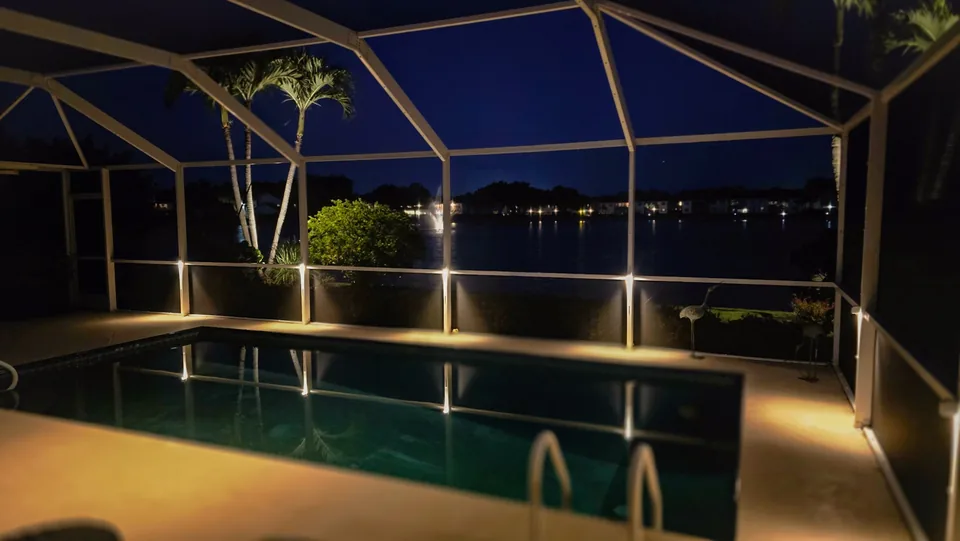
Photograph: a screened pool over the water in Southwest Florida. Not taken in Port Royal.
At the gate
Port Royal’s zoning district, R1-15A, counts lighting as part of an entry column’s finished height. It lets up to 32 inches on top of a main entry column hold a light fixture, but the finished column still has to stay within the height in the code’s table for your frontage and setback. Lighting on a wall that serves more than one gated driveway is not allowed, and there is no waiver.
The wording is exact. "Maximum height means finished height, including wall, column or post footings, caps, lighting, finials, and all other architectural embellishments." Then the allowance: "Up to 32 inches is permitted on top of a main entry column or post to allow for finished installation of light fixtures. This shall not increase the maximum permitted height of the finished main entry column or post." In other words, the lantern is part of the column, not an extra on top of it.
The table that sets that height is split by side of Gordon Drive and keyed to frontage and setback from the travelway, running from 6 feet up to 12 feet measured from the crown of the road. A lantern chosen before the cap is built is easier to size to the column than one chosen afterward. Light the drive itself from the ground with low, shielded fixtures, so nothing glares into Gordon Drive, which citywide Sec. 22-38 forbids. See driveway and entrance lighting.
Source: City of Naples Sec. 58-124(a) and (b)(3), Municode, read 2026-10-14; Sec. 22-38, Municode, read 2026-10-14.
Ask about a Port Royal planAn R1-15A entry, line by lineNightScapes Landscape Lighting
The fixture is part of the column.
Where the lot meets the water
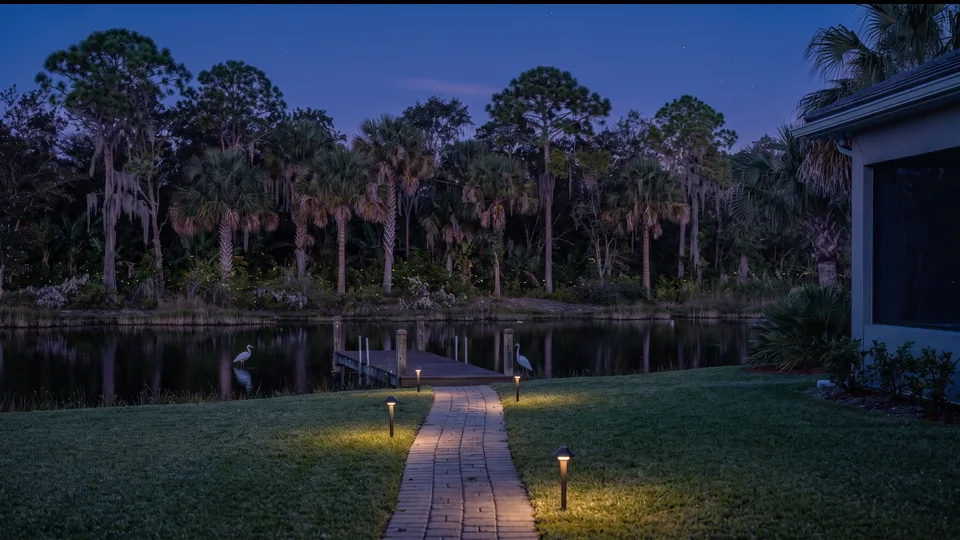
Most Port Royal lots meet the water at riprap rock, not a seawall, and piers must be uncovered and no higher than the lot's grade. The association allows a ground-level walk no wider than four feet from the patio to the dock, behind a five-foot planted buffer. Low, shielded path lights along that walk, and a small, switched light on the dock itself, fit those limits.
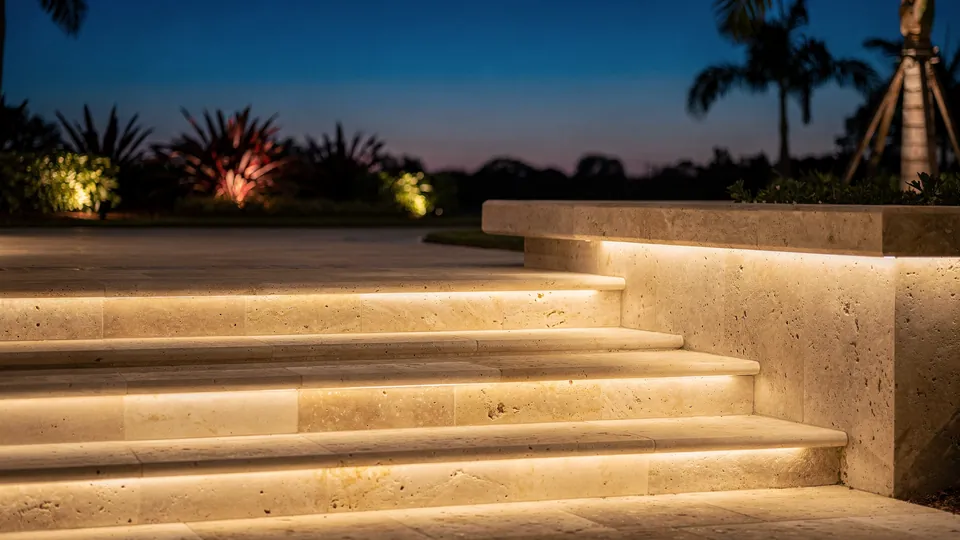
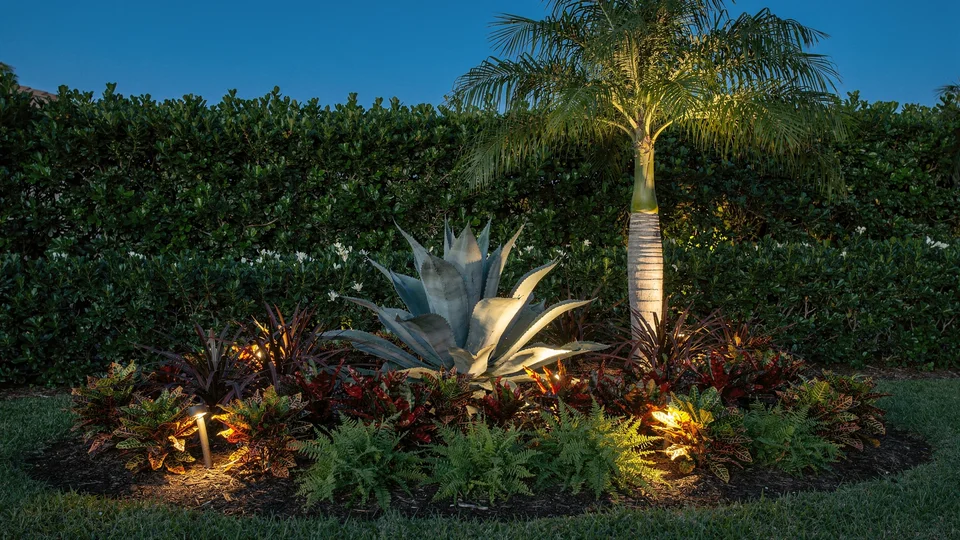
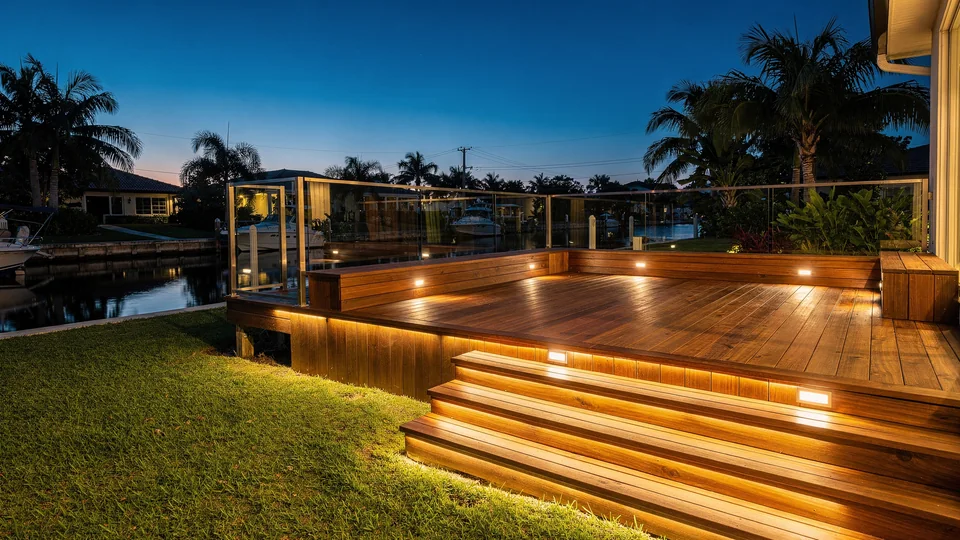
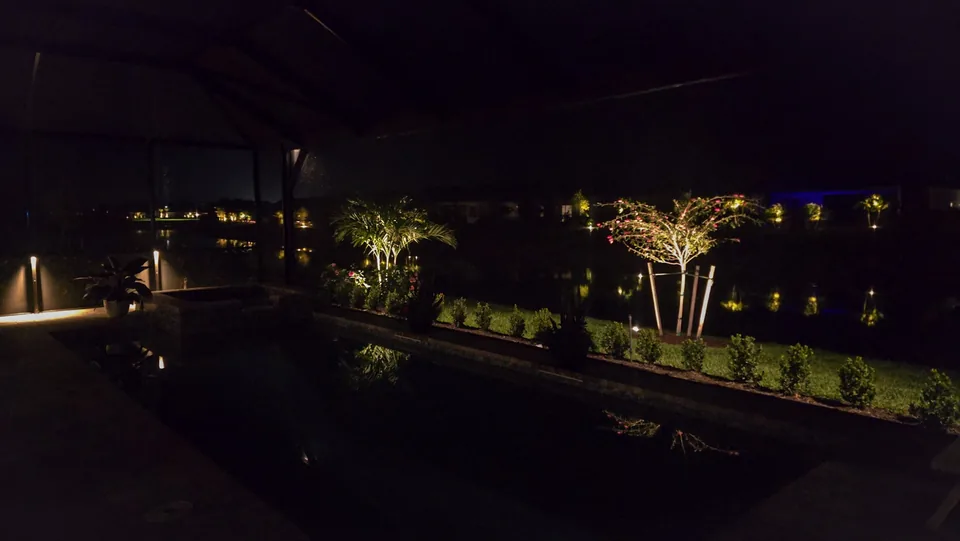
The association’s building procedures allow "a maximum of a four (4) foot wide walkway, at ground level, from the patio to the dock." A walk that narrow and that low wants small path lights or step lights at ankle height, spaced so the surface is readable and nothing shines across the water. See path lighting.
The same procedures require "a minimum of a five (5) foot of landscape plant material buffer" between the top of the riprap and any hardscape. That strip is planting, not paving, so fixtures go in it as low, shielded spots or path lights tucked among the plants, aimed back toward the house rather than out over the rock.
City code says Port Royal piers "cannot be covered" and may not sit higher than the natural grade of the lot, with a 20-foot side setback that counts the boat as well as the pier. With no roof to hang from and no height to gain, the light lives in the deck: recessed or hooded fixtures at the boards and the steps. See deck and dock lighting.
On the two interior lakes the code is short: "No piers or other over-water structures of any kind shall be permitted on Lantern Lake or Half Moon Lake." There is no dock to light, so the waterside plan ends at the planting. The Jamaica Channel is the other exception in Port Royal: certain Galleon Drive and Lantern Lake lots there may have a seawall. Sources, read 2026-10-14: City of Naples Sec. 58-121 and 58-122, Municode; Port Royal POA building procedures.
One lot, on the record
In 2009 the City Council approved power to a dock at 4375 Gordon Drive, in the Cutlass Cove Section, on conditions: only the minimal light needed for safety while authorized users are there, a manual switch, nothing aimed skyward, and no glare onto neighbors. It was one lot's approval, not a rule for every dock, but it shows what the city asked for here.
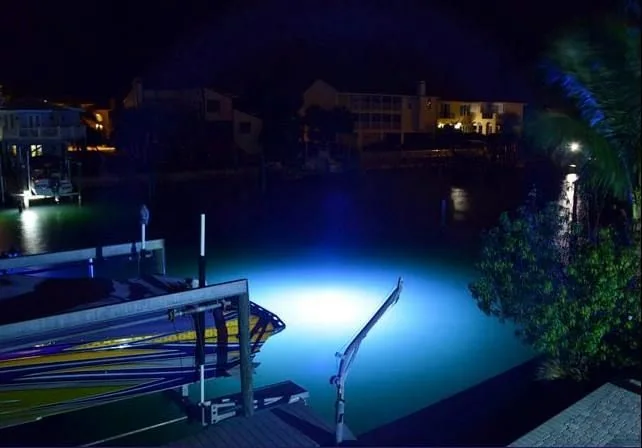
Resolution 09-12381, dated March 18, 2009, covers Lots 38 and 39, Block B, of the Cutlass Cove Section. It allowed electrical service to the dock on the condition that it power only boat lifts "and the minimal lighting required to illuminate the dock for safety purposes and only while authorized users are on the premises." It then set three conditions on the light itself: it "shall be controlled by a manual switch, shall not be oriented skyward and shall not glare onto neighboring properties."
It is the only Port Royal dock lighting decision we found in the city’s records, so it is the clearest picture of what the city asked for when a Port Royal dock came before it. The resolution does not bind any other lot, and we do not treat it as a rule. As a design brief, though, it is a sensible one for a neighborhood where every lot is on the water: safety light at the boards and steps, on a switch you turn on when you walk down, aimed down and kept on your side of the property line.
In practice that means step and deck lights recessed or hooded, a single manual switch at the top of the walk (or a control that does the same job), and no floodlight on a piling. Citywide Sec. 22-38 already asks for "a full cutoff at the property line as classified by the Illuminating Engineering Society of North America," and Sec. 16-285 says "All lighting shall be shielded and aimed at the owner's premises or sidewalk and street abutting the premises." The DarkSky lighting principles put the same idea as "Use light only when it is needed." Lights under the water are a separate choice; see underwater lights at a dock, and smart lighting control for switching.
Sources: City of Naples Resolution 09-12381, read 2026-10-14; Sec. 22-38 and Sec. 16-285(b)(23), Municode, read 2026-10-14; DarkSky, lighting principles, read 2026-10-13.
Where it applies
Port Royal runs from 21st Avenue South to Gordon Pass, with the Gulf on the west and Naples Bay on the east, and every home was laid out with water frontage. That makes the water the lighting question here. Each bulb on this map marks a place where a code rule, a deed rule or the beach changes what goes in the ground.
Port Royal’s southern edge, where the Rookery Bay reserve begins. Piers on the pass may run past 25 feet to reach depth.
The neighborhood’s Gulf-front beach club, a fixed point on the Gordon Drive beachfront where the city’s turtle rule reaches.
A city beach access on Port Royal’s Gulf front. The pin is an interpolated address point, not the path itself.
A named Port Royal plat where no pier or over-water structure is allowed, so any shoreline light stays on land.
The Half Moon Lake Addition. The same no-pier rule applies here as on Lantern Lake.
The one stretch where certain Galleon Drive and Lantern Lake lots may have a seawall instead of riprap.
One of the coves the deed names for mooring pilings. A dock light here is seen by every home around the cove.
A deed-named cove inside the Galleon Drive plats, ringed by docks that face one another.
Points placed from nominatim.openstreetmap.org. Map data from Google.
Before fixtures go on anything
The association's deed restrictions require written approval before any structure is built or exteriorly altered, on the lot or in the water next to it, and approval can turn on looks alone. Neither the restrictions nor the building procedures mention lighting by name. Before fixtures go on columns, walls, docks or the house, call the association at (239) 261-6472 and ask whether a review is needed.
Deed restriction 5 is broad: "No buildings or structures of any kind shall be constructed, exteriorly altered or placed upon the premises herein conveyed or in the submerged area contiguous thereto until the plans therefor, including the specifications for the exterior color scheme, have been approved in writing by Port Royal." A disapproval "may be based upon any ground including purely aesthetic grounds." We read the restrictions in full. There is no lighting clause.
The association’s building procedures say approval "applies to both new construction and additions or alterations of existing structures, including changes in exterior colors," and plans come in through an architect or landscape architect its committee has approved. They also settle conflicts between rule books: "If there are inconsistencies or differences among any regulatory bodies, the more restrictive will govern." The procedures do not mention lighting either.
The city points contractors the same way. Its gazebo permit checklist says contractors "should contact Port Royal Property Owners Association (239) 261-6472 for approval prior to permitting." So the honest answer is that nobody has written down whether a landscape lighting job needs review. Ask first, and keep the written answer with the plans.
Sources, read 2026-10-14: Port Royal POA, deed restrictions and building procedures; City of Naples, gazebo permit checklist.
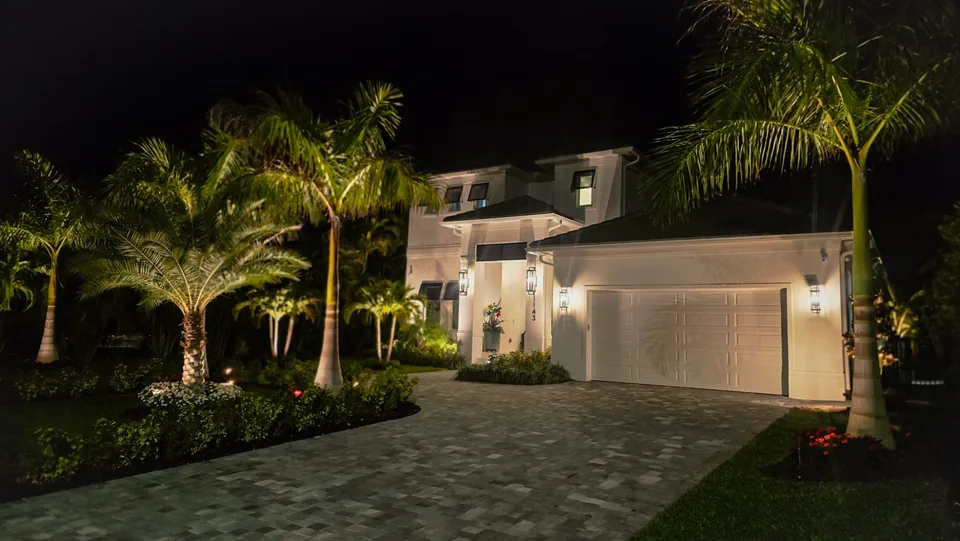
Gordon Drive, beach side
The City of Naples rules in Sec. 52-61 apply where lighting is within 300 feet of mean high water or can be seen from the beach, which takes in the Gulf-front lots along Gordon Drive. There, floodlights and landscape or accent lighting are prohibited for new work. Lots on the coves, the lakes and the pass meet other rules. Pick a lot below.
Port Royal is inside the City of Naples, so the city’s marine turtle section governs it, not the Collier County land development code that applies a few miles away. The city’s test is distance or sight: the rules reach construction or development "if there is lighting associated with such construction or development that is within 300 feet of the line of mean high water," or lighting that is visible from the beach. It is a test of each light, not of the street address.
The obvious group is the Gulf-front row along Gordon Drive, the stretch that holds the Port Royal Club at 2900 Gordon Drive and the city beach access at 3590. The association’s June 2024 newsletter shows how the beach is treated: it reported that Collier County planned to resume an emergency beach berm in Port Royal "this Fall, following sea turtle nesting season," with easements from owners along Gordon Drive, and ran a notice headed "LIGHTS OUT! SEA TURTLE NESTING SEASON IS UPON US." Lots on the bay and the coves sit farther from the sand, but the rule follows sight as well as distance, so check what the beach can see before you assume a light is outside it.
For new work in reach of the rule, the code holds outdoor lighting "to the minimum necessary for security and safety," and "Floodlights and landscape or accent lighting shall be prohibited." The city’s gazebo permit checklist spells out the paperwork: "If the property is seaward of the Coastal Construction Control Line (CCCL) or within sight of the beach, all exterior lighting must comply with Section 52-61(b)," with "exterior lighting plan, manufacturer specifications for all proposed exterior fixtures and lamps, and a completed FWC fixture table." The city’s comprehensive plan commits it to reviewing exterior and landscape lighting plans for properties seaward of that line. FWC’s own guidance is to mount fixtures "as low as possible" and keep them "completely downward-directed." Our coastal lighting page covers fixtures and shields.
Sources: City of Naples Sec. 52-61, Municode, read 2026-10-13 (ledger F-49, F-50), and the city’s sea turtle page, read 2026-10-13 (F-53, F-54, F-83); gazebo permit checklist, Comprehensive Plan Policy 2-8, Port Royal POA June 2024 newsletter; Port Royal Club; all read 2026-10-14; FWC, lighting guidelines, read 2026-10-13.
May to October
For existing homes with lights visible from the beach, the City of Naples code says to turn them off between 9:00 p.m. and sunrise from May 1 to October 31, or hood or reposition them so they cannot be seen. The city's sea turtle page also asks that landscape and accent lighting be off or disabled during nesting season, and notes the season can begin earlier.
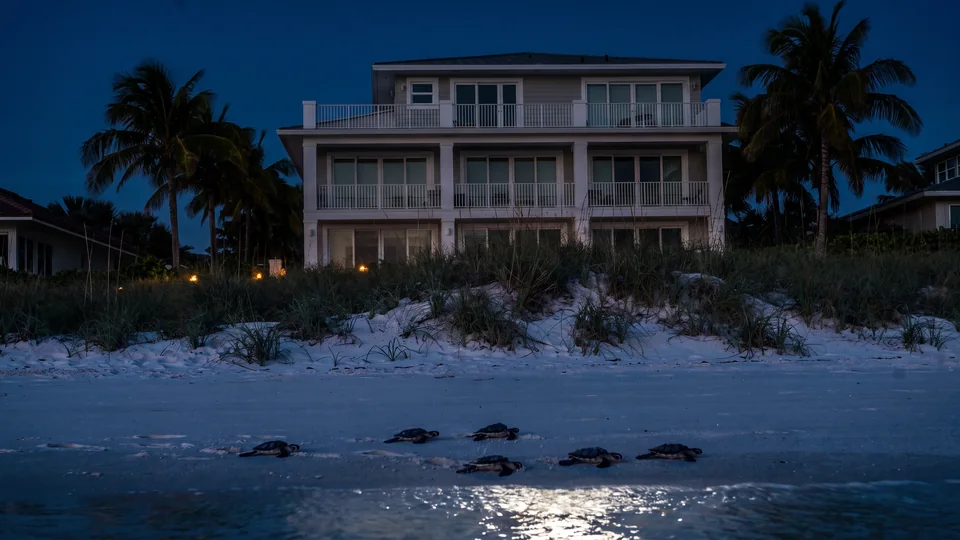 Illustration
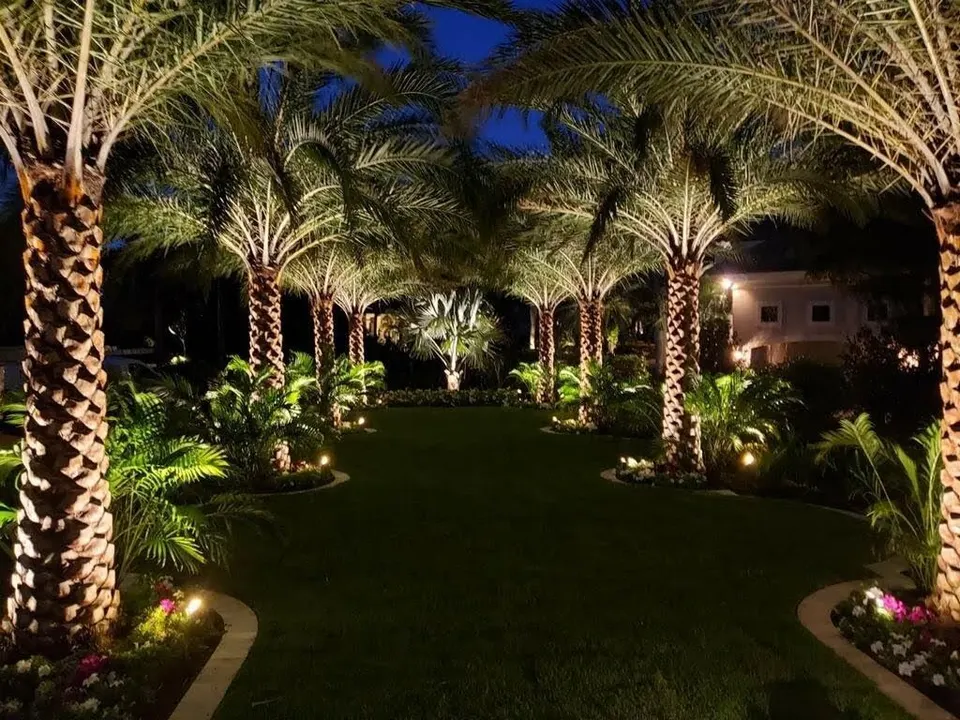
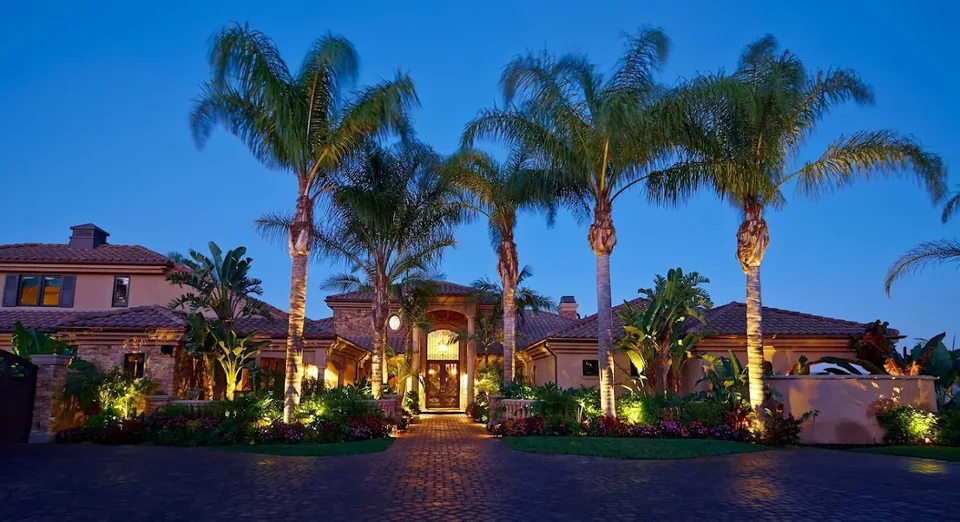
The south end
Port Royal ends at Gordon Pass, and the Rookery Bay National Estuarine Research Reserve begins there, running south across 110,000 acres that include Keewaydin Island. The reserve monitors sea turtles and shorebirds. Its pages set no lighting rule for Port Royal, but lots on the pass look straight across at protected land, which is a good reason to keep light low, shielded and pointed down.
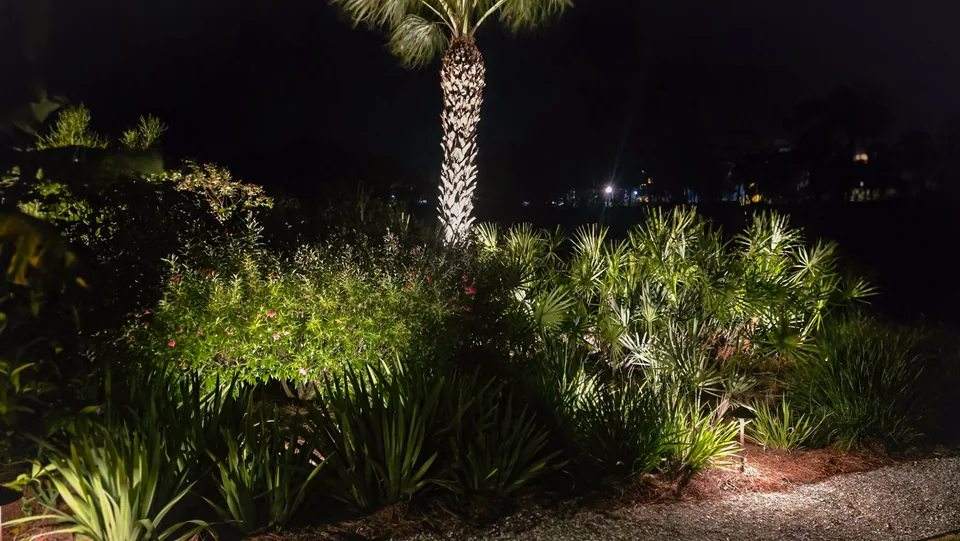
Rookery Bay describes its reach as "110,000 acres from Gordon Pass in Naples to the western Everglades," and says that "Together with FWC, the Conservancy of Southwest Florida, and other partners, we monitor sea turtles, shorebirds, marine mammals, and panthers." That is a statement about what lives across the pass, not a lighting rule, and the reserve’s pages do not set one for Port Royal. We are not going to tell you that a Port Royal light harms the reserve, because nothing we read says so.
The city describes Naples Bay as connecting "to the Gulf of Mexico via Gordon Pass," and the code treats the pass and the bay as their own frontage: piers there may reach past the usual 25 feet to reach five feet of depth at mean low water, and off-shore mooring piles "are permitted at all properties fronting Naples Bay and Gordon Pass." A light on the pass is seen from the water on both sides. Light that is low, shielded and aimed down, DarkSky’s "Direct light so it falls only where it is needed," is the plain answer.
The association has reported invasive cane toads in Port Royal, in its September 2023 and June 2024 newsletters, and contracted a removal service. The city says adult cane toads "are nocturnal and remain hidden during the day while emerging at night to hunt for food" and "are common in yards." FWC notes that "Some frogs gather at lights to forage," but it does not name the cane toad, and no source we read ties yard lighting to them either way. Lighting is not a toad control; the association’s removal service is.
Sources: Rookery Bay NERR and its conservation page; City of Naples, Naples Bay and cane toad pages; Sec. 58-121, Municode; Port Royal POA newsletters September 2023 and June 2024; all read 2026-10-14. FWC, light pollution, read 2026-10-13.
The view across the water
Deed restriction 17 bars hedges, trees or plantings that would grow to block a neighbor's water view beyond the platted building lines. With water on every lot, anything tall or bright near the shore is seen by neighbors and from boats. That favors low fixtures in the waterfront buffer and keeping taller accent lighting on the street side of the house, aimed down where possible.
Underground, and after Ian
The R1-15A code and the deed restrictions both require electric wires to run underground from the utility easement to the house. Hurricane Ian damaged Port Royal streetlights, and the association has worked with FPL on repairs and an underground conversion project. For a landscape system, that means planning buried runs and transformer locations with the association before work starts, and checking after storms.
0 of 5
The runs, the cabinet and the connections are planned for a lot with water on one side and a street on the other.
The association and the cabinet height are the two that are hardest to change once the run is in the ground.
Call (239) 261-6472 and ask whether it wants to see the route and the transformer spot. Then plan around the flood zone.
Sources: City of Naples Sec. 58-123 and 58-116, Municode; Port Royal POA deed restrictions, September 2023 and June 2024 newsletters; FEMA National Flood Hazard Layer; read 2026-10-14. FEMA Technical Bulletin 8, read 2026-10-13. See putting lighting right after a storm.
North of 21st Avenue South
Aqualane Shores sits between Port Royal and Old Naples, on dug canals with seawalls rather than riprap. Its docks are much closer together: the city sets a side setback of seven and a half feet there, against Port Royal's 20, and caps piers at 15 feet or 10 percent of the canal's width. Light on those docks has to stop at the property line.
City code names the subdivisions that make up Aqualane Shores for dock purposes (the Phillip G. Rust Development, Elliott Subdivision, Marina Shores Replat and Kluck Subdivision among them) and then sets their limits: "Side yard setback for piers, boat lifts, and vessels is seven and one-half feet." A pier may reach out no more than "the smaller of 15 feet or ten percent of the waterway width," and a lift or pier with a lift no more than 25 feet or 25 percent. Two docks can sit fifteen feet apart. A short pier is easy to light from deck level; a pole light on one shines straight into the next boat.
In 1959 the City Council set "a seawall or bulkhead line" starting near Seventh Street and 14th Avenue South, along "the platted North line of a dug canal" on the Aqualane Shores Unit No. 1 plat, and said "no filling operations will be permitted outside" it. The city notes that vertical seawalls reflect wake energy and that riprap set in front of one reduces it. For lighting, a seawall cap is a natural low line for small shielded fixtures aimed down at the dock, not out across the canal.
The city lists public beach accesses at 14th through 18th Avenue South, 1900 Gulf Shore Boulevard South, 21st Avenue South and 2100 Gordon Drive, and is rebuilding seawalls at the 14th and 16th Avenue South ends and building one at 15th, with "temporary fencing with turtle-friendly screening" put up ahead of nesting season. Whether a given Aqualane lot falls under Sec. 52-61 depends on its distance and what the beach can see. The Aqualane Shores Association, which dates the neighborhood to 1949 and says its "deep-water channels and coves" give many homes Gulf access, is voluntary and keeps its documents for members, so no lighting rules could be read. Ask it directly.
Sources, read 2026-10-14: City of Naples Sec. 56-93(c)(1), Municode; Resolution No. 753; riprap page; beach accesses and seawall projects; Aqualane Shores Association, About and home page.
Who does the work
NightScapes Landscape Lighting is a Naples outdoor lighting company. This guide was written from the City of Naples code, the Port Royal Property Owners' Association's published deed restrictions and procedures, and the city's own pages, each linked where it is used. It describes the rules and conditions that apply in Port Royal. It does not describe any particular home there.
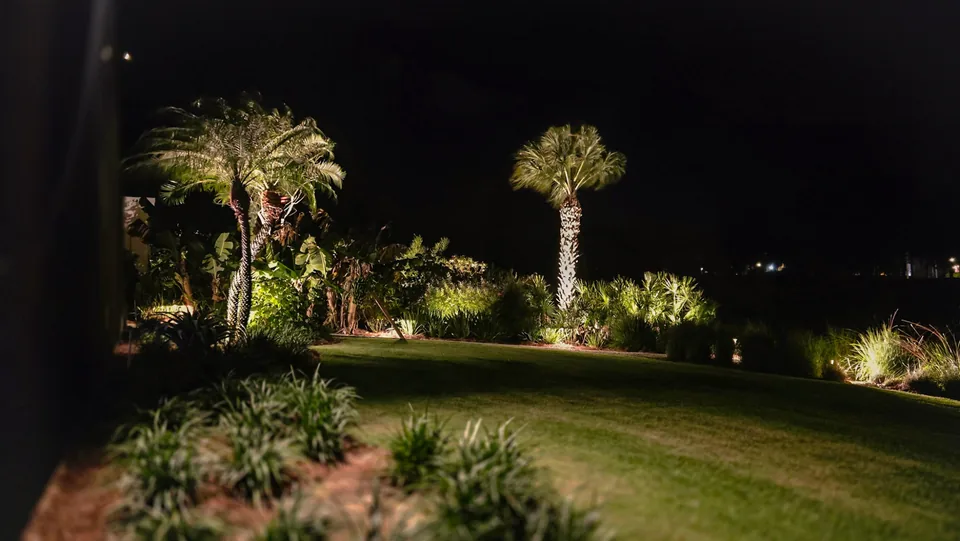
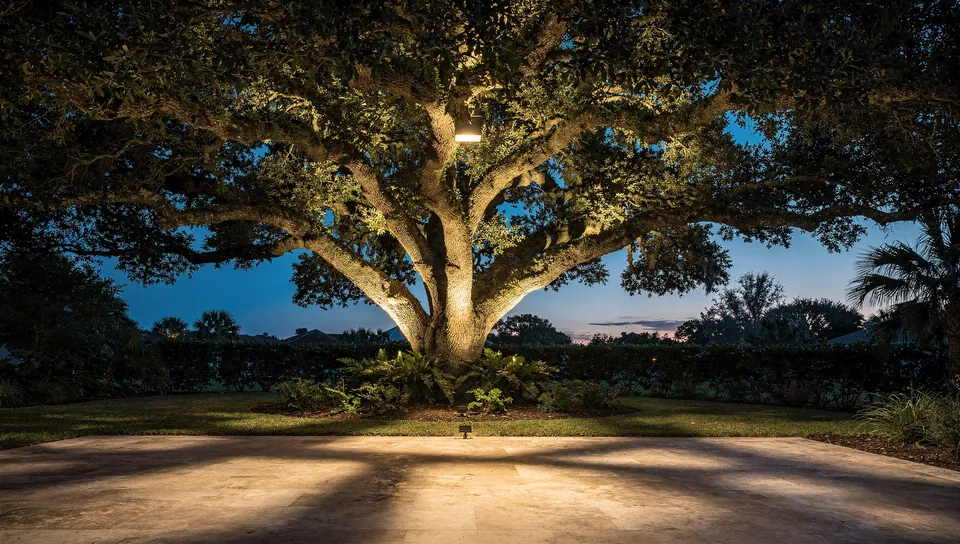
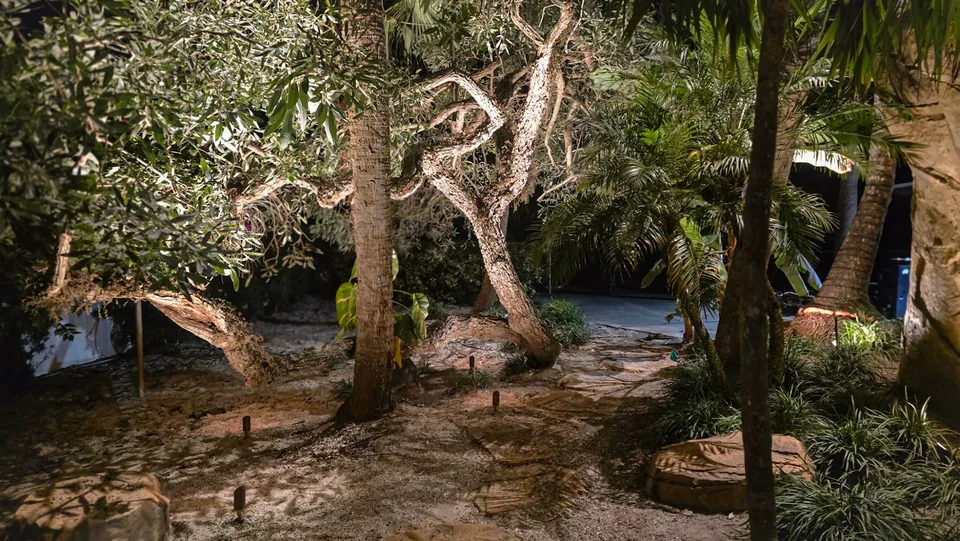
None of the photographs on this page were taken in Port Royal, and the drawings are labeled as illustrations. Where a rule comes from the zoning district, the deed restrictions, the association’s procedures or one City Council resolution, the page says which, because those four carry very different weight. Where we could not find an answer, such as whether the association reviews lighting, we say so and tell you who to ask.
The city’s own glare rules, Sec. 22-38 and Sec. 16-285, apply in Port Royal as everywhere in Naples. No City of Naples rule protecting wildlife other than sea turtles was found, so this page does not invent one.
Boundary and layout: Port Royal POA, Port Royal and history; zoning district: City of Naples Sec. 58-114, Municode; all read 2026-10-14.
Questions we hear
Lights on entry columns and gate walls, whether the association reviews lighting, how bright a dock light can be, uplighting on the Gordon Drive beachfront, the lighting plan the city asks for near the beach, cane toads, and how close Aqualane Shores docks sit. Each answer is drawn from the code or the association's own documents.
 NightScapes Landscape Lighting Outdoor lighting only, Naples since 1998
Choose a question
Ask us about lighting in Port Royal. Choose a question, or call and we will answer it on the phone.
Yes, within limits. Port Royal’s R1-15A zoning allows up to 32 inches on top of a main entry column for a light fixture, but the fixture counts toward the column’s maximum height, which depends on your lot frontage, setback from the road and side of Gordon Drive. The code gives no waiver route for these entry, wall and fence limits.
No. The R1-15A code says no lighting, sculptures or other architectural features may go on a fence or wall that serves more than one gated driveway. Light those entrances from the ground or from the main entry columns instead, keeping fixtures shielded so they do not glare into Gordon Drive, which citywide Sec. 22-38 also requires.
The public documents do not say. The deed restrictions require written approval before structures are built or exteriorly altered, including on the water next to the lot, and the building procedures cover additions and alterations. Neither mentions lighting. Call the association at (239) 261-6472 before mounting fixtures on columns, walls, docks or the house, and keep its written answer.
No Port Royal-wide number was found. The one documented city decision, a 2009 resolution for a dock at 4375 Gordon Drive, limited lighting to the minimum needed for safety while users are present, on a manual switch, not aimed skyward and without glare onto neighbors. Citywide, Sec. 22-38 requires full cutoff at the property line.
Where City of Naples Sec. 52-61 applies to new work, within 300 feet of mean high water or visible from the beach, landscape and accent lighting is prohibited. For existing homes, beach-visible lights must be off from 9:00 p.m. to sunrise, May through October, or shielded from view, and the city asks that accent lighting be off all season.
Yes, if the property is seaward of the Coastal Construction Control Line or within sight of the beach. The city’s gazebo permit checklist asks for an exterior lighting plan, manufacturer specifications for every proposed fixture and lamp, and a completed FWC fixture table, and says all exterior lighting must meet Sec. 52-61(b).
The association reports cane toads in Port Royal and has hired a removal service. The city says adult cane toads hunt at night and are common in yards. FWC notes that some frogs gather at lights to forage, but no source read says lighting draws or controls cane toads, so treat lighting as no fix for them.
The City of Naples sets a side setback of seven and a half feet for piers, boat lifts and moored boats in Aqualane Shores, against 20 feet in Port Royal. With docks that close, lights should be shielded and aimed down at your own dock, because city code requires full cutoff at the property line and no glare onto neighbors.
Free Consultations and Estimates
Tell us the street, which water the lot faces, and what you would like to see lit at night. We will talk through the entry columns, the walk to the dock and, on Gordon Drive, the beach side before anything is drawn.
Tell us about the property