Landscape lighting for Naples communities and commercial properties
A community is lit for hundreds of people, across hundreds of fixtures, by a board that will change. What it needs most is not brightness. It is one standard, kept even, written down where the next board can find it.
What a Naples community or commercial property needs from its lighting
If you sit on a board or manage a property and the lighting looks uneven, with some palms dark, some white and some yellow, the problem is usually not the fixtures. It is that there was never one standard. A community needs one fixture family, one color, set levels by area, and a plan that outlives the board.
A private garden can be lit by eye. A community entry, a mile of median palms and a clubhouse cannot, because they are lit and relit over years by whoever is available, with whatever lamp is to hand. Each replacement drifts a little from the last. After a few years the entry has three colors of white and the boulevard has gaps.
The cure is boring and it works: decide the fixtures, the color, the beam and the level for each kind of area once, write it down, and replace like for like from then on. Everything else on this page hangs off that.
NightScapes has always taken on commercial work as well as homes; in its own words, "Whether it’s a small residential lighting job or a commercial job, NightScapes Landscape Lighting can handle it."
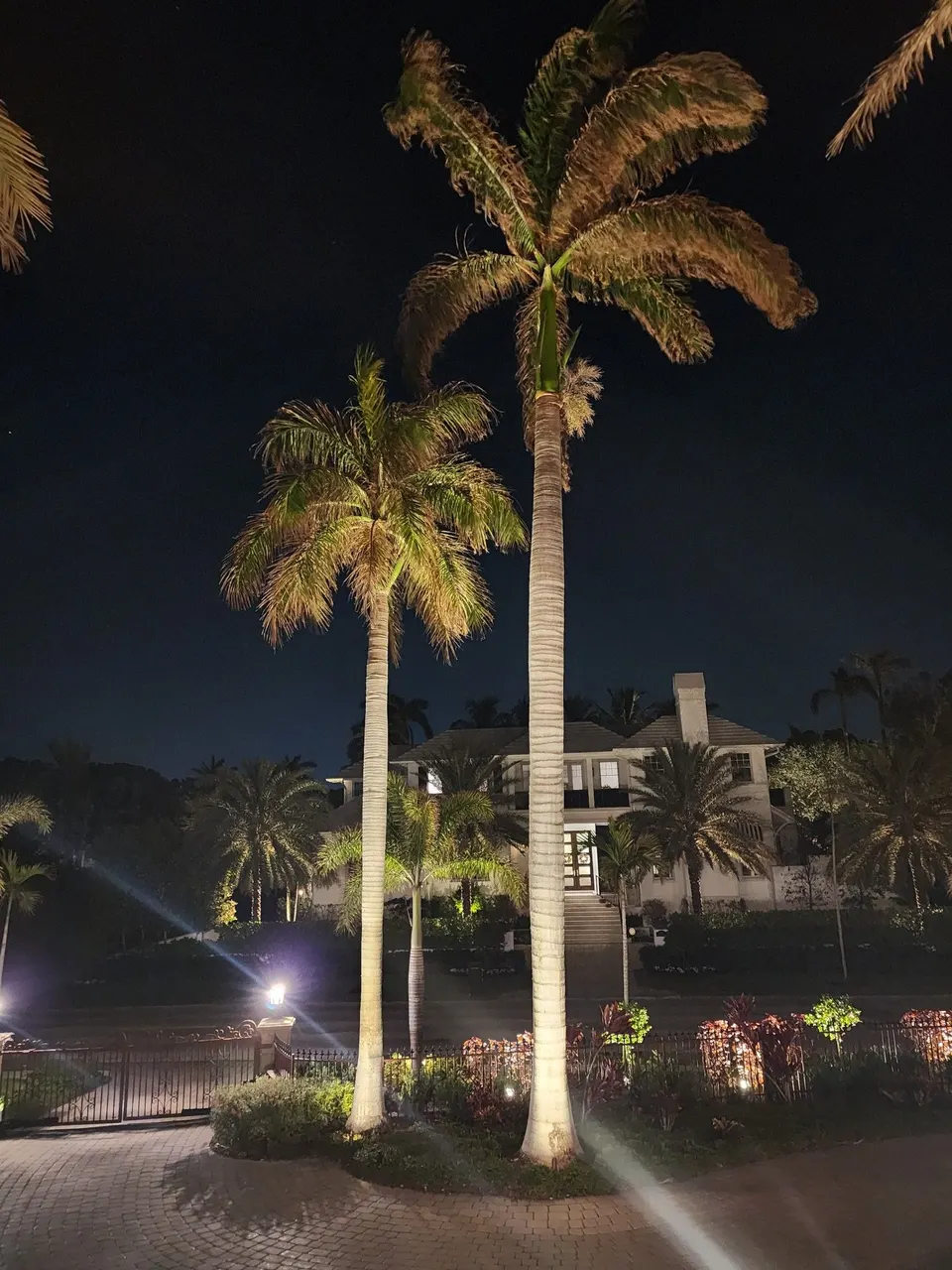
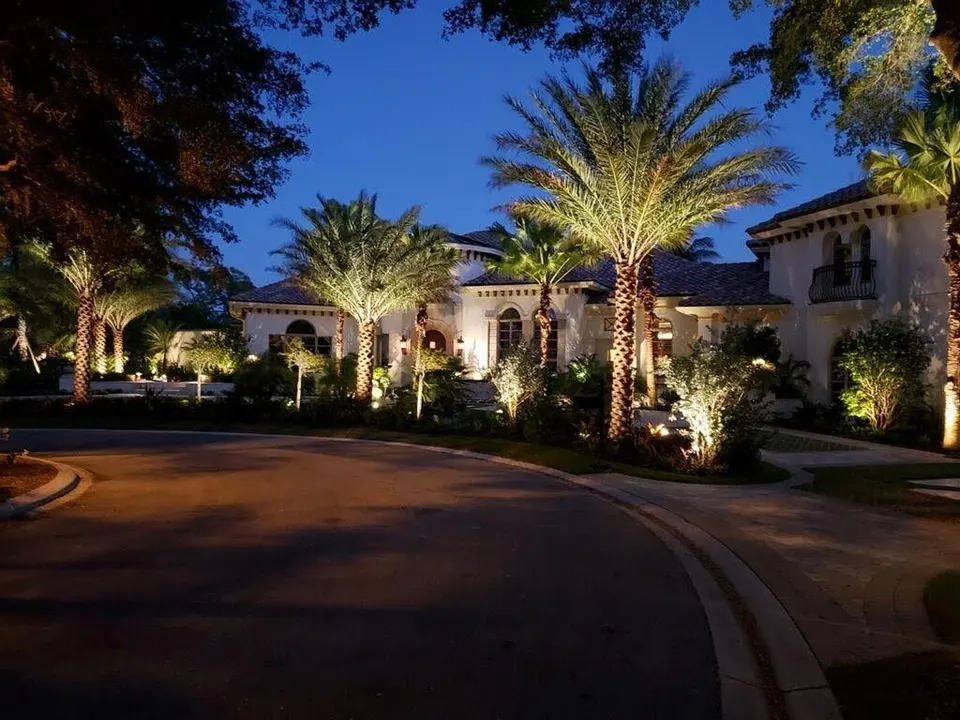
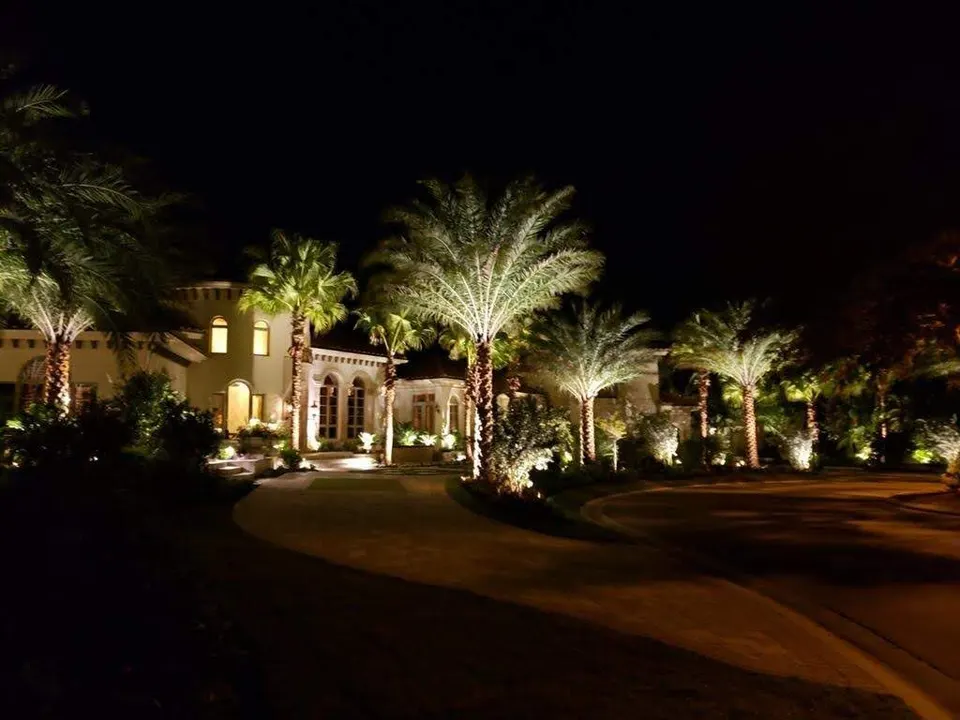
Two palms at an entry, lit as a matched pair. Residential work, shown for the technique.
One family
The same make and series of fixture for each job, so spares match.
One color
One white everywhere. Mixed color temperatures are the first thing noticed.
One plan
What is installed where, and to what standard, kept for the next board.
Community entrance lighting
Entries and monument signs: seen by everyone, every night
An entry is the most-seen lighting in a community and is judged from a moving car. The sign is lit evenly so the name reads, the palms either side are lit identically so the gateway reads as one, the gate and call box are lit without glare, and the planting is set to survive replanting. Point at a number.
Point at a numberTap a number
The monument sign
The name of the community is the one thing every resident, guest and driver needs to read, and it is read from a moving car. It is lit evenly across its face, from low fixtures in the planting, shielded from the road.
Lit for
Legibility from the road at arrival speed, in both directions.
Avoid
Hot spots on the lettering and any lamp visible to oncoming traffic.
The trees that frame it
Tall palms either side of an entry are what tells a driver where to turn from a distance. They are lit identically, so the entry reads as one composed gateway and not two trees.
Lit for
Visibility above hedges and walls from well down the road.
Avoid
Two palms lit differently because they were relamped at different times.
The gate and the gatehouse
At a gated entry the barrier, the call box and the guard’s view all need light that does not glare into a windshield. It is the same problem as a private gate, at a larger scale and with more traffic.
Lit for
Reading the call box and seeing the barrier from the driver seat.
Avoid
Lanterns at windshield height. See our driveway page.
The planting beds
Entry beds are replanted more often than most, and every replanting changes what the light falls on. Fixtures are set so they can move with the beds, and checked after each change.
Lit for
Depth and color around the sign and the gate.
Avoid
Fixtures buried by new planting or knocked by the crews who install it.
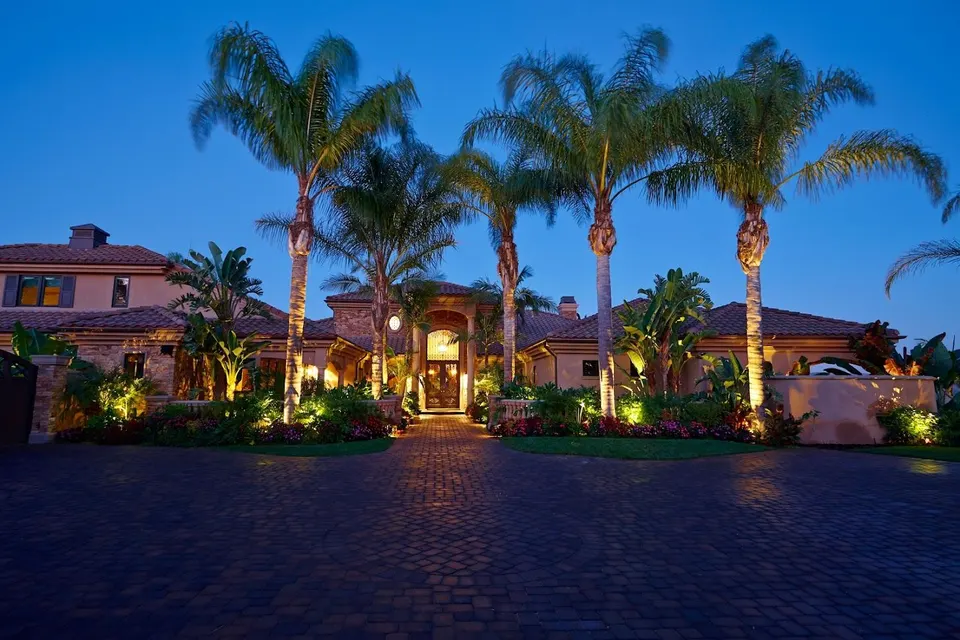
Photograph of a residential entry, used to show the parts of an entrance. Not a community project.
Boulevard and median lighting
Boulevards and medians: rhythm over a long distance
A boulevard is seen in sequence at driving speed, so what makes it look intended is rhythm: every median palm lit from the same side, at the same distance and level. One dark palm breaks the whole line. Medians and islands are also lit as hazards, most of all at their ends, where traffic divides.
A line of palms lit identically. On a boulevard the rhythm is the design.The eye finds the one that is out.Planting islands lit so a driver can pass round them.
Rhythm is what reads
A boulevard is seen in sequence at driving speed. What makes it look intended is regularity: every palm in the median lit from the same side, at the same distance, at the same level, so the line reads as one long gesture down the road.
Gaps break it
One dark palm in a lit median is visible from a long way off and makes the whole line look neglected. On a long run, a single failed fixture, a buried one or a palm that has outgrown its light is the commonest complaint a board hears.
Medians and islands
A planted median is both decoration and a hazard. Lit, it tells drivers which side to pass and marks its own curbs. The ends of a median, where traffic divides, matter most, and they are lit to be seen before the turn, not at it.
Amenity lighting
Amenities: clubhouse, pool deck, courts and walkways
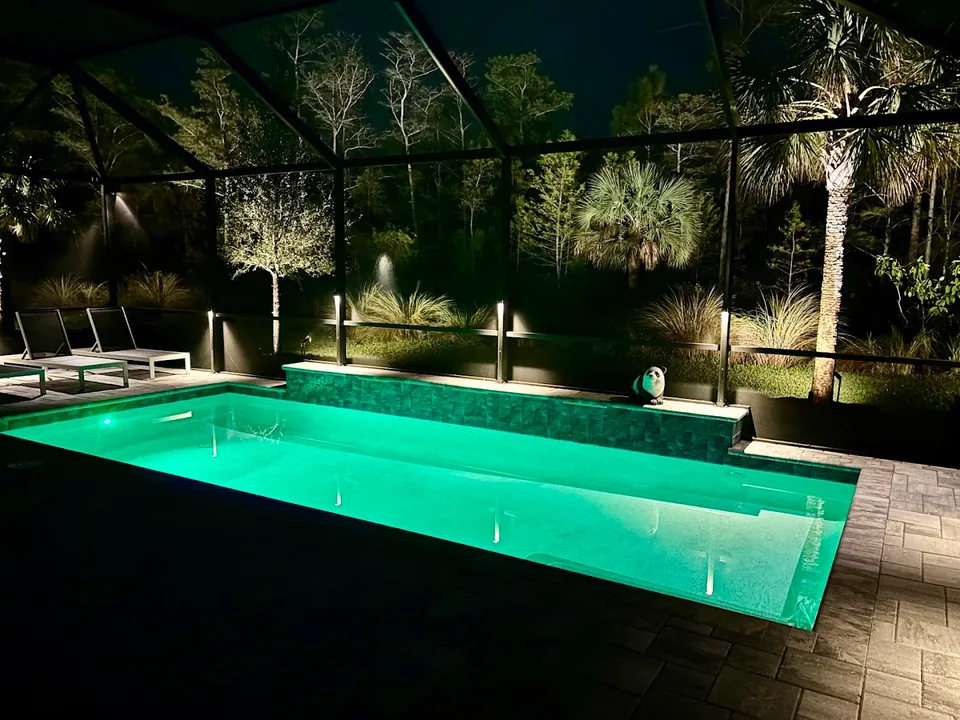
Amenities are used by many people who do not know the layout, often at night. A clubhouse and pool deck need welcoming light and safe edges, walkways need readable curves and steps, and pavilions need event light on a dimmer. All of it sits close to homes, so glare toward windows is checked. Point at each.
Clubhouse and pool deck
Point here to see the approach
The need
A welcoming building and a safe deck, used by many people who do not know the layout.
The approach
Low, shielded light at the edges and the steps; planting and palms lit beyond.
Watch for
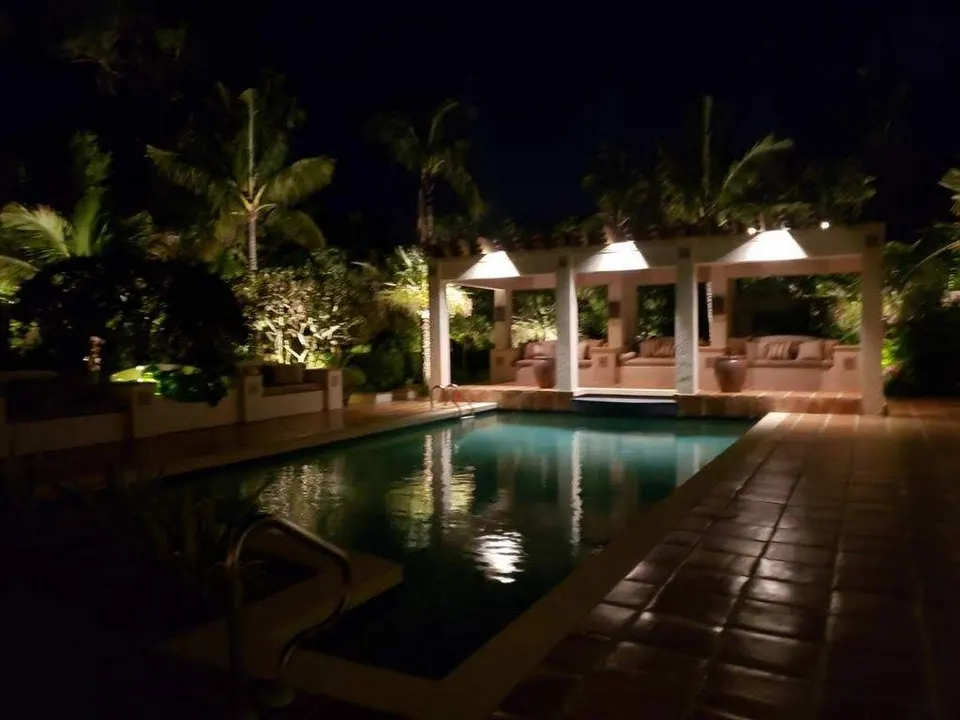
Glare across water and into the windows of homes nearby.
Walkways and paths
Point here to see the approach
The need
Readable edges and steps along routes residents walk after dark.
The approach
Pools of light at curves, junctions and changes of level, not a runway.
Watch for
Fixtures in mowing lines, which on common ground are knocked constantly.
Pavilions and gathering areas
Point here to see the approach
The need
Usable light for events, and a quiet level when nobody is there.
The approach
Downlight from the roof structure on its own dimmed zone.
Watch for
Lights left at event level all night, every night.
Lighting standards
One standard across many fixtures
A lighting standard is a short document that says, for each kind of area, which fixture, which color of white, which beam and what level. Once it exists, every replacement matches its neighbors and the property stays even across years and contractors. It is the single most useful thing a board can own. Point at each part.
One fixture family
What it means
The same make and series of fixture for each job across the property.
Why
Spares are interchangeable and the light from each looks the same.
Written down
Make, series and finish for each type of fixture used.
One color of white
What it means
One color temperature everywhere, chosen once.
Why
Mixed whites are the first thing anyone notices on a large property.
Written down
The specified color for every replacement, forever.
Beam and level by area
What it means
Entry palms, median palms, sign and paths each with a set beam and output.
Why
So a fixture replaced in five years matches its neighbors on day one.
Written down
A short table per area, kept with the plan.
Records
A plan the next board can read
Boards change and managers move on, and the knowledge of what was installed goes with them. A plan of the lighting, showing each fixture, each run and each transformer, with the standard for each area, lets the next board see what was intended and keep to it without having been there when it was decided. Explore one below.
A drawn example of the kind of plan described here, not a drawing of any real property.
What a plan shows
Every fixture, its type and what it lights. Every cable run and which transformer feeds it. Every transformer, where it is and what it carries. And the standard for each area, so a replacement fixture has an answer before anyone asks the question.
Why it matters at handover
When a board turns over, the people who knew why the median palms were lit from the north side are gone. Without a plan, the next contractor guesses. With one, they match. Faults are found faster too, because the run feeding a dark section is already known.
Large systems
What scale does: long runs, voltage and finding faults
A community system is many small systems joined together, over long distances. Voltage falls along every cable, so long runs to a distant entry or a mile of median are designed for it. FX Luminaire says each LED fixture should receive between 10 and 15 volts. Finding faults takes method, because one failure can darken a whole run.
Large properties are lit by several transformers, each feeding its own runs.
Voltage over distance
FX Luminaire explains that "the greater the resistance of the circuit, the higher the
voltage drop," and that "the input operating voltage at each fixture should always be
between 10-15 VAC." On a long run, that means heavier cable, shorter runs from more
transformers, or both. FX names 16/2, 14/2 and 12/2 as the common sizes and warns that
"incorrect wire size may result in voltage dropping past 10 VAC."
More transformers, smaller zones
Splitting a large property into several transformers, each with its own runs, keeps
voltage in range and limits what goes dark when something fails. It also makes the
standard easier to keep, because each area can be checked and adjusted on its own.
Finding faults
A dark section of median could be a failed fixture, a cut cable from irrigation work, a
corroded connection or a tripped transformer. With a plan, the run is known and the
search is short. Without one, it starts from scratch every time. The method is the same
as on any system: see lighting repair. After a named
storm, see putting a system right after a named
storm.
A community system stays even when it is checked at night on a schedule, lamps in a run are replaced together, fixtures are reset after replanting, and the whole system is walked after storms. Just as important is one person on the board or management side who approves changes, and every change recorded on the plan. Tick what is true of yours.
0 of 6
Held to its standard
The property is checked, kept even and written down. The next board will inherit a system and a record that agree.
Mostly held
The lines you left unticked are the ones that let a large system drift: replacements bought one at a time, beds replanted over fixtures, changes nobody recorded.
Start with the plan
A walk of the property and a plan of what is there are the first two steps, and everything else follows from them. Ask about a property.
Who lights the property: NightScapes Landscape Lighting, Naples
NightScapes Landscape Lighting has designed and installed outdoor lighting in Naples since 1998, for homes and commercial properties. Todd and Sherry own and run it, outdoor lighting is the only work it does, and its Google Business Profile shows 63 reviews at 5.0. A board deals with the owners directly.
We light low-voltage landscape: entries, signs, palms, medians, planting, paths and
amenity areas. We do not do street or parking lot pole lighting. We work across Naples
and through Lee and Collier counties.
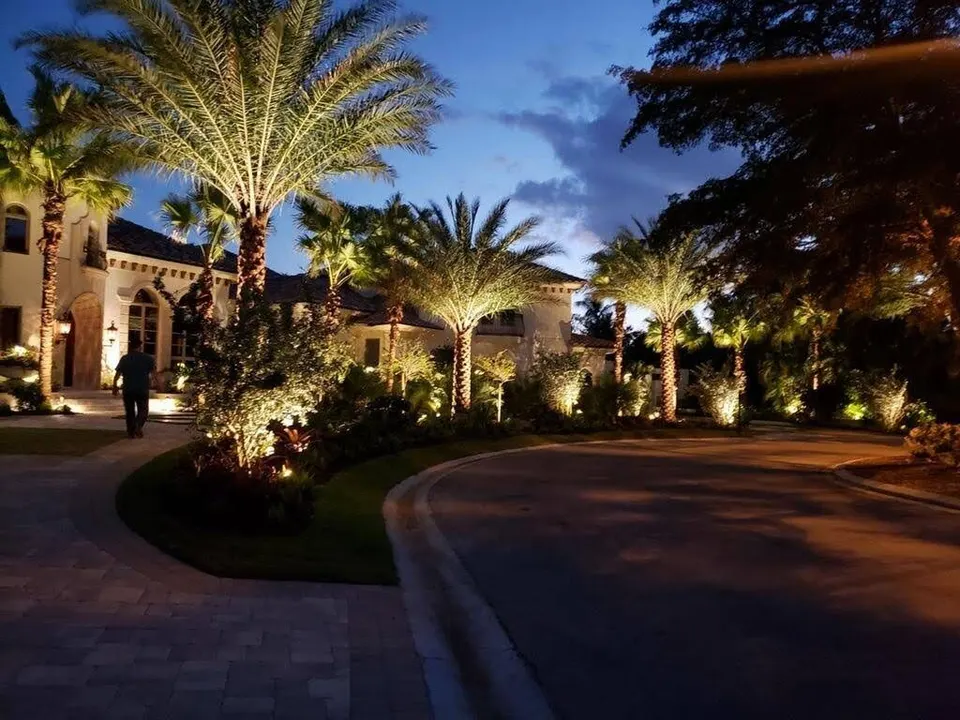
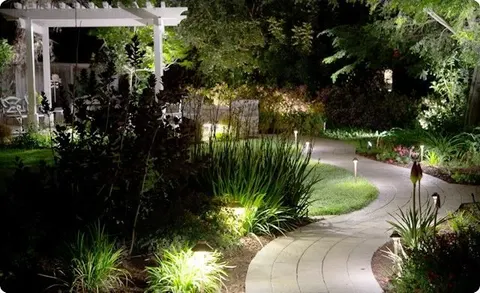
Residential work: the same standards apply at a larger scale.
Since 1998
Lighting properties in Naples and Southwest Florida.
Todd and Sherry
Family and locally owned. The owners are the people you deal with.
63 Google reviews
Rated 5.0 on the NightScapes Google Business Profile.
Lee and Collier counties
Naples, Marco Island, Bonita Springs, Fort Myers, Sanibel and Captiva.
Questions we hear
Questions boards and managers ask about community lighting
Service arrangements, whether to use a specialist, streetlights and parking lot poles, converting an older entry to LED, whether a bid is required and how to keep lighting consistent as boards change. Questions about law and governance are pointed to your documents and counsel, where they belong.
NightScapes Landscape LightingOutdoor lighting only, Naples since 1998
Ask us about a community or commercial property. Choose a question, or call and we will answer it on the phone.
Do you offer a service arrangement for a community’s entrance lighting?
We look after the systems we light, and for a community that means regular night checks and keeping the standard. What an arrangement includes, how often, and on what terms is agreed with the board or the manager for that property. We do not publish terms here.
Should a community use a specialist rather than a general contractor?
Landscape lighting on common ground is a design job as much as an installation: rhythm down a boulevard, legibility of a sign, glare toward homes and traffic. Whoever does it should be able to show you the plan and the standard they are working to. Your governing documents and your association’s counsel decide how contractors are chosen.
Do you work on streetlights or parking lot poles?
No. We design and install low-voltage landscape lighting: entries, signs, palms, medians, planting, paths and amenity areas. Pole lighting on streets and in parking areas is a different kind of electrical work, and in many communities the poles belong to the utility.
Can an older community entry be converted to LED?
Usually, fixture by fixture, and it is a good moment to set the standard: one color, one fixture family, levels by area. Converting a large property also means checking the transformers and runs, because an older system was sized for different loads. See our halogen to LED page for how the decision is made.
Is a bid required?
That depends on your community’s governing documents and on Florida law as it applies to associations, and your association’s manager or counsel is the right person to ask. We are glad to provide what a board needs to compare proposals properly, starting with a clear description of the work.
How do we keep the lighting consistent as residents and boards change?
By writing the standard down and keeping a plan of what is installed where. The fixtures, color, beams and levels for each area, and every change since, recorded in one place. A new board or manager should be able to see what was intended without having been there when it was decided.
Tell us about the property: the entries, the boulevards, the amenities, and what bothers residents most about the lighting now. We walk it with you and tell you what we see.