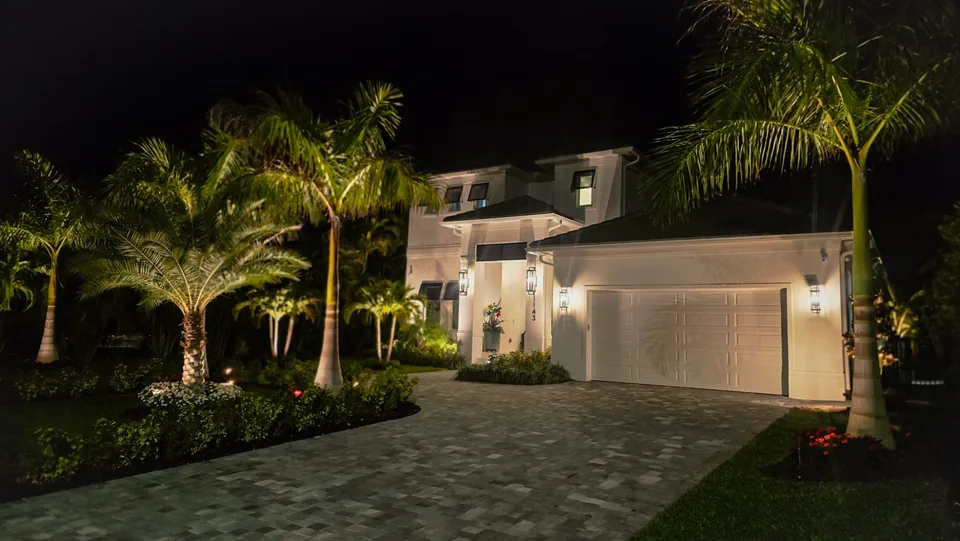
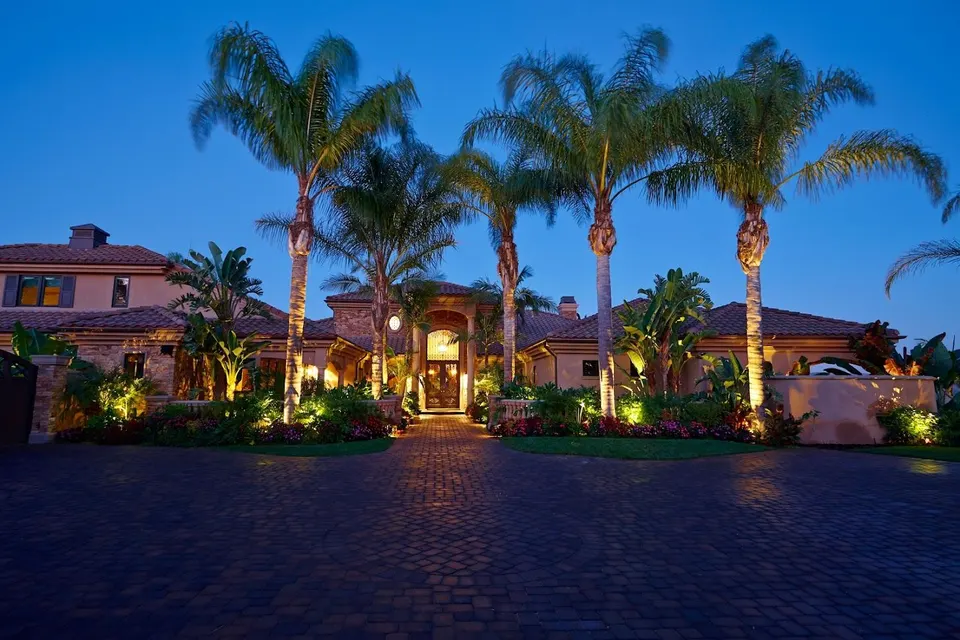
Facade, column and stone wall lighting for Naples homes
One fixture at the foot of a wall can make it look carved or make it look patched. The difference is how far it sits from the surface, and that is decided on the property, wall by wall.
How far the fixture sits from the wall decides the look
If the lights along your house leave bright cones at the foot of the wall and nothing higher up, the fixtures are too close for the height. Set tight to a wall, a fixture grazes and shows texture. Stepped back, it washes the wall evenly. With a plant in between, it throws a shadow. Distance decides which you get.
At the wallStepped back
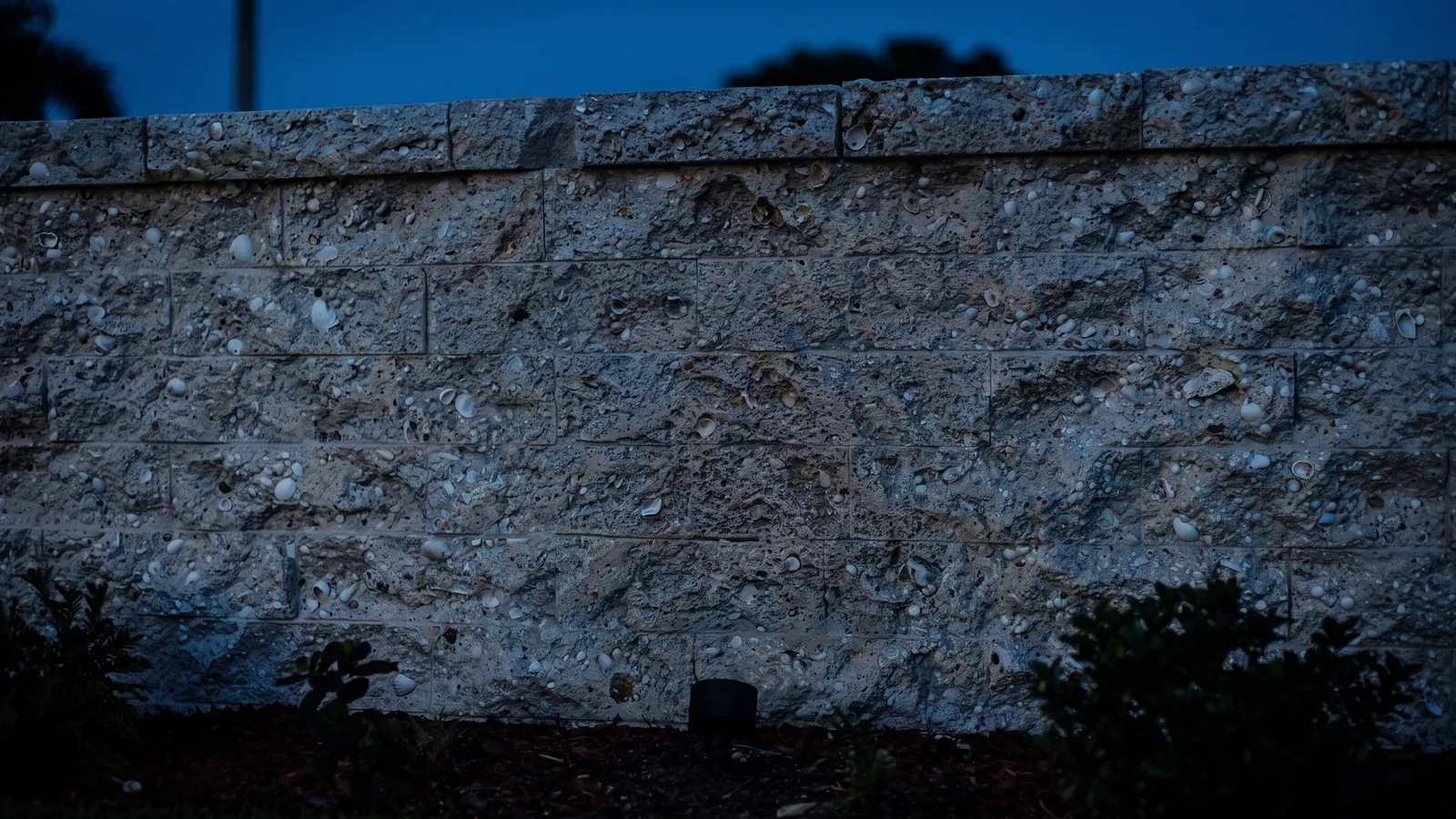
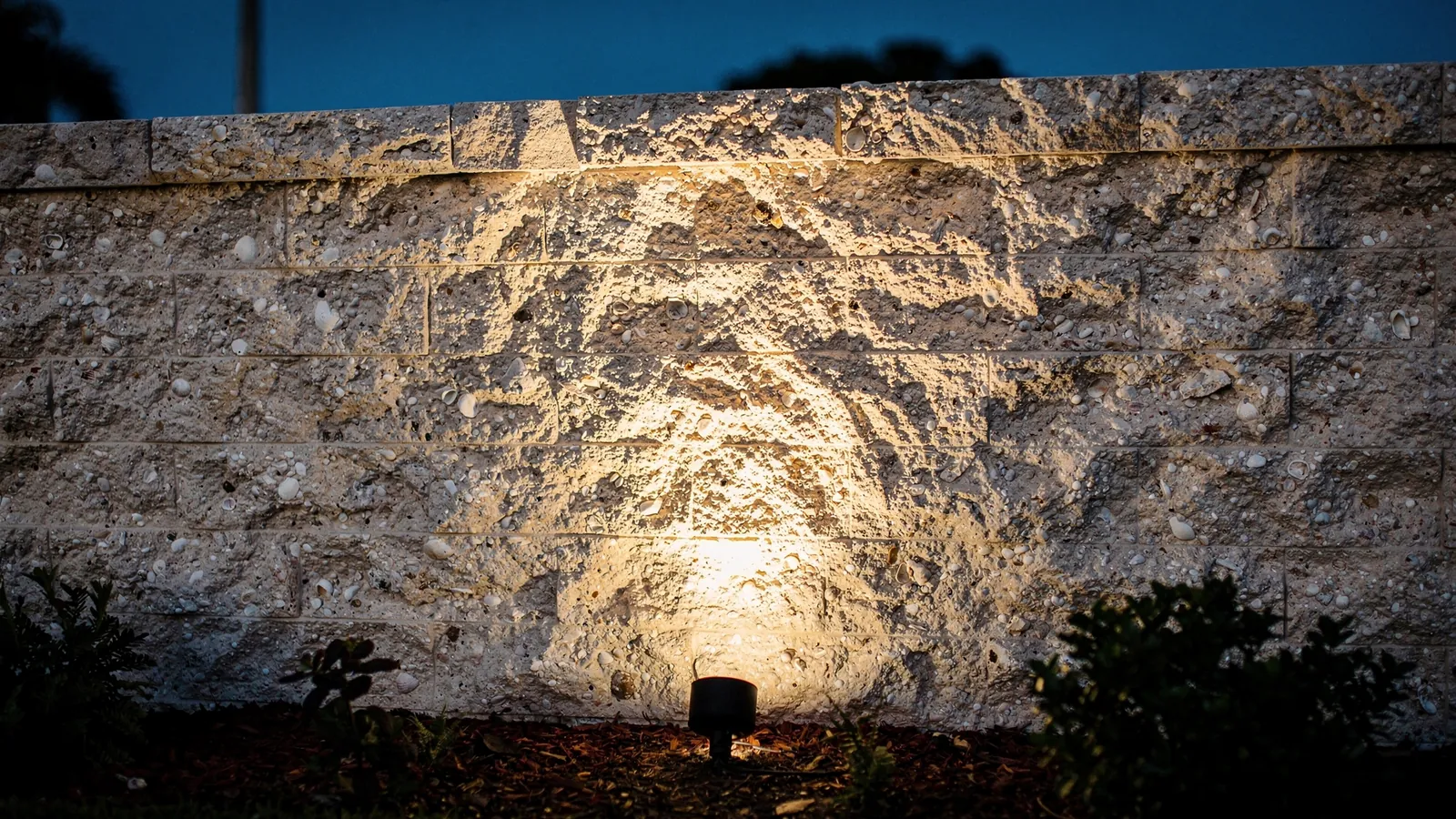
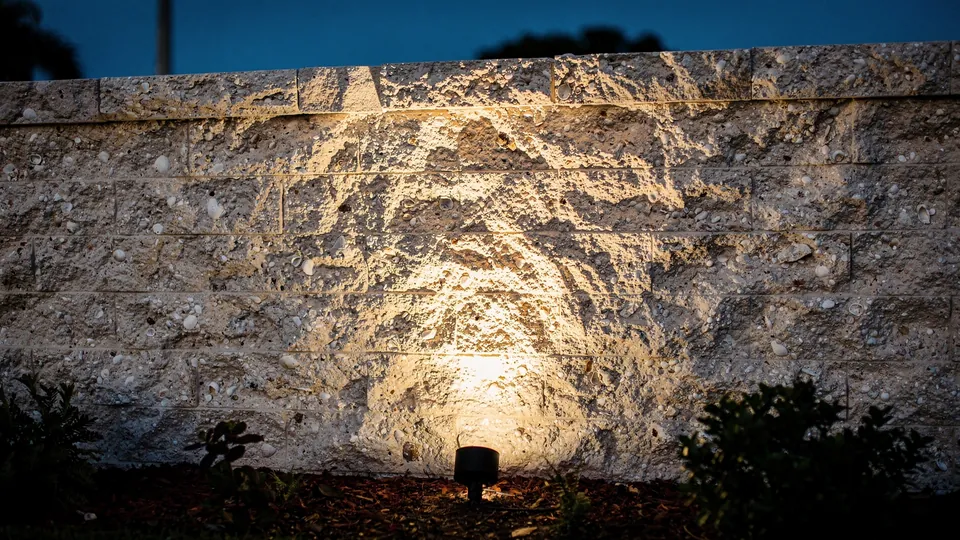
Graze. Tight to the wall, the light skims the stone. Every joint throws a shadow and the wall looks carved.
Illustration: one coral stone wall and one fixture, from the front and, in the inset, from the side.
Architectural lighting is the part of an outdoor system that lights the building itself: the walls, the entry, the columns, the stone. It is also the part most often done by habit. A fixture goes in at the foot of each wall, at whatever distance the bed allows, and the house gets what it gets.
Done on purpose, each surface is looked at for what it is. Stone wants to be grazed. Smooth stucco wants to be washed. A blank wall behind a good plant wants a shadow. A tall elevation wants light from two heights. None of it shows up on a drawing, which is why we set positions on the property itself.
Tight to the wall. Shows texture. Right for stone, wrong for smooth stucco.
Wash
Stepped back. Shows shape and color. Right for stucco and long walls.
Shadow
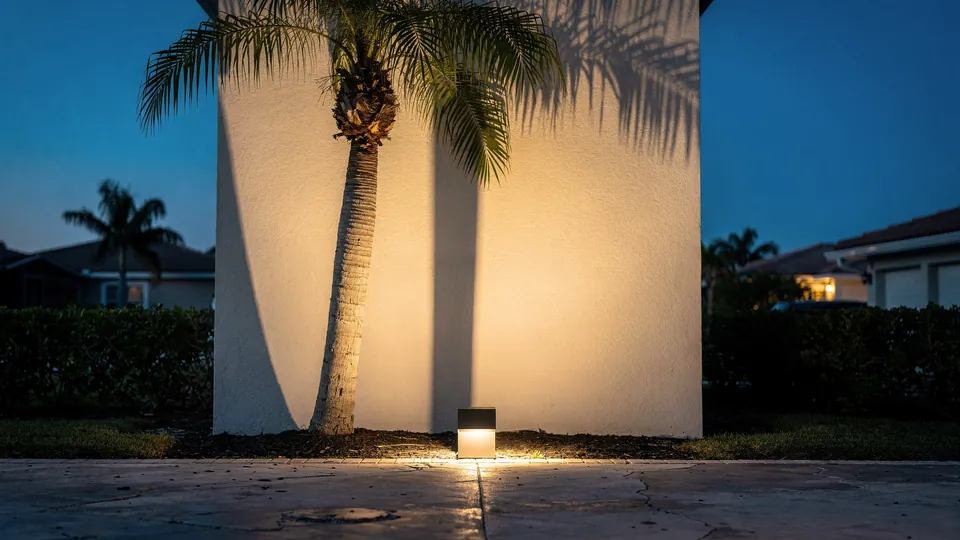
A plant between light and wall. Needs a plain surface behind it.
Facade wall washing
Washing a facade evenly, up to the second story
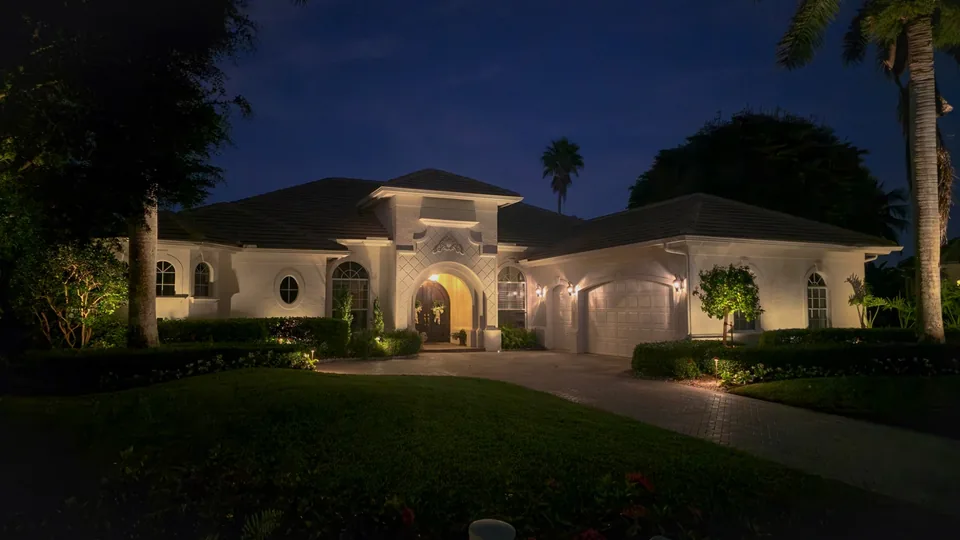
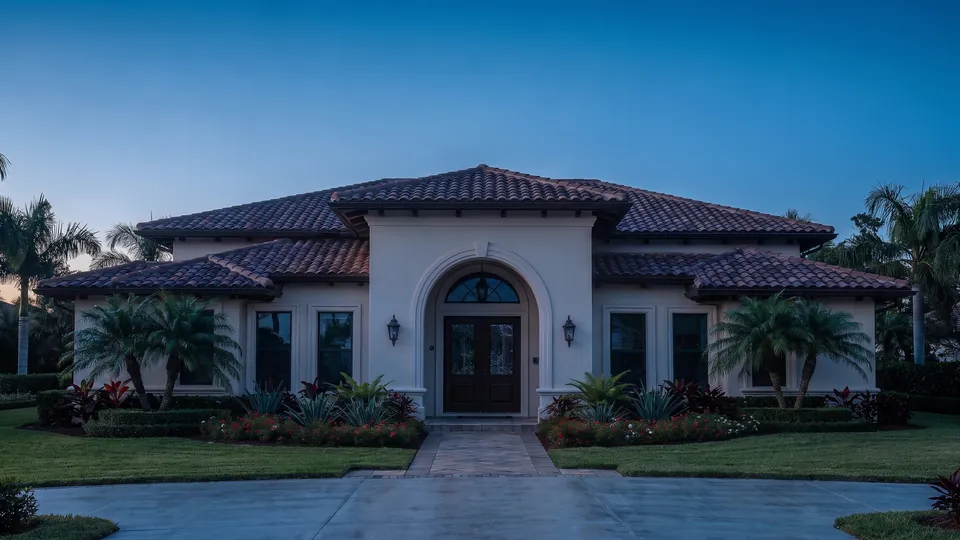
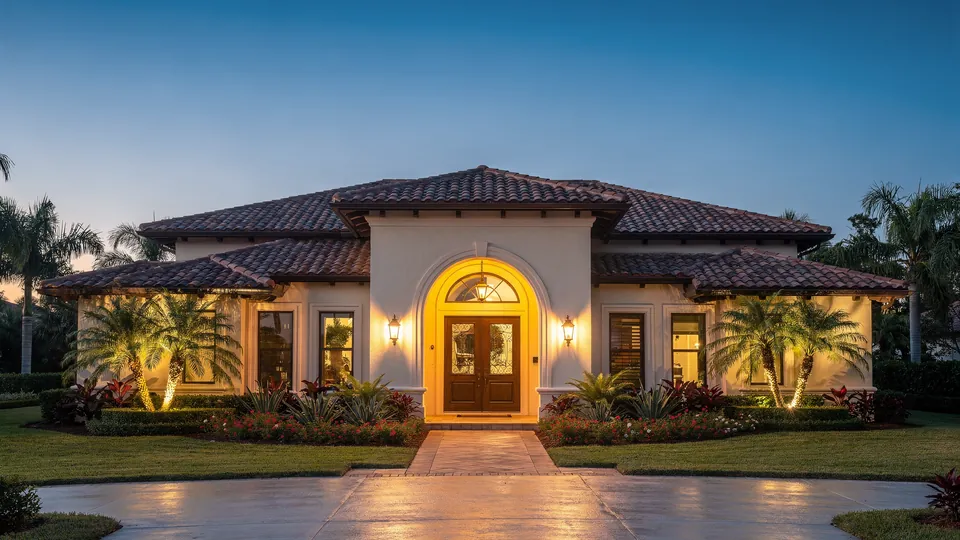
An even wash comes from setback, beam width and spacing chosen together, never from brighter lamps. Light falls off with height, so a tall elevation is lit in more than one lift. This house front starts unlit. Scroll, and it is built up the way we do it on a property: the entry, then the walls, then the ground.
First
The entry is where the eye should land
The front door is the one part of a house everyone is looking for. It is lit first and it is lit warmest, so that when everything else comes on it is still the brightest thing on the elevation.
Carries it
Light inside the arch or under the soffit, so the opening glows from within.
Goes wrong
A fixture aimed at the door from the lawn, which lights the visitor’s back.
Second
Then the walls either side
The wings are washed from the bed in front of them, held a step below the entry. This is where setback matters most: too close and you get bright cones at the base with a dark upper wall, too far and the planting throws shadows across the stucco.
Carries it
Even spacing, so the wall reads as one surface and not a row of scallops.
Goes wrong
Windows. A wash that crosses glass puts a fixture in somebody’s bedroom.
Third
Then the ground in front of it
Light on the walk and the drive ties the house to the property. It is the lowest layer and the easiest to overdo. A wet paver court reflects everything above it, so a little light here goes a long way.
Carries it
Spill from the layers above, with low fixtures only where a step needs them.
Goes wrong
A bright apron that makes the house behind it look dimmer than it is.
Together
Three layers, and one of them leads
Seen together, the entry still leads, the walls support it and the ground holds it all in place. If any one layer were turned up to match the door, the house would stop reading as a building and start reading as floodlit.
A graze sets the fixture tight to the wall so the light skims the surface. On stacked stone, coral stone and textured block every joint throws a shadow and the wall looks carved. On painted stucco the same light finds every trowel mark, patch and hairline crack, which is why stucco is washed from further back instead.
Graze
Point here to see where it sits
The fixture sits
Tight to the foot of the wall, aimed almost straight up it.
What it shows
Every joint, pit and ledge. Stacked stone, coral stone and split-face block come alive.
Where it goes wrong
On painted stucco. The same steep light finds every trowel mark, patch and hairline crack.
Wash
Point here to see where it sits
The fixture sits
Stepped back into the bed, with a wider beam aimed at the wall.
What it shows
The shape of the building: the wall as an even, quiet plane of color.
Where it goes wrong
When planting grows up between the light and the wall and throws a shadow across it.
Shadow
Point here to see where it sits
The fixture sits
In front of a plant or an object, with a plain wall behind it.
What it shows
The plant twice: once lit, and once as a larger shadow on the wall.
Where it goes wrong
On a busy wall. Shadow needs a blank surface or it becomes clutter.
Part by part
Columns, arches, entries and rooflines
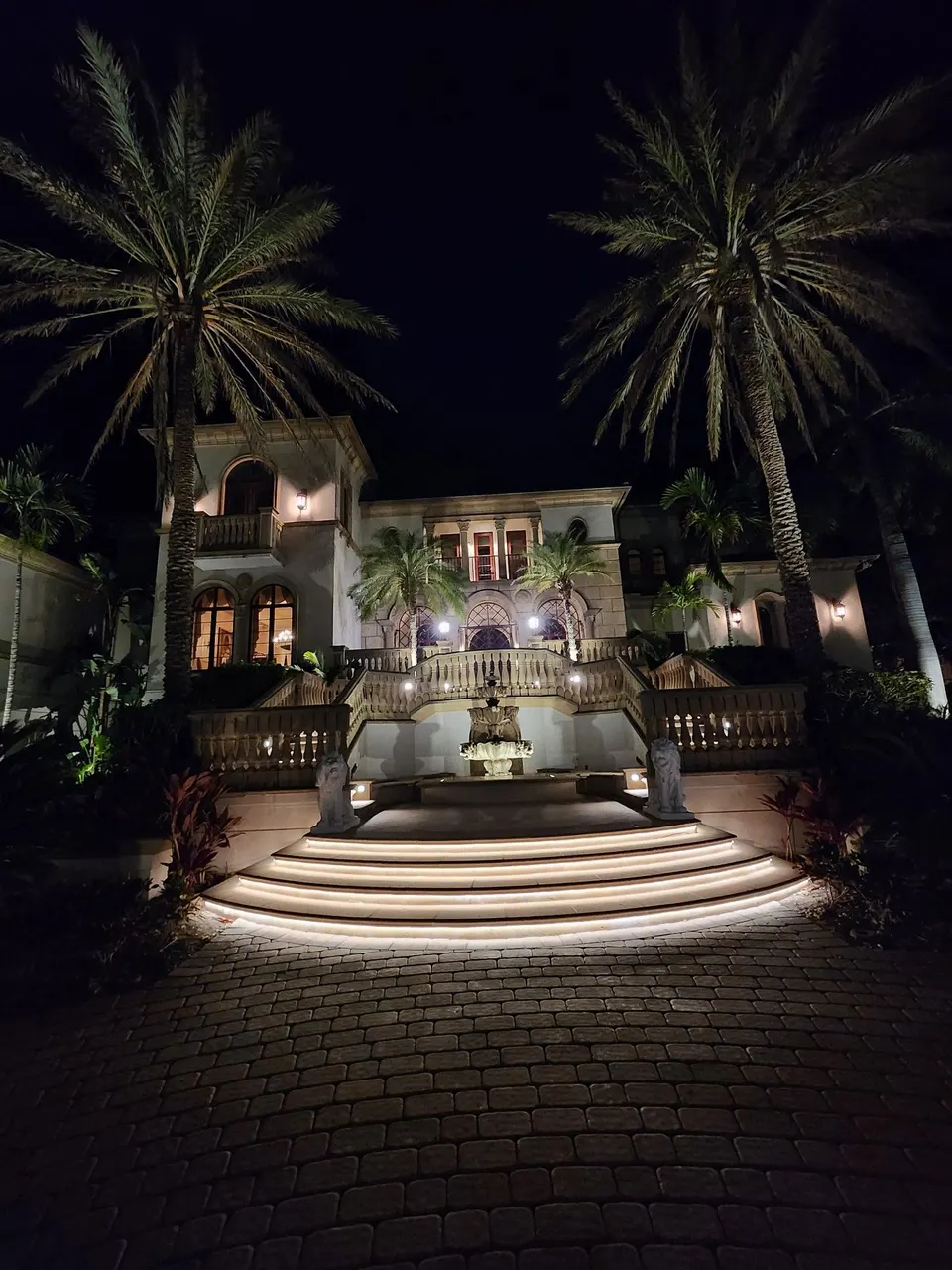
A house front is made of parts, and each is lit as its own object. A column wants light from its base, stepped out far enough to reach the capital. An arch is lit from inside itself. A tall elevation gets a second lift from a balcony or the eave. Point at a number on this Naples entry.
Point at a numberTap a number
Entries and arches
An arch is lit from inside itself. Light tucked into the soffit or the reveal makes the opening glow, and the shape of the arch is drawn by the shadow at its edge. Lit from the front, the same arch goes flat.
Sits
In the reveal, the soffit, or low either side of the opening.
Watch for
Glare at eye level for someone standing at the door.
Columns and balustrades
A column is a single object and is lit as one. Tight to the base it becomes a bright shaft with a dark capital. Stepped out a little, the light reaches the top. A round column usually wants two sources so it reads as round.
Sits
At the base, offset to one side, or one each side for a pair.
Watch for
A row of columns lit at different levels. The rhythm is the point.
Reaching the second story
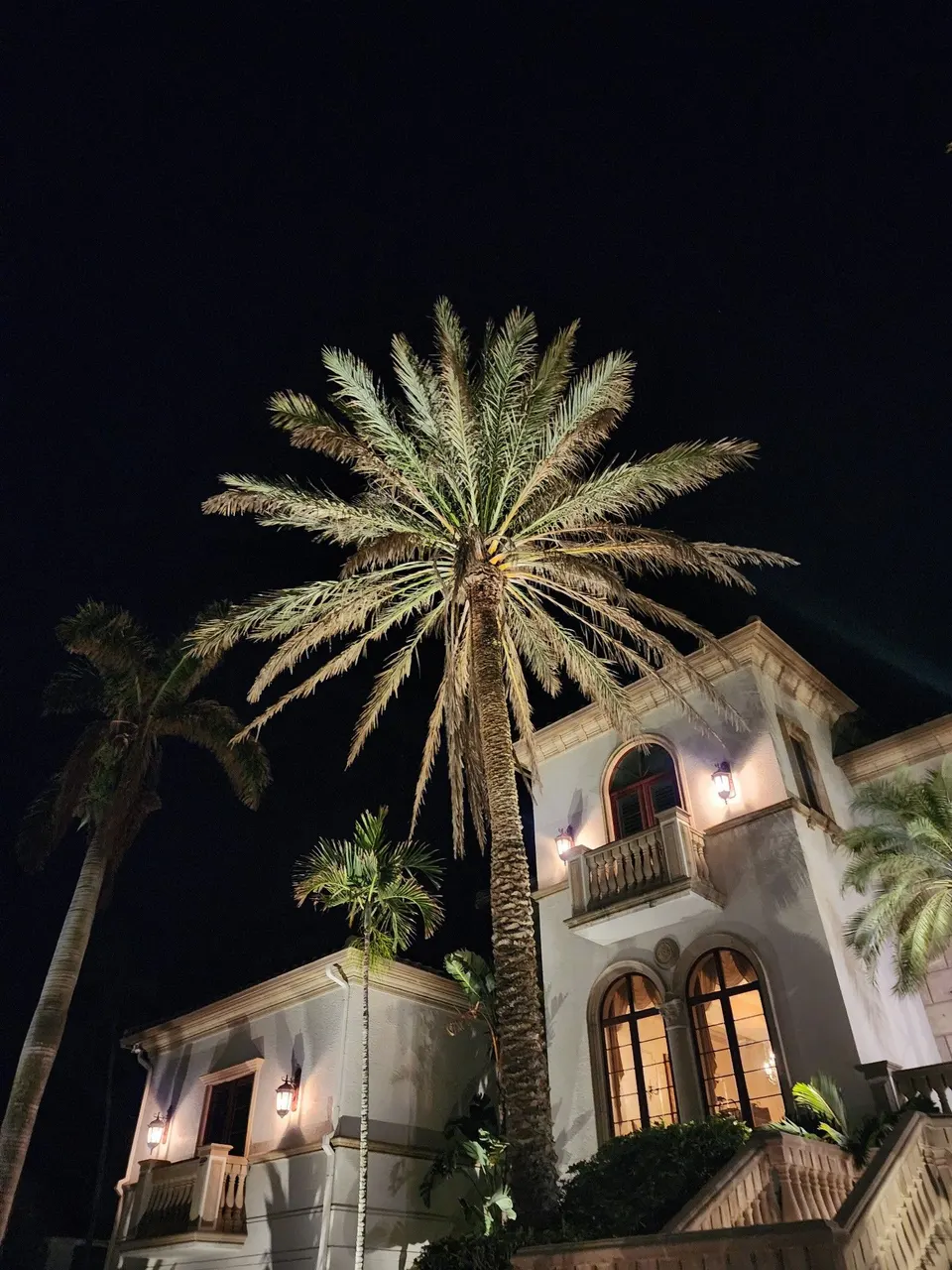
Light falls off with height. A fixture that washes the ground floor well leaves the upper wall dim, and turning it up only burns the base. A tall elevation is lit in two lifts: one from the ground, one from a ledge, a balcony or the eave.
Sits
On the lower roof, a balcony, or under the upper eave aiming down.
Watch for
A hot band at the base. That is the sign one fixture is doing two jobs.
Rooflines and gable peaks
A roofline is lit from the eave down or from a lower roof up, never from the lawn. A small source under the eave draws the edge of the building against the sky and gives the upper wall the light the ground fixtures cannot carry that high.
Sits
Under the eave aiming down, or on a lower roof aiming up at a gable.
Watch for
A lamp visible from the street. Up here it has to be tucked out of sight.
Steps that belong to the building
Where the entry is raised, the steps are part of the architecture. Light under each tread draws the curve of the stair and makes it safe to climb, without a single fixture standing in the view of the house.
Sits
Under the nosing of each tread, or in the wall beside the flight.
Watch for
Brightness. Steps this lit can outshine the door above them.
What frames the house
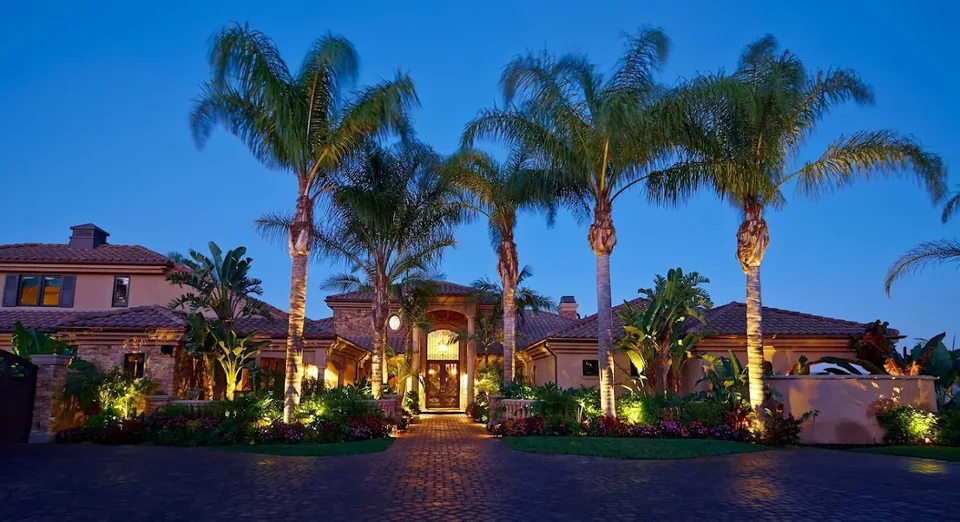
A facade never sits alone. The palms either side set the height of the picture and close its edges. They are lit as part of the elevation, at a level that frames the house and does not compete with it.
Sits
In the bed at the foot of each palm, shielded from the drive.
Watch for
Trees brighter than the building. Then the house is the background.
Glare and spill
Windows, shutters and glass: where facade light goes wrong
Glass is where facade lighting fails. A beam that crosses a window is a light in the bedroom behind it, and the pane throws a reflection back at the street. Fixtures are placed on the solid wall between openings, aimed below the sill line, and checked from inside the house as well as from the road.
Light on the wall between the windows, not across them.
Glare into the rooms
An uplight under a window sends its beam past the sill and into the room. From outside
it looks fine. From the bed it is a lamp aimed at the ceiling all night. The fix is
position, not a dimmer: the fixture moves sideways onto solid wall, or the beam is cut
off below the sill with a shield.
Reflections and dark holes
Glass is a mirror after dark. A fixture in line with a window shows up in it as a hard
point of light, seen from the drive. And where a wash crosses a run of windows, the
glass reads as black holes in a lit wall. Sometimes the answer is to light the piers
between the windows and let the interior lamps do the rest; a house with a few rooms
softly lit from inside looks occupied and warm.
Shutters, screens and the lot next door
Louvered shutters and screen frames throw busy shadows under a graze, so the wall around
them is washed. And any beam that misses the building carries on to the neighbor or the
street. On the close lots of Old Naples and Park Shore that matters as much as how the
house itself looks. Every facade is walked from the lot line before it is finished.
Level and color
Keeping the house from looking floodlit
A house reads as architecture when some of it is lit and some is not, when the entry leads and the walls support it. More fixtures at lower output can be balanced; one bright flood cannot, and it makes a home look like a parking lot. Warm white suits cream stucco, stone and clay tile.
SurfaceStone, block, smooth or textured stucco, and what a graze would show on it.
SetbackHow far the bed allows a fixture to sit, and what grows in between.
OpeningsEvery window, door and vent a beam could cross.
HeightWhether one lift reaches the top, or the upper wall needs its own.
The leadWhich part of the house is brightest, and that it is on purpose.
From the streetThe whole elevation checked from where it is actually seen.
Set against the real wall.
Walked
Who does the work
Who lights the house: NightScapes Landscape Lighting, Naples
NightScapes Landscape Lighting has lit house fronts in Naples since 1998. Todd and Sherry own and run it, outdoor lighting is the only work it does, and its Google Business Profile shows 63 reviews at 5.0. Facade positions are set against the real wall, by the people who will come back to adjust them.
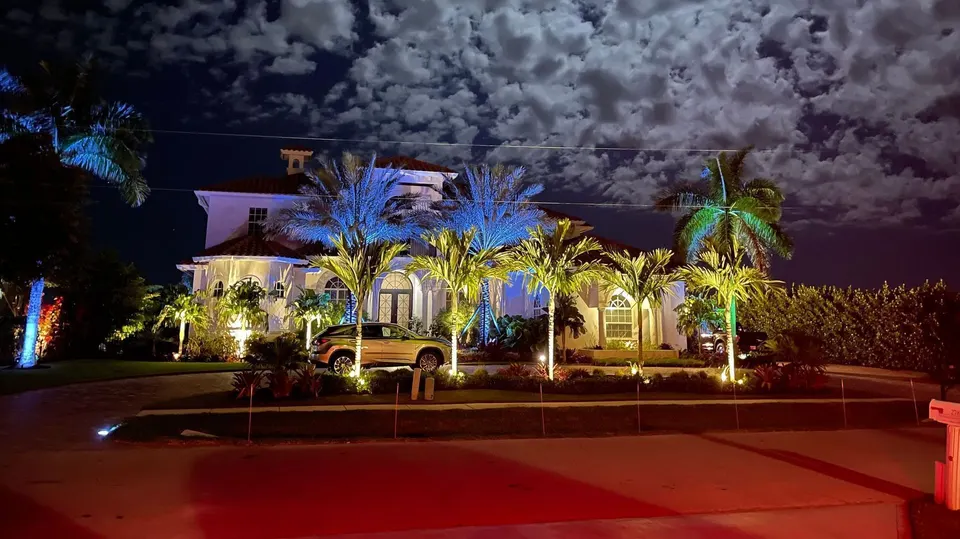
The houses on this page are in and around Naples: Mediterranean elevations with arches
and balustrades, stucco wings behind rows of palms, stone entries. We work across Port
Royal, Old Naples, Aqualane Shores, the Moorings, Park Shore and Pelican Bay, where the
lots are close and a facade is seen from the street, and in Grey Oaks and on Marco
Island, where it is seen from a long drive or across water.
We do not sell fixtures by the box. We light the outside
of houses, one wall at a time, and we look at each one from where the owner will.
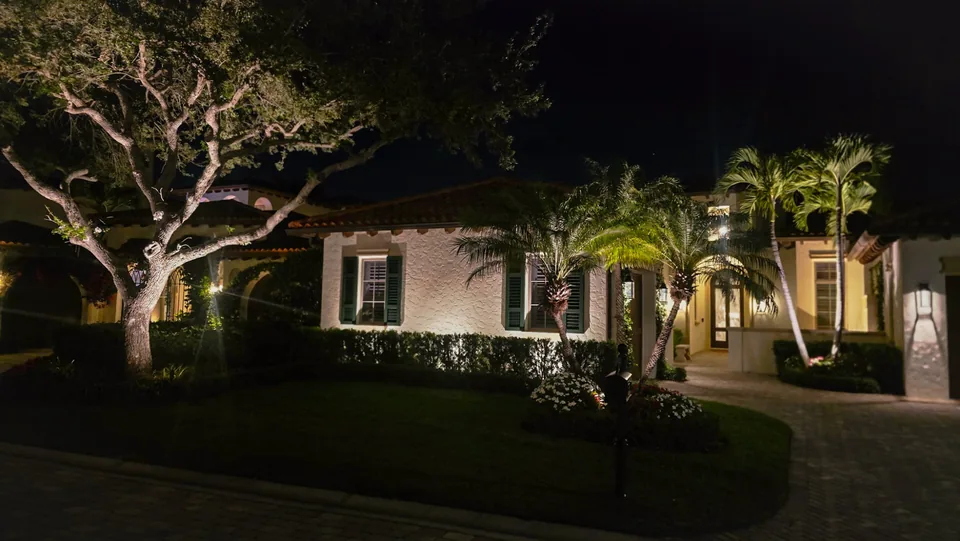
A shuttered elevation washed between the windows, an oak lit in front.
Since 1998
Lighting properties in Naples and Southwest Florida.
Todd and Sherry
Family and locally owned. The owners are the people you deal with.
63 Google reviews
Rated 5.0 on the NightScapes Google Business Profile.
Outdoor lighting only
No side trades, this is the whole business.
In Southwest Florida
What a Naples property does to a facade fixture
A facade fixture in Naples lives in a planting bed a few feet from a wall, under an irrigation head, in salt air. Planting grows in front of it, mulch buries it, spray films its lens, and the finish corrodes near the Gulf. Each of those dims or bends the light, and each is predictable enough to plan for.
A wide elevation washed evenly, with the entry still the brightest part.
Planting grows between the light and the wall
Foundation planting is put in small. A wash fixture set in front of a row of young shrubs
has a clear path to the wall on the day it is installed. Two wet seasons later the shrubs
are waist high and the fixture is lighting the back of a hedge. The wall goes dark in
patches and the hedge glows. The fix is to move the fixture forward of the planting or lift
it above it, and it is the single most common adjustment on an established house.
Irrigation leaves its mark where a graze will find it
Overspray from sprinklers dries on walls and lenses as a mineral film. On a lens it dims
the light and turns it patchy. On a wall it leaves a tide line, and a grazing light is
very good at showing a tide line. Where a wall is to be grazed, the irrigation near it is
worth a look first, and lenses near any head need cleaning as routine.
Mulch, sand and the buried fixture
Beds here are topped up with mulch every year, and an in-ground or low fixture slowly
disappears under it. A half-buried lens runs hot and throws a fraction of its light.
Fixtures are set with that in mind, and digging them out is part of any service visit.
Both jobs are on our maintenance plans page.
Fewer, lower sources read as architecture. One bright flood reads as a parking lot.
Salt air on the finish
Close to the Gulf and the bays, salt settles on everything. Painted and plated fixtures
pit and flake, and the staining can run onto the wall beneath them. Solid brass and
copper darken instead and keep working, which is why material is chosen by where the
fixture will sit.
Questions Naples homeowners ask about architectural lighting
Graze or wash, why the base of a wall is hot and the top is dark, how to get a long wall even, and what color of light suits a Naples house front. These are the questions people bring when they are working out how to light the building itself, with the answers we give on the phone.
NightScapes Landscape LightingOutdoor lighting only, Naples since 1998
Ask us about lighting the house. Choose a question, or call and we will answer it on the phone.
What are the different types of architectural lighting?
On a house, three do most of the work. Grazing puts a fixture tight to a wall so the light skims the surface and shows its texture. Washing sets the fixture back so the wall is lit evenly. Shadowing puts a plant between the light and a plain wall. Columns, arches and steps are lit as objects in their own right, usually from very close.
What is wall grazing, and where should it be used?
Grazing is light that travels along a wall at a steep angle, from a fixture close to its base. Anything that stands proud of the surface throws a shadow, so texture is exaggerated. It belongs on stone, coral stone, brick and textured block. It does not belong on smooth painted stucco, where the same light exaggerates every flaw.
Wall washing or wall grazing: which one should I choose?
The wall chooses. If the surface has texture worth showing, graze it. If it is smooth, wash it. Many houses have both: a stone entry surround that is grazed and stucco wings that are washed. The mistake is using one position for the whole elevation because it is easier to install.
If I move the light further from the wall, is it still a graze?
Less and less. As the fixture moves out, the angle flattens, the shadows in the texture shorten, and the effect drifts toward a wash. There is no hard line. We set it on the property by moving the fixture until the stone looks the way it should from where you stand.
Why is the wall bright at the bottom and dark higher up?
The fixture is too close for the height it is being asked to cover, or its beam is too narrow. Brighter lamps make the base hotter without lifting the top. The answer is more setback, a wider beam, or a second lift of light higher on the building.
How do I get even brightness along a long wall?
With spacing and setback worked out together, and the same lamp in every fixture. Uneven walls usually come from fixtures at different distances, or from lamps of different ages and outputs. A deliberate scallop, where each fixture draws its own cone, is also a legitimate choice. It just has to be regular.
What color of light is right for a house front?
Warm white suits most Naples houses, because it flatters cream stucco, stone and clay tile. Cooler light can suit a modern white or gray elevation. It is chosen against the actual wall, with samples. Our LED page goes into color temperature in more detail.
Tell us what the walls are made of, how tall the elevation is, and what you want people to notice first. We walk it with you and design the options around the real surface.