Behind the sheet
Where water falls clear of the rock in a sheet, there is a pocket of air behind it. A
fixture tucked into that pocket and aimed outward lights the back of the sheet, and the
whole fall becomes a curtain of light with the source completely hidden. It is the most
striking way to light a fall and it needs a fall that is built for it: enough of a ledge
to stand a fixture on, and a sheet that stays intact.
At the splash point
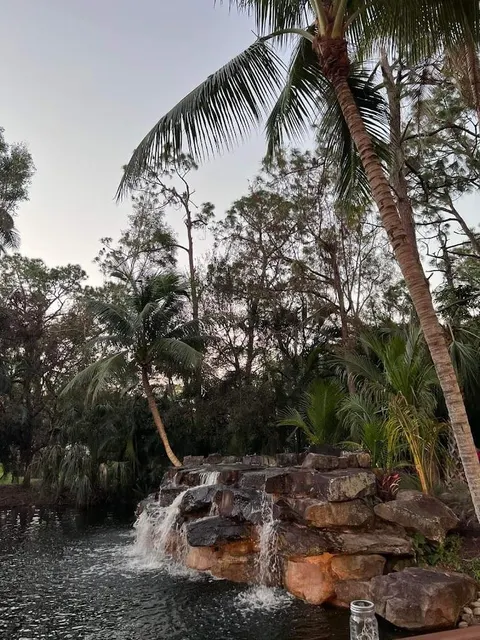
The foot of a fall is all foam and spray. A submerged fixture there, aimed up, lights
the most broken water on the feature, and the light climbs the fall as far as the water
is turbulent. This works on almost any waterfall, including rock falls with no clean
sheet, and it is the usual starting point.
Grazing the stone
A fixture low at the side, aimed along the face of the rock, shows every ledge and
shadow and makes wet stone glisten. It lights the structure more than the water, and it
is the one position that needs nothing in the pond. Used with a light at the splash
point, it gives a fall both its form and its movement.
Light the water where it is broken, and the stone where it is wet.
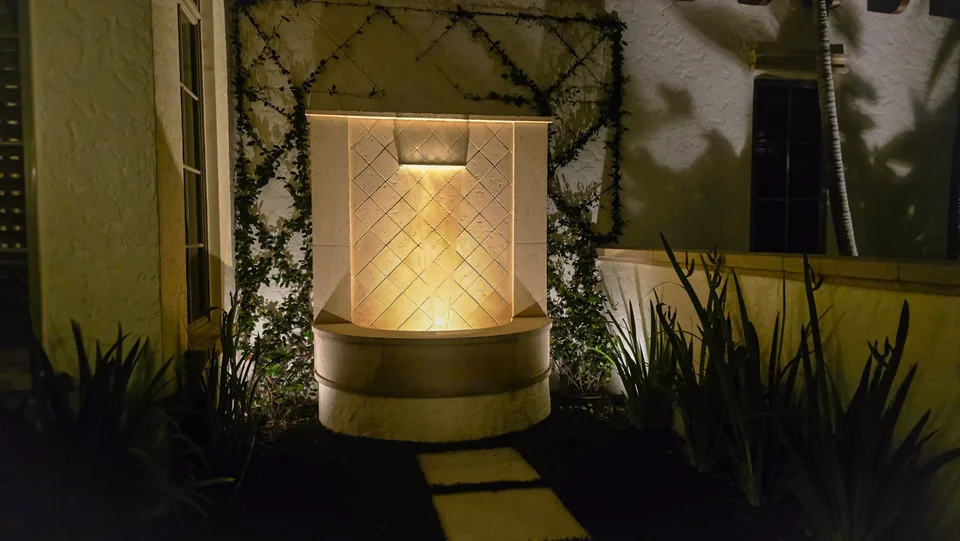
Spillways, sheer falls and raised walls
A spillway bowl or a sheer descent from a raised wall into a pool is a small waterfall
with a pool for a basin. It is lit from under the lip or from the wall behind the sheet,
so the falling water is drawn as a bright line against the tile. The deck and the screen
around it follow different rules, covered under
the pool deck and the screen enclosure around it. The
same thinking applies below a dock, with salt water and tide added:
underwater lights on a canal dock.