Lighting for outdoor kitchens and patios in Naples
The cook needs to see a flame and a knife. The table a few steps away needs almost no light at all. Put both on one switch and one of them is always wrong.
How to see the grill without lighting the table like a garage
If you turn the patio lights up to see the grill and the dinner table ends up as bright as a workshop, everything is on one circuit. The cook needs strong light on one surface. The table needs almost none. They are lit by different fixtures, on separate dimmed zones, so each can be set without the other.
An outdoor kitchen is two rooms with no wall between them. One is a workplace: heat, sharp edges, raw food, a sink. The other is a place to sit for three hours. Indoors those are lit completely differently and nobody thinks twice about it. Outdoors they usually get one row of fixtures and one switch.
So the evening goes one of two ways. Either the lights are bright enough to cook by and everyone at the table is squinting, or they are low enough to dine by and someone is checking the chicken with a phone flashlight.
The fix is not a compromise level. It is two kinds of light. Task light, aimed tightly at the work, that can be bright and then switched off. And ambient light, low and warm, that stays on all evening. Most of this page is about keeping them apart.
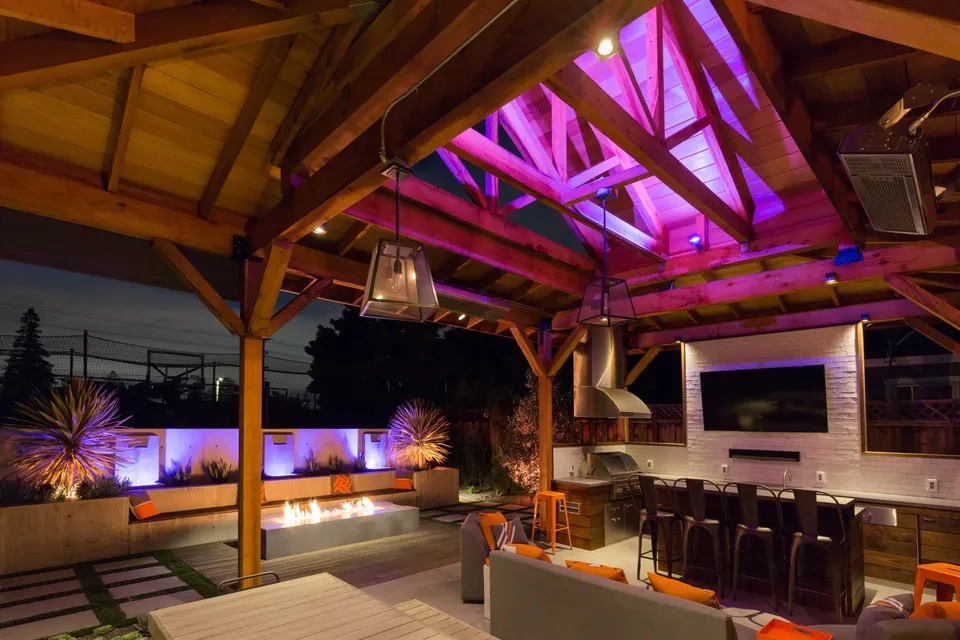
A covered outdoor room: the kitchen on one side, the fire and seating on the other.
Task
The grill, the counter, the sink. Bright, tight, from in front of the cook.
Ambient
The table, the bar, the seating. Low, warm, from the side or above.
The rule
Separate zones, each on a dimmer. Never one switch for both.
Outdoor kitchen task lighting
Task light: the grill, the counter, the sink
Task light comes from above and in front of the cook, so your own body does not shadow the work. It sits on the hood, a shelf or the structure overhead, shielded from the bar side, and it is kept out of the heat and grease of a grill or a pizza oven. Point at a number on this kitchen.
Point at a numberTap a number
Under the counter ledge
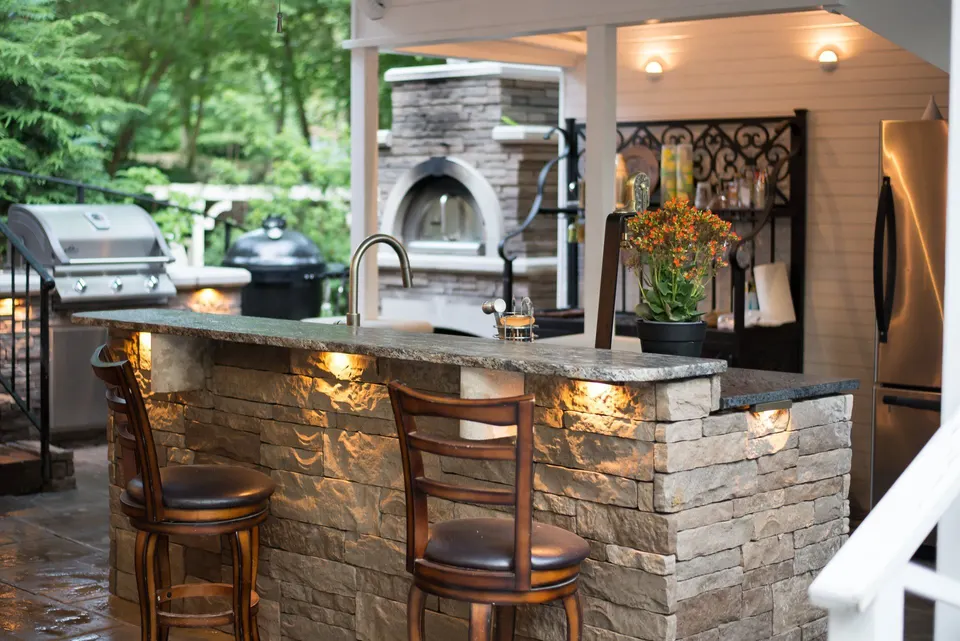
A small light under the overhang of the bar top washes the stone face below it and lights the floor where the stools stand. It is the cleanest fixture in an outdoor kitchen: it is fully hidden, it shows the stonework, and it gives the bar side its own soft level.
Lights
The face of the island and the floor at the stools.
Kind
Ambient. It stays on through dinner at a low level.
The grill
This is the one place that needs real light, and it has to come from above and in front of the cook. Light from behind puts your own shadow across the grate. A shielded source on the hood, a shelf or the structure over the grill solves it.
Lights
The cooking surface, from in front, so the cook does not shadow it.
Kind
Task. Bright while cooking, then off.
The counter and the sink
Prep space needs enough light to use a knife and see what is in the sink. It comes from above the back of the counter, aimed down, so it lands on the work and not in the eyes of anyone on the far side of the bar.
Lights
The worktop and the basin, straight down.
Kind
Task, on the same zone as the grill or one of its own.
Heat, smoke and grease
Anything fixed near a grill, a smoker or a pizza oven lives in heat and grease. Fixtures are kept out of the plume, mounted where they can be wiped, and chosen in metals and lenses that tolerate both. Flexible strip lighting does not belong beside a cooking surface.
Lights
The mouth of the oven and the landing in front of it.
Kind
Task, kept clear of the heat.
Light on the wall behind the kitchen
A lit wall or backsplash behind the cook gives the whole space a background and bounces soft light forward. It is ambient light doing a little task work for free, and it is what stops the kitchen reading as a bright counter in a dark hole.
Lights
The back wall and whatever is on it.
Kind
Ambient. It ties the kitchen to the house.
The side people sit on
The stools face the cook, so anyone sitting there is looking straight at the kitchen lights. Every task fixture is shielded and aimed down with that view in mind. If a guest at the bar can see a lamp, it is in the wrong place.
Lights
Nothing aimed here. It is lit by spill and by the ledge.
Kind
The seat the whole kitchen is checked from.
Patio ambient lighting
Ambient light: the table, the bar, the seating
Ambient light is low, warm and comes from the side or from above through structure. It belongs on the tabletop and softly on faces, never in them. A table, a bar, lounge seating and a fire each want a slightly different level, and all of them want far less than a kitchen does.
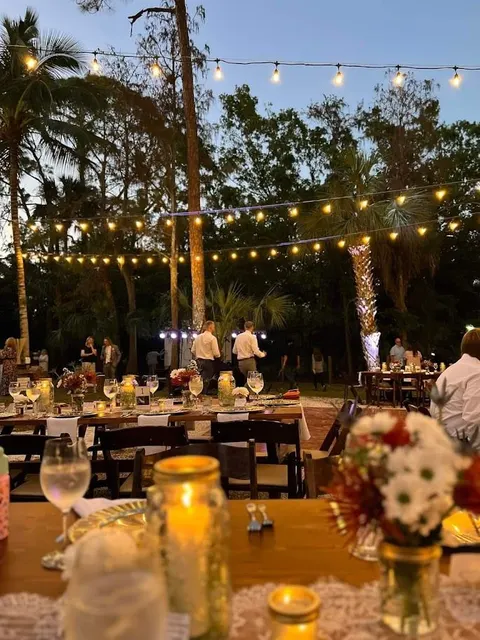
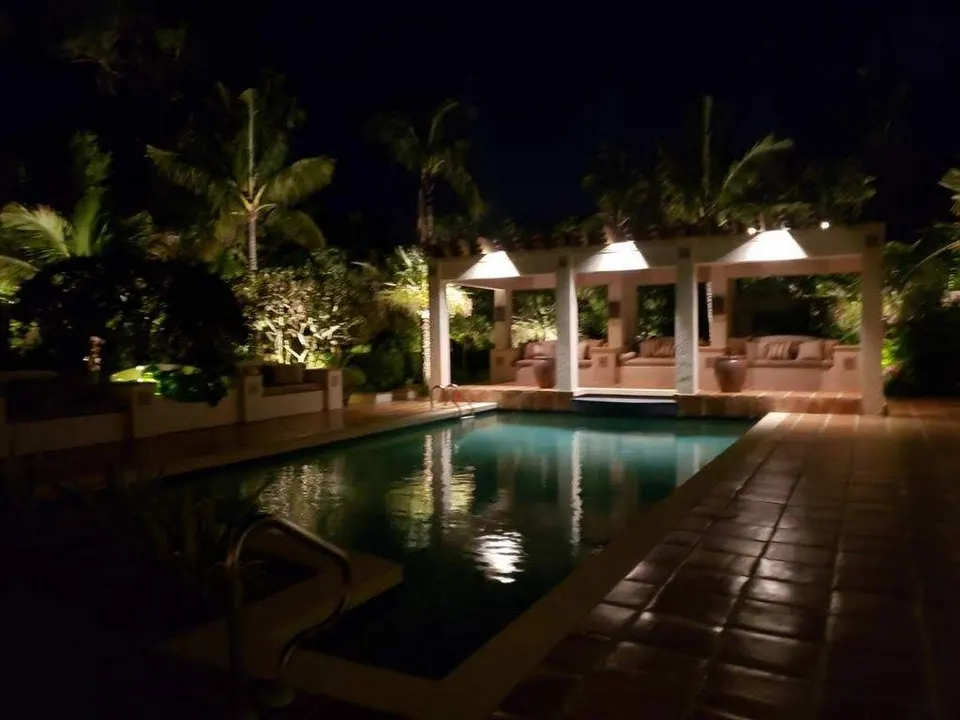
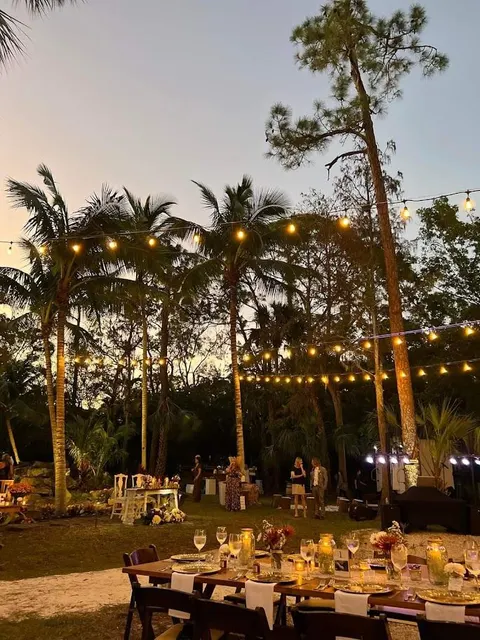
Dinner under string lights: light on the table and faces, and dark beyond.A covered outdoor room with a bar and a fire feature.Seating under a pavilion, lit softly from above.Strings overhead at dusk, before the dinner.
The table
A dining table needs light on the tabletop and a little on the faces around it, and almost none anywhere else. It comes from above, through a pergola or from a tree, or from candles and low sources on the table itself. The level is far lower than a kitchen, and that difference is the whole design.
The bar
A bar sits between the two worlds. The cook side is task, the stool side is ambient, and the top is where they meet. Light under the ledge and a dimmed source overhead lets it read as part of the kitchen while people are being served and part of the seating once they are settled.
The seating and the fire
Lounge seating and a fire feature want the least light of all. The fire is a light source, and anything brighter than it kills it. Low sources built into seat walls and steps light the floor, and the rest is left to the flames and to the lit garden beyond.
String lights, as one layer
Overhead strings give a patio a ceiling and a festive, even glow. They are ambient light only: they will not light a grill and they are the same brightness everywhere. Used on a dimmer, over the table, with task light kept separate, they earn their place. For a party or a season, see string lights for a dinner or a season.
Sight lines
Nobody should see the source from a chair
The seated eye line is low and it does not move, so a lamp that is in view from a chair is in view all evening. Every dining chair, bar stool and lounge seat is sat in and checked. Wherever it can, the structure lights itself: seat walls, counters and steps carry hidden light that lands on the floor. Try it from your own seats.
0 of 6
Lit for sitting in
The sources are where nobody looks. What is left is usually a level: the table and the kitchen on separate zones, each on a dimmer.
Close: a lamp or two to hide
The lines you left unticked point at the fixtures to lower, shield or move, or at a seat wall or counter that could carry its own light.
The patio is lit to be looked at, not sat in
The sources are at eye level. The usual answer is fewer fixtures, mounted higher or hidden in the structure, set from your own chairs. Ask about your kitchen.
It is the least glamorous part of the job and the one guests notice without knowing why. We design it seated, one seat at a time.
Color
Why food and faces need better color than a hedge does
A hedge looks fine under almost any light. Food and skin do not. Under poor light a steak looks gray and a face looks tired. An outdoor kitchen and table are lit in one consistent warm white that renders color well, and where the work surface needs more, it gets more of the same.
Warm light on a table. People and food both look their best in it.
Two things a lamp does to color
The first is its tint: warmer or cooler white. The second is how faithfully it shows the
colors of what it lights, which is a separate quality and varies a great deal between
lamps of the same tint. A lamp can be pleasantly warm and still make red meat look
brown. For a garden that hardly matters. For a kitchen and a table it is the difference
between food that looks appetizing and food that does not.
One white, everywhere
The common mistake is a cool, bright lamp over the grill "for task" and warm lamps
everywhere else. The eye sees the mismatch instantly, and the cooking area looks like a
different building. The work surface does need more light. It gets it from more warm
light, aimed tighter, not from a different color.
More light at the grill, not different light.
What we specify, and where it is written down
We do not quote a number on this page, because the right lamp depends on the fixture and
on the stone, timber and finishes it is lighting. The specification itself, and what the
terms mean, is on our LED page: color temperature and color rendering
explained.
Zones and dimming
Separate zones and a dimmer on everything but the cooktop
One space is used four ways in an evening: cooking, serving, dining and sitting on afterward. Each wants its own balance of task and ambient light, which is only possible when the two are on separate zones and every ambient zone has a dimmer. The cooking light is simply on or off. Step through the evening below.
Drawing: a covered outdoor kitchen, a table and a lounge, not to scale. The levels are the ones described for each scene.
One switch. Bright enough to cook by, so everyone at the table is squinting and the patio is lit like a garage. Turn it down for dinner and someone is checking the chicken with a phone flashlight.
What there is to mount to
Under a roof, a pergola or open sky
The structure overhead decides where light can come from. A solid roof takes small downlights in its rafters. A pergola hides fixtures on top of its beams. An open patio has nothing above it, so light comes from a nearby tree, from the walls and from the furniture level. Under cover, fixtures are never rinsed by rain.
A pavilion roof gives a place to mount light and a place to hide it.
A solid roof or pavilion
Rafters and a ridge give plenty of places to put a small downlight and aim it at a
counter or a table. The risk is overdoing it: a ceiling full of fixtures at full output
turns an outdoor room into a showroom. A few, well aimed, on dimmers, with the rest of
the light coming from the walls and the garden, keeps it feeling like outdoors.
A pergola
Open beams are ideal. A fixture mounted on the top face of a beam cannot be seen from
below, and the light that comes down between the rafters has their shadow in it. It is
also the natural place to hang strings, if those are wanted, with a support line so the
cable carries no weight.
Open sky
With nothing overhead, the light has to come from somewhere else. A tree that overhangs
the patio is the best answer: soft downlight from a
tree over the table. Failing that, a wall beside the patio, low sources in seat
walls and planters, and task light built into the kitchen island itself.
Salt, humidity and the cage
A fixture under a roof in Naples sits in salt air and humidity and is never washed by
rain, so film builds up on it faster than on one in the open. It needs wiping. Many
outdoor kitchens here are inside the pool cage, which adds one more problem, the mesh
acting as a mirror: see reflections off the lanai
screen.
Who does the work
Who lights the kitchen and the patio: NightScapes Landscape Lighting, Naples
NightScapes Landscape Lighting has lit outdoor kitchens, patios and pavilions in Naples since 1998. Todd and Sherry own and run it, outdoor low-voltage lighting is the only work it does, and its Google Business Profile shows 63 reviews at 5.0. A kitchen is designed from the grill and from every seat.
We light outdoor kitchens, patios and pavilions across Naples, Marco Island and Bonita
Springs, and through Lee and Collier counties. Under a roof, a pergola or a tree, the
work is the same: task light where the cooking is, low light where people sit.
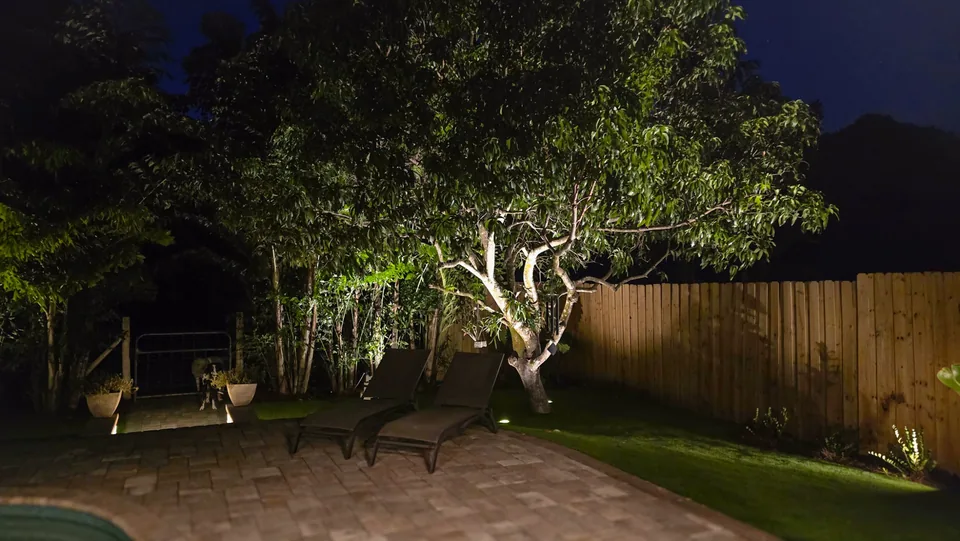
A NightScapes patio: the tree overhead lit, the loungers left in its glow.
Since 1998
Lighting properties in Naples and Southwest Florida.
Todd and Sherry
Family and locally owned. The owners are the people you deal with.
63 Google reviews
Rated 5.0 on the NightScapes Google Business Profile.
Outdoor lighting only
No side trades, this is the whole business.
Questions we hear
Questions about outdoor kitchen and patio lighting
How to light a grilling area, what kind of fixtures work, what color of light suits entertaining, how many lights a kitchen needs, whether strip lights are safe near a grill, whether string lights can stay up all year and what suits a patio. These are the questions people ask, with the answers we give.
NightScapes Landscape LightingOutdoor lighting only, Naples since 1998
Ask us about your outdoor kitchen or patio. Choose a question, or call and we will answer it on the phone.
How do you light an outdoor kitchen or grilling area?
In two parts that are switched separately. Task light at the grill, the counter and the sink, from above and in front of the cook, bright enough to work by. Ambient light everywhere people sit, low and warm. The two go on their own zones, because the level that suits a grill would ruin a dinner table.
What kind of lights work best for an outdoor kitchen?
Small, shielded, low-voltage fixtures built for outdoor use: downlights on the structure over the cooking area, lights under the counter ledge, and low sources in seat walls and steps. They need to tolerate heat and grease near the grill and salt air everywhere. Decorative fixtures and strings add atmosphere and do not replace any of those.
What is the best color temperature for outdoor entertaining?
One consistent warm white across the whole space. Warm light flatters food and faces and matches the rest of the landscape. Where more light is needed at the work surface, the answer is more of the same warm light there, not a cooler lamp. Mixed whites in one space always look like a mistake. Our LED page covers the specification.
How many lights does an outdoor kitchen area need?
It cannot be worked out from the floor area, and indoor kitchen rules do not apply outdoors. It depends on what there is to mount to, how big the cooking area is and where people sit. We count them from every seat, not from the floor plan.
Are LED strip or rope lights safe near a grill?
Flexible strip and rope lighting should be kept away from a cooking surface. Heat and grease are hard on it, and most of it is not made for that. Near a grill we use fixtures that are built to be wiped down and that sit out of the heat, and we keep strip to places such as under a ledge well clear of the burners.
Can outdoor string lights stay up all year?
Some are made to, and many are not. A permanent set needs commercial-grade cable and sockets, a proper support line so it does not hang by its own wire, and a dimmer. Even then, sun, salt and storm season take a toll. We can tell you which it is worth leaving up and which should come down for the summer.
What type of lighting is best for a patio?
Low, warm and indirect. A patio is lit by its edges and by what is around it: planting, a wall, a tree overhead, steps. A small amount of light on the floor and plenty on the garden beyond makes the space feel larger. One bright fixture on the house wall does the opposite.
Tell us what is in the space: the grill, the bar, the table, and whether there is a roof over any of it. We walk it with you and design it from the grill and from your own chair.