
Sea Turtle Lighting Rules From Naples to Sanibel, Compared Code by Code
Sea turtle lighting rules from Naples to Sanibel share one season, May 1 to October 31, and one aim: keep artificial light off the beach. The six codes in Collier and Lee County split on the details. Collier County and Naples give existing beach-visible lights a 9:00 p.m. cutoff unless they're hooded, Lee County's rules run 9:00 p.m. to 7:00 a.m., and Sanibel's code says, citywide, "Uplighting is prohibited" [1][2][3][4].
Published Last updated
Free Consultations and Estimates
The state doesn't write one rule for every beach. Florida's Rule 62B-55 adopts a Model Lighting Ordinance that "provides guidelines for local government regulations that control artificial lighting to protect sea turtles" [5]. The rule your property answers to is your city's or county's. We opened all six local codes on Municode on October 23, 2026 and tabled them side by side, stating each disagreement as a disagreement. This is a plain reading of the codes, not legal advice.
Cost driver checker
Which sea turtle lighting rules apply at my address?
Shows what that code says, as read on Municode on October 23, 2026. Not legal advice.
Nothing picked yet.
Unincorporated Collier County
- Code
- Land Development Code 3.04.02 B[1]
- Season
- May 1 to October 31[1]
- Who it reaches
- Lighting within 300 feet of coastal mean high water; existing lights visible from the beach[1]
- Nightly rule
- Existing beach-visible lights off after 9:00 p.m., or hooded or positioned so they can't be seen from the beach[1]
- Wavelength
- The code names none[1]
- Landscape and uplights
- Floodlights and landscape or accent lighting prohibited where the section applies[1]
- Who checks
- Parks and Recreation inspects semimonthly; a visible shadow on the beach is a violation[8]
City of Naples
- Code
- Sec. 52-61, Marine turtle protection regulations[2]
- Season
- May 1 to October 31 in the code; the city's web page says it can begin as early as April 15[2][9]
- Who it reaches
- New lighting within 300 feet of mean high water or visible from the beach; existing lights visible from the beach[2]
- Nightly rule
- Existing beach-visible lights off 9:00 p.m. to sunrise, or hooded or positioned out of view[2]
- Landscape and uplights
- Floodlights and landscape or accent lighting prohibited for new development[2]
- Who checks
- Sec. 52-61 names no inspection schedule; check with the city[2]
Marco Island
- Code
- Chapter 54, Article V, Sea Turtle Protection[6]
- Season
- May 1 to October 31; the city manager may extend it up to 30 days[6]
- Who it reaches
- Beachfront lots from Cape Marco to Hideaway Beach; all light visible from the beach[6]
- Nightly rule
- Existing exterior lights off after 9:00 p.m., except turtle-friendly long wavelength, low, shielded light; nighttime is 9:00 p.m. to 6:00 a.m.[6]
- Wavelength
- 560 nanometers or greater with none below 560; no filters, gels or lenses[6]
- Landscape and uplights
- Landscape lights and up lights may not be visible from any portion of the beach; path lights 42 inches or lower[6]
- Who checks
- Code enforcement inspections every two weeks in season[6]
Sanibel
- Code
- Chapter 126, Article XIV, Division 4, Outdoor Lighting[4]
- Season
- May 1 to October 31[4]
- Who it reaches
- Every new or replacement light in the city; turtle rules for fixtures in direct line of sight of the beach[4]
- Nightly rule
- No clock time; fixtures must not light the beach at any hour[4]
- Wavelength
- Greater than 560 nanometers[4]
- Landscape and uplights
- Uplighting prohibited citywide, and existing uplighting prohibited since January 1, 2018; landscape and path lights 3 feet or less exempt if they don't project light skyward[4]
- Who checks
- Optional city certificate of luminaire compliance; development permit to add or replace lights in the beach zones[4]
Unincorporated Lee County
- Code
- Land Development Code Chapter 14, Article II, Division 2[3]
- Season
- May 1 to October 31, from 9:00 p.m. until 7:00 a.m.[3]
- Who it reaches
- Gulf of Mexico beaches in unincorporated Lee County[3]
- Nightly rule
- The rules apply 9:00 p.m. to 7:00 a.m. in season; nesting habitat must not be lit[3]
- Wavelength
- No nanometer figure; names 25-watt yellow bug type bulbs for new fixtures visible from the beach[3]
- Landscape and uplights
- No artificial lighting, uplighting included, seaward of the 1978 CCCL for new development[3]
- Who checks
- A shadow cast on nesting habitat creates a rebuttable presumption of a violation[3]
Bonita Springs
- Code
- Chapter 7, Article II, Division 2, Sea Turtle Conservation[7]
- Season
- May 1 to October 31; the city may extend it each year[7]
- Who it reaches
- Barrier island properties whose light is visible from the beach, beachfront or not[7]
- Nightly rule
- Nighttime is sunset to sunrise[7]
- Wavelength
- 560 nanometers or greater with none below 560[7]
- Landscape and uplights
- Outdoor lighting long wavelength, downward directed and fully shielded; non-egress lights allowed landward of buildings if not visible from the beach[7]
- Who checks
- Notice at least 30 days before the season; after-dark inspection before a certificate of occupancy[7]
Each code as published on Municode, read October 23, 2026. Codes change; confirm with your city or county before you install. Not legal advice.
Key takeaways
- All six codes set nesting season at May 1 to October 31, and Marco Island and Bonita Springs let the city extend it [6][7].
- The nightly rule differs: after 9:00 p.m. in Collier County, 9:00 p.m. to sunrise in Naples, 9:00 p.m. to 6:00 a.m. on Marco Island, 9:00 p.m. to 7:00 a.m. in unincorporated Lee County, sunset to sunrise in Bonita Springs, and no hour in Sanibel's lighting division [1][2][3][4][6][7].
- Marco Island and Bonita Springs define long wavelength as 560 nanometers or greater with nothing below 560, Sanibel says "greater than 560 nanometers," and Collier County's and Naples' codes name no wavelength [4][6][7].
- Sanibel prohibits uplighting citywide, not just near the beach; Collier County and Naples prohibit landscape and accent lighting where their beach sections apply [1][2][4].
- This guide tables all six codes, with section numbers and read dates, so you can find your row and list what must change before May 1.
01Six codes
The six codes at a glance
Six local codes govern sea turtle lighting between Naples and Sanibel: Collier County Land Development Code 3.04.02 B, City of Naples Sec. 52-61, Marco Island Chapter 54 Article V, Sanibel Chapter 126 Division 4, Lee County Land Development Code Chapter 14 Division 2, and Bonita Springs Chapter 7 Division 2. All six use May 1 to October 31. They differ on reach, hours, wavelength and uplighting.
| Code (read October 23, 2026) | Season | Who it reaches | Nightly rule | Wavelength | Landscape and uplights | Inspections |
|---|---|---|---|---|---|---|
| Collier County (unincorporated), LDC 3.04.02 B [1] | May 1 to Oct. 31 | Lighting within 300 feet of mean high water; existing lights visible from the beach | Existing: off after 9:00 p.m., or hooded or positioned out of view | None stated | Landscape or accent lighting prohibited where the section applies | Semimonthly by Parks and Recreation; a visible shadow on the beach is a violation [8] |
| City of Naples, Sec. 52-61 [2] | May 1 to Oct. 31 (city web page: can begin as early as April 15) [9] | New lighting within 300 feet of mean high water or visible from the beach; existing lights visible from the beach | Existing: off 9:00 p.m. to sunrise, or hooded or positioned out of view | None in the code | Landscape or accent lighting prohibited for new development | None named |
| Marco Island, Ch. 54, Art. V [6] | May 1 to Oct. 31, extendable up to 30 days | Beachfront lots from Cape Marco to Hideaway Beach | Existing: off after 9:00 p.m., except turtle-friendly low, shielded light; nighttime is 9:00 p.m. to 6:00 a.m. | 560 nm or greater, none below 560 | Landscape lights and up lights may not be visible from the beach | Every two weeks by code enforcement |
| Sanibel, Ch. 126, Div. 4 [4] | May 1 to Oct. 31 | All new or replacement lights citywide; turtle rules in line of sight of the beach | No clock time | Greater than 560 nm | Uplighting prohibited citywide; landscape lights 3 feet or less exempt if not aimed skyward | Optional city compliance certificate |
| Unincorporated Lee County, LDC Ch. 14, Div. 2 [3] | May 1 to Oct. 31 | Gulf beaches in unincorporated Lee County | Rules apply 9:00 p.m. to 7:00 a.m. | None in nm; names 25-watt yellow bug bulbs | No lighting, uplighting included, seaward of the 1978 CCCL (new development) | A shadow on nesting habitat presumes a violation |
| Bonita Springs, Ch. 7, Div. 2 [7] | May 1 to Oct. 31, extendable | Barrier island properties visible from the beach, beachfront or not | Sunset to sunrise | 560 nm or greater, none below 560 | Outdoor lighting downward and fully shielded; non-egress lights allowed landward of buildings if not visible from the beach | Notice 30 days before season; after-dark check before a certificate of occupancy |
This comparison reflects each code as published on Municode when we read it on October 23, 2026. Codes change; confirm with your city or county before you install.
The row that applies follows the city or county line your lot sits in, and that isn't always the town on your mailing address. NightScapes' turtle lighting page puts the working rule plainly: "We read the section that applies before designing."
Two details in the table are easy to miss. Collier County's and Naples' codes never mention a lamp wavelength; their only nanometer figure is the 400 to 700 nanometer range used to measure window tint [1][2]. And Sanibel's uplighting ban sits in the city's general lighting standards, so it reaches lots nowhere near the Gulf [4].
02Who the codes reach
Who the codes reach: 300 feet and line of sight
Collier County's and the City of Naples' sea turtle lighting rules reach new lighting within 300 feet of mean high water, and any existing light that can be seen from the beach. Marco Island's district covers beachfront lots from Cape Marco to Hideaway Beach. Bonita Springs reaches every barrier island property whose light can be seen from the beach, whether it's beachfront or not.
Collier County's section applies "when development or lighting associated with development is located within 300 feet of coastal mean high water," and also when lit reflective surfaces will be visible from the beach [1]. The City of Naples uses the same 300 feet for new development, or any light or lit surface "that will be visible from the beach" [2]. For existing homes, both codes turn on visibility alone.
Marco Island draws the line by place. Its district is "all beachfront properties from Cape Marco to Hideaway Beach," and inside it the article "applies to all light visible from the beach" [6]. Bonita Springs reaches further back. Sec. 7-42 covers barrier island properties whose light is visible from the beach, "regardless of whether those properties are beachfront properties" [7]. The Bonita Springs guide shows what that means for homes that aren't on the sand.
Sanibel splits its reach in two: general standards for every new or replacement light in the city, and turtle sections for fixtures "within direct line of sight of the beach" [4]. Lee County's division covers the Gulf beaches of the unincorporated county [3].
"Visible" includes a lit wall, a lit window and a glowing pool, not just the fixture. As NightScapes' page on designing a beachfront property for nesting season puts it, "The only reliable way to know what the beach sees is to stand on it."
Not sure which row applies to your property? NightScapes has worked on coastal and beachfront properties in Naples since 2006 (Todd since 1998). Request a free estimate or call (239) 649-6940.
03Nightly cutoff
Nightly cutoff: 9 p.m. to sunrise, 6 a.m. or 7 a.m.
There's no single sea turtle lighting curfew in Southwest Florida. Collier County says existing beach-visible lights go off after 9:00 p.m., the City of Naples says 9:00 p.m. to sunrise, Marco Island defines nighttime as 9:00 p.m. to 6:00 a.m., Lee County uses 9:00 p.m. to 7:00 a.m., Bonita Springs uses sunset to sunrise, and Sanibel's lighting division names no hour.
In Collier County and the City of Naples the hour is one of two choices. Collier's LDC 3.04.02 B.3.a says existing lights "shall be turned off after 9:00 p.m. between May 1 and October 31 of each year, or fitted with a hood or positioned" so they can't be seen from the beach [1]. Naples' Sec. 52-61(c)(1) reads the same way, but the window runs "between 9:00 p.m. and sunrise" [2]. Collier's text gives no end time.
Marco Island's Sec. 54-144 tells existing exterior lights in the district to go off after 9:00 p.m., but it exempts "turtle friendly long wavelength bulbs, low, and shielded light" [6]. Lee County builds the hours into its definition of the season: "from 9:00 p.m. until 7:00 a.m. during the period of May 1 through October 31" [3].
Bonita Springs ties its rule to the sun. Its code defines nighttime as "the locally effective time period between sunset and sunrise during nesting season" [7]. At Naples' coordinates, the U.S. Naval Observatory has the sun setting at 7:59 p.m. on May 1, 2026 and 8:22 p.m. on June 21, 2026 [10]. So a sunset rule starts 38 to 61 minutes before a 9:00 p.m. rule.
Sanibel's Division 4 has no clock time at all. It regulates which fixtures may be used and whether they light the beach, at any hour [4].
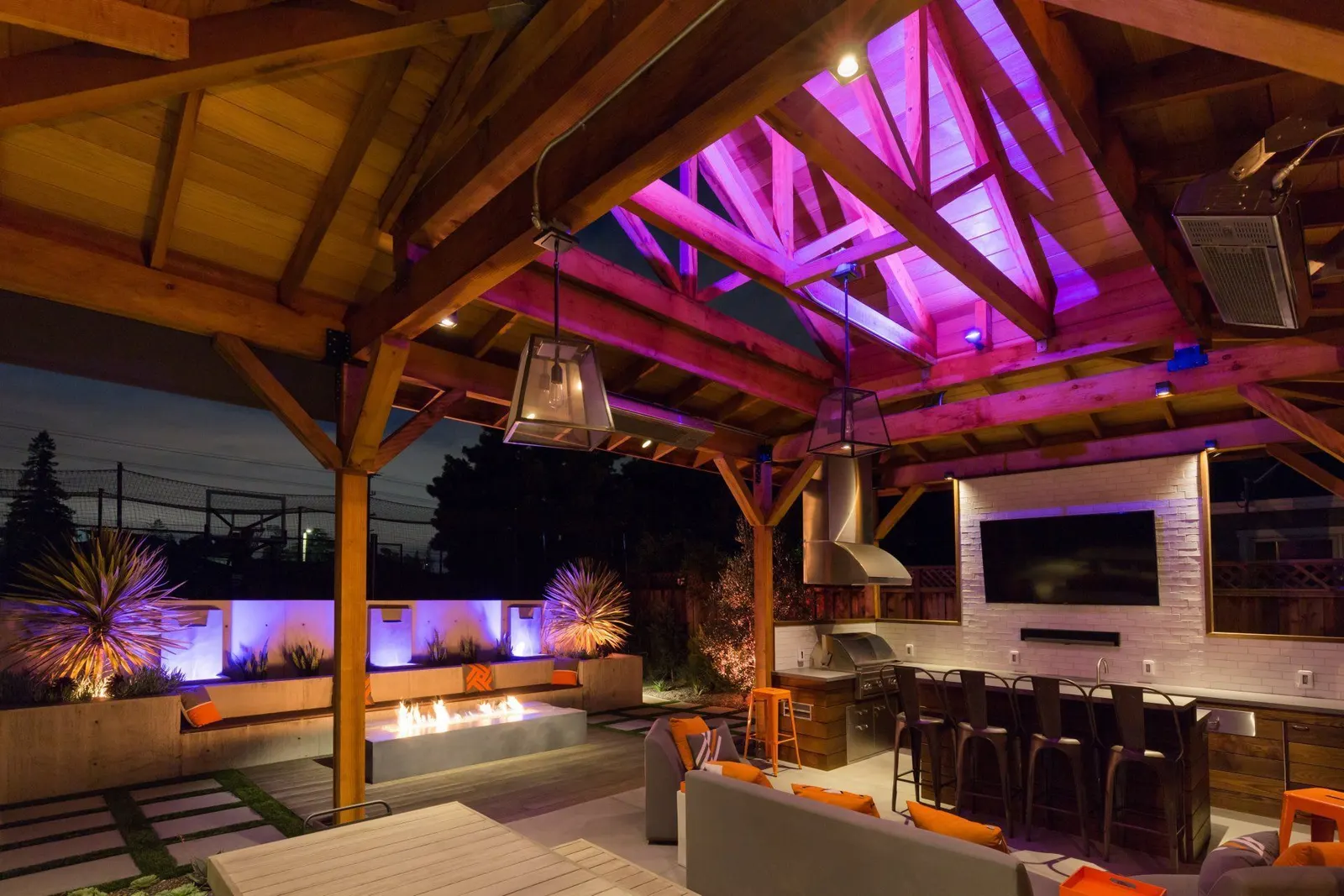
A timer set to "9 p.m."? Right in some rows, wrong in others. NightScapes puts the beach-visible fixtures on their own zone, "so for the season they can be switched off, dimmed or put on a schedule while the street side of the property stays exactly as it is." The page on zoning, dimming and color options shows how a zone can follow your code's hour.
04Wavelength
Wavelength: what 560 nanometers means
Long wavelength light, as Marco Island's and Bonita Springs' codes define it, means light at "560 nanometers or greater and absent wavelengths below 560 nanometers." In practice that's amber, orange or red. FWC's certification criteria say "greater than 560 nm," and Sanibel's code uses the same "greater than" wording. Collier County's and Naples' codes state no wavelength.
A nanometer is a billionth of a meter; here it describes the color of a lamp's light. FWC's Sea Turtle Lighting page asks for lamps that "produce only long wavelength light (560 nm or greater, which is amber, orange, or red)" [11]. FWC's Wildlife Lighting criteria say "greater than 560 nm AND absent wavelengths below 560 nm" [12]. The City of Naples' web page says "> 560 nm" [9].
That disagreement only matters at exactly 560. A lamp whose light all sits above 560 meets every version. None of the six codes requires 590 or 620. Where you see a figure like that, it's a product color, not a code threshold.
The second half of the definition, nothing below 560, matters more. FWC's guidelines say "PC amber bulbs are not true long wavelength light sources, since there are wavelength readings below 560 nm" [13]. FWC's criteria add that "PC Ambers, RGBs, dual lighting boards, and color change options are not acceptable" [12]. Marco Island's code says lamps that reach long wavelength "using filters, gels, or lenses are not permitted" [6]. An amber setting on a color-changing fixture isn't the same thing.
Lee County's division dates from 1998, was last amended in 2005, and uses no nanometer figure. For new fixtures visible from the beach it names "25-watt yellow bug type bulbs" [3].
Ask for proof, not a label. FWC says you can request a "spectral distribution graph" from the manufacturer [13]. And amber isn't invisible to turtles. FWC calls that idea a "common misconception" and answers it: "This is FALSE" [13].
05Uplighting
Uplighting, landscape and accent lights
Sanibel is the strictest on uplighting. Its code says "Uplighting is prohibited" for new and replacement lights citywide, and existing uplighting has been prohibited there since January 1, 2018. Collier County and the City of Naples prohibit landscape and accent lighting where their beach sections apply. Marco Island says landscape lights and up lights may not be visible from the beach, and Bonita Springs requires outdoor lighting to be downward directed and fully shielded.
Sanibel's Sec. 126-997(c)(10) prohibits uplighting, and Sec. 126-997(e)(3) says existing uplighting "shall be strictly prohibited as of January 1, 2018" [4]. One exemption matters for gardens: "Landscaping and pathway lighting, three feet or less in height," as long as it doesn't project light skyward. In the Bay Beach, Gulf Beach and Gulf Beach Ridge zones that lighting must also meet the turtle standards, and adding or replacing outdoor lights there needs a development permit [4].
In Collier County and the City of Naples, where the beach section applies, the rule is one sentence: "Floodlights and landscape or accent lighting shall be prohibited" [1][2].
Marco Island lists "landscape lights, and up lights" as nonegress lighting and says "All nonegress outdoor lighting shall not be directly or indirectly visible from any portion of the beach" [6]. Its path lights may not exceed 42 inches. Bonita Springs caps bollards at 42 inches and requires all outdoor-area lighting to be long wavelength, downward directed, full cutoff and fully shielded. Its one exception is non-egress lighting landward of buildings, if it's long wavelength and "not directly, indirectly, or cumulatively visible from any portion of the beach" [7]. The Marco Island guide covers that city's district in more detail.
Lee County bars artificial lighting, "including, but not limited to, uplighting," seaward of the 1978 coastal construction control line for new development. Its guidelines say floodlights, up-lights and decorative lighting visible from nesting habitat "should not be used during the nesting season" [3].
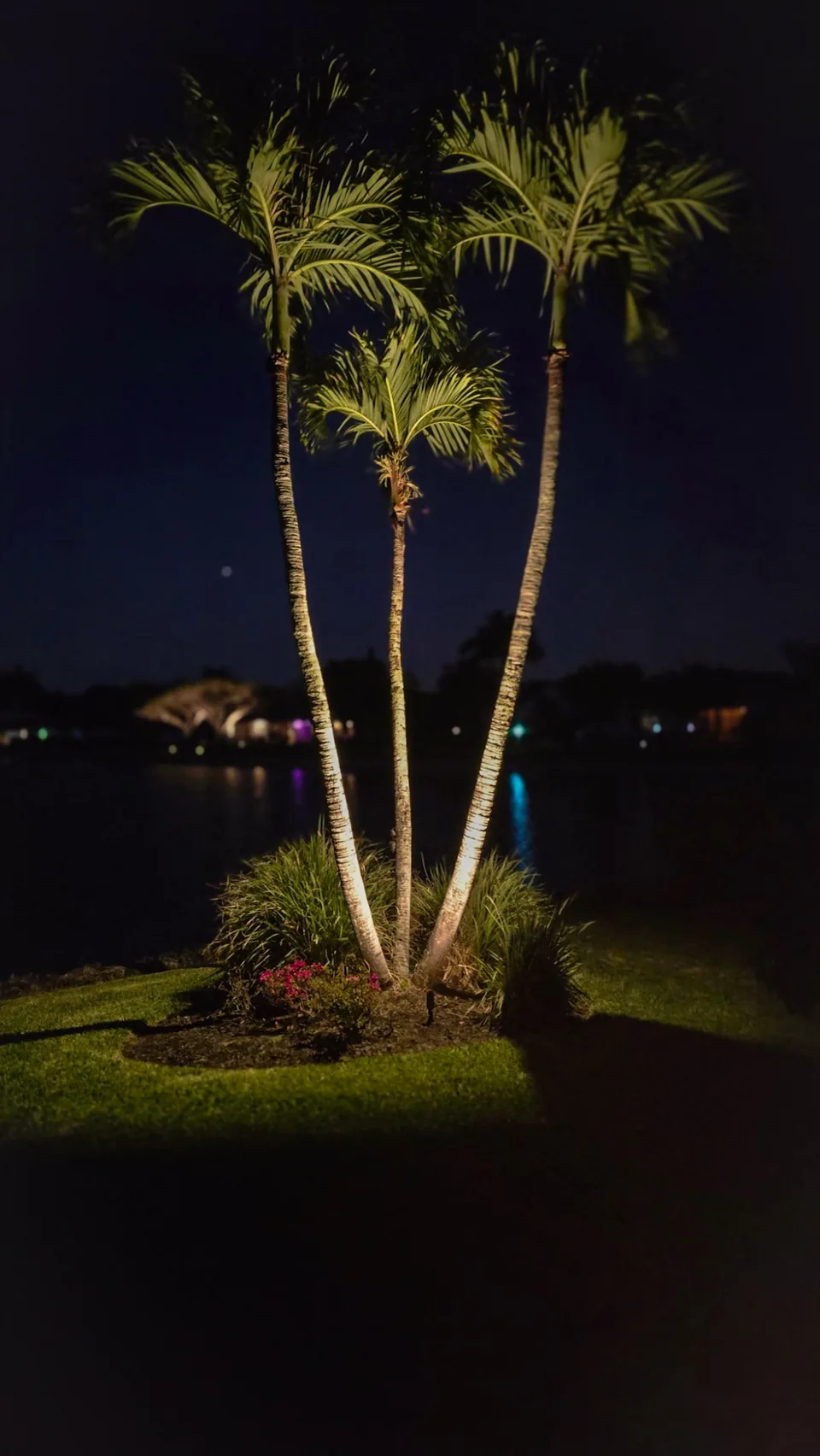
FWC is blunt: "Decorative lights, such as uplights, string lights, or lights in trees, serve no purpose for human safety," and should stay off until the season ends October 31 [11]. For other night animals on the same coast, see wildlife-friendly lighting.
06Pools and interiors
Pools, ponds and interior light seen from the beach
Sea turtle lighting rules don't stop at landscape fixtures. Marco Island and Bonita Springs require underwater pool lights to be mounted in the wall and not visible from the beach, and Lee County requires a colored or partially opaque lens over new pool and spa lights. All six codes also deal with interior light, through tinted glass or window measures.
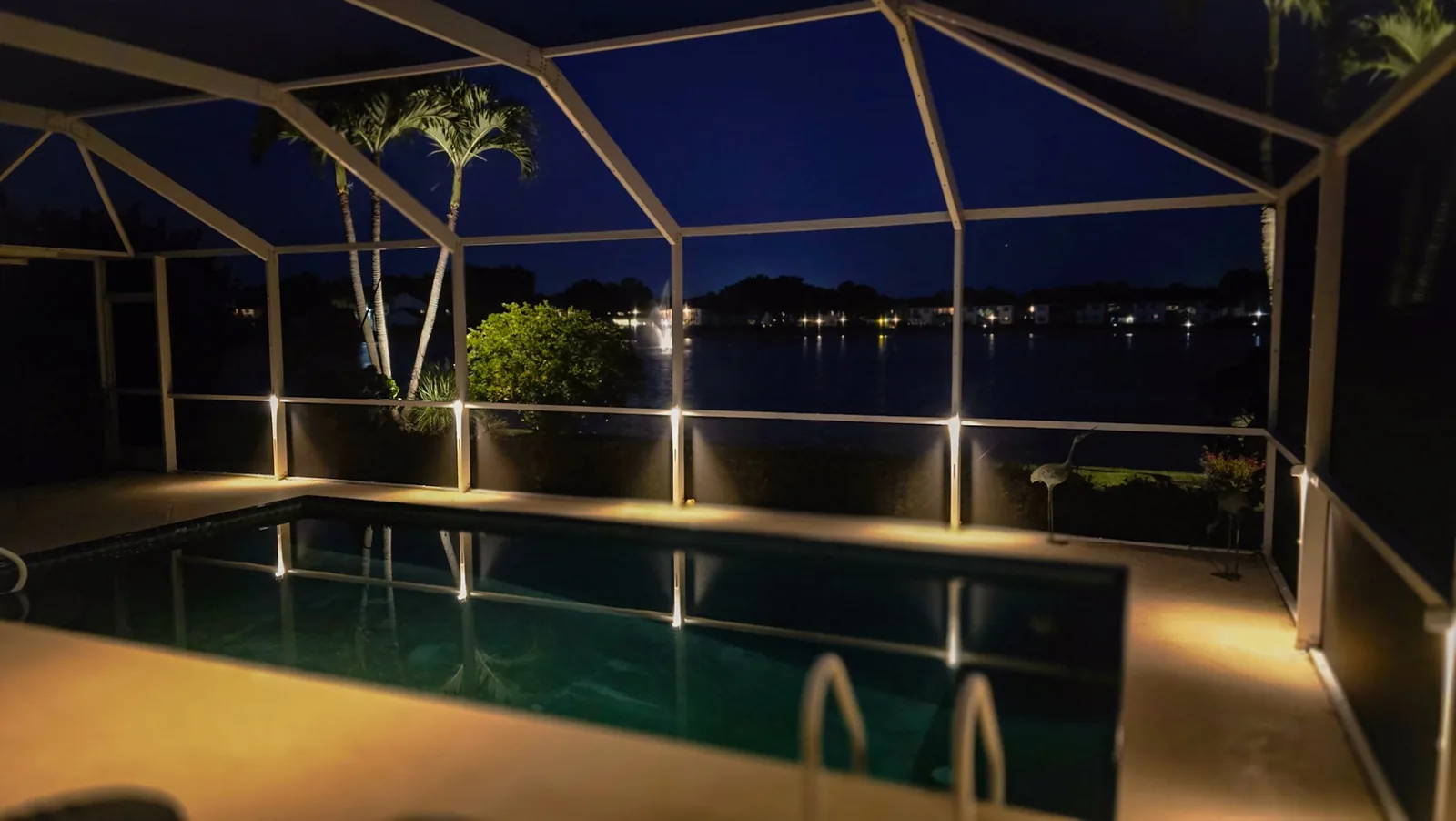
Marco Island's Sec. 54-149(3) says underwater pool or spa lighting must be mounted in the wall and "Not produce light that is directly or indirectly visible from any portion of the beach" [6]. Bonita Springs' Sec. 7-48 says the same, and adds that pool lighting "shall be long wavelength and fully shielded" [7]. Lee County's Sec. 14-76 requires "A colored or partially opaque lens" over pool and spa lights in new development [3].
In Sanibel's three beach zones, a pool light visible from the beach must meet the turtle rules [4]. FWC notes that pool lights "can be locked on an amber or red color during the marine turtle nesting season" [11]. Marco Island and Bonita Springs also say ponds and fountains on the seaward and shore-perpendicular sides of a building may not produce light visible from the beach [6][7].
Windows are in every code. All six use tinted glass with an inside-to-outside light transmittance of 45 percent or less, or measures such as shades, moving lamps away from windows and turning off unneeded lights [1][2][3][4][6][7].
NightScapes' turtle lighting page says it directly: "Landscape fixtures are often not the main problem." On many beachfront homes, what the beach sees is the pool and lanai or the living room.
07Who checks
Who checks, and what counts as a violation
Collier County Parks and Recreation inspects sea turtle lighting "semimonthly throughout sea turtle nesting and hatching season," and says "Light sources that create a visible shadow on the beach are considered a violation." Marco Island's code sets code enforcement inspections every two weeks in season. Lee County treats a shadow cast on nesting habitat as a rebuttable presumption of a violation.
If a light throws your shadow on the sand, the beach can see it. Collier County Parks uses that test [8], and Lee County's Sec. 14-73 writes it into the code: a presumption of violation exists when "A shadow is created or cast by artificial lighting" on an object in nesting habitat during the season [3].
Marco Island's Sec. 54-155(3) says "Every two weeks, lighting compliance inspections shall be conducted by a code enforcement official during sea turtle nesting season" [6]. Bonita Springs sends notice of its rules at least 30 days before each season, and inspects new construction after dark before a certificate of occupancy [7]. Sanibel offers an optional certificate of luminaire compliance [4]. Naples' Sec. 52-61 names no inspection schedule, so check with the city.
Marco Island, Lee County and Bonita Springs send penalties to their general enforcement chapters [3][6][7]. Ask your city or county what applies.
How to check your property before May 1:
- Find your row in the table: your city or county, and its section number.
- After dark, stand on the beach and look back at the house. List every fixture you can see and every lit surface.
- Mark each one against your row: off by the code's hour, shielded or repositioned, or replaced with a long wavelength source.
- Check the pool, the lanai and the windows, not just the landscape lights.
- Put beach-visible fixtures on their own zone or timer, set to your code's hours.
- In Sanibel's beach zones, ask about the development permit before you add or replace a light.
- Walk the beach again after the changes. If anything still casts a shadow, it isn't done.
08
Questions we hear
Frequently Asked Questions About Sea Turtle Lighting Rules in Collier and Lee County
 NightScapes Landscape Lighting Outdoor lighting only, Naples since 2006
Choose a question
What wavelength is turtle friendly lighting?
Turtle friendly lighting uses long wavelength light, which Marco Island's and Bonita Springs' codes define as "560 nanometers or greater and absent wavelengths below 560 nanometers". FWC's certification criteria and Sanibel's code say "greater than 560" instead. FWC says phosphor-converted amber bulbs don't qualify because they have readings below 560 nm, and its criteria don't accept color-changing fixtures either. Ask the manufacturer for the spectral distribution graph.
Do I need turtle-friendly lighting at my beach house?
If any of your lights can be seen from the beach between May 1 and October 31, whichever of the six codes covers your address reaches them. Collier County and Naples cover existing lights visible from the beach, Marco Island covers its beachfront district, and Bonita Springs covers barrier island properties visible from the beach, beachfront or not. Collier County and Naples also accept switching off by their hour or hooding the fixture instead of changing the bulb.
Is turtle lighting required by the state or by my county?
The rule you follow is local. Florida's Rule 62B-55 adopts a State of Florida Model Lighting Ordinance effective December 15, 2020, which "provides guidelines for local government regulations". Each county and city writes its own code, and that's what's enforced at your address.
What light color is required in Naples?
The City of Naples code, Sec. 52-61, doesn't name a color or wavelength. It tells existing beach-visible lights to be "extinguished between 9:00 p.m. and sunrise" in season, or hooded or positioned out of view, and it prohibits landscape or accent lighting for new development within its reach. The city's sea turtle web page recommends long wavelength light "(> 560 nm)," such as amber, orange or red LEDs, and says landscape and accent lighting "should be off or disabled during nesting season".
Can I keep my palm uplights on during turtle season?
In most rows, not where the beach can see them. Sanibel prohibits uplighting citywide, all year. Marco Island says landscape lights and up lights may not be visible from the beach, and Bonita Springs requires outdoor lighting to be downward directed, which an uplight isn't, except landward of buildings where the beach can't see it. Collier County and Naples prohibit landscape and accent lighting where their beach sections apply, and existing beach-visible lights must be off after 9:00 p.m. or hooded. FWC says decorative lights, uplights included, should stay off until October 31. For uplights the beach can't see, read your row.
Related services
09Next step
What to do before next May 1
Every code from Naples to Sanibel starts nesting season on May 1, and the 2026 season ended October 31. That leaves the winter to find your row, walk the beach at night, and fix what the beach can see. A change that's right on Marco Island may be wrong in Bonita Springs.
Start with your code's section, not a summary. Then decide, fixture by fixture, whether it goes off, gets shielded or gets replaced.
NightScapes has worked on coastal and beachfront properties in Naples since 2006 (Todd since 1998), and outdoor lighting is all we do. We read the rule that applies to your address, walk the beach side with you, and tell you what we'd change. Call (239) 649-6940 or request a free estimate.
10Sources
References
- Collier County. Land Development Code, Section 3.04.02 B, Sea Turtle Protection. Municode, read October 23, 2026. library.municode.com/fl/collier_county/codes/land_development_co
- City of Naples. Code of Ordinances, Sec. 52-61, Marine turtle protection regulations (Ord. No. 95-7484, 1995). Municode, read October 23, 2026. library.municode.com/fl/naples/codes/code_of_ordinances
- Lee County. Land Development Code, Chapter 14, Article II, Division 2, Sea Turtle Conservation (Secs. 14-71 to 14-79). Municode, read October 23, 2026. library.municode.com/fl/lee_county/codes/land_development_code
- City of Sanibel. Land Development Code, Chapter 126, Article XIV, Division 4, Outdoor Lighting (Secs. 126-996 to 126-1003). Municode, read October 23, 2026. library.municode.com/fl/sanibel/codes/code_of_ordinances
- Florida Department of Environmental Protection. Rule Chapter 62B-55, F.A.C., Model Lighting Ordinance for Marine Turtle Protection (rule text, amended 12-15-20). Florida Administrative Code, read October 23, 2026. flrules.org/gateway/readFile.asp
- City of Marco Island. Code of Ordinances, Chapter 54, Article V, Sea Turtle Protection (Secs. 54-141 to 54-156; Ord. No. 22-03, 2022, and Ord. No. 24-15, 2024). Municode, read October 23, 2026. library.municode.com/fl/marco_island/codes/code_of_ordinances
- City of Bonita Springs. Code of Ordinances, Chapter 7, Article II, Division 2, Sea Turtle Conservation (Secs. 7-40 to 7-53; Ord. No. 23-08, 2023). Municode, read October 23, 2026. library.municode.com/fl/bonita_springs/codes/code_of_ordinances
- Collier County Parks and Recreation. Sea Turtle Protection. Read October 23, 2026. collierparks.com/Division-Information/Sea-Turtle-Protection
- City of Naples Natural Resources. Sea Turtles. Read October 23, 2026. naplesgov.com/naturalresources/page/sea-turtles
- U.S. Naval Observatory. Sun and Moon Data for One Day, Naples, Florida (26.142 N, 81.795 W), May 1 and June 21, 2026. Local clock time, daylight saving time applied (May 1: same query with date=2026-05-01). Read October 23, 2026. aa.usno.navy.mil/api/rstt/oneday
- Florida Fish and Wildlife Conservation Commission (FWC). Sea Turtle Lighting. Read October 23, 2026. myfwc.com/wildlifehabitats/wildlife/sea-turtle/lighting/
- Florida Fish and Wildlife Conservation Commission (FWC). Wildlife Lighting Criteria. Read October 23, 2026. myfwc.com/conservation/you-conserve/lighting/criteria/
- Florida Fish and Wildlife Conservation Commission (FWC). Sea Turtle Lighting Guidelines. December 2018. Read October 23, 2026. myfwc.com/media/18511/seaturtle-lightingguidelines.pdf