
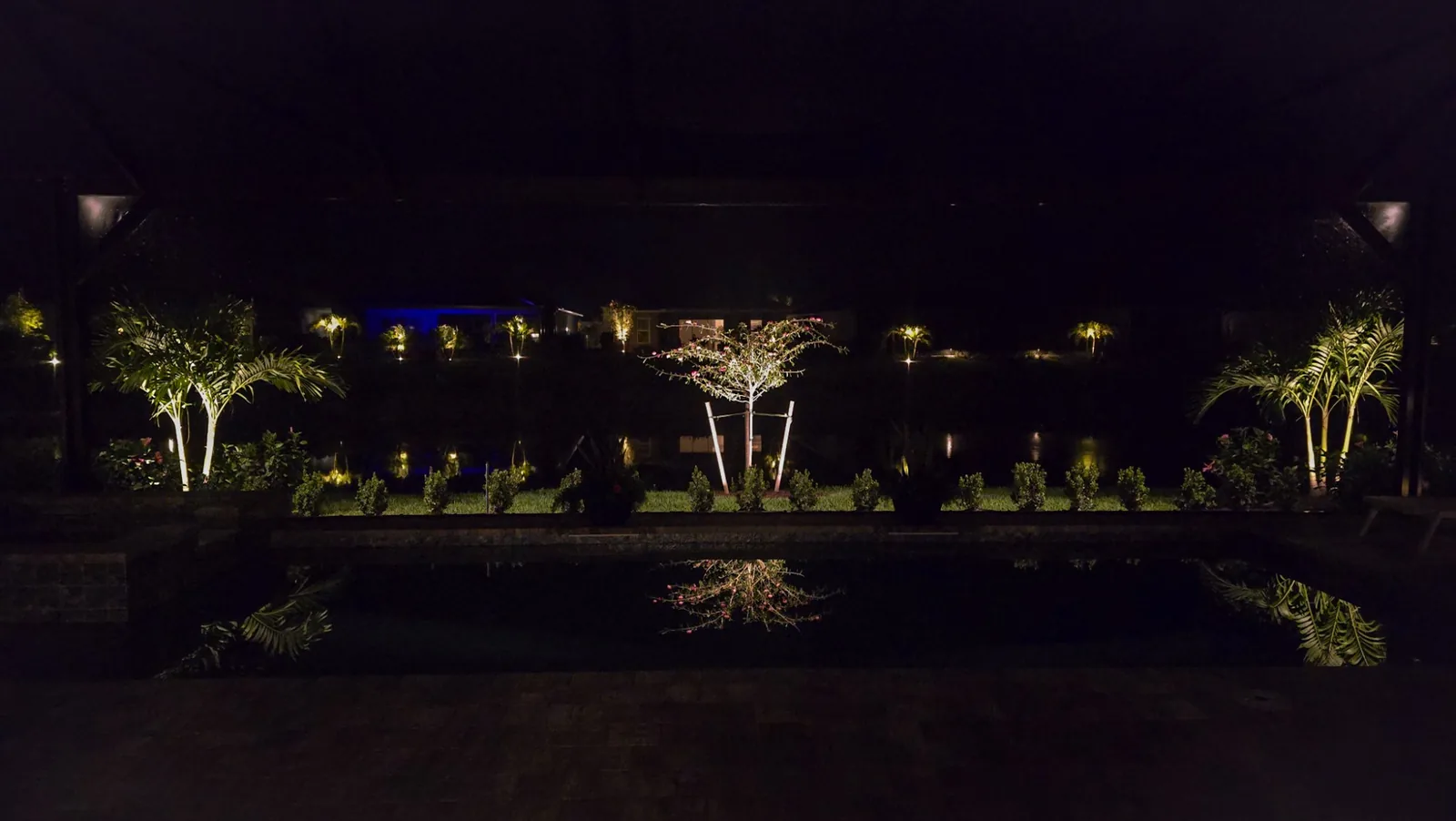
Landscape Lighting and Bugs: What Color Temperature and Shielding Change
Landscape lighting does attract bugs, and color is a big part of why: short wavelengths, the blue end of white light, are disproportionately attractive to many insects [1]. In a field study in Peru, amber-filtered LEDs drew nearly 60 percent fewer insects than white LEDs with reduced blue [2]. Switching from cool white to warm white changes less than most advice claims, and turning off lights you don't need does the most [3].
Published Last updated
Free Consultations and Estimates
This guide sets the studies side by side, with where each was done and what it measured, because the rule of thumb that warmer always means fewer bugs goes further than the research. It also covers what a Florida yard adds: treefrogs and geckos on lit walls, fireflies, and the screened lanai where you notice it first.
Cost driver checker
What will cut the bugs at your lights
Shows what the research says changes. It doesn't promise a bug-free lanai.
Nothing picked yet.
Cool white light
- Warm white instead
- A 2024 review found scant evidence for any substantial difference in insect attraction between cool white and warm white LEDs.[3]
- Amber instead
- In a Smithsonian field study in a Peruvian rainforest, amber-filtered LEDs drew 34 percent fewer kinds of insects and nearly 60 percent fewer individuals than white LEDs with reduced blue.[2]
Warm white light
Amber light
Exposed fixtures (the lamp is visible)
General information from published studies and agencies, not a site assessment. Sources: Owens and Lewis 2018; Smithsonian 2021; Owens, Pocock and Seymoure 2024; FWC; DarkSky.
Key takeaways
- In a Smithsonian field study in a Peruvian rainforest, amber-filtered LEDs drew 34 percent fewer kinds of insects and nearly 60 percent fewer individual insects than white LEDs with reduced blue light [2].
- A 2024 review found "scant evidence" of a real difference in insect attraction between cool white and warm white LEDs, so moving to warm white isn't a bug fix on its own [3].
- The same review rates removing unnecessary light as by far the most effective step and calls shielding a "no regrets" action [3].
- Lit walls feed frogs and geckos: UF/IFAS says Cuban treefrogs wait near lighted areas for the insects the lights attract [9].
- Fewer, lower, shielded lights on a schedule help with both. NightScapes can walk your yard with you: call (239) 649-6940.
01Why insects come
Why insects come to lights
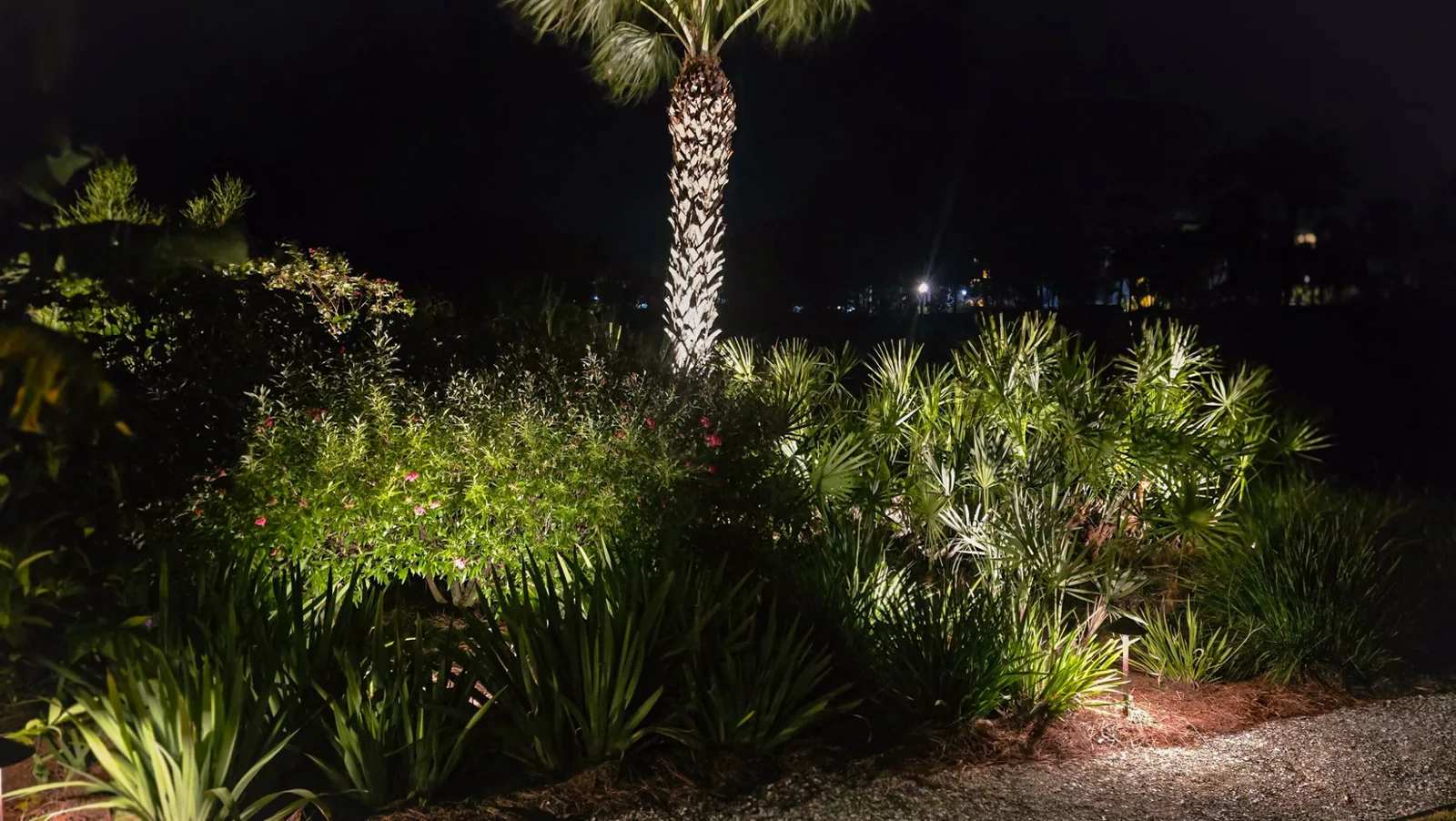
Insects come to outdoor lights because many species are drawn to light, and to short-wavelength light most of all. The Florida Fish and Wildlife Conservation Commission (FWC) says even one artificial light source can disrupt normal flight activity or attract insects that don't normally leave their habitat [4]. Why some moths do it still isn't settled. The Xerces Society says the reason "is still not well understood" [5].
Researchers call it flight-to-light behavior. A 2024 review in Current Opinion in Insect Science, by Avalon Owens, Michael Pocock and Brett Seymoure, describes how artificial light disorients insects, hides the visual cues they use to find resources, and pulls them into flight that harms them [3]. The Smithsonian adds how that can end: insects can die from collisions with hot lamps, from exhaustion, or from predators drawn to the same light [2].
A lit fixture also changes who shows up. The 2024 review notes that "disproportionate numbers of predators, parasitoids, scavengers, and parasites" gather around artificial lights [3]. On a Naples property, that looks like moths at the wall light and webs in the corner of the lanai screen.
The lamp matters too. UF/IFAS Extension in Sarasota County says insects prefer light at 300 to 420 nanometers, and that incandescent, CFL, halogen and HID bulbs emit more of those short wavelengths and "put out more heat, which further attracts insects" [6].
02Color and the studies
What color changes, and what the studies disagree on
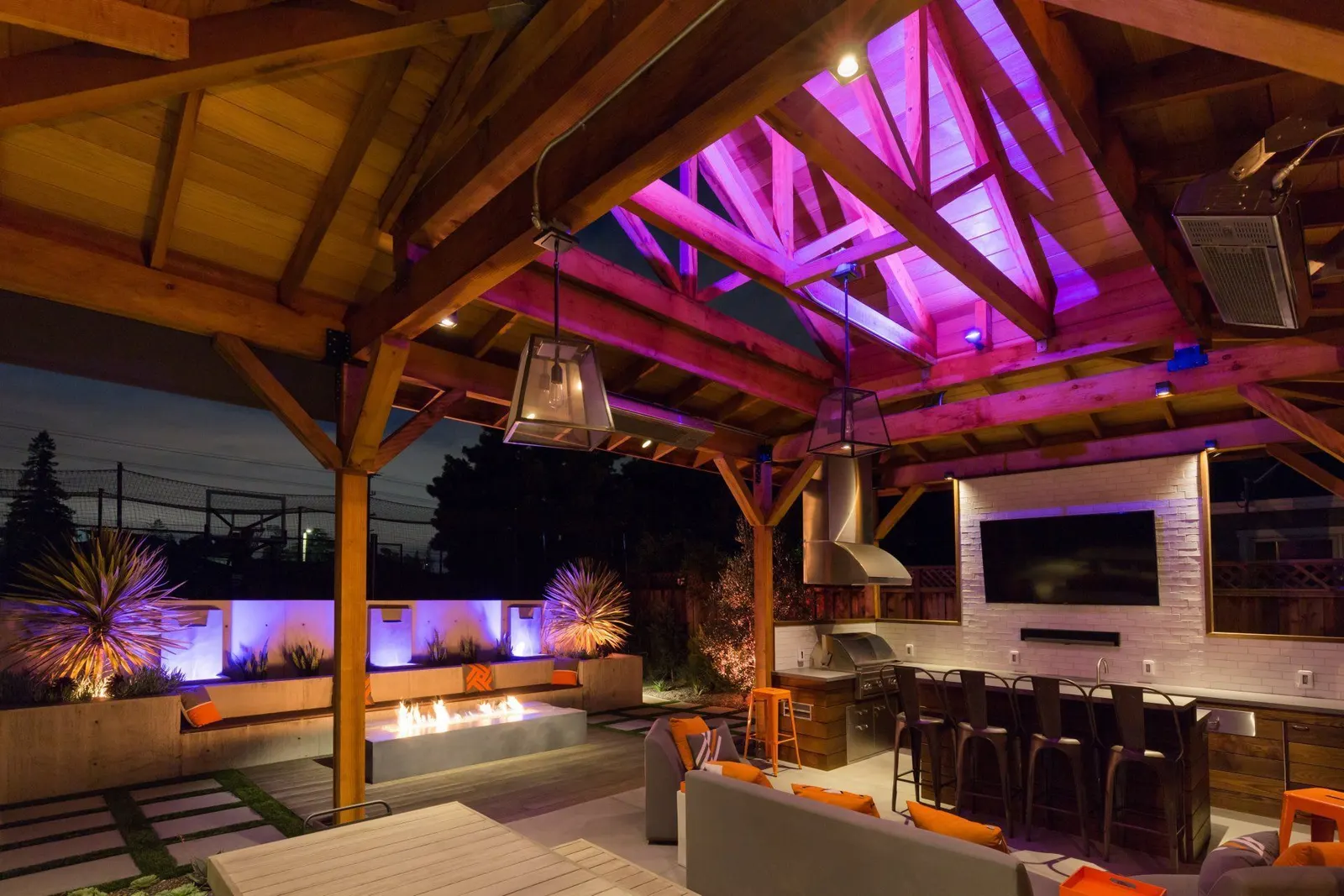
Light color matters, but less than the usual advice says. Amber light drew far fewer insects than white light in a Smithsonian field test in Peru [2]. Between two whites, the gap mostly disappears: a 2024 review found "scant evidence for any substantial difference in insect attraction to cool white versus warm white LEDs" [3]. The likely reason, the authors say, is that the two often differ only slightly in blue light.
Color temperature, measured in Kelvin (K), describes how warm or cool white light looks. The lower the number, the warmer the white. DarkSky International advises "a color temperature of 3000K and below" outdoors, to cut the blue light that is more harmful to many animal species [7]. Amber goes a step further. The Smithsonian's amber-filtered LEDs were warm white lamps with the blue filtered out [2].
| Source | Where and how | What it found |
|---|---|---|
| Owens and Lewis, Ecology and Evolution, 2018 | Review of published research on light at night and nocturnal insects | Short wavelengths are disproportionately attractive to many insects, relative to how visible they are [1] |
| Smithsonian Conservation Biology Institute, Insect Conservation and Diversity, 2021 | Light traps at 12 sites in lowland rainforest in northern Peru; more than 15,000 insects caught | Amber-filtered LEDs drew 34 percent fewer morphospecies and nearly 60 percent fewer insects than white LEDs with reduced blue [2] |
| Flying-insect study, Frontiers in Ecology and Evolution, 2023 (as summarized in the 2024 review) | Two broad-spectrum and seven single-color lights | Insects most attracted to short wavelengths, minimally to long ones, with no preference for cool white over warm white [3] |
| Owens, Pocock and Seymoure, Current Opinion in Insect Science, 2024 | Review of recent studies on each outdoor lighting practice | Changing color and dimming "seem generally ineffective in practice"; removing unneeded light is by far the most effective step [3] |
The studies don't contradict each other as much as they measure different things. The Peru study compared amber-filtered light with white light, a large change. The warm-versus-cool question compares two whites that share most of their blue. The 2024 review also lists counterexamples where longer wavelengths didn't cut flight-to-light behavior, and says color effects beyond attraction tend to be "highly species, system, and habitat dependent" [3]. The 2018 review saw the same problem: where two firefly studies disagreed, Owens and Lewis wrote that the gap "could reflect differing emission spectra of their artificial light sources" [1].
Peru isn't Naples, and light traps in a rainforest aren't a lit lanai. Still, every source here points the same way. Less blue, fewer insects.
Our view: use warm white at 3000K or below for the house and garden, because it looks right on stucco and palms and meets DarkSky's line. Save amber for the zones where insects matter most, and give those zones their own color. A color change alone won't clear a lanai.
Want warmer, lower, shielded light around your lanai without losing the look of the house? NightScapes offers free consultations and estimates in Naples. Request a free estimate or call (239) 649-6940.
03Aim, shield, dim, time
Aim, shield, dim and time
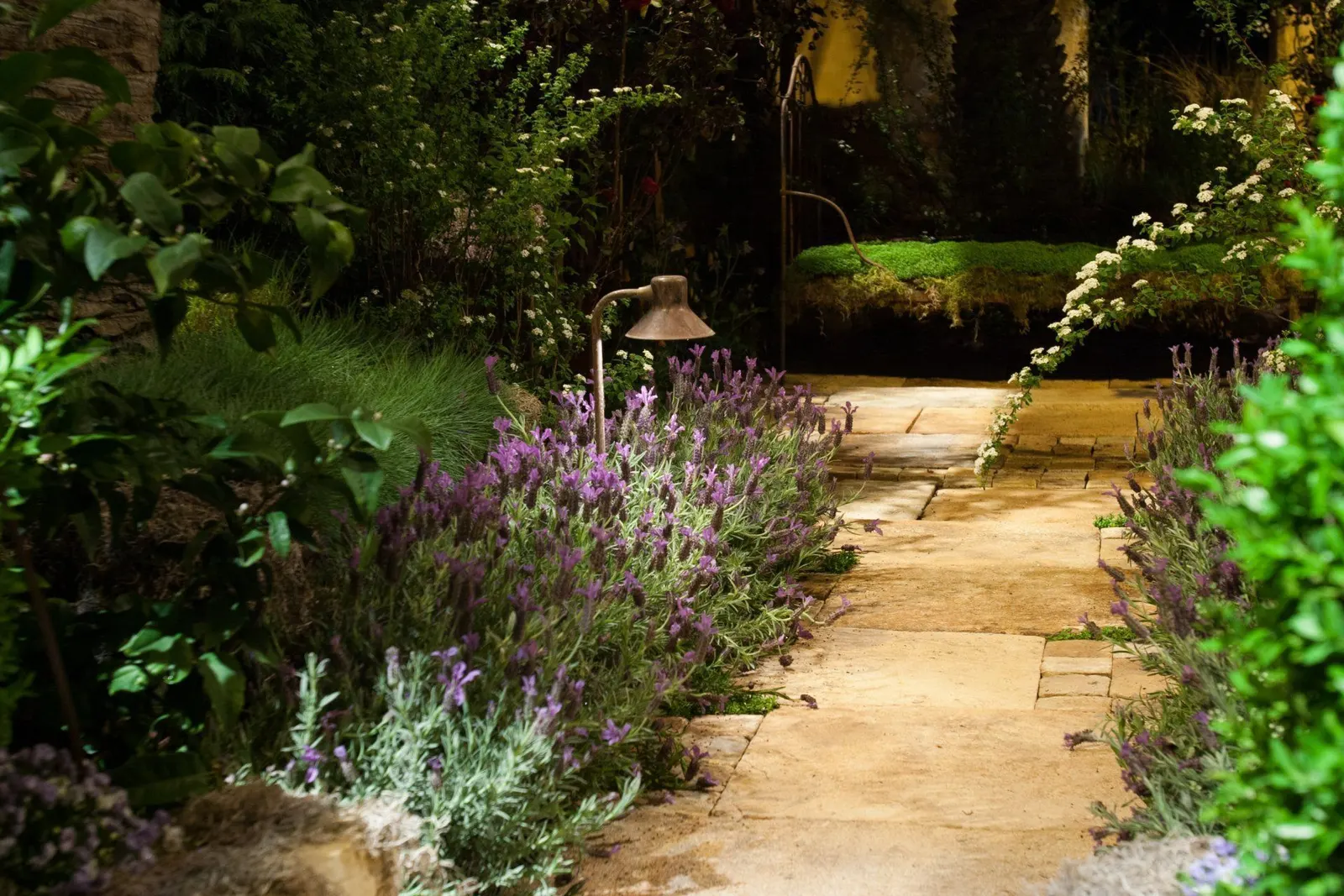
The steps with the strongest support aren't about color. A 2024 review of insect-friendly lighting found that removing unnecessary light is "by far the most effective" way to limit its effects on insects, and called shielding a "no regrets" action [3]. Shielding and motion detectors "show promise as mitigation methods but remain remarkably understudied," the authors add, so that evidence is promising rather than settled [3].
Aim and shield come next. The 2024 review says upward light is especially disorienting to light-attracted insects, and one test it cites found "careful direction of artificial light alone can significantly reduce flying insect attraction" [3]. FWC asks for lights kept low and fully shielded, "so bulbs and/or glowing lenses are not visible" [4]. UF/IFAS Extension in Sarasota County says to install outdoor lights "as close to the ground as possible" [6].
Dimming is mixed. Even severely dimmed light, under 5 lux, still inhibited feeding in moths and still triggered flight-to-light behavior in the studies the review covers [3]. It helps fireflies more than most insects.
Timing has a catch, and a lot of advice misses it. Most light-attracted insects gather between 1 and 3 hours after sunset, when timer-controlled lights are still on, so lights that go off at midnight "likely have limited benefit for most nocturnal flying insects" [3].
What works is light that's on only when someone is using it. The Xerces Society suggests dim low-voltage lighting, motion-activated lights or warm LEDs, "as these are all less attractive to moths and other insects" [5]. Low-voltage landscape lighting on zones and a schedule already covers the first two.
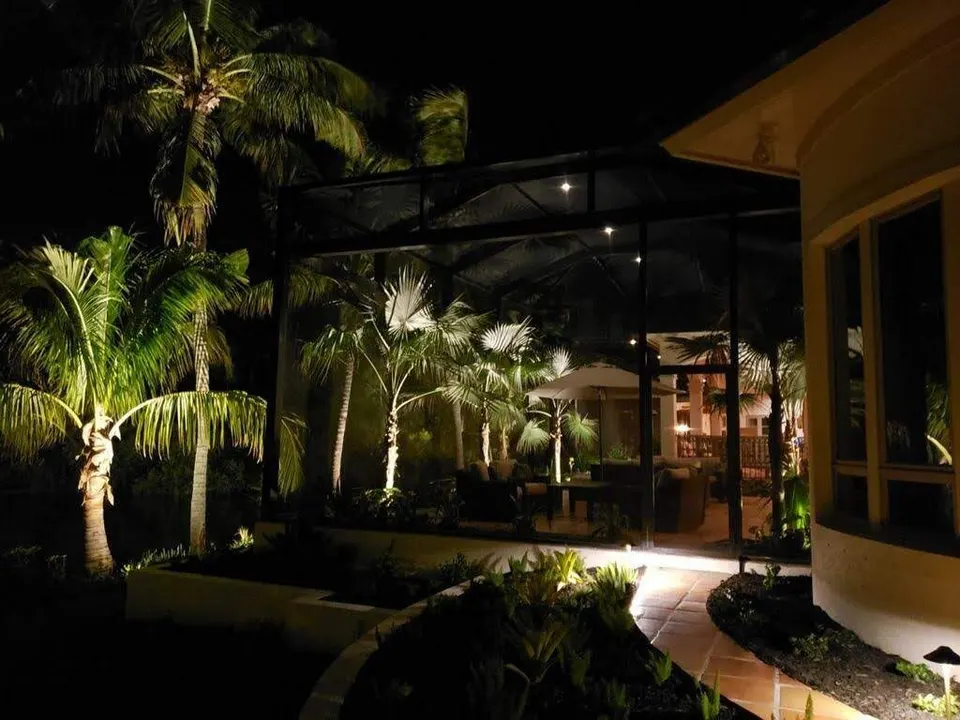
04Frogs and geckos
What follows the bugs: frogs, geckos and the lanai
Frogs and geckos on lit walls are there for the insects. UF/IFAS says Cuban treefrogs, an invasive species in Florida, hang on walls and windows near lighted areas on warm nights "as they sit and wait for insects attracted to the lights" [9]. FWC says geckos "are drawn to light to feed" [4]. A light that draws fewer insects gives them less to wait for.
The Cuban treefrog is more than a nuisance. UF/IFAS says that because Cuban treefrogs "eat native frogs and other wildlife," they need to be managed, and their droppings on windows and walls can become unsightly over time [9]. A bright wall light by the lanai slider works as a feeding station.
Native frogs are affected too. FWC says some frogs gather at lights to forage, "making them more susceptible to dehydration and predators," and that the effect of artificial light on amphibians "has not been well studied" [4]. Treat that as a direction, not a measured size.
The lanai is where it all collects. Our pool and lanai lighting page puts it simply: "Warm, low and shielded is also the usual approach where insects are a concern." Put the brighter light on the planting beyond the screen, keep fixtures inside the cage low, and wash walls at low level on a curfew.
05Fireflies
Fireflies and the rest of the night
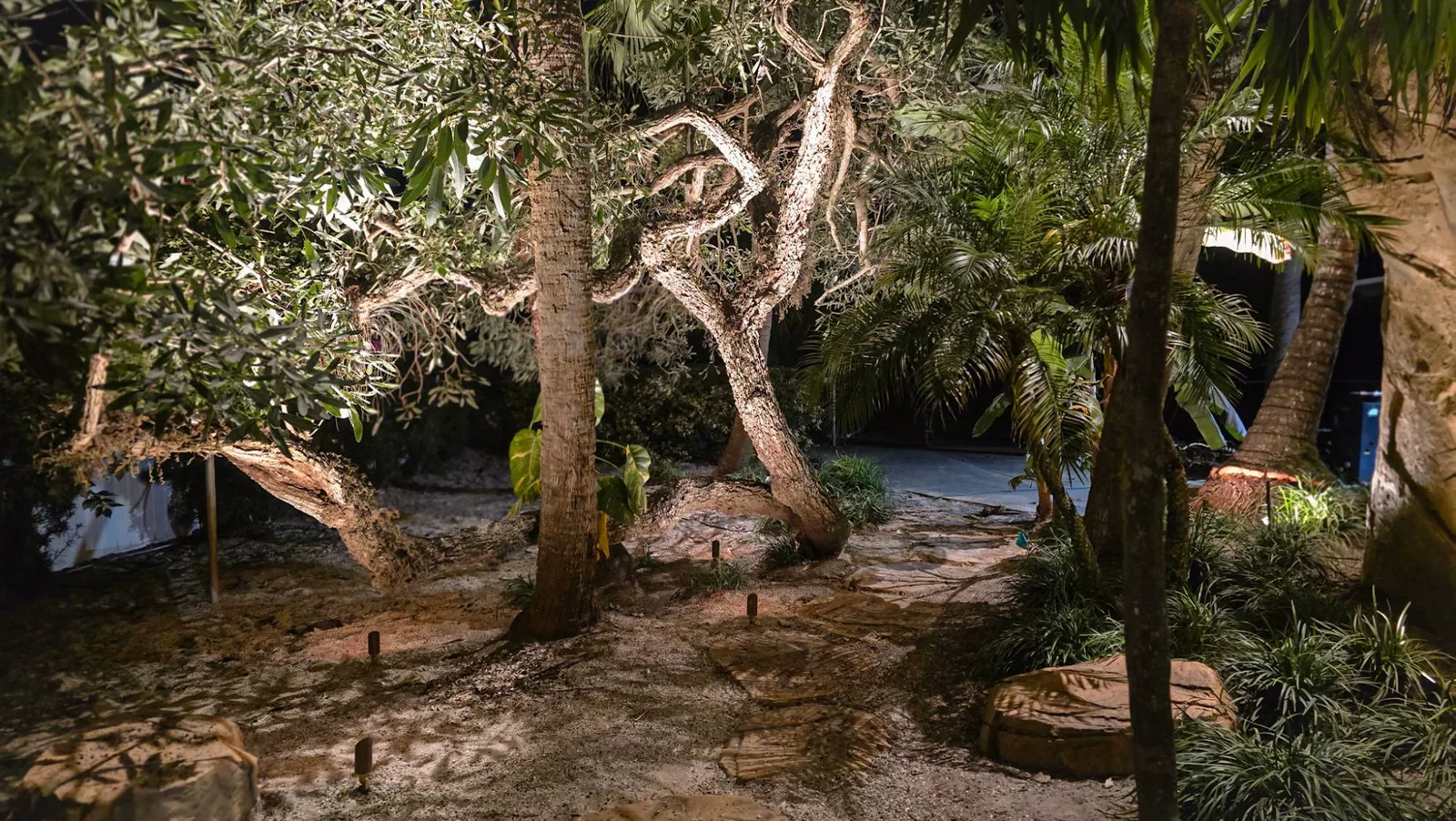
Landscape lighting can push fireflies out of a yard. UF/IFAS Extension says fireflies "avoid areas with high volumes of artificial lights and lots of urban development" [10]. The Xerces Society says at least 80 percent of firefly species in the United States and Canada signal with flashes, flickers or glows, and lights on at dusk or after dark make it harder for them to see each other [8].
Fireflies are the clearest case where dimming helps. The 2024 review says dimming light only slightly, to under 30 lux, is enough to ease or reverse its effects on firefly courtship and mating, because the flashes get through again [3]. The Xerces Society's firefly fact sheet puts removal first: "Remove lights that only serve a cosmetic purpose, such as tree lights and facade lighting" [8].
That's an awkward sentence for a lighting company, and we don't argue with it. Every design we draw already decides what stays dark. Where fireflies live (wet edges, preserve lines, the bank of a lake), that decision matters more than the bulb.
Xerces also suggests timers that turn lights off when fireflies are active, "which is dusk through dawn in summer months," and red LEDs over bright blue-white ones when you replace lights [8]. The UF/IFAS Extension podcast on Florida fireflies says it plainly: "So turn off those porch lights" [10]. Our wildlife-friendly landscape lighting page sets out the same order (fewer, lower, shielded, timed, then color), and on a beachfront lot sea turtle lighting rules add their own limits.
06A yard adjusted
A Florida yard, adjusted
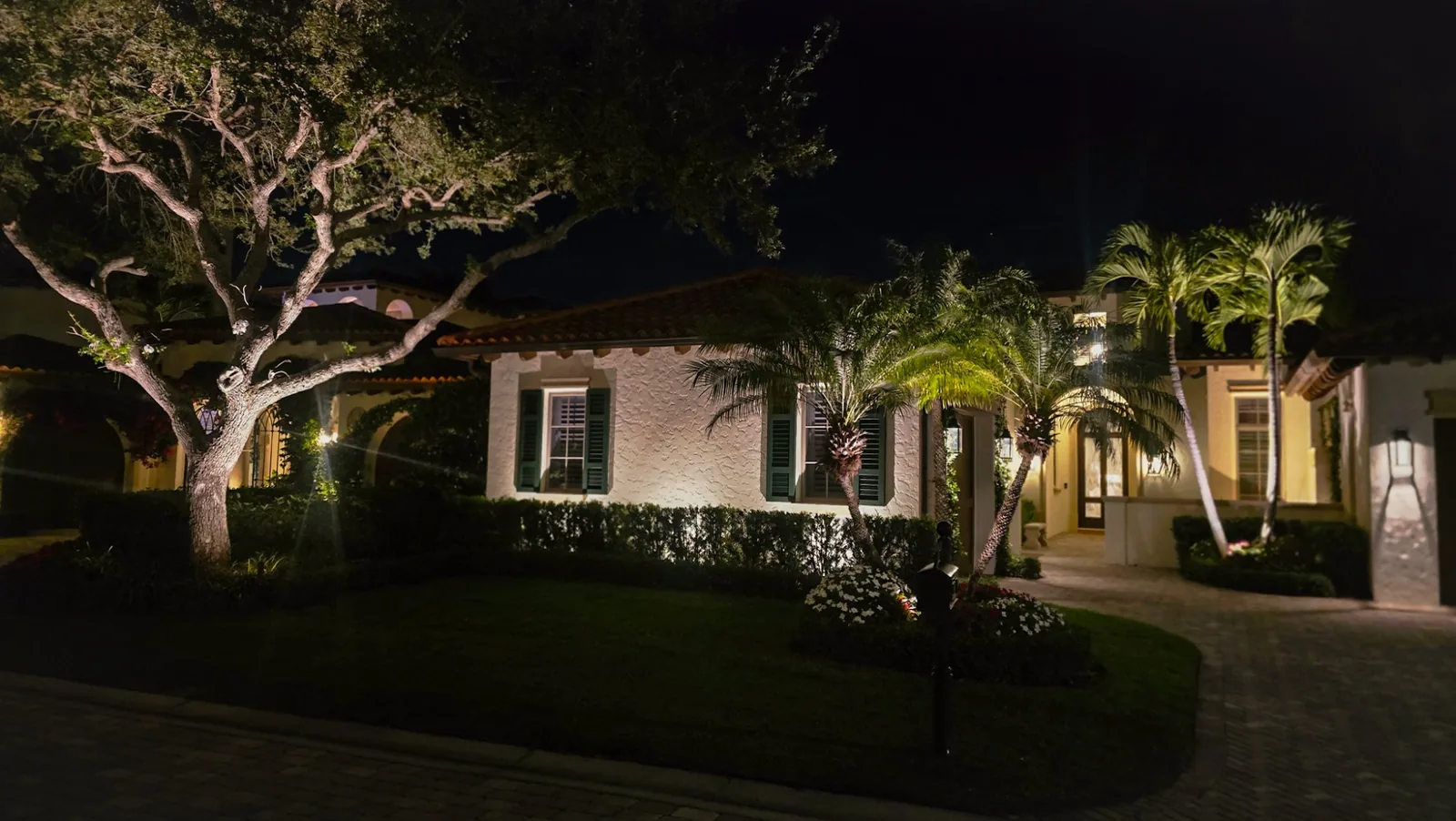
Here is the order we'd adjust a typical Florida yard in: remove first, then shield and lower, then schedule, then change color. The early steps carry the strongest support in the 2024 review, and FWC, UF/IFAS and the Xerces Society give the same order of work [3][4][6][8]. None of it means giving up the lighting.
- Walk the yard after dark and list every light. Mark the ones nobody uses after the lanai empties; Xerces puts cosmetic lights first on its list to remove [8].
- Lower and shield what stays. Keep path lights low, put glare shields on uplights, and make sure no lamp is visible from the lanai chairs or shines into the sky [4][6].
- Move bright light away from doors and screens. Light the planting beyond the cage, not the slider, so more of the insects gather out there.
- Put each zone on a schedule that matches when you use it. Don't count on a later start; most light-attracted insects arrive 1 to 3 hours after sunset [3].
- Use warm white at 3000K or below across the property, as DarkSky advises [7]. If the system is still halogen, converting to LED removes a lamp type UF/IFAS says emits more short wavelengths and more heat [6].
- Try amber where insects are worst: the lanai entry, the wall by the slider, the bed beside a pond. Amber-filtered LEDs drew nearly 60 percent fewer insects in the Peru study [2].
- Leave dark edges near water and preserve lines for fireflies and frogs [10][4].
You won't get a bug-free lanai. You'll get fewer insects at the lights, fewer frogs on the glass, and a yard that still looks lit.
07
Questions we hear
Frequently Asked Questions About Landscape Lighting and Bugs
 NightScapes Landscape Lighting Outdoor lighting only, Naples since 2006
Choose a question
Do LED landscape lights attract bugs?
Yes, LED landscape lights attract some insects, but usually fewer than older lamps. UF/IFAS Extension in Sarasota County says incandescent, CFL, halogen and HID bulbs emit more short, high-energy wavelengths and more heat, which further attracts insects. The LED's color still matters, because short wavelengths are disproportionately attractive to many insects. In the Smithsonian's Peru study, amber-filtered LEDs drew nearly 60 percent fewer individual insects than white LEDs with reduced blue. Switching to LED is a good start. Fewer, lower, shielded fixtures on a schedule do more.
What color outdoor light keeps bugs away?
No color keeps bugs away completely, but amber and red draw the fewest. A 2024 review says monochromatic red light "has repeatedly proven minimally attractive to light-attracted insects," and the Peru study found amber-filtered LEDs drew nearly 60 percent fewer insects than white LEDs. Warm white is a smaller step than most advice suggests: the same review found scant evidence of a substantial difference between cool white and warm white LEDs. For lighting that still shows the house, warm white at 3000K or below with amber in the insect-heavy zones is the practical mix.
What bulb color draws the fewest bugs to a Florida lanai?
Of the colors you'd actually live with, amber. The Smithsonian field study found amber-filtered LEDs drew 34 percent fewer kinds of insects and nearly 60 percent fewer individuals than white LEDs with reduced blue. That study ran in a Peruvian rainforest, not on a Florida lanai, so treat the size of the drop as a guide. On a lanai, placement matters as much as color: keep fixtures inside the cage low and shielded, and put the brighter light on the planting beyond the screen. UF/IFAS Extension in Sarasota County recommends bulbs under 3600K labeled warm or ultra warm white.
Do motion sensors help with bugs?
Probably, though the evidence is thin. The 2024 review in Current Opinion in Insect Science says shielding and motion detectors "show promise as mitigation methods but remain remarkably understudied". Its reasoning: a light on a motion sensor is off most of the night, and insects are far too small to trigger most motion detectors. The Xerces Society lists motion-activated lights among the options that are "less attractive to moths and other insects". Motion sensors suit a side yard or a path, not accent lighting you want on while you sit outside.
Should my landscape lights come on later to avoid bugs?
A later start helps less than it sounds. The 2024 review says most light-attracted insects gather between 1 and 3 hours after sunset, and a study it summarizes found flight-to-light behavior peaking between 90 minutes and 3 hours after sunset. A light that waits an hour after dusk is still on through most of that peak. The review also says part-night schemes that switch lights off around midnight likely have limited benefit for most night-flying insects. Turning off zones nobody is using, shielding and lowering what stays on, and using amber where you sit all help more.
Related services
08Next step
What to change first
Landscape lighting attracts bugs mainly through short-wavelength light, and the research is clearer about what to do than about color. Turn off what nobody uses, lower and shield what stays, and put each zone on a schedule [3]. Then choose warm white at 3000K or below, with amber where insects or frogs collect [7][2]. Don't expect a switch from cool white to warm white, on its own, to make a visible difference [3].
NightScapes has designed, installed and repaired outdoor lighting in Naples since 2006 (Todd since 1998), and outdoor lighting is all we do. The consultation and the estimate are free: we walk the property with you and give you a design that shows which zones, which features and what stays dark. Call (239) 649-6940 or request a free estimate.
09Sources
References
- Owens, A.C.S. and Lewis, S.M. The impact of artificial light at night on nocturnal insects: A review and synthesis. Ecology and Evolution 8(22):11337-11358. 2018. pmc.ncbi.nlm.nih.gov/articles/PMC6262936/
- Smithsonian's National Zoo and Conservation Biology Institute. Smithsonian Scientists Discover the Key To Mitigating Impact of Artificial Light at Night in Tropical Forests. March 17, 2021. nationalzoo.si.edu/news/smithsonian-scientists-discover-key-miti
- Owens, A.C.S., Pocock, M.J.O. and Seymoure, B.M. Current evidence in support of insect-friendly lighting practices. Current Opinion in Insect Science 66:101276. September 2024. par.nsf.gov/servlets/purl/10587277
- Florida Fish and Wildlife Conservation Commission (FWC). Light Pollution (wildlife lighting). Read October 23, 2026. myfwc.com/conservation/you-conserve/lighting/pollution/
- Xerces Society (Justin Wheeler). To Protect Moths, Turn Out the Lights. July 27, 2017. xerces.org/blog/to-protect-moths-turn-out-lights
- UF/IFAS Extension Sarasota County. Don't be Afraid of the Dark! Benefits of Dark Skies. October 28, 2025, updated February 6, 2026. blogs.ifas.ufl.edu/sarasotaco/2025/10/28/savedarkskies
- DarkSky International. Light Pollution Can Harm Wildlife (fact sheet). 2023. darksky.org/app/uploads/2023/10/DarkSky-Light-Pollution-Can-Harm
- Xerces Society (Candace Fallon and Avalon Owens). Conserving the Jewels of the Night: Firefly-Friendly Lighting Practices (fact sheet 19-055_01). 2020. xerces.org/sites/default/files/publications/19-055_Firefly_Frien
- University of Florida IFAS Extension (Steve A. Johnson). The Cuban Treefrog in Florida (WEC218/UW259). 2025. ask.ifas.ufl.edu/publication/UW259
- UF/IFAS Extension Polk County. Naturally Florida podcast, Season 1, Episode 3: Fireflies (transcript). Read October 23, 2026. sfyl.ifas.ufl.edu/polk/natural-resources-and-conservation/natura