
Halogen or LED Landscape Lighting in Florida: Is Switching Worth It?
In Florida, switching halogen landscape lighting to LED is worth it for most systems: FX Luminaire's lamp table puts the LED replacement for a 20-watt halogen MR-16 at an actual 4.0 watts, about 16 watts less per lamp [1]. On FPL's residential rate effective October 2026, 20 of those lamps running dusk to dawn in Naples cost about $15 to $20 a month as halogen and about $3 to $4 as LED [1][3][4]. The harder question is the fixtures and the transformer you already have. Not the bulbs.
Published Last updated
Free Consultations and Estimates
This guide works the halogen vs LED landscape lighting math on FPL's current tariff, with the manufacturer's lamp draws and U.S. Naval Observatory night lengths, so you can run it for your own system. FX notes that halogen landscape lights can draw anywhere from 10 to 50 watts each, sometimes more [2].
Cost driver checker
What switching to LED saves on an FPL bill
Shows the electricity your lamps use as halogen and as LED. It does not estimate the cost of converting.
Nothing picked yet.
20-watt halogen lamps
35-watt halogen lamps
50-watt halogen lamps
Utility energy estimate, not a NightScapes price. FPL residential rate (RS-1) effective October 2026, before taxes, fees and transformer losses. Lamp draws: FX Luminaire design guide (2021). Night lengths: U.S. Naval Observatory, Naples. LCEC customers (Marco Island, Sanibel, Captiva, Everglades City) use their own rate.
Key takeaways
- An FX Luminaire MR-16 LED lamp draws an actual 4.0, 5.0 or 7.0 watts in place of a 20-, 35- or 50-watt halogen lamp, a cut of 80 to 86 percent at the lamp [1].
- On FPL's October 2026 rate, converting 20 lamps from 20-watt halogen to LED saves about $12 to $16 a month dusk to dawn in Naples, roughly $147 to $193 a year; these are utility estimates, not a NightScapes price [1][3][4].
- A dusk-to-dawn system in Naples runs about 3,700 to 4,900 hours a year, so a halogen lamp rated for 2,000 to 4,000 hours lasts from about five months to a little over a year [1][4].
- Most conversions keep the fixture positions, most of the wire and often the transformer; the transformer's taps are re-measured because the load just fell.
- To talk through your own system, call NightScapes at (239) 649-6940 for a free consultation and estimate.
01Wattage
The wattage gap, lamp by lamp
The wattage gap between halogen and LED landscape lamps is easiest to read from the manufacturer's own table. FX Luminaire lists its MR-16 LED lamps, sold as 20-, 35- and 50-watt halogen equivalents, at an actual 4.0, 5.0 and 7.0 watts [1]. That is a cut of 80 to 86 percent at the lamp, before anything else in the system changes.
| Halogen MR-16 lamp | FX MR-16 LED replacement, actual draw | LED load on the transformer | Watts saved per lamp | Cut at the lamp |
|---|---|---|---|---|
| 20 W | 4.0 W | 4.3 VA | 16 W | 80% |
| 35 W | 5.0 W | 5.4 VA | 30 W | 86% |
| 50 W | 7.0 W | 7.5 VA | 43 W | 86% |
Halogen figures are rated lamp wattages; LED figures are FX's 2021 design guide table for its MR-16 LED lamp [1].
Looser percentages get quoted. FX's design guide says LED fixtures use 30 to 80 percent less energy than incandescent lamps [1]. ENERGY STAR says LED lighting products "produce light up to 90% more efficiently than incandescent light bulbs" [6]. The U.S. Department of Energy's line that LEDs "use at least 75 percent less energy than incandescent bulbs" comes from a 2010 guide about household bulbs, not landscape lamps [5].
None of them is your system. The lamp table is the honest comparison, because it describes the lamp that actually goes into the fixture.
02The FPL math
The FPL math, worked through
On FPL's residential rate effective October 2026, converting 20 lamps from 20-watt halogen to FX's 4.0-watt MR-16 LED saves about 98 kilowatt-hours in a June month and 130 in a December month, running dusk to dawn in Naples. That's about $12.04 to $15.89 a month at 12.258 cents per kilowatt-hour, or roughly $147 to $193 a year [1][3][4].
- 20 lamps: 20-watt halogen to 4.0-watt LED
- About 98 kWh saved in a June month, 130 in December, dusk to dawn
- About $12.04 to $15.89 a month at 12.258 cents per kWh, roughly $147 to $193 a year
How we worked it out: FPL's residential (RS-1) charges effective October 2026 add up to 12.258 cents per kilowatt-hour for the first 1,000 kilowatt-hours and 14.258 cents above that, before taxes and fees [3]. In Naples, the U.S. Naval Observatory has the sun setting at 8:22 p.m. on June 21, 2026 and rising at 6:36 a.m., about 10.2 hours of dark, and setting at 5:40 p.m. on December 21, 2026 and rising at 7:10 a.m., about 13.5 hours [4]. Each month is 30 nights; a year falls between 365 June-length nights (about 3,735 hours) and 365 December-length nights (about 4,928).
On FPL's residential rate effective October 2026, converting 20 lamps from 20-watt halogen to FX's 4.0-watt MR-16 LED saves about 98 kilowatt-hours in a June month and 130 in a December month, running dusk to dawn in Naples.
June, dusk to dawn
December, dusk to dawn
Transformer losses, taxes and fees aren't included. These are utility estimates, not a NightScapes price.
| 20 lamps, 30 nights | Draw | June, dusk to dawn | December, dusk to dawn | 6-hour timer |
|---|---|---|---|---|
| 20 W halogen | 400 W | 122.8 kWh, $15.05 | 162.0 kWh, $19.86 | 72.0 kWh, $8.83 |
| FX MR-16 LED, 4.0 W | 80 W | 24.6 kWh, $3.01 | 32.4 kWh, $3.97 | 14.4 kWh, $1.77 |
| 35 W halogen | 700 W | 214.9 kWh, $26.34 | 283.5 kWh, $34.75 | 126.0 kWh, $15.45 |
| FX MR-16 LED, 5.0 W | 100 W | 30.7 kWh, $3.76 | 40.5 kWh, $4.96 | 18.0 kWh, $2.21 |
| 50 W halogen | 1,000 W | 307.0 kWh, $37.63 | 405.0 kWh, $49.64 | 180.0 kWh, $22.06 |
| FX MR-16 LED, 7.0 W | 140 W | 43.0 kWh, $5.27 | 56.7 kWh, $6.95 | 25.2 kWh, $3.09 |
Dollar figures use FPL's 12.258-cent rate for the first 1,000 kilowatt-hours. Transformer losses, taxes and fees aren't included. These are utility estimates, not a NightScapes price.
Above 1,000 kilowatt-hours in a month, FPL charges 14.258 cents [3]. Where the lights' use falls above that line, the 20-watt example saves up to about $14.01 in June and $18.48 in December.
This guide uses FPL's residential rate effective October 2026. If FPL changes its rates, the running-cost figures here change with them. Marco Island, Sanibel, Captiva and Everglades City are served by LCEC, not FPL, so use your own utility's rate there [11]. Electricity is one line of the budget; the other costs on a quote come from design, materials and wire.
Want the math done for your own system? NightScapes offers free consultations and estimates in Naples, and we walk the property with you. Request a free estimate or call (239) 649-6940.
03Your own savings
How to work out your own savings
You can work out your own halogen-to-LED savings in five steps. You need the lamp count and wattages, the LED replacement's actual draw from the manufacturer's table, the hours your system runs, and your utility rate. On FPL's October 2026 residential rate, that's 12.258 cents per kilowatt-hour for the first 1,000 [1][3].
- Count the lamps and read the wattage printed on each halogen lamp, for example 20, 35 or 50 watts.
- Subtract the LED replacement's actual draw. FX's MR-16 LED table gives 4.0, 5.0 and 7.0 watts for those sizes, a saving of 16, 30 or 43 watts per lamp [1].
- Multiply by the number of lamps and the hours per night. In Naples, dusk to dawn runs about 10.2 hours in late June and 13.5 in late December [4].
- Multiply by 30 nights and divide by 1,000 for kilowatt-hours a month.
- Multiply by your rate: 12.258 cents on FPL's RS-1 rate, or 14.258 cents above 1,000 kilowatt-hours [3].
Worked through: ten 35-watt halogen lamps save 300 watts. At 13.5 hours a night for 30 nights, that's 121.5 kilowatt-hours, about $14.89 in a December month.
04Lamp life
Lamp life and what "rated life" means
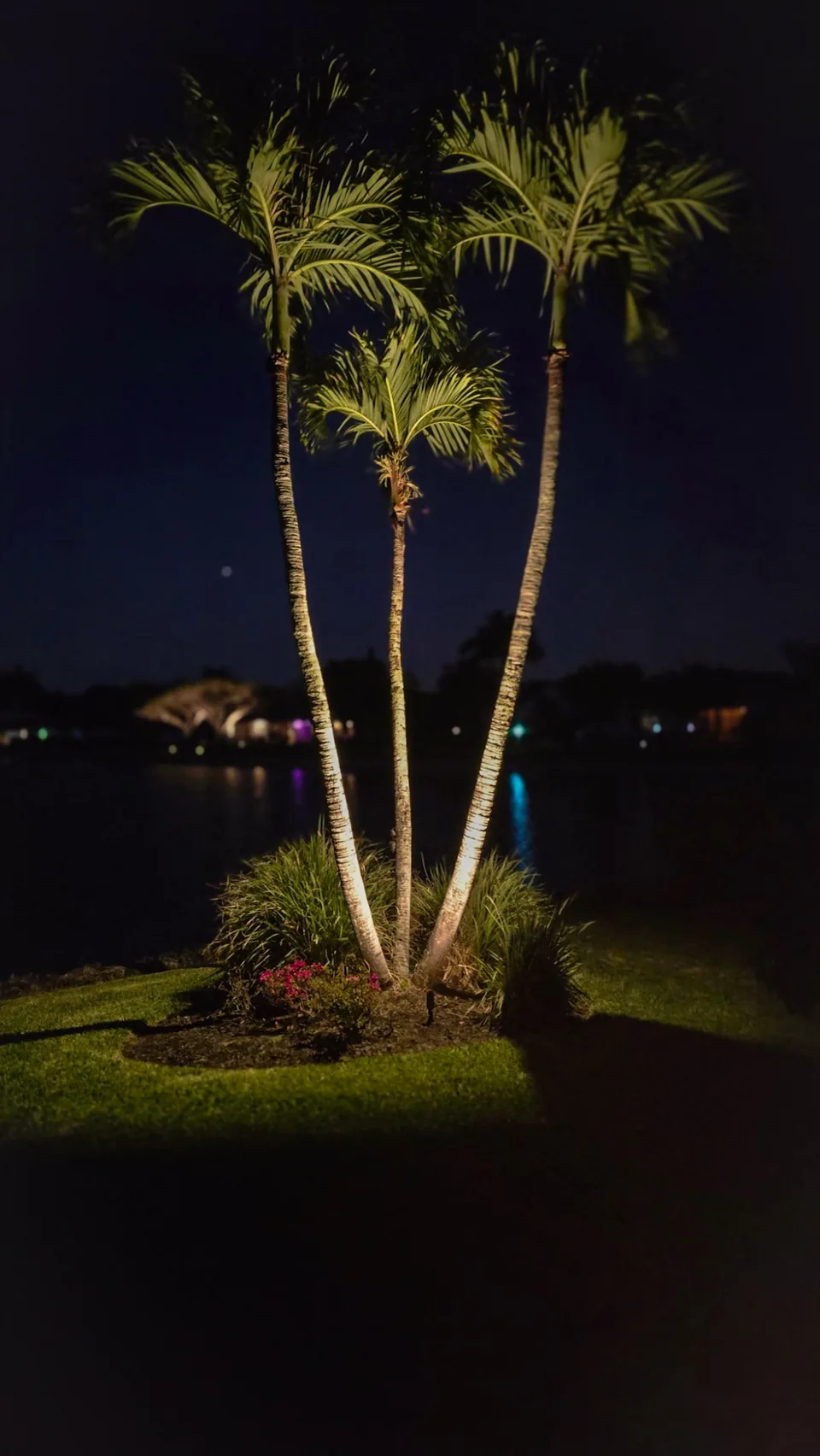
Lamp life is where halogen costs you visits, not just watts. FX Luminaire's design guide gives halogen lamps 2,000 to 4,000 hours [1]. A Naples system running dusk to dawn is on for about 3,700 to 4,900 hours a year, worked from U.S. Naval Observatory night lengths, so a halogen lamp's rated life runs out in about five months to a little over a year [1][4].
"Rated life" means different things for the two lamps. FX's glossary explains halogen: "If lamps are rated for 4,000 hours at 12 V, it means that at 4,000 hours, 50% of the lamps are still working and 50% are not" [1]. Half are already out by the rated hour.
LED life is a different measure. ENERGY STAR says LEDs "typically do not 'burn out' or fail," and that LED lifetime "is established on a prediction of when the light output decreases by 30 percent" [6]. That point is L70. FX puts it simply: "LEDs slowly dim over time" [2].
FX's LED figures differ by product. Its 2021 design guide lists 40,000 hours for Standard Series MR-16 lamps and 55,000 for integrated fixtures, as average useful life to L90 [1]. Its LED advantages page says LEDs "can last 50,000 hours or more" [2]. Its NP up light page lists 72,000 hours to L70 (55,000 for the color-changing version) [9]. Even 40,000 hours is about 8 to 11 years of dusk-to-dawn nights.
NightScapes' retrofit page sums up halogen in one line: "It works, it is warm, and it eats lamps." On a dusk-to-dawn halogen system, relamping is a yearly job.
05Lamp or fixture
Lamp swap or new fixture
Many halogen landscape fixtures can take an LED lamp in the same socket. FX Luminaire sells its drop-in MR-16 LED lamps individually "for retrofits or as replacements, or for installation in landscape lights made by other manufacturers" [1]. Whether a fixture gets a new lamp or is replaced depends on its body, its socket and its seal, not on the lamp.
FX states the trade-off: drop-in LED fixtures "tend to be more economical at cost per fixture, but lack the heat management and performance capabilities of integrated LED fixtures" [1]. An integrated fixture has the LED built in.
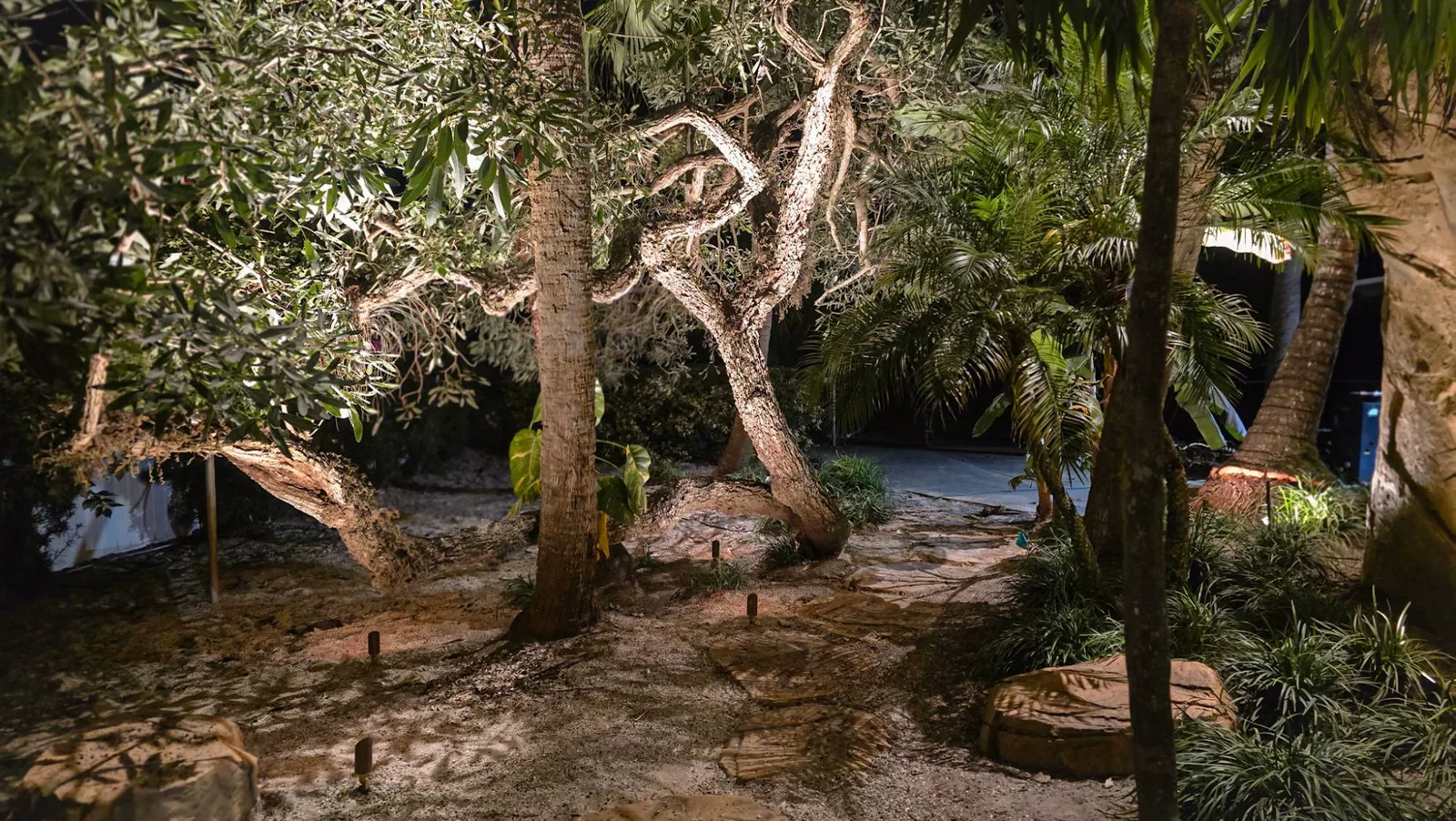
NightScapes sorts every fixture in a conversion into one of three outcomes. "A sound brass or copper body with a clean socket takes an LED lamp." A sound body with a corroded socket gets a new socket or seal where the maker supplies one. A pitted housing or failed seal is replaced with one of the integrated LED fixtures in the same position.
Match the beam, too. FX's MR-16 LED comes in very narrow (10 degree), flood (35 degree) and wide flood (60 degree) beams [1]. A palm lit by a 35-degree halogen lamp needs a 35-degree LED, or the top of the crown goes dark. The retrofit page covers converting a halogen system fixture by fixture.
06Transformer
When the transformer has to change
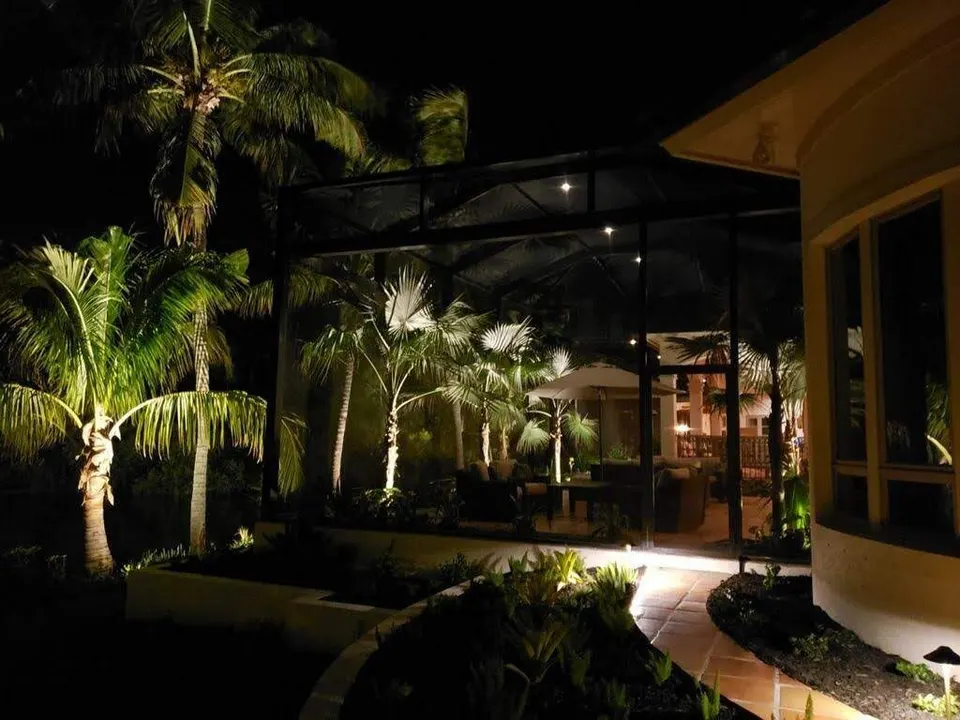
Most halogen-to-LED conversions keep the transformer and re-measure its taps, because the load on it has just fallen by 80 percent or more. The transformer changes when it's an older electronic unit built around a halogen load, when it's corroded or failing, or when new fixtures will need more capacity. FX Luminaire sizes transformers by volt-amperes (VA), not watts [1].
FX's guide says to "sum the total volt-amps (VA) of all lighting fixtures connected," because "most lamps or LED fixtures consume more power than their rated wattage" [1]. That's why the table above lists 4.3 VA beside the 4.0-watt lamp. FX also says not to load a transformer beyond 80 percent of its rated capacity [1].
The taps are the part people miss. FX describes the PX transformer's "12 V to 15 V multi-tap outputs" as there to "minimize voltage loss" [10]. A long halogen run was often put on a high tap. FX's layout guide gives 10.5 to 11.5 volts per lamp as the low-voltage target for maximum output and life, and says LED fixtures keep the same brightness anywhere between 10 and 15 volts [7]. After conversion the run loses far less voltage, so a high tap can over-feed it. FX says each LED fixture's input "should always be between 10-15 VAC" [8].
The wire usually stays, since LED draws far less current. FX still warns that "it is imperative to take voltage drop into account even when designing an LED lighting system" [8]. One exception changes everything: NightScapes' retrofit page notes that an old installation with no transformer anyone can find may be running at line voltage. That's checked first, along with the transformer itself.
07Color
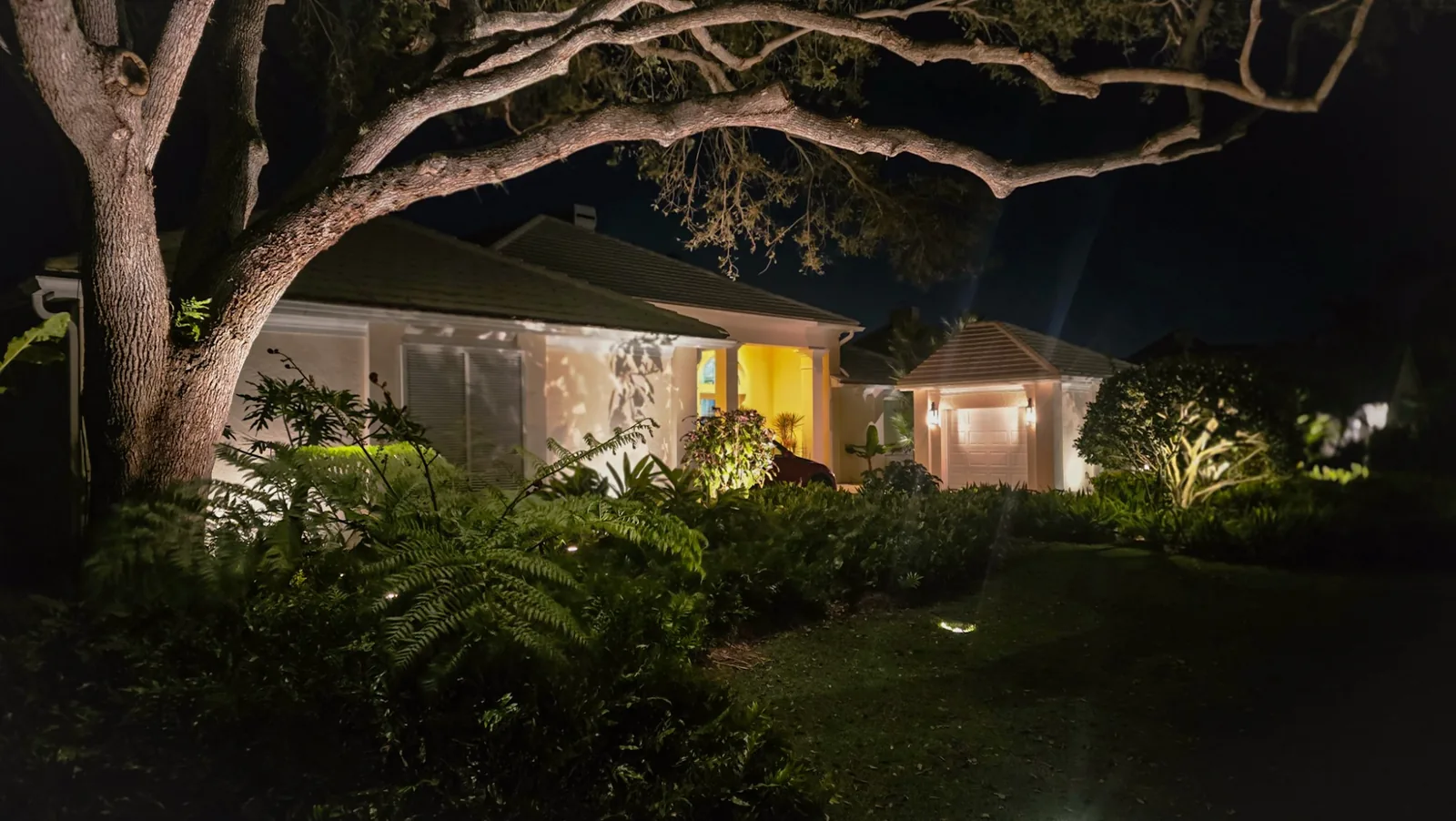
Color: keeping the warm look
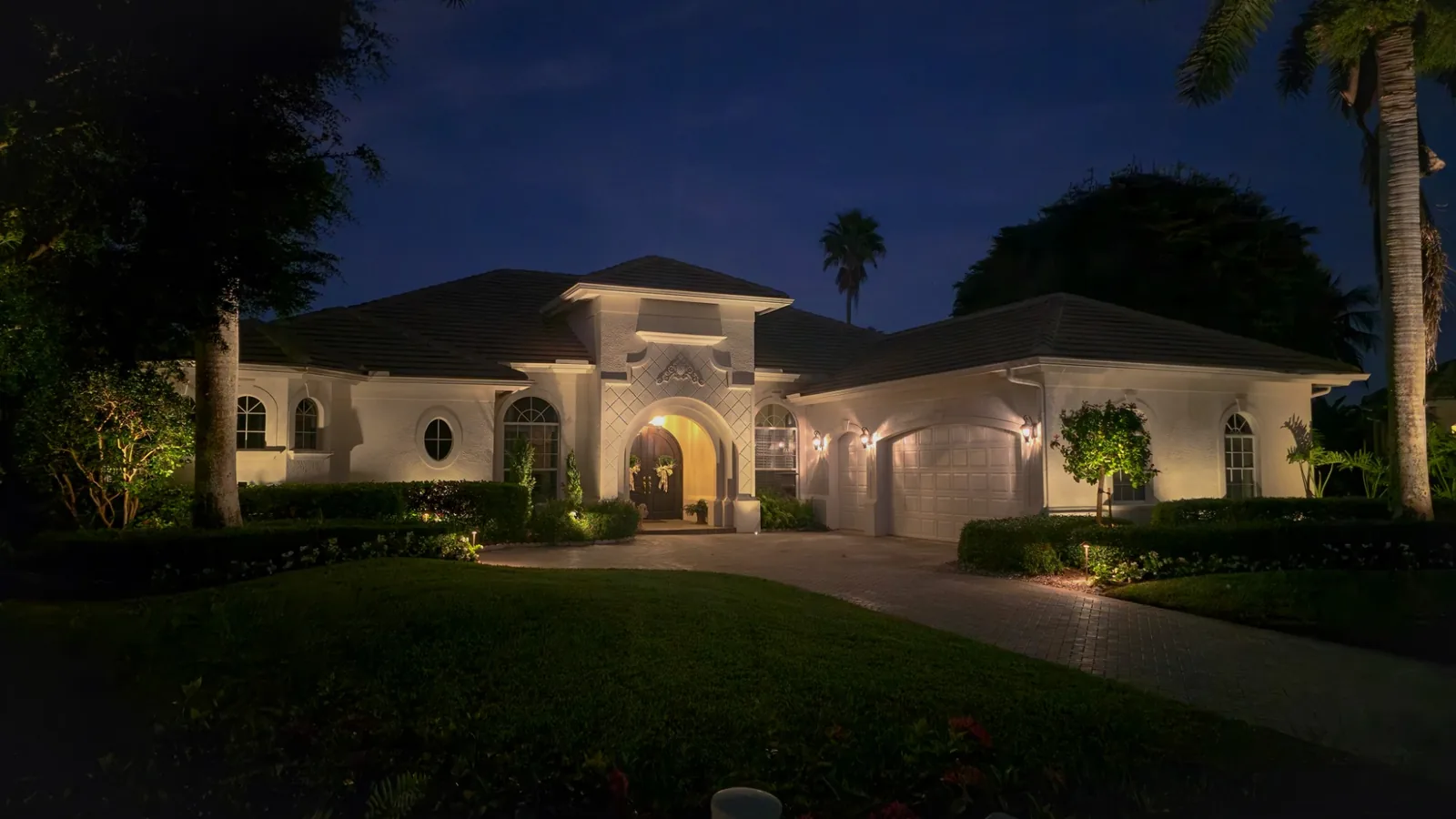
LED landscape lighting doesn't have to look cold. FX Luminaire's design guide labels 2,700 to 3,000K as warm and 3,600 to 5,500K as cool [1]. Its MR-16 LED lamps come in Warm (2,700K) and Soft (3,000K) [1]. The guide also notes that "incandescent and halogen lamps fall in the warm range, with halogen lamps being slightly cooler" [1].
NightScapes converts one area first and checks it at night beside what remains, so a mismatch gets fixed while it's one area, not the whole property.
08When to wait
When switching can wait
Switching to LED can wait when the halogen system is small, on a short timer and out of sight. Ten 20-watt halogen lamps on a 6-hour timer would save only about 28.8 kilowatt-hours a month as LED, about $3.53 on FPL's October 2026 rate [1][3]. If those lamps rarely fail and the run lights a side yard, the savings come slowly.
NightScapes' own advice on pacing is direct: "A run that works and sits out of sight loses little by waiting." Convert the runs that fail most and the views you see every evening first.
The opposite case, big halogen lamps on dusk-to-dawn hours, runs to tens of dollars a month in electricity alone.
09
Questions we hear
Frequently Asked Questions About Switching From Halogen to LED Landscape Lighting
 NightScapes Landscape Lighting Outdoor lighting only, Naples since 2006
Choose a question
How long do LED landscape lights last?
It varies by product, as FX Luminaire's own figures show. Its 2021 design guide lists 40,000 hours for Standard Series MR-16 LED lamps and 55,000 hours for integrated fixtures, as average useful life to L90. Its NP up light page lists 72,000 hours to L70. ENERGY STAR defines LED lifetime as the predicted point where light output drops by 30 percent. In Naples, a dusk-to-dawn system runs about 3,700 to 4,900 hours a year, so 40,000 hours is about 8 to 11 years of nights.
How much do outdoor lights cost to run?
LED landscape lighting costs a few dollars a month to run in Naples. Twenty FX MR-16 LED lamps at 4.0 watts each, dusk to dawn, use about 24.6 kilowatt-hours in a June month and 32.4 in a December month: about $3.01 to $3.97 on FPL's residential rate effective October 2026. The same 20 fixtures with 20-watt halogen lamps cost about $15.05 to $19.86, and with 50-watt lamps about $37.63 to $49.64. These are utility estimates, not a NightScapes price, before transformer losses, taxes and fees.
Can you add to my existing lights?
Often, yes, and converting to LED first is what usually makes room. After conversion, the same fixtures draw a fraction of the load, so the transformer has capacity free for palms, a pool deck or a path that was never lit. What decides it is the transformer's VA rating and the voltage at the far end of the run. FX advises keeping a transformer under 80 percent of its rated capacity and each LED fixture between 10 and 15 volts. If the numbers don't fit, the addition needs a second transformer or a new run.
Can I mix LED and halogen lamps on the same system?
Yes, on the same transformer, but it's easier on separate runs. NightScapes' retrofit page says mixing them on one run "is possible but makes balancing harder, because the two draw so differently": a 35-watt halogen lamp against a 5.0-watt LED, in FX's table. FX's layout guide gives 10.5 to 11.5 volts per lamp as the low-voltage target, while LED fixtures keep the same brightness anywhere between 10 and 15 volts. Convert a whole run at a time, then measure its tap. In a shared view, a warm 2,700K or 3,000K LED sits closest to halogen.
Is switching to LED worth it on a timer instead of dusk to dawn?
Usually yes, though the savings are smaller. On a 6-hour timer, 20 lamps converted from 20-watt halogen to FX's 4.0-watt LED save 57.6 kilowatt-hours a month, about $7.06 on FPL's October 2026 rate. With 50-watt halogen lamps, the same 20 lamps save about $19 a month. A 6-hour timer runs about 2,190 hours a year, so a halogen lamp rated for 2,000 to 4,000 hours still needs replacing every one to two years.
Related services
10Next step
Is switching worth it? The short answer
For most Florida landscape lighting systems, yes. FX's lamp table cuts a halogen lamp's draw by 80 to 86 percent, and on FPL's October 2026 rate that turns tens of dollars a month into a few dollars for a typical dusk-to-dawn layout [1][3]. LED also ends the yearly round of halogen lamp replacement.
The judgment is in the rest of the system: which fixtures take a lamp, whether the transformer and its taps suit the new load, and which runs go first.
NightScapes has designed, installed and repaired outdoor lighting in Naples since 2006 (Todd since 1998), through the whole change from halogen to LED, and outdoor lighting is all we do. The consultation and the estimate are free. Call (239) 649-6940 or request a free estimate.
11Sources
References
- FX Luminaire (Hunter Industries). Landscape Lighting Design Guide (FX-229). 2021. fxl.com/sites/fxl.com/files/fx-229-dg-lightingtraining-us-web.pd
- FX Luminaire (Hunter Industries). Advantages of LED Lighting. Read October 23, 2026. fxl.com/advantages-led-lighting
- Florida Power & Light. Residential Rates and Clauses, Effective October 2026. October 2026. fpl.com/content/dam/fplgp/us/en/rates/pdf/residential-rates-oct2
- U.S. Naval Observatory. Sun and Moon Data for One Day, Naples, Florida (26.142 N, 81.795 W), June 21 and December 21, 2026. Times in local clock time, daylight saving time applied (December 21: same query with date=2026-12-21). Read October 23, 2026. aa.usno.navy.mil/api/rstt/oneday
- U.S. Department of Energy. Guide to Energy-Efficient Lighting (DOE/EE-0344). October 2010. energy.gov/sites/prod/files/guide_to_energy_efficient_lighting.p
- ENERGY STAR (U.S. EPA and DOE). Learn About LED Lighting. Read October 23, 2026. energystar.gov/products/learn-about-led-lighting
- FX Luminaire (Hunter Industries). LED System Layout. Read October 23, 2026. fxl.com/led-system-layout
- FX Luminaire (Hunter Industries). Luxor LED Fixture Flashing (support article). Read October 23, 2026. fxl.com/support/luxor-led-fixture-flashing
- FX Luminaire (Hunter Industries). NP up light, product page and spec chart. Read October 23, 2026. fxl.com/product/up-lights/designer/np
- FX Luminaire (Hunter Industries). PX transformer, product page. Read October 23, 2026. fxl.com/product/transformers/standard/px
- LCEC (Lee County Electric Cooperative). About LCEC. Read October 23, 2026. lcec.net/my-cooperative/about-us/about-lcec